
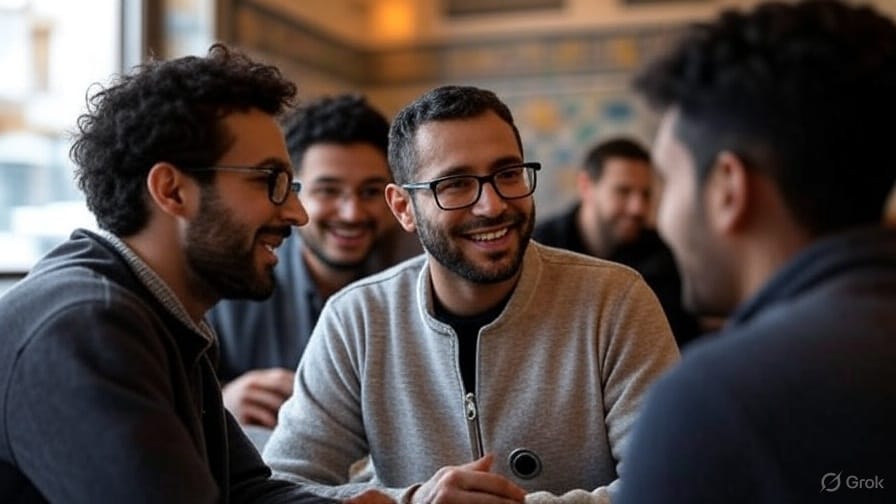
Learning Arabic conversation doesn’t have to feel daunting. With the right phrases, strategies, and a little daily practice, you can begin speaking immediately—even if you’re a complete beginner. This guide offers simple yet powerful starters, tools for memory, and a real-world conversation plan.
✨ Why Conversation Starters Matter
Breaks the ice: These phrases give you the confidence to initiate conversation naturally.
Builds momentum: Each phrase learned is a stepping stone toward longer, richer conversations.
Engages memory: Saying phrases aloud helps you memorize them faster.
Creates practical habits: You’re not just learning vocabulary—you’re using it in context.
1. Warm-Up: How to Greet and Introduce Yourself
| Arabic (Transliteration) | English | Notes |
|---|---|---|
| As-salamu alaykum (السلام عليكم) | Peace be upon you | Traditional Arabic greeting |
| Wa alaykum as-salam (وعليكم السلام) | And upon you (peace) | Great reply after a greeting |
| Marhaban / Sabah al-khayr / Masa’ al-khayr | Hello / Good morning / Good evening | Casual or time-specific greetings |
| Ismi [Your Name]; wa anta/anti? | My name is … and you? | Use “anta” for males, “anti” for females |
| Tasharraftu bima‘rifatika | Nice to meet you | Polite, respectful closing of introduction |
Pro-tip: Smile while greeting—that natural friendliness helps with pronunciation and invitation to speak.
2. Asking About Origin & Purpose
Min ayna anta/anti? (من أين أنت؟) – Where are you from?
Hal zurt [city]? (هل زرت كذا؟) – Have you visited [city]?
Layla sa‘ida—ayna taskun/hayat? – Have a good night—where do you live? (extra friendly context)
Practice tip: Ask someone in your household or language partner, then repeat their response to yourself to build familiarity.
3. Daily Essentials: Politeness, Shopping & Transportation
Here are common, polite phrases useful in markets, buses, taxis, or cafés:
Kam hatha / kam hiya al-thaman? (كم هذا؟/كم الثمن؟) – How much is this?
Min fadlak / Min fadliki – Please (masculine/feminine)
Shukran / ‘Afwan – Thank you / You’re welcome
Ayna al-maṭar? / Ayna maḥaṭṭat al-ṭā’ir? – Where is the airport?
Hal hunak mata’ar? (هل هناك موقف سيارات؟) – Is there parking here?
Memory tip: Learn numbers (1-20) once, and you can use them to bargain or ask pricing easily.
4. Expressing Needs and Asking for Help
Ana uḥibbu… / Ureed… / Aḥtaju ila… – “I like…/I want…/I need…”
Hal mumkin an tu‘īnī? (هل ممكن أن تعينني؟) – Can you assist me?
Mumkin tatsawerni? – Could you take my photo, please?
Arju tawjīh ila… – Please direct me to…
Role-play idea: Pretend you’re at a tourist spot or store—use these phrases to simulate situations like asking for directions or help.
5. Conversational Sentences: Talking About Daily Life
Use these to build rapport and flow:
Kam umruk? (كم عمرك؟) – How old are you?
Mā huwa ḥubbika al-‘afḍal fi l-wakt al-farigh? – What’s your favorite way to spend free time?
Ayna ta‘mal/ta‘malīn? – Where do you work/study?
Hal tatakallam lugha ukhra? (هل تتكلم لغة أخرى؟) – Do you speak another language?
Tip: Don’t just ask—share your own answer. This builds natural back-and-forth.
6. Improving Accuracy & Correcting Common Mistakes
Mixing up “Ma” (ما) vs “Mada” (ماذا): Use “Mada” for asking “what?” formally.
Pronouncing غ (ghayn) like English “g” is incorrect—learn to feel the throat vibration like a gentle gargle.
“Ayna” vs “Ila ayna”: Use “Ayna” asking for location, “Ila ayna” asking for direction.
Self-check method: Record yourself saying a phrase, then listen and compare—a fast route to self-improvement.
7. Systematic Practice with Voice and Memory
Daily Practice Plan (4–5 minutes):
Record yourself greeting and introducing in Arabic.
Repeat essential phrases from memory.
Use a dictation app or voice memo to review pronunciation.
Weekly Engagement Plan:
Say 10 phrases multiple times until they sound natural.
Role-play at least one scenario (e.g., ordering food, asking directions).
Create flashcards with the phrase on one side and transliteration plus meaning on the other.
8. Spaced Repetition + Conversation Combo
Use simple tools (paper flashcards or an app):
Add a phrase each morning.
Review in the evening, and again after 24 hours.
Speak it aloud in a sentence or brief dialogue.
For example:
Flashcard: Kam hatha? / How much is this?
Dialogue: “Kam hatha, min fadlak?” “Thamanuh 50 riyal.”
9. Putting It All Together: Built–In Scenarios
Scenario 1: Greeting & Name Exchange
You: As-salamu alaykum!
Stranger: Wa alaykum as-salam!
You: Ismi John; wa anta?
Stranger: Ana Salam.
You: Min ayna anta?
Stranger: Min Misr.
You: Tasharraftu bima‘rifatika.
Scenario 2: At the Market
You: Salaam! Kam hatha?
Seller: Thamanuh 30 riyal.
You: Min fadlak 25?
Seller: Ma mumkin. 25 riyal.
You: Shukran!
10. Friendly Tips for Consistent Progress
Start small: Just 1–2 minutes a day is better than nothing.
Visualize: Picture the scenario (market, café, airport) as you speak the phrase.
Celebrate mistakes: Each slip is a sign you’re trying—it’s good!
Record weekly: You’ll hear how much you improve over time.
Find accountability: Whether with a language buddy, group, or journal.
✅ Final Thoughts
You now have:
A powerful set of essential Arabic conversation starters.
A plan to practice them daily—voice, memory, context.
Techniques for immediate use in real situations.
These tools can create real confidence. Each phrase you speak, each interaction you initiate, builds momentum—and fluency follows.
Would you now like a long companion article on “How to Use Spaced Repetition to Master Arabic Vocabulary” or “Mastering Arabic Pronunciation the Smart Way”? I’m ready when you are!