
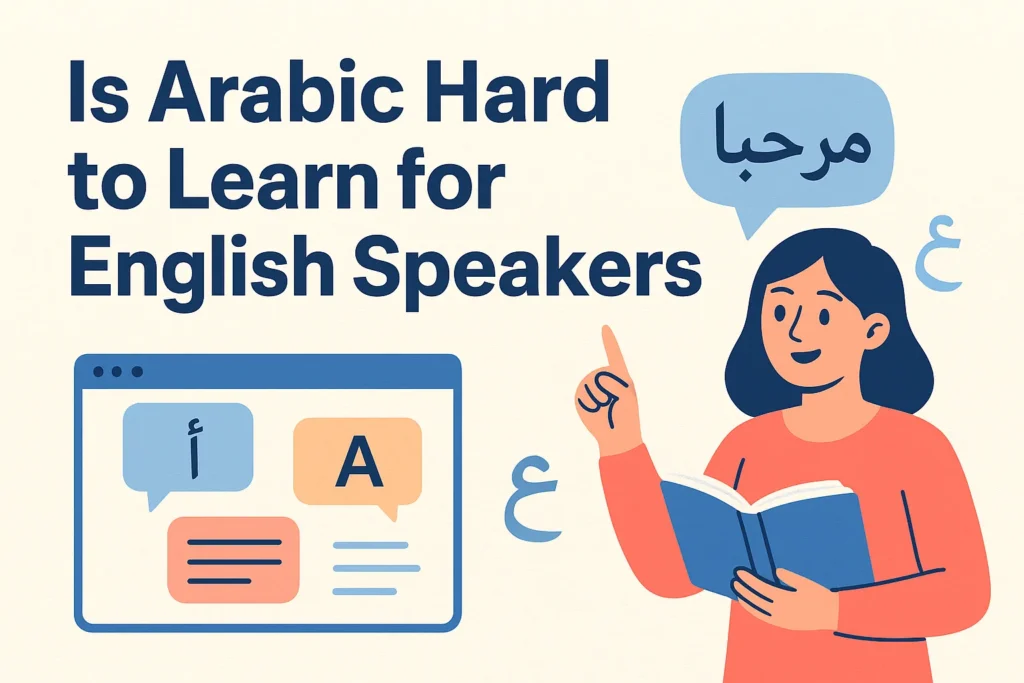
Learning Arabic often feels like standing at the foot of a tall mountain. Many English speakers wonder: Is Arabic really that hard to learn? The truth is—Arabic is challenging, yes, but not impossible. With the right guidance, patience, and consistent practice, the “mountain” becomes a series of manageable steps.
In this article, we’ll answer 100 real questions English speakers often ask about learning Arabic. From pronunciation struggles to grammar mysteries, from cultural nuances to study routines, we’ll cover it all. Each answer is written in a friendly and human way, with practical advice, encouragement, and gentle reminders that you are not alone on this journey.
Part 1: Understanding the Basics
Q1: Is Arabic really the hardest language in the world?
A1: Not at all. Arabic is challenging for English speakers because it comes from a completely different language family, but “hardest in the world” is an exaggeration. With structured lessons, like the ones at eArabicLearning, you’ll find progress much faster than you think.
Q2: Why do people say Arabic is hard?
A2: Mostly because it has a new script, sounds that don’t exist in English, and a grammar system that feels very different. But once you break it into steps, the difficulty feels manageable.
Q3: Do I need to learn the Arabic alphabet first?
A3: Yes, absolutely. Learning the script is like getting the keys to the car. Without it, you can’t really drive. The good news is—you can learn the alphabet in just a few weeks with steady practice.
Q4: Is Arabic grammar impossible?
A4: It may look scary, but “impossible” is too strong a word. Arabic grammar is highly logical—once you see the patterns, it starts to click.
Q5: Which part of Arabic is the hardest for English speakers?
A5: Most learners struggle with pronunciation of new sounds (like ع or ق) and with verb conjugations. But remember: what feels hard in the beginning often becomes your strength later.
Q6: How long does it take to learn Arabic?
A6: It depends. If you study 1–2 hours a day with a teacher, you can hold basic conversations within 6–12 months. Mastery takes years, but every step feels rewarding.
Q7: Is Arabic harder than learning Spanish or French?
A7: Yes, for most English speakers, because Arabic doesn’t share roots with English the way European languages do. But it’s not “too hard”—it’s just different.
Q8: Do kids learn Arabic faster than adults?
A8: Usually, yes. Children’s brains absorb new sounds quickly. But adults can still succeed—especially with the right motivation and consistent practice.
Q9: What about dialects? Do I need to learn all of them?
A9: No, not at all. Start with Modern Standard Arabic (MSA), the foundation of the language. Dialects can come later once you’re comfortable.
Q10: Should I be worried about right-to-left writing?
A10: It feels strange at first, but your brain adapts quickly. Within a few weeks, right-to-left reading will feel natural.
Part 2: Common Fears and Misconceptions
Q11: Is Arabic only for Muslims?
A11: No. Arabic is a global language with over 300 million speakers. It’s deeply tied to culture, history, and modern communication—not just religion.
Q12: Do I need to memorize thousands of words before speaking?
A12: Not at all. Start with 200–300 core words. You’ll be surprised how many simple conversations you can have with that base.
Q13: Is Arabic boring to study?
A13: It doesn’t have to be. If you use stories, songs, and interactive lessons (like those at eArabicLearning), Arabic becomes fun and alive.
Q14: Will I sound silly when I try to pronounce Arabic?
A14: Maybe at first, yes—but that’s part of learning any new language. Native speakers actually admire your effort and usually encourage you warmly.
Q15: Is Arabic useful for English speakers?
A15: Very! Arabic opens doors to work, travel, culture, and friendships across the Middle East and North Africa.
Q16: Is learning Arabic a waste of time if I just want to visit once?
A16: Not at all. Even learning greetings and basic phrases will make your trip far richer and more enjoyable.
Q17: Does Arabic have too many words to remember?
A17: Arabic vocabulary is big, yes, but so is English! Start with the most common words—you don’t need to know everything to communicate.
Q18: Do I need to be “good at languages” to succeed?
A18: Nope. Arabic is learnable for anyone who is patient and consistent. You don’t need a special talent—just dedication.
Q19: Can I learn Arabic online from home?
A19: Yes, and that’s the easiest way today. Online platforms like eArabicLearning give you live teachers who guide you step by step.
Q20: Is Arabic harder than Chinese?
A20: It depends who you ask. Arabic has a different script, but Chinese has tones and thousands of characters. Each has unique challenges. Many learners say Arabic feels easier once you get past the alphabet stage.
Part 3: Learning the Alphabet & Sounds
Q21: Is the Arabic alphabet very different from English?
A21: Yes, it is. Arabic has 28 letters, and some of them don’t exist in English at all. But don’t panic—once you learn the shapes and sounds, you’ll see that it’s not as overwhelming as it looks. Think of it like learning a new secret code.
Q22: How long does it take to learn the Arabic alphabet?
A22: With focused practice, you can learn to recognize and write the letters in about 2–4 weeks. Reading fluently takes longer, but the basic alphabet isn’t a lifetime project—it’s a short-term milestone.
Q23: Do Arabic letters change shape?
A23: Yes, and that’s what surprises many learners. Letters look slightly different depending on whether they’re at the beginning, middle, or end of a word. But after practicing a few words, you’ll see the pattern and it becomes second nature.
Q24: What about vowels—are they confusing?
A24: Arabic has short vowels (tiny marks above or below letters) and long vowels (like “aa,” “ee,” “oo”). The short vowels are often left out in texts, which feels strange at first. But don’t worry—context and practice will help you “fill in the blanks.”
Q25: Which Arabic sound is the hardest for English speakers?
A25: Most learners say it’s the letter ع (‘Ayn), because it doesn’t exist in English. It’s made deep in the throat. Others struggle with ق (Qaf) or ح (Haa’). The secret is practice—your mouth muscles need training, like going to the gym.
Q26: Can I learn Arabic without mastering pronunciation?
A26: You can learn to read and write, yes, but for speaking you’ll need to work on pronunciation. Luckily, native speakers are very forgiving and will help you if they see you trying.
Q27: Do kids find the alphabet easier than adults?
A27: Usually, yes. Children often treat new scripts like a game. But adults can master it too—it just takes a little more patience and structured practice.
Q28: Should I learn Arabic script or just use transliteration?
A28: Always aim for the script. Transliteration is a short-term tool, but it will slow you down in the long run. Arabic script connects you to real books, news, and native resources.
Q29: Is Arabic calligraphy the same as the alphabet?
A29: Calligraphy is the artistic side of Arabic writing. The alphabet is functional; calligraphy is decorative. But learning the alphabet first will help you appreciate the art even more.
Q30: Will learning the alphabet help me understand the Quran?
A30: Yes, definitely. The Quran is written in Arabic script, and knowing the letters is your first step toward reading it properly.
Part 4: Vocabulary & Grammar
Q31: Do I need a huge vocabulary to start speaking Arabic?
A31: Not at all. Start with the basics—common greetings, numbers, family words, and daily phrases. Even with 300–500 words, you can hold simple conversations.
Q32: Why does Arabic have so many word roots?
A32: That’s the beauty of Arabic. Most words come from three-letter roots. For example, from the root k-t-b (كتب), you get words like “kitab” (book), “kataba” (he wrote), and “maktab” (office). Once you learn the root system, your vocabulary expands quickly.
Q33: Is Arabic grammar harder than English grammar?
A33: It’s not “harder,” just different. English relies heavily on word order, while Arabic relies on endings and patterns. Once you understand the system, it feels logical.
Q34: Why does Arabic have masculine and feminine words?
A34: Just like Spanish or French, Arabic classifies nouns as masculine or feminine. It may feel unusual at first, but soon you’ll spot the common patterns (like words ending in -a often being feminine).
Q35: Do verbs really change a lot in Arabic?
A35: Yes, verbs conjugate based on person, gender, and number. At first this looks complicated, but it’s consistent. Once you learn the rules, you can apply them across many verbs.
Q36: Is Arabic sentence order strange?
A36: Sometimes. Arabic can be flexible: you might see “Verb–Subject–Object” or “Subject–Verb–Object.” But don’t stress—native speakers understand you even if you don’t get it perfect.
Q37: Do I need to learn grammar before speaking?
A37: Not necessarily. You can start speaking with basic phrases, then add grammar step by step. Many learners find that grammar makes more sense after they’ve already practiced speaking.
Q38: Is Arabic vocabulary really that different from English?
A38: Yes and no. Many words are totally new, but some English words actually come from Arabic—like “sugar” (from sukkar) or “algebra” (from al-jabr). You might recognize more than you expect!
Q39: Do I need to memorize verb tables?
A39: It helps, but you don’t have to do it all at once. Start with the most common verbs like “to be,” “to have,” and “to go.” Practice them in daily sentences. The rest will follow naturally.
Q40: Why do some Arabic words sound so long?
A40: Because they often pack a lot of meaning into one word. For example, a single verb might include tense, subject, and gender all together. It’s efficient once you get used to it, even if it sounds long at first.
Part 5: Listening & Speaking
Q41: Is Arabic hard to understand when spoken fast?
A41: At first, yes. Native speakers talk quickly and often drop sounds. But with practice—and by listening to slow, clear Arabic audio—you’ll begin to catch the rhythm and recognize familiar words.
Q42: Should I listen to Arabic music or podcasts to improve?
A42: Absolutely. Music helps you with pronunciation and rhythm, while podcasts train your ear for real conversations. Choose children’s shows or slow podcasts at the beginning—they’re easier to follow.
Q43: Is watching Arabic TV helpful for beginners?
A43: Yes, but don’t expect to understand everything at first. Use subtitles if possible, and focus on hearing repeated words. Over time, your brain will start connecting the dots.
Q44: How can I improve my Arabic accent?
A44: Copy native speakers. Record yourself saying the same phrases and compare. It may feel silly, but shadowing (mimicking exactly what you hear) is one of the best techniques for improving your accent.
Q45: Do I need to sound like a native speaker?
A45: No. The goal is clarity, not perfection. If people understand you, you’re succeeding. A light foreign accent is normal and even charming.
Q46: Why do Arabs sometimes speak English when I try Arabic?
A46: They want to be polite and make communication easier for you. A good tip is to keep replying in Arabic. Eventually, they’ll continue in Arabic with you.
Q47: Should I practice speaking even if I make mistakes?
A47: Yes, mistakes are part of learning. In fact, making mistakes is how your brain learns the correct form. Don’t wait until you’re “ready”—start speaking from day one.
Q48: Is it better to learn Modern Standard Arabic (MSA) or a dialect for speaking?
A48: If your main goal is conversation, start with a dialect. If you want to read or work in Arabic media, focus on MSA. Many learners do both gradually.
Q49: Can I mix MSA and dialect when speaking?
A49: Most learners do! It’s normal. Arabs will still understand you, and over time you’ll learn when to use which form.
Q50: How can I find people to practice speaking Arabic with?
A50: Language exchange apps, online tutors, or joining an Arabic class are great options. Even practicing with Arabic-speaking friends or neighbors counts.
Part 6: Real-Life Practice
Q51: How soon can I use Arabic in real life?
A51: Surprisingly fast! Within a few weeks, you can greet people, introduce yourself, and order food. These little wins build confidence.
Q52: Will Arabs appreciate my effort to speak their language?
A52: Yes, very much. Even if you only say a few words, people usually smile and encourage you. It shows respect for their culture.
Q53: Is it okay if I only learn conversational Arabic and not reading/writing?
A53: Yes, if your goal is travel or speaking only. But learning the script eventually will open more doors and help your listening.
Q54: Should I learn Arabic for business?
A54: Definitely if you plan to work with Arabic-speaking countries. It gives you an edge, builds trust, and shows cultural respect.
Q55: Will learning Arabic help me when I travel?
A55: Absolutely. Simple phrases like “Where is…?” or “How much?” make travel smoother and more enjoyable.
Q56: Is Arabic useful outside the Middle East?
A56: Yes. There are Arabic-speaking communities all over the world—in Europe, North America, and beyond.
Q57: Can I practice Arabic in daily life if I don’t live in an Arab country?
A57: Yes. Label items in your house with Arabic names, switch your phone to Arabic, or talk to yourself in Arabic. Small steps keep you immersed.
Q58: Will Arabs correct my mistakes when I speak?
A58: Often yes, but gently. Most people appreciate your effort and help you improve in a supportive way.
Q59: Is learning Arabic useful for religious purposes?
A59: Definitely. If you’re Muslim, it connects you deeply with the Quran and prayers. Even learning basic Arabic enhances understanding.
Q60: Can I use Arabic in international jobs?
A60: Yes. Arabic is one of the six official UN languages and is in demand in fields like diplomacy, translation, teaching, and international business.
Part 7: Reading & Writing
Q61: Is reading Arabic harder than speaking it?
A61: At first, yes, because Arabic script is new to English speakers. But once you learn the alphabet, reading becomes a skill you can practice daily—like riding a bike.
Q62: How long does it take to learn the Arabic alphabet?
A62: Many learners can recognize all 28 letters in about 1–2 weeks with consistent practice. Writing them neatly may take longer.
Q63: Why do Arabic letters look different depending on their position?
A63: Arabic is written in a connected script, so letters change shape when at the beginning, middle, or end of a word. Think of it like English cursive handwriting.
Q64: Do I need to learn Arabic handwriting or just typing?
A64: Both are useful. Typing is practical for online communication, while handwriting helps you recognize signs, notes, and handwritten messages.
Q65: Is Arabic spelling difficult?
A65: Not really. Arabic is mostly phonetic, meaning words are spelled as they sound. Once you know the letters, spelling makes sense.
Q66: Are Arabic vowels written?
A66: Short vowels are usually not written in everyday texts, but long vowels are. This may seem tricky at first, but context helps you guess the missing sounds.
Q67: Can I read Arabic without learning grammar first?
A67: Yes. Many learners start by reading simple texts like children’s books or signs. Grammar comes naturally as you read more.
Q68: Is Arabic calligraphy necessary to learn?
A68: Not necessary, but it’s beautiful! Calligraphy is an art form, and learning it can give you a deeper appreciation for the language.
Q69: How do I improve my Arabic reading speed?
A69: Read daily—even just a few sentences. Start with vowel-marked texts, then gradually read without them. The more you practice, the faster you’ll recognize words.
Q70: Can I read Arabic newspapers as a beginner?
A70: Newspapers are advanced, but you can pick out headlines or familiar words. Over time, reading the news becomes a great way to practice.
Part 8: Cultural Insights
Q71: Is Arabic connected to religion only?
A71: No. While Arabic is central to Islam, it’s also the language of millions of Christians, Jews, and secular communities across the Middle East and North Africa.
Q72: Do Arabs all speak the same dialect?
A72: No. Dialects differ by region, but people usually understand each other. Modern Standard Arabic acts as a “bridge” between dialects.
Q73: Why do Arabic dialects sound so different?
A73: History, geography, and outside influences (like French, Turkish, and English) shaped regional dialects. That’s why Moroccan Arabic sounds different from Egyptian or Gulf Arabic.
Q74: Is it rude to mix dialects when speaking?
A74: Not at all. Arabs often switch between dialects or mix in Modern Standard Arabic, especially with non-native speakers.
Q75: Do I need to learn cultural etiquette alongside the language?
A75: Yes. Language and culture go hand in hand. Simple customs—like greetings, politeness, and hospitality—make conversations smoother.
Q76: Will knowing Arabic help me understand Arab culture better?
A76: Definitely. Language reflects values, traditions, and humor. Once you learn Arabic expressions, you’ll get a window into how Arabs think.
Q77: Are Arabic proverbs useful to learn?
A77: Yes, they’re very common in conversation. Using a proverb can impress native speakers and make you sound more natural.
Q78: Is humor in Arabic easy to understand?
A78: It takes time. Arabic humor often relies on wordplay or cultural references. As your vocabulary grows, jokes become funnier and easier to get.
Q79: Do Arabs like it when foreigners try their language?
A79: Yes, very much. It shows respect and interest. Even a few words can create warm connections.
Q80: Can learning Arabic help me build friendships?
A80: Absolutely. Language breaks barriers, builds trust, and opens doors to genuine friendships you might never make otherwise.
Part 9: Advanced Learning
Q81: Is Arabic grammar harder than English grammar?
A81: Arabic grammar has more structure, but it’s logical. English has many irregularities, while Arabic follows consistent rules once you learn them.
Q82: What is the most challenging part of Arabic grammar?
A82: Many learners find verb conjugations and case endings tricky at first, but practice makes them second nature.
Q83: Do I need to master grammar to be fluent?
A83: No. Many learners reach conversational fluency first, then gradually refine their grammar as they progress.
Q84: Is Arabic harder to write or speak?
A84: Speaking feels easier at first since you focus on communication. Writing requires precision, but it also sharpens your understanding.
Q85: Can I write essays in Arabic as an English speaker?
A85: With consistent practice, yes. Start with short paragraphs, then work your way up. Teachers at eArabicLearning can guide you step by step.
Q86: How do I avoid mixing up similar-looking Arabic letters?
A86: Practice writing slowly, focusing on dots and curves. Over time, your brain will quickly spot the differences.
Q87: Are there shortcuts to mastering Arabic?
A87: No magic shortcuts, but smart methods—like daily practice, immersion, and guided learning—can speed up your progress.
Q88: Should I learn Modern Standard Arabic before dialects?
A88: Yes. Modern Standard Arabic gives you a strong foundation, and later, you can branch into any dialect you prefer.
Q89: Is Arabic harder to learn than Chinese?
A89: Many learners say Arabic is more logical than Chinese because it uses an alphabet rather than thousands of characters.
Q90: How do I stay motivated with Arabic long-term?
A90: Celebrate small wins, set realistic goals, and stay connected with teachers or study partners who encourage you.
Part 10: Long-Term Benefits
Q91: Will Arabic help me in business?
A91: Yes. The Middle East is a major hub for trade, oil, tourism, and technology. Speaking Arabic gives you an advantage in negotiations and networking.
Q92: Does Arabic open career opportunities?
A92: Absolutely. From international relations and education to translation and business, Arabic is highly valued.
Q93: Can learning Arabic improve my brain health?
A93: Yes. Studies show that learning a second language boosts memory, problem-solving, and even delays age-related decline.
Q94: Does Arabic help in learning other languages?
A94: Definitely. Knowing Arabic makes it easier to learn Hebrew, Persian, Turkish, and even Urdu, since they share vocabulary and structures.
Q95: Will Arabic make traveling easier?
A95: Yes. In many Arab countries, locals may not speak much English. Speaking Arabic helps you navigate, connect, and feel more at home.
Q96: Does Arabic give me access to unique literature?
A96: Yes. You’ll be able to read classics like “One Thousand and One Nights” and modern Arab writers in their original beauty.
Q97: Can Arabic help me understand world history better?
A97: Absolutely. Arabic is tied to ancient science, medicine, philosophy, and trade. Learning it gives you direct access to historic texts.
Q98: Will I feel proud learning Arabic?
A98: Without a doubt. Mastering such a rich and global language brings a strong sense of achievement.
Q99: Is it worth the time and effort?
A99: 100% yes. Every minute you invest in Arabic pays back in cultural understanding, friendships, and opportunities.
Q100: Where’s the best place to start learning Arabic?
A100: The best place is with eArabicLearning, where expert teachers guide you step by step, making Arabic enjoyable, structured, and achievable for every learner.