
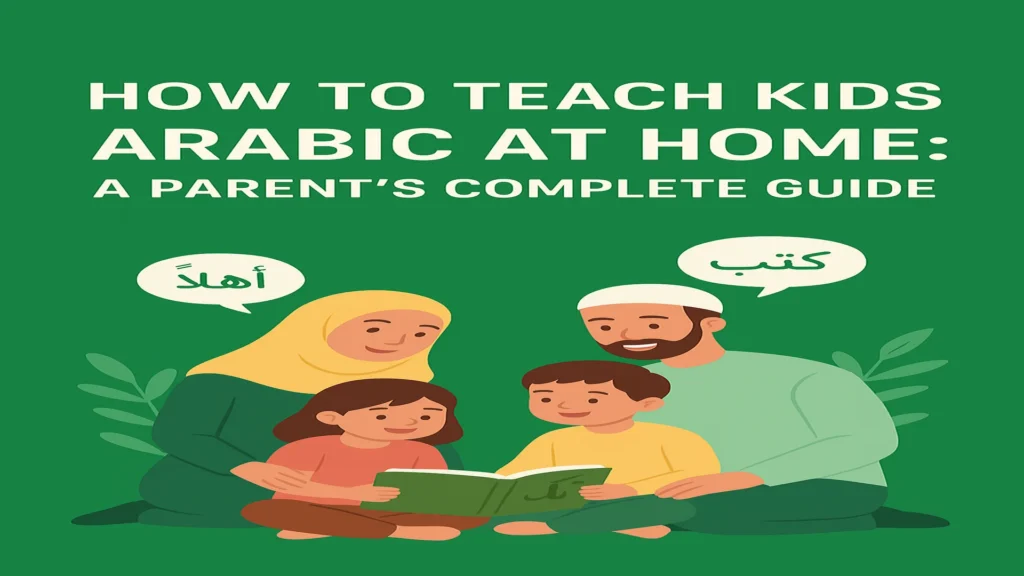
For many parents in the US, UK, and UAE, raising children in a non-Arabic environment can feel like swimming against the current. Your kids are surrounded by English at school, in cartoons, in games, and even with friends. Slowly, Arabic can start fading into the background — becoming only the “language of grandparents” or “the language of Qur’an class.”
But Arabic is more than just another subject to study. For Muslim families, it’s the language of the Qur’an, daily prayers, and countless duas. For heritage speakers, it’s a bridge to culture, identity, and family roots. Teaching kids Arabic at home means giving them a gift that lasts a lifetime.
The good news? You don’t need to be a fluent speaker or a trained teacher. With patience, fun activities, and the right strategies, your home can become the best Arabic classroom.
🏡 Step 1: Create a Language-Friendly Environment
Children don’t learn language by memorizing; they absorb it. That’s why your first goal is to surround them with Arabic daily.
Use Arabic Commands: Simple phrases like تعال (come), اجلس (sit), اسمع (listen).
Label Everything: Put Arabic labels on doors, tables, cups, toys. Kids start linking visuals with words.
Arabic-Only Hour: Pick one hour a day when only Arabic is spoken. Make it fun, not strict.
Celebrate Mistakes: When kids mix English with Arabic, don’t correct harshly. Smile, repeat the word in Arabic, and keep going.
💡 Tip: Think of Arabic as the “background music” of your home. The more your kids hear it naturally, the faster it sticks.
📖 Step 2: Start with the Alphabet and Sounds
The Arabic alphabet may seem intimidating, but children love exploring new symbols.
Phonics First: Focus on sounds before names. Say /b/ not “baa.”
Sing Together: The alif baa taa song is a classic way to lock letters into memory.
Hands-On Writing: Use sand trays, clay, or even shaving cream on a tray to trace letters.
Story Letters: Give each letter a personality. Example: ج (Jeem) loves camels (جمل).
🎲 Step 3: Play Your Way into Arabic
Play is a child’s first language. Turning Arabic into play ensures kids don’t see it as a chore.
Arabic Bingo: Numbers, colors, or food items.
Memory Card Games: Match letters with pictures (ب with بيت “house”).
Pretend Market: Use fake money and Arabic phrases: بكم هذا؟ (How much is this?)
Bedtime Stories: Even simple ones, like “The Hungry Caterpillar” in Arabic, can spark joy.
🕌 Step 4: Connect Arabic to Faith
For Muslim families, Arabic carries a deep spiritual connection. Teaching it through faith makes it more meaningful.
Daily Duas: Start small: بسم الله (Bismillah) before eating, الحمد لله (Alhamdulillah) after meals.
Prayer Vocabulary: Teach the meaning of Allahu Akbar, SubhanAllah, Astaghfirullah.
Qur’an Integration: Link Arabic letters and words to short surahs kids already know.
Islamic Songs (Nasheeds): Nasheeds with simple lyrics are both fun and memorable.
📅 Step 5: Build Routines (Consistency Beats Intensity)
Parents often overload kids, then give up when it doesn’t work. Instead, build slow, steady exposure.
Short Daily Sessions: 15–20 minutes of Arabic daily is better than 2 hours once a week.
Weekend Immersion: Pick Saturday mornings for Arabic cooking, stories, or family games.
Reward System: Stickers, stars, or points when kids use Arabic naturally.
Family Goals: For example: “This week, we will use Arabic numbers only.”
🌍 Step 6: Use Technology the Smart Way
Screens can be your best friend if used wisely.
Apps for Kids: Duolingo Kids (Arabic), Marhaban Kids, Noorani Qaida for Quran basics.
YouTube Playlists: Cartoons, Arabic nursery rhymes, and stories.
Podcasts & Audiobooks: For bedtime or car rides.
Online Classes: Native-speaking tutors (like eArabicLearning) can personalize lessons.
✈️ Step 7: Bring Arabic to Life
Arabic shouldn’t just live in books. Show your kids it’s alive around the world.
Community Events: Islamic centers, Eid bazaars, Arabic language clubs.
Playdates: With Arabic-speaking families in your city.
Travel: A trip to Egypt, Jordan, or UAE can be a life-changing language boost.
Cultural Foods: Cook Arabic dishes together. Teach words like khubz (bread), laban (yogurt).
💡 Overcoming Common Challenges
Kids answer in English → Stay consistent. You speak Arabic, even if they reply in English.
Parents aren’t fluent → Learn together! This motivates kids.
Kids lose interest → Rotate between games, songs, stories. Keep it fresh.
Busy schedules → Use “hidden time”: car rides, meals, bedtimes.
✅ Key Takeaways
Start with exposure, fun, and routine.
Mix faith, play, and family life.
Use apps and teachers as support, not the main source.
Progress may be slow, but every word learned is a step toward fluency.
❓ Frequently Asked Questions (FAQ)
1. How long does it take for kids to learn Arabic at home?
It really depends on age, consistency, and how much Arabic your child hears every day.
Generally, if you dedicate 15–20 minutes daily, most children can begin recognizing Arabic letters and simple words within a few months.
Fluency, however, can take a few years — but the key is steady exposure rather than long lessons.
Remember: it’s a marathon, not a sprint!
2. Can non-native parents teach their kids Arabic effectively?
Absolutely! You don’t need to be a native speaker to help your kids learn Arabic.
In fact, many parents in the US, UK, and UAE start learning alongside their children — and kids love it.
Use apps, songs, storybooks, and online classes with native tutors (like eArabicLearning) to guide both of you.
Children are naturally curious; if they see you trying, they’ll follow your lead.
3. Should I teach Modern Standard Arabic (Fus’ha) or a dialect?
This depends on your goals.
If your priority is reading Qur’an and formal understanding, start with Modern Standard Arabic (Fus’ha) — it builds a strong foundation for all dialects.
If your goal is daily conversation or connecting with family, you can introduce your native dialect gradually later on.
A good balance is: Fus’ha for structure, dialect for fun and real-life talk.
4. My kids answer in English even when I speak Arabic. What should I do?
This is completely normal! It’s called “passive bilingualism.”
Your child understands Arabic but feels more confident replying in English.
Don’t pressure them to switch — keep replying in Arabic naturally.
Over time, with enough exposure and encouragement, their speaking confidence will grow.
Consistency is more powerful than correction.
5. What are the best apps and resources to teach Arabic to kids?
Here are some parent-approved favorites:
Duolingo Kids (Arabic): Fun and interactive for beginners.
Marhaban Kids: Focuses on basic Arabic vocabulary and games.
Noorani Qaida App: Perfect for Qur’anic Arabic basics.
YouTube Channels: “Lamsa Arabic,” “Little Thinking Minds,” and “Learn with Zakaria.”
eArabicLearning.com: Live 1-on-1 classes with native Arabic teachers, tailored for kids.
Combine these with real-life activities like Arabic bedtime stories, labels around the house, and Arabic-only hours for best results.
6. What if my child loses interest in learning Arabic?
That’s a common challenge!
Children don’t respond well to pressure — they respond to fun and connection.
Try these quick fixes:
Rotate activities weekly (stories, games, songs).
Use reward systems for effort, not accuracy.
Join online group classes with other kids — peer energy makes a big difference.
Watch Arabic cartoons or short videos together, then talk about them in Arabic.
When learning becomes part of play, motivation returns naturally.
7. Can my child learn Arabic online effectively?
Yes — if the program is interactive and personalized.
Unlike generic apps, platforms like eArabicLearning use live human tutors who adapt to your child’s level, interests, and age.
This human connection keeps kids engaged, helps fix pronunciation early, and gives parents regular progress updates.
Online classes are especially powerful when paired with daily home exposure.
🌟 Start Your Child’s Arabic Journey with eArabicLearning
You don’t have to figure it all out alone. At eArabicLearning, our native Arabic teachers make learning fun, engaging, and perfectly suited for children — whether they’re complete beginners or already familiar with Arabic sounds and words.
We focus on interactive lessons, storytelling, games, and faith-based learning — all in a safe, positive online environment that kids actually look forward to.
🎯 What parents love most:
One-on-one live classes with friendly, experienced teachers
Structured programs for kids aged 4–14
Lessons that combine Arabic language + Islamic values
Flexible scheduling for busy families
✨ Give your child the gift of Arabic — a skill, an identity, and a connection that lasts a lifetime.