
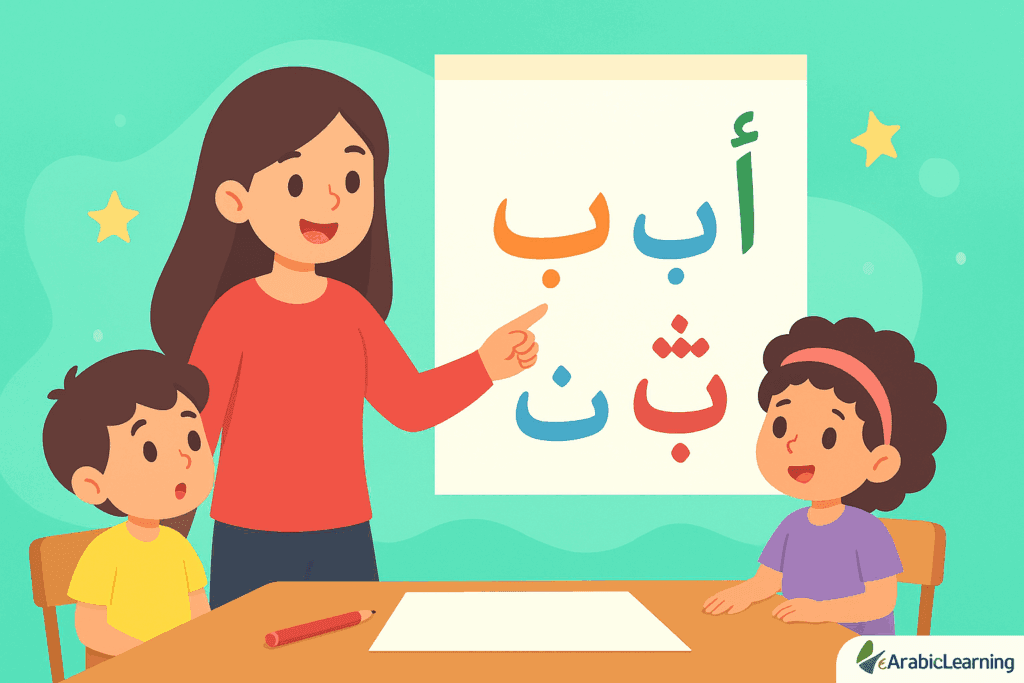
For most children, learning a new alphabet is like stepping into a magical new world. Every letter feels like a symbol to decode, a mystery to unlock. When it comes to the Arabic alphabet, that magic is doubled: not only is it visually beautiful, but it also carries deep cultural and spiritual meaning.
The Arabic alphabet—known as al-abjadīyah (الأبجدية)—consists of 28 letters. It is written from right to left, and each letter changes shape depending on whether it appears at the beginning, middle, or end of a word. For a child, this can feel confusing at first—but with the right approach, it becomes a fun, exciting challenge.
This guide is designed for parents, teachers, and tutors who want to introduce Arabic letters to children in a way that is engaging, playful, and effective. We’ll go beyond worksheets and drills, exploring songs, games, apps, storytelling, cultural activities, and daily-life integration. By the end, you’ll have a toolkit full of practical strategies to make the Arabic alphabet not just something to study, but something to love.
👉 For the big picture, see our Kids Learning Pillar Page.
👉 Want structured lessons? Check out our Arabic for Kids Course.
Why Learning the Arabic Alphabet Matters
1. It’s the Gateway to Arabic
Without the alphabet, there is no reading or writing. Mastering letters and sounds opens the door to words, then sentences, and finally books, stories, and Qur’an recitation. Think of the alphabet as the foundation stones of a building: if they’re weak, everything built on top is shaky.
Case Study: A parent in London reported that once her 5-year-old mastered the Arabic letters through songs and tracing, he began recognizing words like “باب” (door) and “نور” (light) in storybooks at bedtime. That recognition built instant excitement and motivation.
2. Connection to Faith and Identity
For Muslim children, learning the Arabic alphabet is more than academic—it’s spiritual. Every letter connects them to the Qur’an, duas, and daily prayers. Recognizing even small words like الله (Allah) or محمد (Muhammad) fills children with pride and a sense of belonging.
For heritage learners, the Arabic alphabet is a link to family roots. Imagine a child writing their grandparent’s name in Arabic—it creates joy, identity, and cultural pride.
3. Cognitive Benefits of Bilingualism
Learning a second alphabet enhances brain development. According to Harvard’s bilingualism research, children who master multiple scripts show:
Better memory.
Improved problem-solving skills.
Greater creativity.
Higher adaptability in school.
Arabic, with its unique shapes and sounds, trains the brain to recognize patterns differently than English. This dual-script literacy makes children sharper learners overall.
4. Global Relevance
Arabic is the 5th most spoken language in the world, with over 420 million speakers across more than 25 countries. Teaching your child the Arabic alphabet is not only about heritage—it also equips them with a skill that has global importance.
👉 Related: Easy Quranic Words Every Learner Should Know.
Common Challenges Children Face
Changing Letter Shapes: Unlike English, Arabic letters change form based on their position. Example: ب = isolated (ب), initial (بـ), medial (ـبـ), final (ـب).
Look-Alike Letters: ب (baa), ت (taa), ث (thaa) differ only by dots.
Unique Sounds: ع (ʿAyn), ق (Qaaf), غ (Ghayn) require new tongue positions.
Direction Shift: Writing right-to-left can confuse children used to English.
Resource Gaps: Many materials are outdated, black-and-white, or uninspiring.
💡 Solution: Use color, play, movement, and multi-sensory activities.
Step-by-Step Guide to Teaching the Arabic Alphabet
Step 1: Start with Sounds, Not Names
Children connect more easily when they learn the sound of a letter first. Instead of saying “This is baa,” say: “This makes the sound /b/.”
Example: ب + بطة (duck). Show a picture of a duck while saying /b/.
Game: Sound Hunt → Ask kids to find things around the room that start with /b/.
👉 Internal link: 100 Essential Arabic Words for Beginners.
Step 2: Use the Arabic Alphabet Song 🎶
The Alif-Baa-Taa Song is the Arabic ABCs. Repetition plus melody makes it unforgettable.
Play it daily at set times (breakfast, car rides, bedtime).
Add clapping or drumming to involve rhythm.
Use animated videos on our YouTube Channel.
Example: Many parents report their children start singing the alphabet song even outside lesson time—proving it sticks!
👉 Learn MSA through our Classic Arabic Course.
Step 3: Worksheets and Tracing ✏️
Hands-on practice cements recognition.
Tracing Sheets: Dotted outlines to trace letters.
Coloring Pages: Kids color a letter and a picture that starts with it.
Dot-to-Dot: Reveal letters by connecting dots.
Cut-and-Paste Activities: Match letters to images.
👉 Download our free Arabic Alphabet Youtube video .
Step 4: Multi-Sensory Play
Children remember best when they use multiple senses.
Sand/Rice Trays: Trace letters in sand or rice.
Playdough Letters: Form letters with clay.
Air Writing: Write letters in the air with large arm movements.
Body Shapes: Try to “form” Arabic letters with your body or in groups.
Case Study: In a Cairo classroom, children used their fingers to trace letters in flour spread on trays. The tactile sensation helped struggling students recognize shapes faster.
Step 5: Teach Look-Alike Letters Together
Group tricky letters.
ب, ت, ث → Different dots (1 below, 2 above, 3 above).
ج, ح, خ → Same base shape, different dots/lines.
Tip: Use stories. For example: “The three brothers ب ت ث wear different hats of dots.”
Step 6: Connect Letters to Words
Once children know letters, link them to words.
Combine letters: ب + ا = با (ba).
Use simple words: بيت (house), باب (door).
Pair words with colorful flashcards.
👉 Easy Quranic Words Every Learner Should Know.
Step 7: Use Technology & Apps 📱
Gamification keeps motivation high.
Marhaban Kids: Alphabet games.
Duolingo Kids Arabic: Letter recognition drills.
Qur’an Apps: Connect alphabet to tajweed basics.
👉Arabic Learning Apps for Children: Top Reviews.
Step 8: Daily Life Integration
The alphabet shouldn’t live only in books.
Label home items: باب (door), كرسي (chair).
Write shopping lists in Arabic letters.
Encourage children to sign their names in Arabic.
Tips for Parents & Teachers
Keep lessons short (10–15 minutes).
Be consistent: daily exposure beats weekly lessons.
Celebrate progress with stickers or certificates.
Don’t compare children—every learner is unique.
Model enthusiasm: if you enjoy Arabic, your child will too.
Extended Resources
📄 Free printables.
🎶 Arabic Alphabet Songs on YouTube.
📚 Beginner storybooks with Arabic letters.
🧩 Flashcards and matching games.
🎲 Apps & digital games.
FAQs
Q1: What age should kids start learning the Arabic alphabet?
Ages 3–6 are best, but older kids can start anytime.
Q2: How long does it take to learn the alphabet?
2–3 months with daily practice.
Q3: Should I use MSA or dialect?
Always begin with Modern Standard Arabic for reading/writing.
Q4: What about look-alike letters?
Teach in groups with fun stories.
Q5: Are songs effective?
Yes—songs boost memory through rhythm.
Q6: What if my child confuses letters?
Use color coding and tactile games.
Q7: Can non-Arabic-speaking parents teach the alphabet?
Yes—use apps, worksheets, and learn alongside your child.
Q8: What are the hardest letters?
ع (ʿAyn), ق (Qaaf), غ (Ghayn). ض (Dauhad)
Q9: Should we practice writing or reading first?
Start with recognition (reading), then practice writing.
Q10: How can I keep motivation high?
Rotate between songs, games, and worksheets.
Q11: Are apps enough?
No. Use them as supplements.
Q12: Do alphabet games help Qur’an learning?
Yes, they prepare children for tajweed basics.
Q13: How do I stop kids from mixing Arabic & English?
Mixing is normal. Gently reinforce Arabic.
Q14: Is calligraphy good for kids?
Yes, simple calligraphy builds letter confidence.
Q15: Should I use rewards?
Yes, but keep them small and consistent. Stickers or stars work well.
The Arabic alphabet is more than just 28 letters—it’s the key that unlocks a world of language, faith, and identity. Teaching it to children can feel challenging, but with the right mix of songs, worksheets, games, and real-life integration, it becomes an adventure filled with joy and discovery.
👉 Ready to take the next step? Enroll your child in our Arabic for Kids Course.
👉 Want your child to read Qur’an fluently? Explore our Classic Arabic Course.
👉 Free songs and videos: eArabicLearning YouTube Channel.