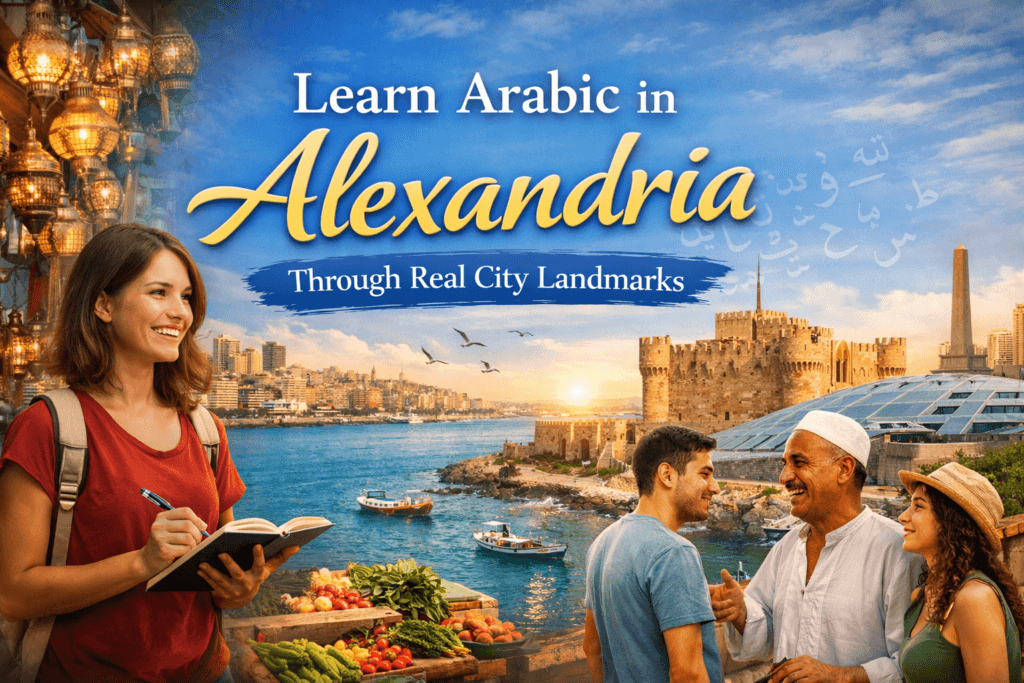
Learn Arabic in Alexandria Through Real City Landmarks
Alexandria is not just a city you visit — it is a city you experience. For learners of Arabic, this experience becomes a living classroom where language, culture, history, and daily life meet naturally. Instead of learning Arabic from isolated textbooks or memorized word lists, learning Arabic in Alexandria allows you to hear, see, and use the language in real situations, surrounded by authentic Egyptian life.
This page explains how learning Arabic through Alexandria’s real landmarks creates faster progress, deeper understanding, and stronger speaking confidence, especially for non-native speakers.
Why Learn Arabic in Alexandria?
Alexandria offers a unique environment for Arabic learners that few cities in the region can match.
A Clear, Natural Form of Egyptian Arabic
The Arabic spoken in Alexandria is widely understood across Egypt and the Arab world. It is natural, expressive, and practical for daily communication. Learners are exposed to real conversational Arabic — not artificial classroom language — from the very first day.
A City That Encourages Interaction
Alexandria is known for its welcoming atmosphere. Locals are open to conversation, curious about foreigners, and happy to help. This creates countless opportunities to practice Arabic naturally in cafés, markets, public transportation, and cultural spaces.
Culture, History, and Language Combined
Language is never separate from culture. Alexandria’s landmarks allow learners to connect Arabic vocabulary directly to real places, stories, and experiences — making words easier to remember and easier to use.
Learning Arabic Through Real City Landmarks
Instead of teaching Arabic as abstract rules, we use Alexandria itself as the learning framework. Each landmark becomes a context where vocabulary, expressions, and cultural understanding grow together.
This method mirrors how native speakers actually learn language: through observation, repetition, and meaningful interaction.
Bibliotheca Alexandrina: Language of Knowledge and Culture
The Bibliotheca Alexandrina is more than a modern library — it is a symbol of learning, dialogue, and cultural exchange.
What You Learn Here:
- Academic and cultural vocabulary
- Describing ideas, opinions, and abstract concepts
- Formal and semi-formal Arabic structures
Learners practice Arabic related to education, books, research, history, and public discussions. This is ideal for students interested in academic Arabic, media Arabic, or cultural conversation.
Qaitbay Citadel: History Comes Alive in Arabic
Standing by the Mediterranean Sea, Qaitbay Citadel introduces learners to the language of history, architecture, and storytelling.
What You Learn Here:
- Past tense naturally through historical narration
- Descriptive adjectives and spatial expressions
- Cultural vocabulary connected to Egyptian heritage
Instead of memorizing grammar rules, learners hear and use Arabic while describing real historical scenes.
Montaza Palace: Everyday Descriptive Arabic
Montaza Palace and its gardens offer a relaxed setting for learning descriptive and conversational Arabic.
What You Learn Here:
- Describing places, nature, and surroundings
- Expressing emotions and opinions
- Common spoken Egyptian expressions
This environment helps learners speak comfortably without pressure, which is essential for building confidence.
Alexandria Corniche: Arabic in Daily Life
The Corniche represents everyday Egyptian life. Families, friends, street vendors, and cafés create the perfect backdrop for real spoken Arabic.
What You Learn Here:
- Ordering food and drinks
- Asking for directions
- Casual conversations and slang
This is where learners transition from understanding Arabic to using it naturally.
Why Context-Based Learning Works
Traditional Arabic learning often focuses on memorization. This creates recognition, but not fluency.
Learning Arabic through Alexandria landmarks:
- Builds strong memory through visual association
- Connects words to emotions and experiences
- Reduces fear of speaking
- Improves listening skills faster
Learners stop translating in their heads and start thinking in Arabic.
Arabic Courses in Alexandria for Non-Native Speakers
Our Arabic language programs are designed specifically for foreigners who want practical, real-world Arabic.
Who These Courses Are For:
- Complete beginners
- Travelers and expats
- Students of Middle Eastern studies
- Professionals working with Arabic speakers
- Anyone interested in Egyptian Arabic
Courses focus on:
- Speaking and listening first
- Vocabulary in context
- Cultural understanding
- Gradual introduction to grammar
Learn Arabic Online — With Alexandria as Your Classroom
Even if you are not physically in Egypt, you can still learn Arabic through Alexandria.
Our online Arabic courses use:
- Real videos from Alexandria landmarks
- Native Egyptian Arabic teachers
- Structured lessons built around real situations
This approach allows students worldwide to experience Alexandria linguistically and culturally.
Why Choose eArabicLearning?
- Native Arabic teachers
- Real Egyptian Arabic, not textbook language
- Context-based learning method
- Cultural immersion approach
- Proven results with non-native speakers
We believe Arabic should be lived, not memorized.
Start Your Arabic Journey in Alexandria
Learning Arabic in Alexandria means learning the language as it is truly used — connected to people, places, and daily life.
Whether you are walking along the Corniche, exploring ancient landmarks, or learning online through real city content, Alexandria becomes your Arabic classroom.
Start learning Arabic today — through the real landmarks of Alexandria.