
“I want my child to know Arabic. But I have no idea where to even start looking.”
If that sentence sounds familiar, you’re in exactly the right place. This is the guide I wish every parent could read before making a decision — not a sales pitch, but the honest, practical information you need to find a program that will genuinely work for your child.
Every week, I speak with parents who are somewhere between excited and overwhelmed. They know they want their child to learn Arabic — for their faith, their heritage, their future, or all three. What they don’t know is how to navigate the crowded, confusing landscape of apps, weekend schools, group classes, online tutors, and YouTube channels to find what will actually stick.
I’ve been teaching Arabic to children online for nearly two decades. I’ve taught four-year-olds their first Arabic letters and watched them grow into teenagers who read the Quran with genuine comprehension. I’ve seen what works, what doesn’t, and — most importantly — what keeps children genuinely engaged in a language that is not easy but is profoundly rewarding.
This guide covers everything: what age to start, what kind of program to look for, what questions to ask a prospective teacher, how to support your child’s learning at home even if you don’t speak Arabic yourself, and what realistic results look like at different ages. By the end, you’ll have a clear picture of exactly what your child needs.
Why Arabic for Children — The Case Beyond Faith
For most Muslim families reading this, the primary motivation is clear: you want your child to have a meaningful relationship with the Quran and their faith. That motivation is beautiful, and it’s entirely sufficient. But it’s worth knowing the full scope of what you’re giving your child, because it goes further than most parents realise.
The Spiritual Dimension
A child who understands Arabic doesn’t just recite the Quran — they hear it. The difference is enormous. When a child in Salah understands what they’re saying, prayer becomes a living conversation rather than a memorised ritual. When they hear the imam recite in Taraweeh, they follow the meaning, not just the sound. That connection — established in childhood — shapes a person’s relationship with their faith for their entire life. It’s genuinely one of the most profound gifts a Muslim parent can give.
The Cognitive Dimension
The neuroscience is consistent: bilingual children develop enhanced executive function — better attention control, stronger working memory, and greater cognitive flexibility. Children who learn a language as structurally rich as Arabic — with its root system, its case grammar, and its script — show particular benefits in analytical thinking and pattern recognition. Your child’s Arabic lessons are also a workout for their brain in ways that benefit every other subject they study.
The Heritage Dimension
For children of Arab descent growing up in the United States, United Kingdom, France, or anywhere in the Western diaspora, Arabic is more than a language. It’s a bridge. It’s the language of grandparents, of family gatherings, of a culture that exists in fragments in their daily life but becomes whole when they can access it linguistically. Children who grow up knowing Arabic maintain a connection to their heritage that is qualitatively different from those who know their background only as an identity label.
The Future Dimension
Arabic is one of the most strategically valuable languages a young professional can hold. Energy, finance, diplomacy, international development, journalism, and technology sectors in the Gulf and broader Arab world are in sustained demand for professionals who can operate in Arabic. A child who begins Arabic at seven and maintains it through their teens will enter adulthood with a genuinely rare skill set. In competitive careers, that difference is measurable.
What Age Should Your Child Start? An Honest Answer
The short version: earlier is better, but it’s never too late.
Here is what developmental linguistics tells us. Children’s brains have a property called neural plasticity — an extraordinary ability to absorb language structures, sounds, and patterns without explicit effort. This plasticity is at its peak in the first decade of life and gradually decreases afterward. A child who begins Arabic at age five acquires its sounds and rhythms in a fundamentally different way than an adult who begins at 25 — more naturally, more efficiently, and with a far higher ceiling for accent and intuitive fluency.
In practical terms: the earlier you start, the easier it is. But “easier” for a child at five does not mean it requires no effort or consistency — it means the effort produces deeper, more lasting results.
Children at this age don’t learn a language through instruction — they absorb it through experience. Lessons at this age are entirely play-based: songs, animated games, colourful stories, call-and-response activities. The Arabic alphabet is introduced visually and auditorily, not as a grammar exercise. Progress feels slow from the outside but is happening at a deep level. If your child is four or five, start now.
This is the ideal starting age for a structured Arabic program. Children can begin reading and writing the Arabic alphabet alongside speaking, hold very simple conversations, and retain vocabulary with genuine enthusiasm when it’s taught engagingly. The teacher’s ability to make lessons fun is the decisive factor at this age. A child who has positive emotional associations with Arabic at age 7 will still be learning it at 17.
Children in this age range can absorb Arabic grammar explicitly in a way younger children cannot. They make faster conscious progress, particularly in reading comprehension and structured vocabulary. The challenge is that pronunciation becomes less intuitive than for younger children — but it’s entirely manageable with a good teacher. Starting at 10 or 11 is still excellent; the window hasn’t closed.
Teenagers and older learners bring a decisive advantage that younger children often lack: genuine intrinsic motivation. A 15-year-old who personally wants to understand the Quran can make rapid progress that surprises even experienced teachers. The accent may have more of a foreign quality than a child who started at five, but the comprehension, reading ability, and grammatical understanding can be exceptional. It’s never too late.
The honest answer is no. Every year you wait is a year of natural language acquisition ability you can’t get back. The best time to start was last year. The second best time is right now.
The Different Types of Arabic Programs: What They Are and Who They Suit
The market for children’s Arabic education has exploded over the last decade. Here is an honest breakdown of what exists and what each option realistically delivers.
| Program Type | Best For | Realistic Outcome | Typical Cost |
|---|---|---|---|
| Private 1-on-1 Online Lessons | All goals, all ages, all levels | ✅ High — fastest path to fluency | $$–$$$ |
| Islamic Weekend School | Community, Islamic values, light Arabic | ⚠️ Limited Arabic progress — valuable for other reasons | $–$$ |
| Online Group Classes | Budget-conscious families, supplementary structure | ⚠️ Moderate — limited personalisation | $–$$ |
| Arabic Learning Apps | Alphabet basics, vocabulary supplement | ❌ Low for real fluency — useful as supplement only | Free–$ |
| YouTube / Free Video | Passive exposure, entertainment | ❌ Very low alone — useful alongside lessons | Free |
| Full-Time Arabic School (in-country) | Immersion programs abroad | ✅ Very high — most intensive option | $$$$ |
The pattern is consistent across every child I’ve worked with: private one-on-one instruction produces the fastest and deepest results. This is what second language acquisition research says, and it’s what two decades of teaching confirms. A personalised lesson adapts to your child in real time — slowing when they’re struggling, accelerating when they’re thriving, adjusting when their energy drops, pivoting to a game when attention is fading. No app, no group class, no algorithm can do that.
A Note on Apps
I’m not dismissing apps — they have genuine uses. Duolingo makes the Arabic alphabet less intimidating. YouTube cartoons build passive vocabulary. Anki flashcard decks help with retention between lessons. But these are seasoning. They enhance real instruction; they cannot replace it. A child who has only ever used apps will plateau at a very basic level and stay there. A child who has a good teacher and uses apps as supplements accelerates their progress significantly.
Online vs In-Person Arabic for Children: The Honest Comparison
Ten years ago, many parents would have instinctively assumed that in-person instruction was superior. The experience of the last several years has significantly updated that assumption — and the evidence now clearly shows that online instruction, done well, is not just comparable to in-person: it has specific advantages that matter for children.
🏫 In-Person Arabic Lessons
- Physical presence — some children respond strongly to this
- Tactile materials — books, worksheets, letter cards
- No technology dependency
- Limited to local teachers — quality varies enormously by location
- Travel time for both parent and child
- Fixed scheduling — harder to fit around school activities
- Often more expensive when factoring in logistics
💻 Online Arabic Lessons (1-on-1)
- Access to the best teachers worldwide — not just locally available ones
- Flexible scheduling around school and activities
- Interactive digital tools: virtual whiteboards, screen-share games, animated flashcards
- Comfortable home environment — many children perform better
- Often more cost-effective when travel is factored out
- Sessions easily recorded for review
- Requires reliable internet and a device
- Young children (under 5) may need a parent nearby initially
One thing I’ve consistently noticed with online lessons for children: the home environment removes the social anxiety that some children feel in an unfamiliar physical setting. They’re on their own turf. That confidence — being comfortable — accelerates learning in ways that are sometimes dramatic. Children who were shy in a classroom bloom in one-on-one online instruction.
What a Great Online Arabic Lesson for a Child Actually Looks Like
Many parents have never observed an Arabic lesson and have no baseline for what “good” looks like. This matters enormously, because the difference between a great children’s Arabic teacher and a mediocre one isn’t just a matter of quality — it can be the difference between a child who loves Arabic and one who resents it.
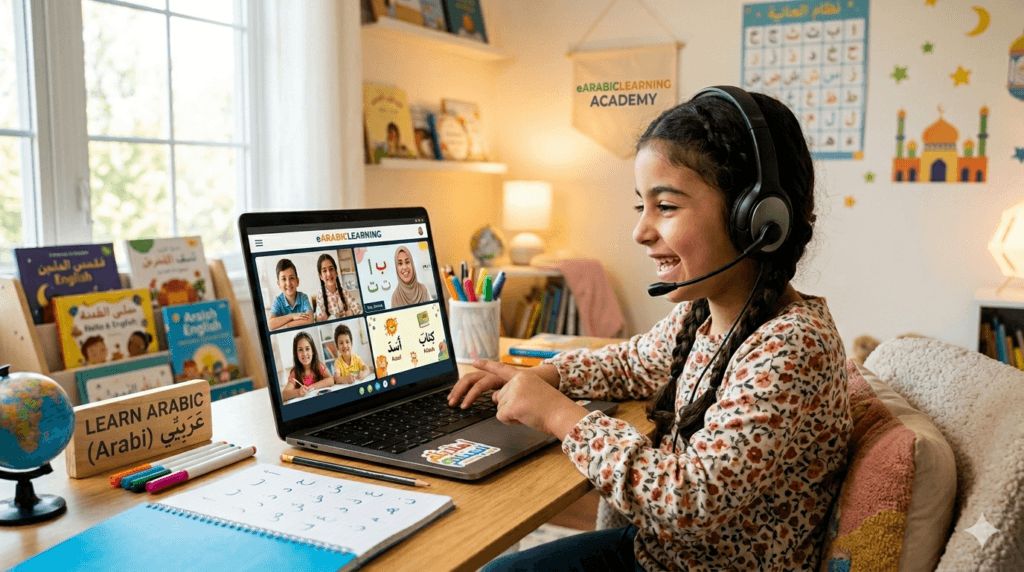
Here is what an excellent online Arabic lesson for a 7-year-old looks like in practice.
The teacher greets the child in Arabic with warmth and energy — not a formal “good morning” but something genuinely playful. They review two or three words from the last lesson through a quick game: the teacher holds up a flashcard on screen and the child tries to say the word before a timer runs out. The child laughs. They get one wrong and the teacher acts dramatically shocked, which makes them laugh again. The brain is now alert and engaged.
Today’s lesson introduces five new Arabic words related to a theme the child is interested in — let’s say animals (their stated favourite). The teacher introduces each word with an image on screen, repeats it three times, then asks the child to repeat. They use the words in simple sentences. The child draws the animal on paper while saying its Arabic name. Kinesthetic memory reinforces auditory memory.
The teacher shares their screen to reveal a simple digital board game. Each square has an image; when the child lands on a square, they have to say the Arabic word. If they get it right, they advance. If not, they stay. The teacher gives hints rather than just corrections, turning mistakes into micro-puzzles. This is not a reward for learning — this is the learning itself.
The teacher opens a virtual whiteboard and writes two Arabic words in large letters. The child traces them on paper. For a slightly older child, they write the words from memory while the teacher watches via camera, correcting letter shape and direction in real time. Brief, specific, achievable.
The teacher tells the child one simple thing to practise before next time — just one Arabic word to teach to a parent or sibling. They end with a specific, genuine compliment about what the child did well today. The child closes the laptop feeling good about Arabic. That feeling will determine whether they show up enthusiastically next week.
How to Choose the Right Arabic Teacher for Your Child
This is the most important decision in this entire process. The program, the curriculum, the platform — none of it matters as much as the teacher. Get this right, and everything else falls into place. Get it wrong, and even the best curriculum won’t save you.
What to Look For: The Non-Negotiables
- Formal teaching qualifications — A degree in Arabic Language Education, Teaching Methodology, or Applied Linguistics. Native fluency is not the same as teaching ability. A native speaker who has never studied pedagogy is not automatically a good teacher, any more than a native English speaker is automatically a qualified English teacher.
- Documented experience with children of your child’s specific age — Teaching a 12-year-old requires completely different skills from teaching a 6-year-old. Ask directly: “How many children of this age have you taught? What does a typical lesson look like for them?”
- A play-based and engagement-first philosophy for young learners — Ask the teacher: “How do you keep young children engaged in online lessons?” Their answer will tell you almost everything. A good answer is specific and confident. A vague answer is a warning sign.
- Genuine warmth and patience — This is harder to verify in advance but observable in a trial lesson. Does the teacher seem to genuinely enjoy children? Do they respond to mistakes with warmth or with correction-as-correction?
- A clear, structured curriculum — but with flexibility — Ask to see a lesson plan or curriculum overview. Good teachers have a plan; great teachers can adapt it on the fly when a child needs something different.
Questions to Ask Before Booking
These five questions will tell you almost everything you need to know about a prospective children’s Arabic teacher:
- “Can you tell me about your teaching qualifications?” — A good teacher is proud of their credentials and specific about them.
- “How would you structure the first month of lessons for my [age] child at complete beginner level?” — Expect a thoughtful, specific answer. Vagueness here is a red flag.
- “What do you do when a child seems disengaged or frustrated during a lesson?” — The answer reveals their actual teaching philosophy, not the one they give you in a pitch.
- “What should I as a parent do between lessons to support my child’s progress?” — A good teacher sees you as a partner, not a bystander.
- “Can I observe the first lesson?” — Almost every good children’s language teacher will say yes. Hesitation here is a warning sign.
A teacher who: claims they can make a child fluent in an unrealistically short time · has no formal qualifications and can’t explain how they teach · becomes defensive when asked about their methods · has no reviews or testimonials from parents of young learners · uses only a textbook with no interactive or play elements · cannot describe what a typical lesson looks like · charges rates so low they imply very little experience.
How to Support Your Child’s Arabic at Home (Even If You Don’t Speak It)
This is the section most parent guides skip, and it shouldn’t be. Parental involvement is, according to language acquisition research, one of the most powerful predictors of a child’s success in learning a second language — and you don’t need to speak a word of Arabic to provide it.
The One Thing That Matters Most: Showing That Arabic Matters to You
Children are extraordinarily perceptive about what their parents value. A parent who occasionally asks “what did you learn in Arabic today?” and genuinely listens to the answer is communicating something powerful: this language is worth your time and mine. That signal sustains motivation through the inevitable dips that come with any long learning journey.
Practical Ways to Bring Arabic into Your Home
- Ask your child to teach you — “Teach me one Arabic word you learned today.” This is a powerful memory technique (teaching consolidates knowledge), and it gives your child a position of expertise that feels wonderful at any age.
- Arabic cartoons or shows, even briefly — 15 minutes of Arabic-language children’s television once or twice a week builds passive comprehension and normalises the language as something that exists in the real world, not just in lessons.
- Label objects around the house — Sticky notes with Arabic words on common household items create constant, low-pressure exposure. Your child will absorb these words without consciously studying them.
- Celebrate milestones visibly — A progress chart on the fridge where your child marks off new words they’ve learned, or a small celebration when they complete the Arabic alphabet, makes achievement tangible.
- Connect Arabic to their other interests — If your child loves football, look up the Arabic words for their favourite positions and teams. If they love cooking, learn food words together. Language that connects to genuine interest sticks.
- Read the Quran together (for Muslim families) — Even if you read only the short surahs both of you already know, doing so together — and saying “we’re both learning the meaning of these words” — makes Arabic a shared family project.
“My daughter has been learning Arabic for two years. I don’t speak a word of it myself. But every week I ask her what she learned and she teaches me. She now knows more Arabic than I ever will — and she’s proud of it.”
— Parent of a student at eArabicLearning, United States
Realistic Results: What to Expect at 3, 6, and 12 Months
Aligned expectations protect families from two opposite problems: giving up too soon because progress isn’t obvious yet, or feeling something is wrong because progress isn’t as fast as hoped. Here is what consistent, well-taught children can realistically achieve.
| Timeframe | Age 5–7 (2x/week) | Age 8–11 (2x/week) | Age 12–14 (2x/week) |
|---|---|---|---|
| 3 Months | Recognises most letters; sings Arabic alphabet; knows 30–50 spoken words; basic greetings with confidence | Reads and writes most letters; 60–80 words; simple sentences; can introduce themselves in Arabic | Reads Arabic alphabet fluently; 100+ words; writes short sentences; simple conversation |
| 6 Months | Reads simple words; 80–120 words; short phrases; basic Quranic vocabulary introduced | Reads simple sentences; 150–200 words; short conversations; beginning Quranic comprehension | Reads simple texts; 250+ words; holds basic conversations; understanding portions of daily prayers |
| 12 Months | Reads short texts; 200–300 words; simple conversation; understands short surahs; emotional connection to Arabic established | Reads and writes simple Arabic texts; 350–500 words; comfortable basic conversation; meaningful Quranic comprehension beginning | Reads a range of Arabic texts; 500+ words; confident conversation in familiar contexts; direct understanding of much of Juz Amma |
Two important notes about this table. First, these are realistic benchmarks for consistent learners — children who attend lessons regularly, do light practice between sessions, and have parents who show genuine interest. Children who attend sporadically progress much more slowly. Second, every child is different. Personality, learning style, and prior exposure all affect pace. What matters more than hitting specific milestones on a fixed timeline is seeing steady, enjoyable progress in a direction you can feel good about.
Red Flags: Signs a Program Isn’t Working for Your Child
Sometimes parents persevere with a program that isn’t right for their child out of inertia, or a reluctance to seem like they’re giving up. These signs suggest it’s time to reassess — not necessarily to stop, but to have an honest conversation with the teacher or to look for something better.
- Your child consistently dreads lessons. Some resistance is normal at the start; sustained dread, after a reasonable settling-in period, is a signal worth taking seriously.
- Three months in, they can’t say their own name or a basic greeting in Arabic. Slow progress is expected; no visible progress at all is a red flag.
- Your child says lessons are “boring” every single time. A good children’s Arabic lesson should be anything but boring.
- The teacher frequently cancels or reschedules at short notice. Consistency is critical for children’s language learning. Repeated disruptions undo progress.
- You never receive any update on what your child is learning or how they’re progressing. A good children’s Arabic teacher keeps parents informed — a brief message after a lesson, a monthly summary, an open door for questions.
- Lessons seem to repeat the same material endlessly without moving forward. Some revision is essential; being stuck in the same place for months is not.
Ready to Find the Right Arabic Teacher for Your Child?
At eArabicLearning, we’ve helped children from age 4 to 16 build a genuine, lasting relationship with Arabic — whether their goal is Quranic comprehension, conversational fluency, or both. Our teachers hold formal qualifications in Arabic Language Education and have years of specialised experience with young learners.
Book a free trial lesson — no commitment, no payment required — and see for yourself what the right teacher makes possible.
Book a Free Trial Lesson for Your Child →
Trusted by families in 30+ countries · US-registered LLC · 4.9/5 on Trustpilot
Frequently Asked Questions About Online Arabic Classes for Kids
A Final Word to Parents
If you’ve read this far, you clearly care deeply about your child’s relationship with Arabic — and that care is the most important ingredient in this entire equation. No program, no teacher, no curriculum can substitute for a parent who shows their child that Arabic matters and celebrates every small step forward.
The choice you’re making isn’t really about which app to download or which course to buy. It’s about whether your child grows up with Arabic as a living part of their identity — something they carry with pride, something that deepens their faith, something that connects them to a vast, ancient, beautiful tradition. Or whether it remains a vague aspiration that never quite happened.
That choice is available to every family, at every income level, in every country. What it requires is consistency, the right guidance, and a teacher who genuinely loves what they do and who your child genuinely loves spending time with.
If you’d like to find out whether eArabicLearning is the right fit for your family, book a free trial lesson. No commitment, no payment, no pressure — just one lesson to see if it clicks. We’ve started hundreds of children on their Arabic journey this way, and we’d love to start yours.