
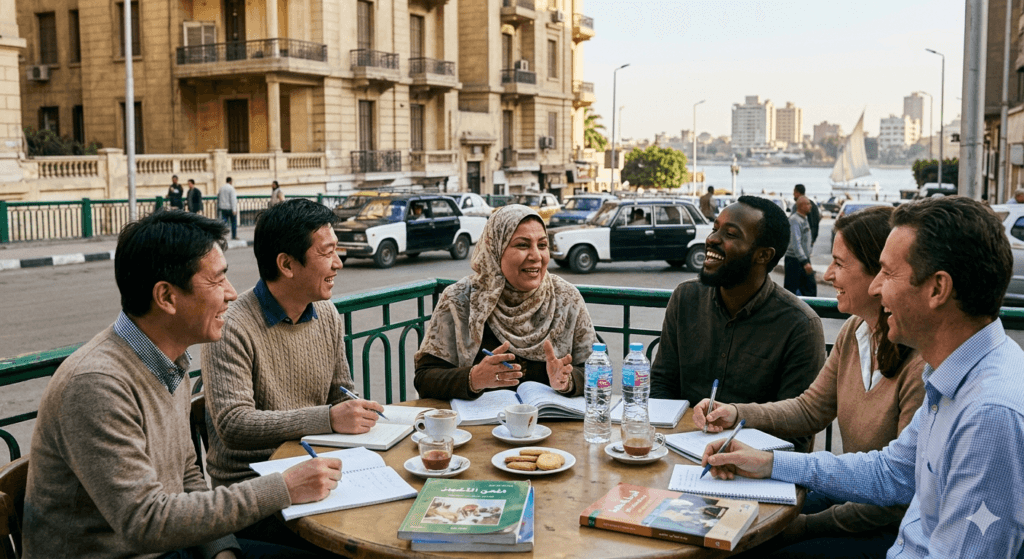
Arabic Immersion Camp in Egypt: The Complete Guide for Adult Learners
Quick answer: An Arabic immersion camp in Egypt is a short, structured program — typically two to four weeks — that combines daily live Arabic lessons with guided cultural excursions, conversation practice, and group activities in Cairo or Alexandria. Unlike open-ended private tutoring or app-based study, a camp runs on fixed cohort dates, groups learners by level, and is built specifically for adults who want fast, immersive progress within a defined window of time — a study-abroad break, a sabbatical, or a few weeks of annual leave.
If you’ve spent months toggling between language apps and the occasional online lesson, you already know the ceiling that approach has. You can build vocabulary at your kitchen table. You cannot build real conversational reflexes there. That’s the gap an Arabic immersion camp in Egypt is designed to close: a compressed period where every morning is a lesson and every afternoon is a chance to actually use what you just learned, with a teacher correcting you in real time and a city full of native speakers around you.
This guide walks through what these camps actually look like, who they’re built for, what they cost, how Cairo and Alexandria compare as host cities, and how to choose a program that won’t waste your limited time. Everything here reflects how we run our own Arabic Immersion Camps — held twice a year in Cairo and Alexandria — after more than two decades of teaching adult foreigners in Egypt.
Ready to see if a camp fits your timeline?
👉 Book your free Arabic lesson here
In This Guide
- What Is an Arabic Immersion Camp in Egypt?
- Who an Arabic Immersion Camp in Egypt Is Right For
- Cairo vs Alexandria: Choosing Your Camp Location
- Egyptian Arabic vs Modern Standard Arabic: What You’ll Actually Study
- Inside a Week at Camp: What a Typical Day Looks Like
- Arabic Immersion Camp in Egypt: Cost Breakdown
- Visa and Travel Logistics
- Real Stories From Past Camp Cohorts
- Common Mistakes and Misconceptions
- How to Choose the Right Arabic Immersion Camp in Egypt
- Frequently Asked Questions
What Is an Arabic Immersion Camp in Egypt? {#what-is-it}
Quick answer: An Arabic immersion camp in Egypt is a fixed-date, cohort-based program — usually two to four weeks — pairing daily live instruction with structured real-world practice: market visits, conversation labs, cultural excursions, and (for working professionals) networking sessions, all guided by native Arabic teachers.
The word “camp” sometimes gets read as something casual or kid-focused. In this context, it means something more specific: a bounded, scheduled program rather than an open-ended course you could, in theory, keep postponing. You apply, you’re placed into a level-appropriate group, you get a start date and an end date, and for that window your entire schedule is built around Arabic.
A typical camp blends three layers:
- Structured lessons — usually 15–20 hours of instruction per week, taught in small groups (4–10 students) organized by proficiency level.
- Guided immersion activities — market visits, café conversations, neighborhood “missions,” and cultural site visits that turn the morning’s vocabulary into the afternoon’s practice.
- Group cohesion — because everyone arrives and departs together, camps build a peer group of fellow learners, which matters more than people expect. Practicing badly pronounced Arabic with a stranger at a market is intimidating. Doing it with three classmates who are also stumbling through it is not.
We’ve run our own Arabic Immersion Camps twice a year — typically a summer cohort and a winter cohort — in both Cairo and Alexandria, with tracks for complete beginners through upper-intermediate learners, and a separate professional track for business travelers and interns.
Takeaway: Think of a camp as the difference between “I’m working on my Arabic” and “I have three weeks, starting June 14th, dedicated entirely to it.” The fixed structure is the point — it forces the kind of daily, compounding practice that open-ended study rarely produces.
Who an Arabic Immersion Camp in Egypt Is Right For {#who-its-for}
Quick answer: Arabic immersion camps suit adults with a defined block of free time — study-abroad students on a break, professionals using annual leave or a sabbatical, diplomats’ spouses between postings, and remote workers who can work from Egypt for a few weeks — who want measurable progress rather than indefinite, low-intensity study.
Not everyone needs a camp. If you can realistically commit to consistent online lessons over a year or more, that path works too, and plenty of our long-term students do exactly that. A camp earns its place when one of these is true for you:
- You have a hard deadline. A semester abroad, a posting start date, a wedding in Egypt, a business trip — something that means “eventually” isn’t good enough.
- You’ve plateaued with self-study. You can read menus and recognize words but freeze in real conversation. Immersion with daily correction breaks that specific plateau faster than more app time will.
- You want to test-drive living in Egypt. Some students use a camp as a low-commitment way to see whether a longer relocation — for work, retirement, or family reasons — actually suits them.
- You learn better with structure and people around you. Camps work well for learners who know that, left alone with an app, their motivation fades by week three.
Camps are generally a poorer fit if your schedule genuinely can’t accommodate two to four consecutive weeks abroad, or if your goal is narrowly academic (passing a specific university exam, for instance) rather than spoken fluency — for that, a more traditional structured course may serve you better.
Takeaway: A camp is the right tool when you have a defined window of time and want to convert it into the fastest possible jump in spoken Arabic — not a requirement for every learner.
Cairo vs Alexandria: Choosing Your Camp Location {#cairo-vs-alexandria}
Quick answer: Cairo offers maximum immersion density — a huge city, constant Arabic exposure, and the largest expat and diplomatic community in Egypt — while Alexandria offers a calmer, Mediterranean coastal pace with strong cultural depth and a quieter learning environment, particularly for learners who find a megacity overwhelming.
We run Arabic Immersion Camps in both cities, and the honest answer to “which one?” depends less on the language itself — the dialect taught is the same Egyptian Arabic in both — and more on what kind of environment helps you concentrate and practice.
| Factor | Cairo Camp | Alexandria Camp |
|---|---|---|
| Pace of city | Fast, dense, constant stimulation | Slower, coastal, more relaxed |
| Immersion density | Very high — Arabic everywhere, all day | High, but a smaller daily footprint |
| Expat/diplomatic community | Large and established (especially around Maadi) | Smaller, more locally-integrated |
| Cultural excursions | Egyptian Museum, Islamic Cairo, Khan el-Khalili, Smart Village and New Cairo business hubs | Mediterranean coastline, Qaitbay Citadel, Bibliotheca Alexandrina, Greco-Roman sites |
| Best for | Learners who want maximum exposure and don’t mind the chaos | Learners who want focus, calmer surroundings, and a coastal pace |
| Professional/networking track | Strongest option — closer to corporate hubs | Available, smaller scale |
Most camp applicants choose Cairo by default, simply because it’s the more recognizable option, but we’d genuinely encourage Alexandria for anyone who suspects a 20-million-person city might overwhelm their first few weeks of immersion. A quieter setting where you can still hear, read, and use Arabic constantly often produces just as much progress — sometimes more, because mental fatigue from sensory overload is real and it does slow language acquisition.
👉 Explore the Cairo Arabic Camp
Takeaway: Both cities deliver real immersion in the same dialect. Choose Cairo for density and energy, Alexandria for calm and coastal focus — there’s no wrong answer, only the one that matches your temperament.
Egyptian Arabic vs Modern Standard Arabic: What You’ll Actually Study {#egyptian-vs-msa}
Quick answer: Camp instruction is built primarily around Egyptian Arabic (the Cairene dialect), since that’s what you’ll hear and need on the street, with Modern Standard Arabic woven in for reading signs, menus, and formal situations — the proportion shifts depending on your goals.
This is the single most common point of confusion among new camp applicants, and it’s worth settling before you arrive rather than during week one. Egyptian Arabic is the spoken language of daily life — markets, taxis, café conversation, the language your classmates will actually be practicing with you in the afternoon. Modern Standard Arabic (MSA) is the formal register: news broadcasts, official documents, religious texts, academic writing. It’s understood throughout the Arab world but isn’t, on its own, what gets you a real conversation with a shopkeeper.
| Feature | Egyptian Arabic (Cairene Dialect) | Modern Standard Arabic (MSA) |
|---|---|---|
| Where you’ll use it during camp | Markets, cafés, conversation labs, daily excursions | Reading menus, signs, official forms |
| Best for | Daily spoken fluency, building real relationships | Reading, writing, formal or academic Arabic |
| Camp time allocation | Roughly 60–80% of lesson time for most tracks | Remaining time, heavier for Quranic or formal-track students |
| Regional reach | Widely understood across the Arab world via Egyptian media | Understood in writing/formal speech everywhere |
For most camp cohorts — expats, study-abroad students, professionals — the bulk of lesson time goes to Egyptian Arabic, since that’s what produces the “I can actually talk to people” breakthrough most students are chasing. If your motivation leans toward reading the Quran or formal study, we adjust that ratio; our guide on learning Arabic for Quran understanding covers that path separately.
Takeaway: Camps prioritize the dialect you’ll actually need on the ground, with MSA layered in — not the reverse, which is where many university-style courses go wrong for this kind of short-term, spoken-fluency goal.
Inside a Week at Camp: What a Typical Day Looks Like {#typical-week}
Quick answer: A typical camp day runs a morning lesson block (around three hours), a guided immersion activity tied to that morning’s material, and either an afternoon conversation lab or a cultural excursion — with weekly rhythm building from placement, through skill-specific days, to a conversation-heavy close.
Here’s roughly how a camp week unfolds for our standard track:
- Day 1 — Arrival and placement. A short spoken and written assessment places you into a beginner, false-beginner (some prior study, little speaking ability), or intermediate group. We also map your specific goals — daily conversation, professional Arabic, cultural depth — onto the cohort’s plan.
- Day 2 — Core lesson + neighborhood mission. Morning class covers a functional theme (greetings, ordering, directions). In the afternoon, your group completes a small task in the city — order something specific in Arabic, ask for directions, negotiate a price.
- Day 3 — Grammar and pronunciation. A more structured session on verb patterns and the handful of Arabic sounds that don’t exist in English, paired with listening practice using authentic Egyptian audio and media.
- Day 4 — Conversation lab. Built almost entirely around speaking: roleplay, guided group conversation, and — for cohorts that want it — a short conversation exchange with a local resident arranged through the program.
- Day 5 — Cultural excursion. A half- or full-day trip — Islamic Cairo, the Egyptian Museum, a business hub like Smart Village for professional-track cohorts, or coastal sites for the Alexandria camp — framed as a listening and reading exercise, not just sightseeing.
- Weekend — Optional group trips. Many cohorts use weekends for excursions within Egypt, which reinforce travel vocabulary and negotiation phrases picked up during the week, plus informal networking dinners for professional-track participants.
The structure repeats and intensifies across a two- or four-week camp, with each week’s conversation labs pushing further than the last as your group’s collective confidence grows.
Want a structured immersion week exactly like this?
👉 Explore the Cairo Arabic Camp or book your free Arabic lesson
Takeaway: The defining feature of camp structure isn’t more classroom hours — it’s that every lesson has a same-day or next-day real-world counterpart, which is what actually moves vocabulary from “recognized” to “usable.”
Arabic Immersion Camp in Egypt: Cost Breakdown {#cost}
Quick answer: A two-week Arabic immersion camp in Egypt typically runs $700–$1,400 for tuition and structured activities, with optional shared accommodation adding roughly $400–$800 for the same period — making a full camp, including housing, generally cheaper than a comparable two-week immersion program in Western Europe.
Cost is usually the second question after “what does a week actually look like?” Here’s a realistic range based on what camp participants typically budget for, though always confirm current pricing directly, since it can shift by cohort and season.
| Expense category | Typical range (USD) | Notes |
|---|---|---|
| 2-week camp tuition (group, ~15–20 hrs/week) | $700 – $1,400 | Includes lessons, guided excursions, materials |
| 4-week camp tuition | $1,300 – $2,500 | Discounted rate per week vs. the 2-week track |
| Shared camp accommodation (2 weeks) | $400 – $800 | Varies by city and furnishing level |
| Private single accommodation (2 weeks) | $700 – $1,200 | Higher-end buildings popular with foreign cohorts |
| Food and daily transport | $15 – $25/day | Local eating and metro/rideshare use |
| Optional weekend excursions | $50 – $150 each | Varies by destination and group size |
Put together, a two-week camp including housing, food, and local transport typically lands between $1,000 and $2,200 all-in — and a four-week camp between $2,000 and $4,000. For context, that’s frequently a fraction of what a comparable two- to four-week immersion program costs in Western Europe, largely thanks to Egypt’s cost of living.
One thing worth saying plainly: don’t choose a camp purely on price. A program with teachers experienced specifically in teaching adult foreign learners — not just a generic group tour with a few Arabic lessons attached — gets you further in the same two weeks, and “further” is the entire point of choosing a camp over slower, self-paced study.
Takeaway: A camp is a meaningfully affordable way to get weeks of structured immersion, but the real value comes from teaching quality and activity structure — not just the lowest sticker price.
Visa and Travel Logistics {#visa}
Quick answer: Most camp participants enter Egypt on a tourist e-visa, which generally covers a 30-day stay — comfortably enough for a two- or four-week camp — while longer post-camp stays may call for a visa extension or a different visa category.
Since most camps run two to four weeks, visa logistics are usually straightforward for this specific use case, though policy can change and you should always confirm current requirements before booking travel.
What most camp participants need
- A tourist e-visa, applied for online before travel or obtained on arrival at major Egyptian airports for eligible nationalities — typically valid for a 30-day single-entry stay, which comfortably covers most camp lengths.
- An enrollment or invitation letter from the program, which some travelers find useful (though not always required) when applying for the e-visa or clearing immigration.
- A passport valid for at least six months beyond your arrival date, as is standard practice for most international travel.
If you’re extending your stay
Participants who plan to stay in Egypt beyond their camp dates — to continue with private lessons, travel further, or explore relocation — can typically extend a 30-day tourist visa once at a local passport office, or transition to a longer-stay visa category if appropriate for their situation.
For official, current visa requirements, the Egyptian e-visa portal is the authoritative source and should be checked a few weeks before your planned travel dates, since requirements can change by nationality.
Takeaway: For the typical two- to four-week camp window, visa logistics are rarely the obstacle people expect them to be — confirm specifics for your nationality, but don’t let visa anxiety be the reason you delay applying.
Real Stories From Past Camp Cohorts {#stories}
Quick answer: Camp participants who pair structured lessons with the program’s daily immersion activities consistently report a sharp jump in spoken confidence within the first two weeks — even those who arrived with strong grammar but little speaking practice.
These are composite examples reflecting patterns we’ve seen repeatedly across cohorts, with details adjusted for privacy.
Daniel — Study-abroad student from Australia
Daniel joined a four-week Cairo camp during a university break, arriving with two semesters of MSA grammar and almost no speaking confidence. His cohort’s mornings paired grammar review with afternoon Egyptian Arabic conversation labs and daily “missions” around the city. By the end of week two, he was ordering food and asking for directions without defaulting to English. By week four, he described the shift as “the first time Arabic felt like something I could actually use, not just something I’d studied.”
Claire — Diplomat’s spouse from France, joining ahead of a posting
Claire signed up for a two-week camp before her husband’s posting to Cairo began, wanting a head start rather than learning entirely on the job once they arrived. The cohort structure suited her well — fixed group lessons in the morning, flexible afternoons she could use for either the program’s activities or independent exploration. She left with enough conversational footing to handle daily errands confidently from her first week of actually living there.
Tom — Management consultant from the UK, professional track
Tom used annual leave to join a professional-track camp combining Egyptian Arabic essentials with business etiquette and Arabic networking phrases, alongside excursions to Smart Village and New Cairo business hubs. The structured networking dinners turned out to be as valuable as the lessons themselves — he left with both practical Arabic and a few genuine business contacts, describing the two weeks as “the most efficient language investment I’ve made, by a wide margin.”
Takeaway: Different goals, different starting points, same pattern — when camp structure pairs daily lessons with daily real-world use, progress compounds fast within just a couple of weeks.
Common Mistakes and Misconceptions {#mistakes}
Quick answer: The most frequent camp mistakes are choosing a track length based on vacation time rather than realistic goals, expecting the immersion itself to do all the work without engaging with lessons, and underestimating how much the cultural adjustment period factors into the first few days.
Mistake 1: Picking two weeks when four would suit your goal better
Two weeks is genuinely valuable, but it’s a strong taste of immersion rather than enough time to move a full proficiency level for most complete beginners. Going in with that expectation set correctly prevents disappointment — and many participants extend to four weeks once they see the pace of progress in week one.
Mistake 2: Assuming the environment alone will “just work”
Showing up to a city full of Arabic speakers without engaging with the structured lesson side of camp is a bit like joining a gym without a program — you’re in the right environment, but progress stalls without guidance. Camps work because immersion and structured teaching reinforce each other, not because either one works alone.
Mistake 3: Underestimating the first few days
The hardest part of the opening days usually isn’t the language — it’s adjusting to a different pace of social interaction and daily rhythm. This is completely normal, and a good cohort and teaching team treats it as part of the learning curve rather than a distraction from it.
Mistake 4: Choosing a generic group tour with “a few Arabic lessons” attached
Not every program marketed as an “immersion experience” is built around adult-focused, level-appropriate teaching. Ask specifically how lessons are structured and who’s teaching them — a program designed primarily as a cultural tour with light language content won’t move your spoken Arabic the way a genuine teaching-led camp will.
Takeaway: Most camp disappointments come from mismatched expectations, not the format itself — knowing these patterns in advance puts you ahead of most applicants.
How to Choose the Right Arabic Immersion Camp in Egypt {#choosing}
Quick answer: Look for native teachers experienced specifically with adult foreign learners, small group sizes, a clear plan for balancing Egyptian Arabic and MSA, and a daily structure that connects lessons to real immersion activities — not just a loosely scheduled cultural tour.
Camp vs. self-study vs. ongoing private lessons
| Factor | Self-study (apps, books) | Ongoing private lessons | Arabic immersion camp |
|---|---|---|---|
| Speaking confidence | Develops slowly, often a weak point | Builds steadily over months | Built quickly through daily guided practice |
| Real-world application | You find opportunities yourself | Depends on your own initiative | Built directly into the daily schedule |
| Time commitment | Flexible, often inconsistent | Ongoing, weekly | Fixed, intensive, two to four weeks |
| Best for | Vocabulary maintenance alongside other study | Long-term, gradual progress | A defined window for maximum, fast progress |
| Social/peer element | None | Minimal | Strong — built-in cohort of fellow learners |
Questions to ask before applying
- Are teachers specifically experienced with adult foreign learners, not just general Arabic instruction?
- What’s the group size, and how are participants placed by level?
- How is time split between Egyptian Arabic and MSA, and can that be adjusted to your goals?
- Are excursions and activities actually built around language practice, or are they separate from the teaching?
- What does a typical day’s schedule look like, hour by hour?
If you want to build some foundation before your camp dates, our guides on Egyptian Arabic for expats and how long it realistically takes to learn Arabic are useful starting points many applicants work through before arrival.
According to research from the Center for Applied Linguistics, sustained engagement in a target-language environment, combined with structured instruction, consistently outperforms either immersion or classroom study alone for adult language acquisition — which is precisely the pairing a well-run camp is built to deliver.
Ready to find your fit?
👉 Book your free Arabic lesson here or explore the Cairo Arabic Camp
Takeaway: The right camp isn’t the one with the flashiest itinerary — it’s the one with experienced teachers, a clear dialect strategy, and a daily structure that actually connects classroom time to real practice.
Frequently Asked Questions {#faq}
What is an Arabic immersion camp in Egypt?
An Arabic immersion camp in Egypt is a short, fixed-date program — typically two to four weeks — combining daily live Arabic lessons with guided cultural excursions and conversation practice in cities like Cairo or Alexandria. It’s designed for adults who want fast, structured progress within a defined window of time, rather than open-ended, self-paced study.
How much does an Arabic immersion camp in Egypt cost?
A two-week camp typically costs $700 to $1,400 for tuition, with shared accommodation adding roughly $400 to $800 for the same period. A four-week camp generally runs $1,300 to $2,500 in tuition. Including housing, food, and local transport, most participants budget $1,000 to $2,200 for a two-week camp.
Do I need a visa to attend an Arabic immersion camp in Egypt?
Most nationalities can attend on a tourist e-visa, typically valid for a 30-day single-entry stay, which comfortably covers most camp lengths. Always confirm current requirements for your nationality through the official Egyptian e-visa portal before booking travel.
Should I do a camp in Cairo or Alexandria?
Cairo offers maximum immersion density and the largest expat community, suiting learners who want constant exposure and don’t mind a fast-paced city. Alexandria offers a calmer, coastal pace, well suited to learners who prefer a quieter environment to focus and absorb the language without big-city sensory overload.
Will I learn Egyptian Arabic or Modern Standard Arabic at camp?
Most camp instruction time goes to Egyptian Arabic, since that’s what you’ll actually hear and use day to day, with Modern Standard Arabic layered in for reading and formal situations. The exact balance can shift depending on your specific goals, including a heavier MSA or Quranic focus if that’s your priority.
Do I need any prior Arabic knowledge to join a camp?
No. Camps place participants into groups by level after a short placement assessment, accommodating complete beginners through upper-intermediate learners. Absolute beginners typically start with the alphabet, core pronunciation, and survival phrases in their first days.
How much progress can I realistically expect from a two-week camp?
Most participants leave a two-week camp with noticeably stronger conversational confidence and the ability to handle everyday situations — ordering food, asking directions, basic small talk — though a single proficiency level jump typically requires closer to four weeks of intensive immersion for most beginners.
Can working professionals join an Arabic immersion camp?
Yes. Professional-track cohorts combine core Egyptian Arabic with business etiquette and networking-focused Arabic, alongside excursions to business hubs and structured networking dinners, designed for participants using annual leave or a short sabbatical.
Final Thoughts: Is an Arabic Immersion Camp in Egypt Right for You?
After two decades of teaching adult foreigners in Egypt, the pattern is consistent: the students who progress fastest are the ones who pair real structure with real exposure, inside a window of time they’ve actually committed to. A camp gives you both, in a form that’s hard to replicate from a desk — daily lessons in the morning, the chance to use every bit of it by lunchtime, and a cohort of fellow learners stumbling through the same beautiful, frustrating, rewarding process alongside you.
Whether you’re a study-abroad student with a few weeks free, a professional using annual leave, or a diplomat’s spouse getting a head start before a posting — an Arabic immersion camp in Egypt turns a fixed block of time into the fastest progress most learners will make all year.
Ready to start?
👉 Book your free Arabic lesson here or explore the Cairo Arabic Camp