
In Arabic, how can you pose simple questions? The meanings of the interrogative phrases who, what, when, where, why, and how are the same in Arabic as they are in English. Knowing fundamental Arabic interrogatives will help you convey your question, even without an extensive vocabulary. There are some rules that we should follow while forming question structures.
Basic Question Structures
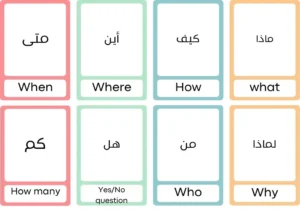
Informational queries usually begin with questions at the beginning of the sentence in Standard Arabic. Here are a few instances:
- What/Which: For “what,” use either “ما” (ma) or “ماذا” (maaza), depending on whether a verb is present. “Which” is represented by “أي” (ayya).
- Where: To ask “where,” use “أين” (ayna).
- Why/When: The word “why” is “لماذا,” while the word “when” is “متى” (li-maza).
- Who: To ask “who,” use “من” (man).
- “كم” is used for “how much,” while “كيف” (kayfa) is used for “how.”
Increase Your Understanding of Arabic Grammar
Would you like to learn more about Arabic grammar? See our extensive Arabic language curriculum to start with these crucial abilities. Enroll now to start on the path to Arabic fluency.
Are you prepared to Learn Arabic Grammar?
Sign up for eArabiclearning to get started on your Arabic learning journey right now. Explore our courses and discover the power of fluent Arabic grammar in enhancing your communication and cultural appreciation.
Common Question Words
مَن؟ man?
Whom?
مَا؟
What? ماذَا؟
What or which
First, take note that question words typically appear at the start of a question in standard Arabic, but they typically appear at the end of a question in colloquial Arabic.
ما and ماذا are used in various kinds of inquiries; we use it in verb-free questions, whereas the latter is used in verb-filled questions. Usually, the pronoun that corresponds to the noun being inquired about comes after ماذا on the other hand, is quite easy and is used anywhere you would say “what” in English.
أيْنَ؟ Ayna?
Where?
mataa?
When?
كَيْفَ؟
How?
The usage of كٌيف is quite easy, but keep in mind that, unlike English, where “how many” is followed by a plural noun, in Arabic (both standard and colloquial) كم must come after a single noun. Additionally, this singular noun in standard Arabic needs to be in the accusative case. Keep in mind that the noun needs to be united because it is singular.
It’s quite easy to ask “how much money”; in standard Arabic, you use بكم, and in the Egyptian dialect, you use بكام. To ask inquiries about “to what extent, how big, how long, how much,” you use كم in standard Arabic and قد ايه in Egyptian. These are the two ways to ask “how much” (to what extent; how much of an uncountable noun).
In what number?
Why?
هَل؟ hal? Certainly or no
When asking a yes-or-no question in Arabic, the question and the related statement have an identical format; the only things that alter are the tone and the optional addition of هل (hal) at the start of the inquiry. Although هل is standard Arabic, educated people also use it in colloquial Arabic.
أ is an alternate for هل. It appears at the start of the question, just like هل. In contrast to هل, it is limited to standard Arabic and cannot be used before a definite noun or a word that starts with a أ. Furthermore, it is far less prevalent than هل. For instanceأليس كذلك؟
Is that not the case?
أغدا ألقاكؔ (A-ġadan alqaak)
Will I see you tomorrow?
(This is the name of a well-known song by Umm Kalthoum.)
A question marked as “alternative” offers two or more options. In standard Arabic, أم (am) divides a single pair of choices. But you have to use أو (aw) in between each option if you provide the user with more than two options to choose from.
It is important that in Egyptian Arabic, you can use the imperfect form to ask someone if they would like to do something.
تشرب شاي؟
Would you like tea?
تشرب ايه؟
What would you like to drink?
تيجي معانا؟
Would you like to come with us?
Examples of Questions
What is your age? كم عمرك؟
What is this? ما هذا
What’s your name? ما اسمك؟
Where do you work? أين تعمل؟
What is the duration of your studies? منذ متى تدرس؟
Do you enjoy Egyptian cuisine? هل تحب الطعام المصري؟
Have you traveled to Egypt? هل سافرت إلى مصر؟
What day is your birthday? متى عيد ميلادك؟
Practice Questions
Type these questions in Arabic.
When is the museum open?
What time does the pharmacy open?
What time does the play begin?
How are you doing?
What is the lesson for today?
What made you not be there yesterday?