
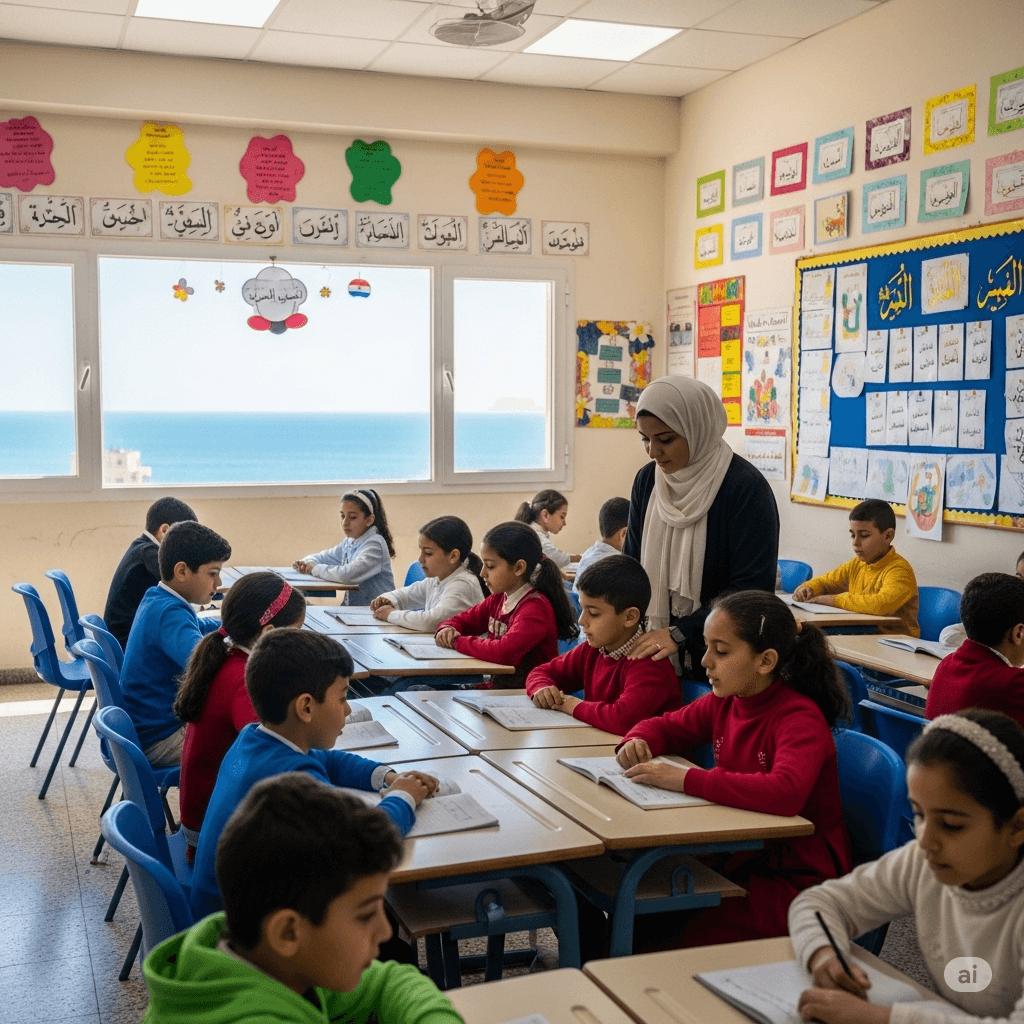
Every summer, we welcome dozens of bright, curious kids to our Arabic summer camp in Alexandria. It’s one of the highlights of the year for eArabicLearning Academy. The camp is full of energy, laughter, discovery—and of course, plenty of Arabic!
But if we’re being honest, teaching Arabic to non-native children at a summer camp isn’t always easy. It’s a beautiful experience, yes—but like anything meaningful, it comes with real challenges. In this post, we want to take you behind the scenes and share what Arabic teachers really face at camp, and how we work to make the experience great for every single child.
1. Not All Kids Are on the Same Language Level—And That Can Be Tricky
One of the first things we have to deal with is language level differences. Some kids come to camp already knowing a bit of Arabic—they’ve maybe heard it at home or taken classes before. Others are starting from zero.
Now, imagine putting those two types of learners in the same class. The beginner might feel lost, while the more advanced student might get bored and tune out. That’s why at eArabicLearning, we take extra care to group kids by their Arabic level before camp starts. Everyone takes a placement test, and we make sure that each classroom has students who are more or less on the same page.
This way, no one feels left behind—and no one feels held back. It’s all about keeping learning fun and fair.
2. Age Gaps Make a Difference—Even If Kids Are on the Same Level
Here’s something many people forget: even if two children speak Arabic at the same level, a six-year-old and a twelve-year-old don’t learn the same way.
The little ones need songs, games, movement, and lots of color. The older kids? They want structure, goals, and more serious conversation. Trying to teach both groups at the same time can be… challenging.
We try to minimize these age gaps as much as possible, but when it happens, our teachers get creative. They might split activities into layers—so the same task can work for everyone, just at different depths. It’s about keeping everyone engaged in a way that suits their stage of development.
3. Our Students Come From All Over the World—And That’s Amazing, But Also Complicated
One of the best parts of camp is the diversity. Kids come from the U.S., Europe, Asia, Africa—sometimes even all in one classroom! This is a beautiful opportunity for cross-cultural friendships, but it also means our teachers have to work with a wide variety of accents, learning habits, and cultural expectations.
For example, a child whose first language is French may struggle with Arabic pronunciation in a different way than a child who speaks Urdu or English. We know this, and we plan for it. Our teachers use visual aids, gestures, and sometimes even a little transliteration to bridge the gap—always with patience and empathy.
4. It’s Summer—Kids Want Fun, Not Homework
Let’s not forget: this is a camp. Kids are here to have fun! Yes, they’re here to learn Arabic, but if the classes feel like school, we lose their interest quickly.
So, how do we keep kids engaged? We turn Arabic into an adventure. We use songs, role-playing, storytelling, treasure hunts, arts and crafts, and sometimes even cooking activities to teach vocabulary and grammar in a way that feels like play. We want children to fall in love with the language—not just learn it by force.
At the end of the day, our biggest goal is for the kids to go home with a smile on their face and a few Arabic phrases they’re proud of.
5. The Clock Is Ticking—We Only Have a Few Weeks
Unlike year-round language programs, our summer camp runs for a short, intense period—usually just a few weeks. That means we have limited time to make real progress.
But we don’t stress about it. Instead, we focus on quality over quantity. Our curriculum is designed to build essential skills—like greetings, introductions, numbers, and everyday vocabulary—using repetition and real-life scenarios. We also provide mini progress reports, so parents can see how their kids are doing and where they’re headed next.
6. Teaching in a Language Kids Don’t Understand Yet? Yep, That’s Tough
One more challenge worth mentioning: classroom management is a bit harder when kids don’t fully understand what the teacher is saying yet. A simple “Please sit down” or “Let’s listen now” might not mean much if the child is just starting Arabic.
That’s why our teachers use tons of gestures, routines, songs, and visual signals. Over time, the kids begin to associate the sounds with actions—and before long, they’re responding in Arabic without even realizing it.
We also mix in a bit of English when absolutely needed, especially at the beginning. But the goal is always to immerse them in Arabic as much as possible, in a safe, supportive way.
Final Thoughts: It’s Challenging, But So Worth It
Yes, teaching Arabic at summer camp is hard work. There are level differences, age differences, cultural differences, time constraints—you name it.
But it’s also one of the most rewarding things we do at eArabicLearning Academy. We see children walk in shy and uncertain… and leave confident, joyful, and connected to a beautiful language and culture.
And if we can plant that seed of curiosity and pride in Arabic—even just a little—we know we’ve done something amazing.