
Egyptian Arabic for Expats in Cairo: The Honest Survival Guide (From Someone Who’s Taught It for 20 Years)
By Mohamed Mortada | eArabicLearning | Updated May 2026 | 18 min read
Categories: Learn Arabic in Egypt · Learn Egyptian Arabic · Arabic for Business
Target keywords: Egyptian Arabic for expats, learn Egyptian Arabic in Cairo, Egyptian colloquial Arabic, Arabic for diplomats in Egypt, Egyptian Arabic classes Cairo, how to speak Arabic in Egypt, Egyptian dialect for foreigners
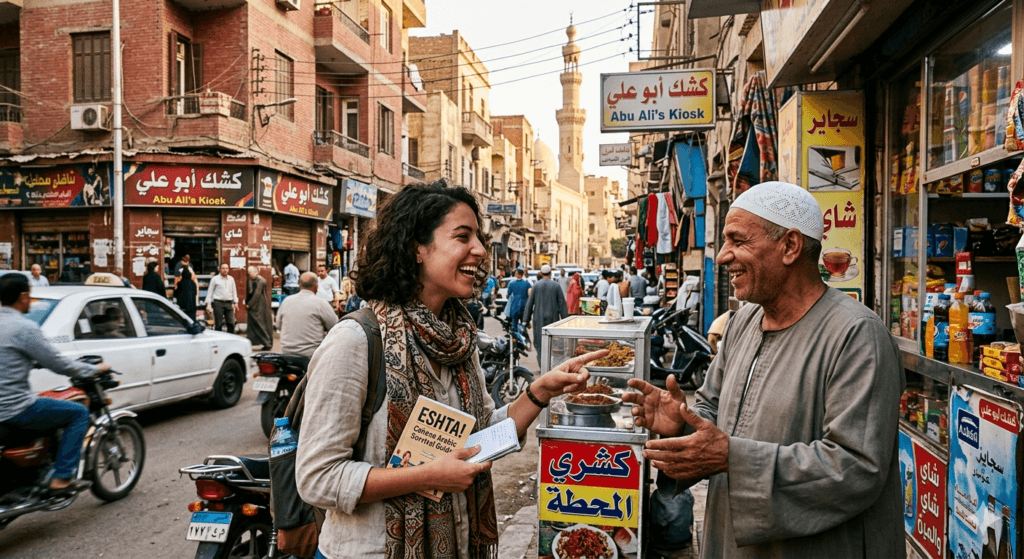
You’ve landed in Cairo. Maybe it’s for a diplomatic posting, an NGO contract, or you just decided that life needed more chaos and falafel. Whatever the reason, you are now in a city of 22 million people who communicate in a dialect that is — and I say this with deep affection — gloriously different from anything you studied in a textbook.
I’ve been teaching Arabic to non-native speakers since 2007. American diplomats, French journalists, British aid workers, German researchers. And almost every one of them walked in with the same polite panic: I studied Modern Standard Arabic for a year and I still can’t understand my doorman.
This guide is for you. It’s long because the topic deserves it. Read it in order or jump to the section that matters most right now.
Why Egyptian Arabic Is Not What They Taught You in Class
Modern Standard Arabic (MSA) — called Al-Fusha (الفصحى) — is the formal, written language of the Arab world. You’ll find it in newspapers, official speeches, and the Quran. It’s a genuine and beautiful form of Arabic, and learning it has real value.
But nobody in Cairo uses it to ask where the nearest pharmacy is.
Egyptian Colloquial Arabic (Al-‘Ammiyya Al-Masriyya / العامية المصرية) is the living, breathing language of daily life in Egypt. It’s what your colleagues speak in the hallway, what taxi drivers shout through traffic, and what neighbors use when they knock on your door to complain about the wifi router.
The gap between MSA and Egyptian Colloquial is significant enough that many students who complete a full university Arabic course still can’t hold a five-minute conversation in Cairo. This isn’t a failure of the student — it’s a mismatch between what was taught and what is actually spoken.
Here’s the good news: Egyptian Arabic is also the most widely understood dialect in the Arab world. Because of Egyptian cinema, television, and music, an Egyptian speaker is understood everywhere from Morocco to Iraq. Learning Egyptian Colloquial doesn’t limit you — it gives you the most portable accent on the continent.
What Makes Egyptian Arabic Different: A Quick Orientation
You don’t need to memorize this section. But knowing these differences will make your first few weeks a lot less disorienting.
The “ج” sounds like “G” In most Arab countries, the letter Jim (ج) is pronounced like the “j” in “jar.” In Egypt, it’s a hard G — like “go.” So Gamal (جمال) is not “Jamal.” This is one of the most immediately recognizable features of the Egyptian dialect.
The “ق” often disappears or becomes a glottal stop The letter Qaf (ق) — a deep, back-of-the-throat sound in classical Arabic — is usually dropped in casual Cairo speech or replaced with a glottal stop (the pause in “uh-oh”). The word ʾalb (قلب, heart) sounds roughly like ‘alb in Egyptian street speech.
Vocabulary borrows from other languages Egyptian Arabic has absorbed French, Italian, Turkish, and English words over centuries of trade and colonization. Orobees (أوتوبيس) is a bus (from “autobus”). Basbort (باسبورت) is a passport. Kumbyouter (كمبيوتر) is a computer. Once you recognize these borrowed words, the language feels much more accessible.
Verb conjugations are simpler in some ways Egyptian Colloquial drops some of the dual forms and certain verb patterns that make MSA grammatically dense. That makes spoken Egyptian Arabic actually easier to get started with for practical communication.
The 7 Phrases Every Expat in Cairo Needs on Day One
These aren’t tourist phrases. These are the phrases that change how Egyptians see you — from a foreigner to a foreigner who tried, which earns enormous goodwill.
1. إزيك؟ / إزيك؟ (Izzayak? / Izzayik?) “How are you?” — masculine and feminine versions respectively. Say this to everyone. The response you’ll most often hear is Tamam, el-hamdulillah (Fine, praise be to God) or Kwayyes/Kwayissa (Good).
2. شكراً جزيلاً (Shukran gazeelan) “Thank you very much.” The word gazeelan is understood everywhere but sounds particularly warm and educated in Egypt.
3. ممكن تساعدني؟ (Mumkin tisa’adni?) “Can you help me?” Simple, polite, and extremely effective. Egyptians are famously helpful to strangers who ask respectfully.
4. فين الـ…؟ (Feen el…?) “Where is the…?” Fill in the blank. Feen el metro? (Where’s the metro?) Feen el beit? (Where’s the house?) This construction alone will get you through most navigation situations.
5. بكام ده؟ (Bikam da?) “How much is this?” Essential in markets, taxis, and anywhere prices aren’t posted. Follow it up with numbers and you can negotiate basic purchases.
6. عايز/عايزة… (Aayiz / Aayza…) “I want…” Again, masculine and feminine. Aayiz mayya (I want water). Aayiza foul (I want fava beans). Blunt but universally understood.
7. معلش (Ma’lesh) This one is untranslatable in a single word. It means “never mind,” “I’m sorry,” “don’t worry,” “it’s okay,” and “these things happen” all at once. It is the emotional lubricant of Egyptian social life. Learn it. Use it generously.
Why Most Expats Plateau — and How to Break Through
After a few weeks in Cairo, most foreign residents pick up survival phrases. They can order coffee, take a Uber, and exchange basic pleasantries with neighbors. Then progress stops.
The plateau happens for a predictable set of reasons.
They’re still thinking in English (or French or German) and translating. Real fluency in Egyptian Arabic — the kind where you understand fast, natural speech — requires your brain to stop translating and start recognizing. This comes from exposure volume, not just study time.
Their input sources are wrong. Watching Egyptian TV with Arabic subtitles is genuinely one of the fastest ways to develop an ear for colloquial Arabic. Egyptian soap operas (musalsal / مسلسل), game shows, and comedy programs are full of natural, repetitive, everyday language. Many expats skip this in favor of apps that teach MSA.
They’re afraid to make mistakes in front of Egyptians. This is the one I see most in professional expats. A diplomat or senior NGO staff member doesn’t want to sound foolish. But Egyptians are among the warmest language partners in the world — a foreigner attempting Arabic, even badly, almost always produces smiles and encouragement rather than judgment.
They don’t have structured speaking time. Listening to Arabic all day in Cairo doesn’t automatically build speaking ability. The brain needs deliberate practice: structured conversation with feedback, correction of specific errors, and repetition of patterns.
Egyptian Arabic for Diplomats and Embassy Staff: Specific Advice
If you’re here on a diplomatic posting, your language needs differ from a tourist or even a long-term resident.
You need to understand register. Egyptian Arabic shifts depending on context. A conversation with a minister’s aide sounds different from a conversation with a street vendor. Learning to read the social situation and adjust your formality accordingly is a real skill — and one that language apps completely ignore.
You need political and cultural vocabulary. Words like sha’b (شعب, people/nation), hukuma (حكومة, government), dawla (دولة, state), intikhabat (انتخابات, elections), and siyasa (سياسة, politics) show up constantly in Egyptian public discourse. These are MSA words that also appear in Egyptian colloquial speech, and knowing them allows you to follow news and conversations that matter professionally.
You need to understand indirect communication. Egyptian conversational culture tends to avoid direct refusals. Inshallah (God willing) can mean genuine hope, polite deflection, or an outright no depending on tone and context. Bokra (tomorrow) sometimes means tomorrow and sometimes means “not now and possibly never.” Reading these signals accurately matters enormously in professional and diplomatic settings.
I’ve worked with embassy staff from the US, France, and several other countries on exactly these skills. The combination of formal MSA reading ability for documents and genuine colloquial fluency for relationships is what makes a diplomatic posting genuinely effective rather than just functional.
Egyptian Arabic for Families: Teaching Kids While You’re Here
If you’ve relocated to Cairo with children, you have a genuine opportunity that most parents abroad miss.
Children under about 12 acquire accents and natural speech patterns at a rate adults simply cannot match. A child exposed to consistent Egyptian Arabic for six months will sound more natural than an adult who studies for two years. This is neuroscience, not exaggeration — the critical period for phonological acquisition is real.
Some things that work well for expat children in Cairo:
Structured Arabic lessons alongside school. If your child is in an international school, their formal schooling won’t provide much Arabic. A weekly one-on-one Arabic lesson — focused on colloquial conversation rather than formal grammar — gives them a foundation to build on through daily exposure.
Arabic-speaking activities. Football (soccer) clubs, art classes, or any regular activity where the adult instructor speaks only Arabic accelerates acquisition through necessity. Children are highly motivated learners when the social reward (joining in the game, following the art instructions) depends on understanding.
Nour El Bayan for Quran-connected families. If Arabic learning is partly motivated by Quran reading and Islamic practice, the Nour El Bayan curriculum (نور البيان) is a well-structured, widely used method for teaching Arabic script and Quranic recitation to children. It works well for non-native learners aged roughly 5 to 12.
What Living in Egypt Actually Teaches You About Arabic (That No Classroom Can)
I want to be honest about something that most language schools won’t say directly: immersion in Egypt will teach you things about Arabic that structured study cannot replicate.
Rhythm and prosody. Written Arabic and spoken Arabic have completely different rhythms. The rising-falling intonation of a Cairo market negotiation, the clipped efficiency of metro announcements, the long warm drawl of a shisha café conversation — these are patterns you absorb in weeks of living here that take years to approximate through recordings.
The emotional weight of words. Ya ibn el-balad (يا ابن البلد) means something like “real man of the people” — a term of affection for someone authentic and unpretentious. Ayyanah (عيانه) means sick, but said with particular tenderness it describes someone delicate or overwhelmed. These emotional colorings don’t appear in any vocabulary list.
Code-switching. Educated Egyptians move fluidly between colloquial Arabic, MSA, and often English or French within a single conversation. Understanding this code-switching — knowing when someone switches to English because they’re being considerate, or to MSA because they’re being formal — is a form of cultural literacy that only comes from time in country.
How Long Does It Actually Take to Speak Egyptian Arabic in Cairo?
Honest answer: it depends on what you mean by “speak.”
Survival conversation — ordering food, navigating directions, basic pleasantries — is achievable in 4 to 8 weeks of consistent study plus daily immersion. Most motivated expats get here without any formal instruction just from living in the city.
Working conversation — holding a 30-minute meeting partly in Arabic, understanding Egyptian television without subtitles, reading prices and signs — takes roughly 6 months of study combined with daily exposure.
Professional fluency — participating comfortably in meetings, understanding regional humor and idiom, reading official documents — takes 2 to 3 years for most adult learners, or faster with intensive structured study.
The FSI (Foreign Service Institute) classifies Arabic as a Category IV language for English speakers — the hardest category, estimated at 2,200 classroom hours to reach professional working proficiency. This is for MSA. Egyptian Colloquial, paradoxically, can be faster for spoken fluency because the grammar is more regular in practice and the vocabulary, once you know MSA, is largely recognizable.
The biggest factor in your timeline is not intelligence. It’s consistency of practice and quality of instruction.
Common Mistakes Expats Make When Learning Egyptian Arabic in Cairo
Mistake 1: Mixing dialect with MSA randomly. MSA and Egyptian Colloquial aren’t interchangeable stylistically. Using an MSA word in casual conversation can sound stilted and strange, the way “I desire sustenance” sounds in English. Mixing them requires awareness of register.
Mistake 2: Learning from other expats. Many Cairo expats pick up phrases from each other — and then propagate each other’s mispronunciations. Finding Egyptian native speakers as your primary language partners matters.
Mistake 3: Assuming literacy will come automatically. Spoken Egyptian Arabic does not require reading Arabic script to learn. But if you plan to stay more than six months, investing in reading ability pays enormous dividends. Street signs, menus, labels, and news all become accessible. The script itself, once learned, is genuinely not as difficult as it looks — most adult learners can read slowly within six to eight weeks of consistent practice.
Mistake 4: Stopping lessons once you can “get by.” Getting by and genuine fluency are far apart. The expats I’ve seen make the most progress are the ones who maintain structured lessons even after they can manage daily life in Arabic — because that’s when the interesting linguistic work actually begins.
Why Cairo Is One of the Best Places in the World to Learn Arabic
I’m not saying this because I’m based here. I’m saying it because the evidence supports it.
Cairo has a population of over 22 million people, most of whom are genuinely willing to talk to a foreigner attempting Arabic. Unlike cities where service workers automatically switch to English, most Cairenes don’t speak English and have no choice but to meet you in Arabic — which is exactly the pressure that accelerates acquisition.
Egyptian Arabic is globally understood, which means the Arabic you learn here is useful everywhere. An Algerian or a Lebanese person may struggle to understand Moroccan Darija, but Egyptian Arabic — thanks to decades of Egyptian media — is comprehensible across the Arab world.
Cairo also has a cultural depth that makes language learning endlessly interesting. Learning Arabic here means simultaneously learning about Islamic art, Pharaonic history, Coptic Christianity, Ottoman architecture, and one of the world’s great culinary traditions. Language anchored in cultural curiosity sticks far better than language studied in a vacuum.
What to Look for in an Egyptian Arabic Teacher (And What to Avoid)
Not all Arabic instruction is equal, and in Cairo, you’ll encounter a wide range of people offering lessons.
Look for teachers who:
- Can explain why a grammar rule works, not just what the rule is
- Have experience with non-native adult learners specifically (teaching methodology for adults differs significantly from teaching children or teaching MSA in an Egyptian school)
- Teach both MSA and Egyptian Colloquial, and can help you understand how they relate
- Track your progress with clear milestones
- Can adjust the lesson content based on your specific professional or personal context
Be cautious of:
- Lessons that are entirely conversation-based with no systematic explanation of grammar
- Teachers who never correct errors (some prioritize being nice over being effective)
- Fixed curricula that ignore what you actually need Arabic for
A 1-on-1 lesson structure, in my experience, is almost always more effective than group classes for adult expats. Your specific vocabulary needs, your accent challenges, and your schedule are all unique. Group classes average across all of those, which means they serve everyone adequately and no one optimally.
Practical Resources for Learning Egyptian Arabic in Cairo Right Now
Egyptian films and series: Start with older Egyptian comedies from the 1990s and 2000s — the language is clear and the humor is accessible. Adel Imam’s films are a good entry point. More recent productions on Netflix’s Arabic catalogue include Egyptian shows with Arabic subtitles.
YouTube: Search for “Egyptian Arabic for beginners” — there’s a reasonable amount of genuine content, though quality varies. Use it for vocabulary exposure, not as a primary instruction method.
Language exchange apps: Apps like Tandem can connect you with Egyptian Arabic speakers willing to exchange conversation practice. Effective as a supplement, not as a standalone method.
Local instruction: There’s no substitute for a qualified teacher who can watch your mouth form sounds incorrectly, catch errors in real time, and adapt lessons to what you specifically need that week.
A Note on Motivation: Why Arabic Learners Quit and Why They Shouldn’t
Almost every adult Arabic learner hits a wall around months three to five. Progress that felt visible in the beginning becomes hard to measure. Conversations that were exciting become frustrating. The language stops feeling romantic and starts feeling intractable.
This is completely normal. It happens with every complex language and it doesn’t mean you’re not suited for Arabic.
What usually breaks through the wall is a shift in focus — from studying Arabic to using Arabic for something you actually care about. A conversation with a neighbor about their kids. Following a football match in Arabic. Reading the first few lines of a Quranic passage and understanding them without translation. These moments of genuine meaning do more for motivation than any app streak.
Arabic is not a fast language to learn. But it is a rewarding one. And Cairo — noisy, chaotic, generous Cairo — is one of the few places in the world where the language you’re learning is literally all around you, every hour, spoken by millions of people who will be delighted when you try.
Ready to Start? Here’s What I’d Suggest
If you’re in Cairo (or planning to be) and want to learn Egyptian Arabic that actually works in real life, the most effective path is:
1. A free trial lesson — not to commit you to anything, but to assess where you are and what you actually need. Every learner’s starting point is different and cookie-cutter advice helps no one.
2. A clear distinction between what you want — survival Arabic for daily life, professional Arabic for work, Quranic Arabic for Islamic practice, or some combination. These require genuinely different approaches.
3. Consistency over intensity — two hours per week for six months beats a ten-hour week for three weeks. Languages are built on repeated exposure over time, not cramming.
eArabicLearning offers 1-on-1 Arabic instruction in Cairo (Zamalek), Alexandria, and online — tailored to your level, your goals, and your schedule. If you’re an expat, diplomat, or foreign resident looking for Arabic that works in real Egyptian life, book a free trial lesson here.
Frequently Asked Questions
Is Egyptian Arabic the same as Modern Standard Arabic? No. MSA is the formal, written standard used across the Arab world. Egyptian Arabic is the spoken dialect of Egypt. They share vocabulary and script but differ significantly in pronunciation, grammar, and everyday vocabulary. For daily life in Cairo, Egyptian Colloquial is far more useful.
Can I learn Egyptian Arabic without learning to read Arabic script? Yes, for spoken purposes. Many learners use transliteration (writing Arabic sounds in Latin letters) in the beginning. However, literacy in Arabic script is strongly recommended for anyone staying in Egypt longer than six months, as it opens up an enormous amount of practical utility.
How many Arabic dialects are there in Egypt? The main distinction is between Cairene Arabic (the urban Cairo dialect, considered standard Egyptian Arabic) and Sa’idi Arabic (the dialect of Upper Egypt, quite different in sound and some vocabulary). If you’re based in Cairo, Cairene Arabic is what you want to learn. It’s also the variety understood across Egypt.
Is Egyptian Arabic good for understanding other Arab countries? Yes. Egyptian Arabic, due to the global reach of Egyptian media, is the most widely understood dialect in the Arab world. Learning it does not lock you into Egypt — it gives you a foundation that is broadly recognizable from Morocco to the Gulf.
What level of Arabic do I need for a diplomatic posting in Egypt? The US Foreign Service Institute recommends a minimum of ILR Level 2 (Limited Working Proficiency) for diplomatic staff in Arabic-speaking countries. Realistically, developing genuine professional effectiveness in Egypt requires working toward ILR Level 3 (Professional Working Proficiency), which combines MSA reading ability with colloquial speaking fluency.
How much does Arabic instruction cost in Cairo? Rates vary significantly. eArabicLearning’s 1-on-1 lessons are $12 per hour — substantially below the market rate for comparable qualified instruction. For expats managing housing costs in Cairo’s increasingly expensive market, this makes consistent lessons financially realistic.
Tags: Egyptian Arabic, learn Arabic in Cairo, Arabic for expats, Arabic for diplomats, Egyptian colloquial Arabic, Arabic immersion Egypt, Cairo Arabic classes, learn Egyptian dialect, Arabic for foreigners in Egypt