
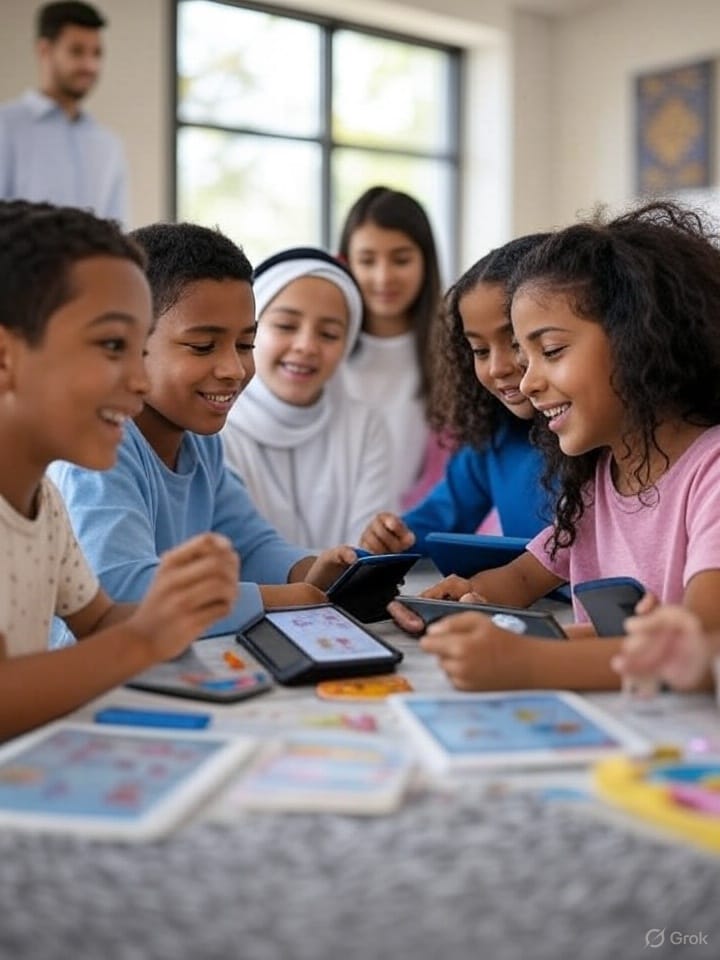
Let’s face it—teaching children a second language isn’t easy. And when that language is Arabic, with its unfamiliar script, sounds, and grammar, it can feel downright intimidating for both the child and the adult.
But here’s the good news: it doesn’t have to be a struggle.
The secret?
Make Arabic fun. Make it visual. Make it interactive.
And the easiest way to do that?
Through a dynamic trio of tools: quizzes, images, and videos.
In this guide, you’ll discover how to use these tools to not just teach Arabic—but to help your child or students enjoy the journey.
🚸 First, Let’s Talk About the Real Challenges
Before we jump into methods, let’s be real about the obstacles:
Arabic looks different. Those looping, right-to-left letters can be intimidating.
It sounds different too. The “ع” (ʿayn) and “خ” (khāʾ) are nothing like English.
It’s often taught in a formal, dry way—long vocabulary lists, stiff grammar, and endless repetition.
But children aren’t built for sitting and memorizing rules.
They’re built for exploring, mimicking, playing, and visual learning.
That’s why we need a new strategy.
🎮 The Power of Play: Why Quizzes Work So Well
Let’s start with quizzes. Yes—quizzes.
Now, we’re not talking about boring end-of-unit exams. We’re talking about game-like, interactive mini-quizzes that kids look forward to.
Think about it:
A quiz that pops up after a video with bright colors and fun sounds.
A matching game that asks them to connect the picture of an animal to its Arabic name.
A multiple-choice question that plays an audio clip and asks, Which word did you hear?
Suddenly, the quiz isn’t a test.
It’s a challenge, a game, a confidence boost.
🔁 Quizzes Reinforce Without Boring
When kids do a 5-question quiz at the end of a lesson, they’re recycling knowledge.
They see a word they learned five minutes ago and think, Oh! I remember this!
That moment of recognition—that little “win”—is exactly what makes them want to keep going.
🔊 Add Audio, Add Life
You can even build quizzes that include audio:
“Click on the word you hear.”
“Match the sound to the correct picture.”
“Listen and repeat.”
This turns listening practice into active learning. And for Arabic, where pronunciation can be tricky, this is gold.
🖼️ Picture This: Why Visual Learning Works So Well
Children are wired to see and feel what they learn.
That’s why images are one of your most powerful tools when teaching Arabic.
Think about it:
Show a child a picture of a smiling cat, and under it, write “قطة” (qiṭṭa).
Do that a few times, and suddenly, the word isn’t just a word—it’s an idea, an emotion, a memory.
Here’s how visuals help:
They activate memory: Visual recall is faster and stronger than verbal memory.
They add emotion: Bright, colorful, happy images help kids feel good about what they’re learning.
They make abstract words concrete: A word like “مدرسة” (school) becomes real when paired with an image of kids walking into a classroom.
🧩 Use Images Creatively:
Create flashcards with Arabic on one side and a picture on the other.
Use digital slides with multiple images and ask, “Where is the ‘تفاحة’?”
Turn image-matching into a team quiz or even a memory game.
The point is: don’t just say the word. Show it. And make it fun.
🎥 Video Is a Language Teacher’s Best Friend
Now we get to the tool that ties it all together: video.
Kids love screens. They’re naturally drawn to motion, sound, and color. So why not use that to teach Arabic?
But here’s the catch: not all videos are created equal.
To be effective for language learning, videos should be:
Short (2–5 minutes max)
Clear (simple, everyday vocabulary)
Repetitive (lots of chances to hear and see the same phrases)
Interactive (pause, ask questions, repeat phrases)
🎶 Music and Song = Instant Engagement
One of the best video formats for Arabic learners?
Songs.
Arabic kids’ songs with clear subtitles, animation, and repetition help learners:
Hear natural pronunciation
Learn sentence rhythm
Memorize common phrases through melody
Pro tip: Pause the video after each line, and ask your child to repeat. Make it a game.
🧠 Turn Watching Into Doing
It’s not enough to watch videos. You want to make them interactive.
Here’s a simple method:
Watch the video once with no interruptions.
Watch again—this time, pause and ask questions:
“What word did they just say?”
“Can you say it with them?”
Wrap up with a mini quiz or drawing task:
“Draw something you saw and write its Arabic name.”
“Match the words from the video with pictures.”
Every viewing becomes an opportunity to think, speak, and create.
📋 So, What Should You Teach First?
You don’t need to start with complicated grammar or textbook dialogues.
Start with what’s familiar:
| Topic | Arabic Example |
|---|---|
| Colors | أزرق (blue), أحمر (red) |
| Animals | كلب (dog), قطة (cat) |
| Family Members | أم (mother), أب (father) |
| Food | تفاح (apple), خبز (bread) |
| Numbers & Counting | واحد، اثنان، ثلاثة |
Each of these topics is visual, relatable, and perfect for quizzes and videos.
🎓 How to Structure an Arabic Lesson with These Tools
Here’s a simple formula that works like magic:
Start with a short video: Introduce the topic with an Arabic cartoon, song, or story.
Move to images: Show pictures of vocabulary from the video and discuss them.
Finish with a quiz: Let the child play a matching game, click-the-word quiz, or speak-aloud challenge.
This “watch-see-play” structure keeps things fresh and natural—no need to beg your child to focus. They’ll want to continue.
💬 What If My Child Isn’t Speaking Yet?
That’s okay.
Kids often go through a “silent period” in second language learning. They’re taking it all in. Don’t force speaking too early.
Instead, encourage repetition:
Repeat words together.
Use songs to build comfort.
Let them point to images and nod when they know the answer.
Speaking will come.
🛠️ Tools and Tips You Can Use Today
Here’s a quick list of things you can try:
✅ Kahoot or Quizizz for interactive quizzes
✅ Canva or Google Slides to create flashcards
✅ Use YouTube Arabic Kids Channels for free video content
✅ Print or draw your own visual vocabulary cards
✅ Make a “Word Wall” at home with Arabic words and images
You don’t need fancy tech. What matters most is consistency, creativity, and a bit of fun.
📈 How Do You Know It’s Working?
You’ll see signs, even if they’re small:
Your child randomly says “تفاحة!” when eating an apple.
They sing along with a song they saw three days ago.
They start pointing at objects and asking, “What’s this in Arabic?”
That’s not just learning. That’s language ownership.
🔚 Final Thoughts: Arabic Doesn’t Have to Be Hard
When you use quizzes, images, and videos the right way, Arabic stops being “the hard language” and becomes a playground of discovery.
You’re not just teaching words—you’re building confidence, curiosity, and a connection with a rich and beautiful language.
So whether you’re a parent, teacher, or tutor—remember this:
📌 Keep it short.
📌 Keep it visual.
📌 Keep it playful.