
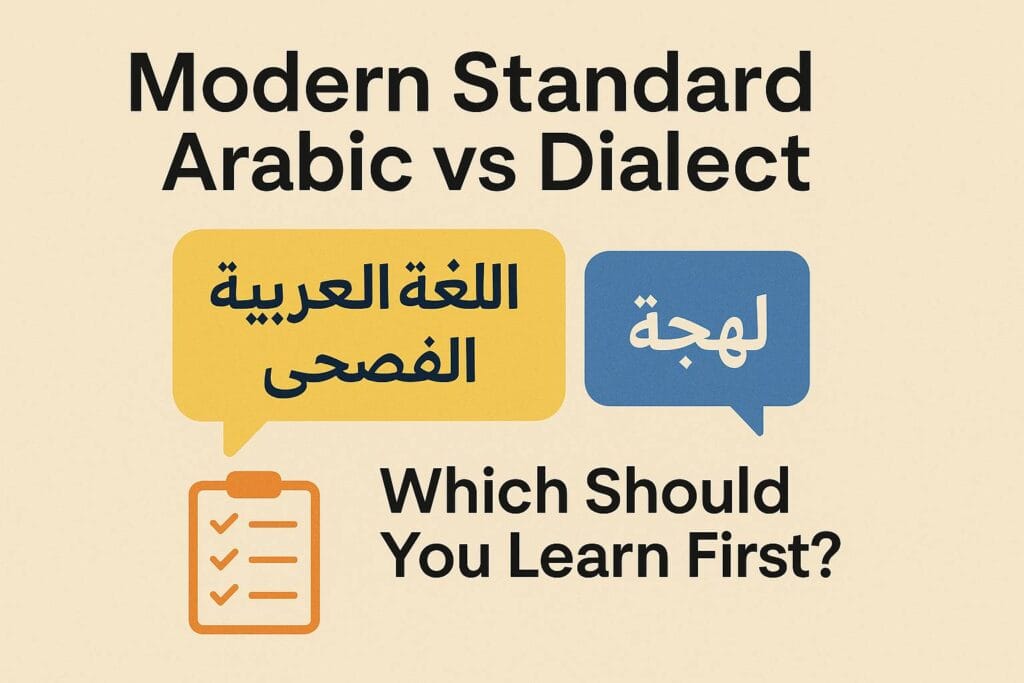
If you’re an English speaker starting your journey to learn Arabic, one of the first questions you’ll likely face is: Should I learn Modern Standard Arabic (MSA) or a dialect like Egyptian or Levantine?
This guide will walk you through everything you need to know, in a friendly and helpful tone, so you can confidently decide which form of Arabic is best for your goals.
🌟 First, Let’s Understand the Two Main Options
What is Modern Standard Arabic (MSA)?
Modern Standard Arabic, or Fusha, is the formal version of Arabic. It’s used in:
- News broadcasts
- Books and newspapers
- Formal speeches
- Official documents
It’s largely standardized across the Arab world, and most educational materials use it.
What Are Arabic Dialects?
Dialects (or Amiyyah) are the everyday spoken forms of Arabic that differ by region. Some common dialects include:
- Egyptian Arabic: Widely understood due to Egyptian media.
- Levantine Arabic: Used in Lebanon, Syria, Jordan, and Palestine.
- Gulf Arabic: Common in the Gulf countries like Saudi Arabia and UAE.
- Maghrebi Arabic: Found in Morocco, Algeria, and Tunisia (often harder for outsiders to understand).
Each dialect has its own slang, pronunciation, and even grammar tweaks.
🌐 Why This Decision Matters So Much
Choosing between MSA and a dialect is important because:
- MSA is great for reading, writing, and listening to the news.
- Dialects are essential for speaking with locals and understanding daily life.
So your choice depends on your purpose.
| Your Goal | Best Choice |
|---|---|
| Academic / religious studies | MSA |
| Working or living in an Arab country | Dialect (specific to region) |
| Understanding news / media | MSA |
| Making friends, travel, casual talk | Dialect |
🤔 Common Confusions (And Clear Answers!)
“If I learn MSA, can people understand me?”
Yes, they will understand you—especially in formal or academic settings. But here’s the catch: most native speakers won’t respond in MSA. They’ll reply in their own dialect, which might sound very different.
“If I learn a dialect, will I be lost when reading or watching the news?”
Pretty much, yes. Dialects are mainly spoken and rarely written, while MSA dominates in reading materials, journalism, and educational content. If you skip MSA entirely, reading and formal comprehension could be challenging.
“Can I learn both at once?”
You can, but it takes a balanced strategy. Many learners begin with MSA to understand grammar and build vocabulary, then gradually immerse themselves in dialects through listening, speaking, and real-life conversation.
“Which dialect is easiest or most useful?”
Egyptian Arabic is often a strong choice because of its wide exposure through film and music. But if you have a specific target country (like Saudi Arabia or Jordan), it makes more sense to learn that dialect directly.
“Are dialects completely different from MSA?”
They’re more like cousins than twins. While the roots and basic structure are similar, pronunciation, word usage, and verb conjugations can differ significantly.
“Can I switch from one to the other later on?”
Absolutely! Many learners evolve their goals over time. You might start with MSA for a solid foundation and shift to dialect once you’re ready for social conversation, or vice versa. Your learning path is flexible.
🌟 MSA: The Strengths and Weaknesses
🌟 MSA: The Strengths and Weaknesses
✅ Pros:
- Used everywhere in writing and formal settings
- Clear grammar rules
- Most resources available
❌ Cons:
- Rarely spoken in casual life
- Sounds overly formal in conversation
👋 Dialects: Everyday Arabic
✅ Pros:
- Natural for real conversations
- Builds faster connection with native speakers
❌ Cons:
- Fewer resources (depending on dialect)
- Changes across regions — even within one country
🔄 How to Learn Both Without Getting Confused
- Start with your need.
- Going to Jordan? Start with Levantine.
- Reading Quran? MSA is essential.
- Pick one focus first, then build gradually.
- Use both in context.
- Watch shows in dialect.
- Read articles in MSA.
- Label your materials. Keep MSA and dialect notes separate to avoid mixing them up.
📅 A Sample Learning Path (6 Months Beginner Focus)
| Month | Focus | Activity Suggestions |
| 1-2 | MSA basics | Learn alphabet, greetings, verbs |
| 3 | Dialect intro | Listen to Egyptian or Levantine audio |
| 4 | Grammar | Study pronouns, past/present tense |
| 5 | Speaking | Roleplays, simple conversations |
| 6 | Media mix | Watch news, dramas, YouTube vlogs |
🔍 Which Arabic is Right for You? Ask Yourself:
- Do you plan to live in or visit one country?
- Do you need Arabic for religious reasons?
- Are you more interested in reading or speaking?
Write your goals down. Be honest.
Then, pick the style of Arabic that brings you closest to them.
Frequently Asked Questions (FAQ) — Modern Standard Arabic vs Dialect
1. What exactly is the difference between Modern Standard Arabic (MSA) and Arabic dialects?
Modern Standard Arabic (MSA), also known as Fusha, is the standardized version of Arabic taught in schools and used in formal settings. It appears in books, newspapers, news broadcasts, and official speeches. It follows strict grammar rules and is consistent across the Arab world.
Arabic dialects (Amiyyah), on the other hand, are the spoken forms of Arabic used in daily life. Each country—and even cities within a country—may have its own dialect. For example:
Egyptian Arabic is widely spoken and understood due to its influence in film and media.
Levantine Arabic includes Jordanian, Palestinian, Syrian, and Lebanese variations.
Gulf Arabic is common in Saudi Arabia, Kuwait, UAE, and neighboring countries.
Maghrebi Arabic (Morocco, Algeria, Tunisia) is often the most distinct and hardest for outsiders to understand.
MSA is more uniform and formal; dialects are casual, localized, and essential for real-world conversations.
2. Should I start learning Arabic with MSA or with a dialect?
This is one of the most common and confusing questions. Here’s a clear way to think about it:
Choose MSA first if your main goals are:
Reading Arabic books, religious texts (like the Quran), or academic materials.
Understanding Arabic news and media.
Gaining a foundational understanding of Arabic grammar and structure.
Choose a dialect first if:
You want to speak with locals during travel or while living in an Arab country.
You’re more focused on practical conversation than formal reading/writing.
You have a specific country or region in mind, like Egypt, Jordan, or the Gulf.
Many learners eventually study both. Starting with MSA gives you a strong linguistic backbone. Starting with a dialect offers immediate practical application.
3. Can people understand me if I speak only MSA?
Yes and no. Native speakers will understand what you’re saying because MSA is taught in school and heard in media. However, it may sound overly formal—like someone walking into a café and speaking Shakespearean English.
For example:
If you say “Kayfa Haluka?” (MSA for “How are you?”), you will be understood.
But most people in Egypt would say “Ezayak?” and in Jordan “Kifak?”
People will appreciate your effort but likely respond in their local dialect, which may be hard to follow unless you’ve studied it.
4. Is it a good idea to learn both MSA and a dialect at the same time?
It depends on your learning style and available time. Learning both is totally possible, but here are a few tips:
Start with MSA for grammar, reading, and structure.
Begin listening to dialects early through TV shows, YouTube, podcasts, or native conversations.
Don’t mix vocabulary between MSA and dialect in your notes—label them clearly.
Focus on one skill per session: grammar from MSA, conversation from dialect.
Balanced exposure will eventually help your brain distinguish the two naturally.
5. Which dialect is easiest or most useful to learn?
Egyptian Arabic is the most widely understood across the Arab world, thanks to Egypt’s massive cultural footprint in music, movies, and media.
Levantine Arabic (Jordanian, Lebanese, Palestinian, Syrian) is also relatively easy to pick up for English speakers and has a melodic, soft sound.
Gulf Arabic is practical if you’re relocating to or working in places like Saudi Arabia, UAE, or Kuwait, but it has less international media exposure.
Maghrebi Arabic is often considered the most challenging due to French and Berber influences and heavy variations in pronunciation.
Choose the dialect that matches your destination, your interests, or the community you plan to speak with most often.
6. Are Arabic dialects really that different from MSA?
Yes—and no. The root system, basic vocabulary, and general grammatical structures remain similar. But differences emerge in:
Verb conjugations (especially present tense)
Pronunciation (e.g., “qaf” becomes “glottal stop” in Egyptian)
Everyday vocabulary (e.g., “now” in MSA is “al’an” but “dilwa’ti” in Egyptian)
Use of articles, negation, and slang expressions
Learning one will help you recognize patterns in the other, but switching between them still requires practice and awareness.
7. Is Arabic a difficult language to learn for English speakers?
Arabic is considered a Category IV language by the U.S. Foreign Service Institute, meaning it’s one of the more challenging languages for English speakers due to:
A new script and right-to-left reading
Sounds not found in English (like ع and غ)
Rich grammar system (root/pattern, gender, case endings in MSA)
BUT—with the right approach, consistent practice, and cultural exposure, it’s absolutely achievable. Many learners find Arabic incredibly rewarding due to its poetic structure and deep cultural connections.
8. Is it okay to skip MSA and only learn a dialect?
Yes, especially if your main goal is conversational fluency. For example:
Travelers often study Egyptian or Levantine to communicate quickly.
Expats in Gulf countries learn Gulf Arabic for workplace interaction.
However, skipping MSA might limit your ability to:
Read signs, news, books, or religious texts
Understand written materials
Transition into academic or professional contexts
In short: it depends on your purpose. For long-term proficiency, combining both is ideal.
9. Can I become fluent in Arabic, and how long does it take?
Yes, you absolutely can. With dedication and structured study:
Conversational fluency: 12–18 months with regular immersion.
MSA proficiency (reading and writing): 18–24 months depending on consistency.
Full fluency (MSA + dialect): 2–3 years with speaking, reading, and listening practice.
Daily exposure, speaking with natives, and using Arabic in context are key to speeding up fluency.
10. Are there good resources for both MSA and dialects?
Yes! Some popular options include:
MSA Resources: Madinah Books, Al-Kitaab , Arabya bina Yadika
Dialect Resources: TalkInArabic.com, Lingualism books, YouTube channels
language exchange apps (Tandem, HelloTalk)
Apps: Drops (vocab), Memrise (dialect courses), Anki (custom flashcards)
Don’t be afraid to mix resources and explore. Arabic learning is not one-size-fits-all.
🚀 Final Advice: Start Somewhere, Keep Going
There’s no wrong choice. Starting with MSA gives you a powerful core. Starting with dialect gives you immediate connection.
Many successful learners mix both—and so can you.
Arabic is deep, poetic, and beautiful. Whichever version you begin with, you’re stepping into a rich world of culture, connection, and history.
Good luck — حظًا سعيدا! 🌟