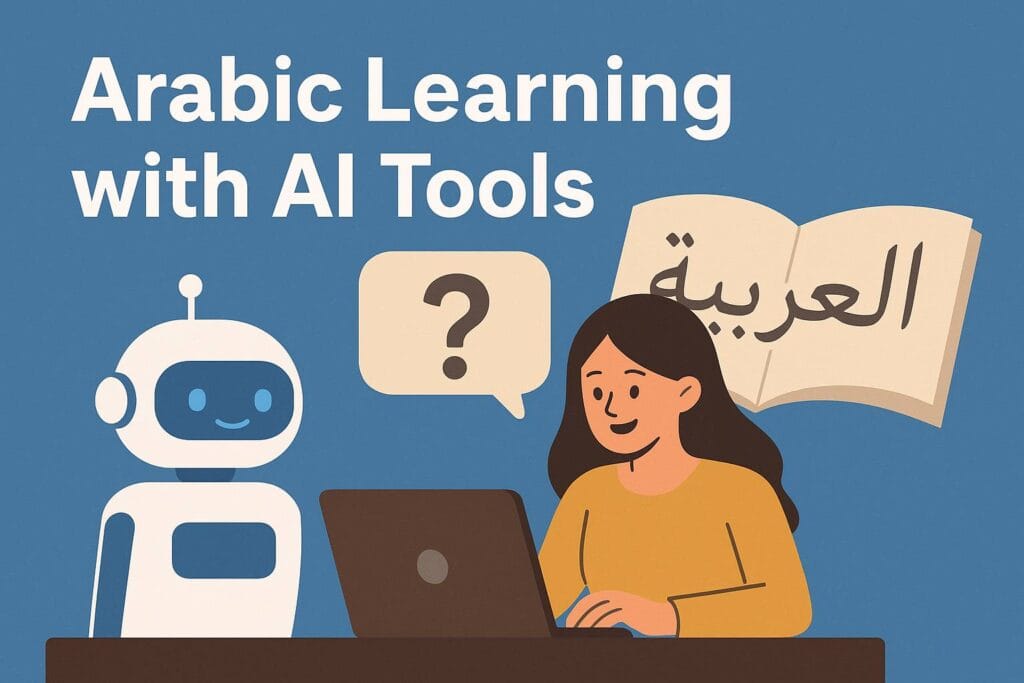
In the past few years, Artificial Intelligence has made its way into almost every part of our lives, and language learning is no exception. If you’ve ever wondered how AI tools can support your Arabic learning journey, you’re not alone. In fact, many learners are turning to AI tutors, chatbots, and smart platforms to complement their studies. But how do they actually help? Can they replace real teachers? And what’s the best way to use them?
In this extended guide, we’ll explore these questions and many more. Think of it as sitting with a friendly mentor who has tested AI tools for Arabic learning and is sharing their honest thoughts. We’ll go through more than 30 common questions—sometimes the very same ones you might already be asking yourself.
1. Can AI really help me learn Arabic, or is it just a buzzword?
Absolutely, AI can help. It’s not just a flashy trend. AI tools are trained on massive amounts of data, which means they can provide instant feedback, generate practice exercises, and even simulate conversations. Of course, AI isn’t perfect—it sometimes makes mistakes—but as a supplementary tool, it’s surprisingly effective.
2. Can AI teach me the Arabic alphabet?
Yes! Many AI apps now include guided alphabet lessons with audio and writing practice. They’ll correct your strokes if you’re using a tablet and repeat pronunciations as many times as you need.
3. Is AI good for learning pronunciation?
AI can be very helpful here. Tools like speech recognition can compare your voice with native recordings and highlight where you’re off. That said, nothing beats listening to and repeating after a real human, especially when it comes to subtle sounds like ع (‘ain) or ق (qaf).
4. Can AI tools help me memorize vocabulary faster?
Yes, especially when they use spaced repetition systems (SRS). These systems make sure you review words just before you’re about to forget them. An AI-powered flashcard app can feel like a personal memory coach.
5. Can AI help me with grammar, or is that too complex?
Grammar is tricky, but AI tools can definitely guide you. They can point out errors in your sentences and offer corrections. Just remember, Arabic grammar is rich and nuanced, so AI might oversimplify at times. Still, it’s a great way to catch common mistakes.
6. What about conversational Arabic—can AI simulate real chats?
Yes, many AI chatbots are designed to have realistic conversations in Arabic. You can practice ordering food, booking tickets, or having a casual chat. It’s not the same as speaking with a real Egyptian or Lebanese friend, but it’s a safe, judgment-free way to build confidence.
7. Should I learn Modern Standard Arabic (MSA) or a dialect with AI?
AI tools often start with MSA because it’s standardized, but some apps now include dialect modules—Egyptian, Levantine, Gulf, and more. Ideally, combine both: use AI for MSA basics, and supplement with authentic content for dialects.
8. Can AI help me read Arabic texts like newspapers?
Yes, some AI tools can simplify Arabic texts or provide instant translations. You can copy a newspaper article into an AI translator and ask for a word-by-word breakdown.
9. What about writing in Arabic—does AI help me improve?
Definitely. You can type or handwrite Arabic into certain AI platforms and get corrections on spelling, grammar, and even style. It’s like having a patient editor by your side.
10. Is AI useful for Quranic Arabic?
This is where caution is needed. AI can help with vocabulary, grammar, and tafsir summaries, but for recitation and tajweed, human teachers are irreplaceable. AI can’t (yet) fully grasp the sacred aspects.
11. Can kids use AI to learn Arabic?
Yes, but supervision is important. Many AI apps gamify learning with points and badges, which children enjoy. Just make sure the content is age-appropriate and balanced with human interaction.
12. Do AI tools replace real Arabic teachers?
No. AI is a supplement, not a replacement. Teachers bring cultural context, encouragement, and empathy—qualities machines can’t replicate.
13. How do AI chatbots compare with language exchange partners?
Chatbots are available 24/7 and never judge mistakes, which is comforting. Language partners, however, provide authenticity, humor, and real-life expressions you won’t find in an AI.
14. Can AI help me prepare for Arabic exams?
Yes. You can practice sample questions, test your vocabulary knowledge, and get instant feedback. Still, exam preparation usually benefits from structured guidance by teachers too.
15. What are the limitations of AI in learning Arabic?
- Sometimes incorrect answers or translations
- Difficulty with context or humor
- Limited understanding of cultural nuances
- Lack of real emotional connection
16. How do I know which AI apps are reliable?
Check user reviews, trial versions, and whether the app is backed by credible language experts. Not all AI apps are equally good.
17. Can AI correct my Arabic handwriting?
Some tools allow you to write with a stylus and get instant corrections, but accuracy varies. It’s improving, though!
18. Can AI help me practice Arabic listening skills?
Yes, you can upload or stream Arabic audio and ask AI to summarize or provide transcripts. It’s like having an instant subtitler.
19. Is it safe to rely on AI translations?
AI translations are helpful for a rough idea, but don’t rely on them 100%. For nuanced text (poetry, religion, idioms), always double-check.
20. How can I use AI to stay motivated?
Gamified apps, streak counters, and AI-generated personalized learning paths can keep you engaged. AI is good at reminding you, “Hey, it’s time for your lesson!”
21. Can AI tools adapt to my level?
Yes. Good AI platforms adjust difficulty based on your answers, so you’re always challenged but not overwhelmed.
22. What’s the best way to combine AI with traditional learning?
Think of AI as your daily practice buddy, while real teachers give structure, cultural depth, and feedback. The mix is powerful.
23. Can AI tools help me with Arabic calligraphy?
Not very well yet. AI can generate beautiful scripts, but true calligraphy requires a human artist’s touch.
24. How do AI tools handle Arabic dialect slang?
They’re learning, but accuracy is hit-or-miss. For slang, nothing beats watching shows or talking to natives.
25. Is AI helpful for advanced learners?
Yes, especially for text analysis, essay corrections, and deep dives into literature. AI can challenge you with complex material.
26. Do AI platforms track my progress?
Most do. You can see stats like words learned, hours practiced, or quiz scores. It’s motivating to watch your progress grow.
27. Can AI personalize my learning path?
Yes, many apps will adapt lessons to your goals—whether you want to read the Quran, travel to Cairo, or write business emails.
28. Can I practice speaking with AI even if I’m shy?
Yes! AI is non-judgmental. It won’t laugh at mistakes, so shy learners often find it liberating.
29. Will AI ever replace human Arabic teachers completely?
Unlikely. AI will keep improving, but human teachers offer empathy, culture, and mentorship that machines can’t replicate.
30. What’s the smartest way to use AI for Arabic?
Use it daily for practice, but always balance it with real input—teachers, friends, media, and community. AI is a tool, not the full toolbox.
Final Thoughts
Learning Arabic with AI tools is exciting. You get instant feedback, practice whenever you want, and personalized guidance. But AI is not magic—it’s a supportive assistant, not a replacement for the human touch. If you combine AI with real teachers, authentic cultural exposure, and consistent effort, you’ll find yourself making progress faster than ever.
So go ahead, try that chatbot conversation, let AI correct your writing, or review vocabulary with a smart flashcard app. Just remember, Arabic is more than words and grammar—it’s a living, breathing culture. And that’s where humans will always play the starring role.
A Note to Our Readers
If you’ve enjoyed this guide, why not take the next step? At eArabicLearning, we combine the best of both worlds—qualified human teachers and the latest online tools—to help you or your child truly master Arabic and the Quran. Our one‑on‑one sessions are tailored, flexible, and infused with cultural insights no app can provide.
👉 Try a free trial class today and experience how human connection and smart tools together make Arabic learning easier, faster, and more enjoyable.