
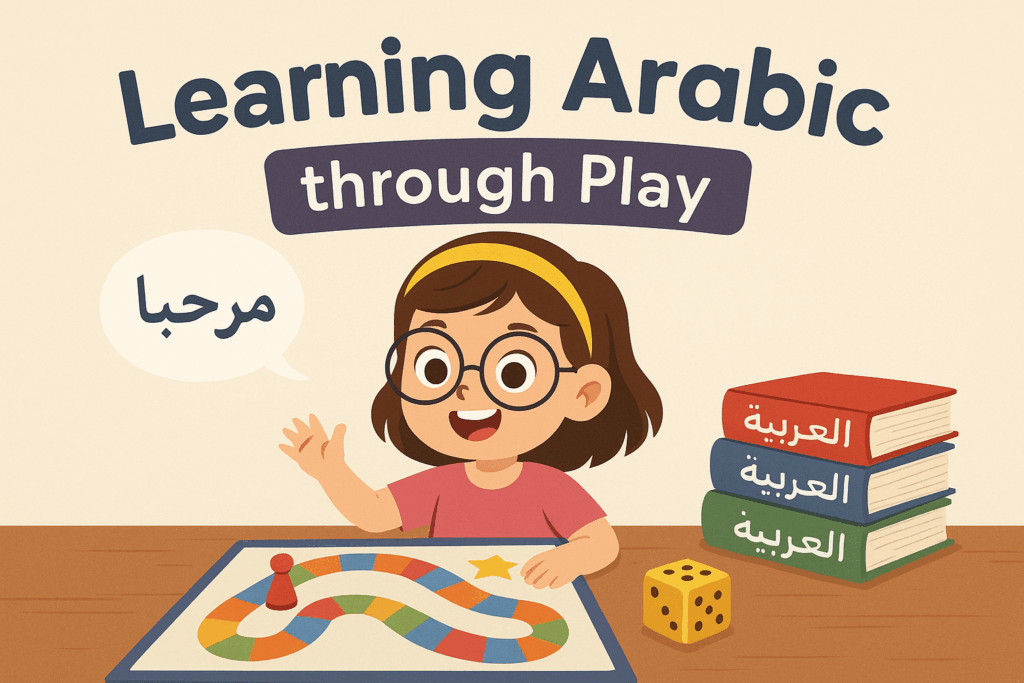
Children naturally love play. For kids growing up in English-speaking environments, learning Arabic can sometimes feel like a “school subject” rather than a living, exciting language. That’s why at eArabicLearning, we design lessons that feel more like fun adventures than rigid classes. By blending modern play-based learning with traditional Arabic and Quran teaching, we make sure children actually look forward to lessons, practice Arabic between classes, and build a lifelong bond with the language.
This article will explore how learning Arabic through play transforms lessons for kids, packed with questions and answers parents often ask.
Q&A Section 1: Why Learning Through Play Works
Q1: Why is play important in teaching kids Arabic?
Play is the natural language of children. When kids play, they aren’t just having fun—they’re absorbing new words, practicing communication, and building social skills. If Arabic is taught through games, children don’t even notice they’re “studying.” They’re simply enjoying themselves while learning Arabic naturally.
Q2: Can play really help my child learn a complex language like Arabic?
Yes, absolutely! Kids between 4–14 are wired to learn languages through repetition, rhythm, and interaction. By embedding Arabic into playful activities—songs, role-plays, drawing, and storytelling—children develop fluency the same way they picked up their first language.
Q3: Is play-based learning only for younger kids?
Not at all. While 4–7 year olds love action songs and interactive stories, older children (8–14) enjoy strategy games, role-playing, and interactive apps. Even teens enjoy playful activities like quiz competitions and escape-room style challenges in Arabic.
Q&A Section 2: How eArabicLearning Uses Games
Q4: What kinds of games are used in your Arabic classes?
We use a variety:
Vocabulary Bingo with Arabic words.
Charades in Egyptian Arabic to practice speaking.
Treasure hunts where kids find Arabic words hidden in stories.
Online word puzzles and quizzes that challenge memory.
Q5: How does “gamification” make lessons exciting?
Gamification means adding points, rewards, and friendly competition. For example, kids might “unlock” new Arabic vocabulary as if they’re moving to the next level of a video game. This keeps them motivated.
Q6: Do you use digital games too?
Yes! We design interactive video-based lessons and even recommend safe, Arabic-learning apps. Children love technology—so we turn it into an ally in Arabic learning instead of a distraction.
Q&A Section 3: Storytelling, Songs, and Role Play
Q7: How does storytelling help children learn Arabic?
Stories are magical for kids. When a teacher tells a short Arabic story—about animals, family, or Egyptian culture—children learn vocabulary in context. They connect words with emotions and pictures, which makes memory stronger.
Q8: What role do songs play?
Songs are one of the most powerful tools in language learning. Kids sing Arabic rhymes and Quran recitation with rhythm, which boosts both pronunciation and memory retention.
Q9: What about role-playing?
Role play is fantastic for teaching real conversation skills. A teacher might pretend to be a shopkeeper, and the child is the customer—learning how to order in Arabic, count money, and greet politely.
Q&A Section 4: Arabic and Quran Together
Q10: Can playful methods work for Quran classes too?
Yes, they can. While Quran requires respect and focus, children still need gentle, playful methods to stay engaged. Teachers use visual aids, repetition games, and memory competitions to help children love recitation instead of feeling pressured.
Q11: How do you balance fun with respect when teaching Quran?
Our teachers are trained to keep Quran lessons warm and engaging—using games that support memorization while maintaining a respectful tone. For example, kids might get “stars” each time they recite a surah correctly.
Q12: Do children actually enjoy Quran lessons this way?
Yes! Parents often tell us their children begin to look forward to Quran recitation, especially when it feels like a friendly challenge rather than an exam.
Q&A Section 5: Results and Benefits
Q13: What benefits do parents usually see?
Parents notice that children:
Start using Arabic words at home.
Show excitement before lessons.
Gain confidence in both Arabic and Quran recitation.
Develop a positive emotional connection to Arabic.
Q14: How quickly can children improve?
It varies, but many kids show progress in just a few weeks. Because the method is playful, they practice without resistance, which accelerates learning.
Q15: Will my child want to continue learning?
Yes. When kids associate Arabic with fun, they ask, “When is my next class?” That curiosity keeps the learning cycle alive.
Extra Q&A for Parents Considering eArabicLearning
Q16: Can my child learn Egyptian dialect for conversation too?
Absolutely. Many parents want their kids to learn Egyptian Arabic conversation alongside Modern Standard Arabic. Games and role-plays make this natural.Q17: Do you offer group and one-on-one classes?
Yes, both options exist. Group classes allow for team games, while one-on-one lessons give personalized play-based attention.Q18: What if my child is shy?
Play-based learning helps shy children open up. Games lower anxiety and make speaking Arabic less intimidating.Q19: Are classes available online only, or also face-to-face?
Both! We offer online Arabic classes for kids worldwide, and for families visiting Egypt, we also provide in-person lessons in Cairo, Alexandria, and Upper Egypt.Q20: Can parents participate in the lessons?
Yes, sometimes! Parents love joining simple activities like Arabic word bingo at home. It turns learning into a family experience.
At eArabicLearning, we believe that play is the secret ingredient to making Arabic and Quran classes unforgettable. By combining games, stories, songs, role-play, and gentle competition, we help children not just learn Arabic—but love Arabic.
The result? Kids wait eagerly for each new lesson, parents see real progress, and Arabic becomes not just a subject, but a joyful journey.