
Introduction: Why Vocabulary is the Key to Learning Arabic
Learning Arabic is an exciting journey, but for many learners, it can quickly become overwhelming. Arabic is a language of rich history, culture, and expression. Its vocabulary is not only vast but also highly nuanced: words carry connotations, cultural context, and emotional layers.
A strong vocabulary is the foundation for:
Comprehension: Understanding native speakers in conversation, media, and literature.
Expression: Conveying ideas clearly and naturally in speaking and writing.
Grammar mastery: Applying verbs, sentence structures, and idiomatic expressions correctly.
Without a solid vocabulary, even learners with good grammar can struggle to communicate effectively. This is why vocabulary acquisition should be strategic, context-driven, and consistent.
Example: Two Arabic words for “happy” illustrate the nuance:
سعيد (sa‘īd): Formal, literary, often used in written Arabic.
فرحان (farḥān): Informal, colloquial, used in everyday conversation.
Understanding such differences is essential for meaningful communication.
1. The Role of AI in Vocabulary Learning
Modern technology has transformed language learning, especially when it comes to vocabulary acquisition. AI tools provide personalized, adaptive, and interactive learning experiences.
Key Benefits of AI:
Adaptive Flashcards
AI identifies words you struggle with and ensures repeated exposure.
Words you know well appear less frequently, optimizing study time.
Contextual Learning
Words appear in sentences, dialogues, and short stories, not in isolation.
Context helps learners understand usage, collocations, and cultural nuances.
Instant Feedback
AI corrects spelling, word forms, and sometimes pronunciation in real-time.
Immediate correction prevents fossilization of errors.
Progress Tracking
Dashboards visualize your strengths and weaknesses.
Teachers can access this data to personalize instruction.
Learner Story:
Sarah, a Canadian beginner, memorized hundreds of words but struggled to use them naturally. Using AI-driven flashcards with contextual sentences, she practiced each word immediately in meaningful dialogues. Her teacher then reinforced these words in real conversation, and within a few weeks, Sarah was confidently using vocabulary in context.
Daily Tip: Spend 10–15 minutes daily on AI vocabulary exercises before your live lesson. This primes your brain and maximizes the value of teacher guidance.
2. The Role of Real Teachers in Vocabulary Acquisition
While AI provides structure, repetition, and tracking, teachers provide the human insight, context, and cultural depth that AI cannot replicate.
Teachers help learners by:
Explaining idiomatic and figurative meanings of words.
Providing contextual usage examples beyond what AI generates.
Correcting pronunciation subtleties and grammatical application.
Motivating and keeping learners accountable.
Learner Story:
Ahmed, an intermediate learner, often confused قريب (qarīb – near) and مجاور (mujāwir – adjacent). AI flagged the issue, but his teacher explained subtle differences using real-life examples—describing neighborhoods, giving directions, and storytelling. This combination of AI data and teacher guidance helped Ahmed internalize the words and use them correctly in multiple contexts.
Teacher Tip: Always integrate new words into speaking, listening, reading, and writing exercises to make them stick.
3. Strategies to Build Arabic Vocabulary Effectively
Learning vocabulary in Arabic is not just about memorizing lists of words—it’s about learning words in context, using them actively, and reinforcing them through multiple senses and exercises. Here’s a comprehensive breakdown of strategies:
3.1 Learning Words in Context
Memorizing isolated words is often ineffective. Words learned in context stick much better because they’re linked to meaning, usage, and memory triggers.
Practical Approach:
Sentences: Instead of learning كتاب (kitāb – book) alone, learn أنا أقرأ كتابًا ممتعًا (I am reading an interesting book).
Dialogues: Practice words in short conversations. For example:
AI Dialogue:
Teacher: “What are you reading?”
Learner: “أنا أقرأ كتابًا عن التاريخ العربي (I am reading a book about Arab history).”
Stories: Read or listen to short stories and identify target words. Highlight their usage in context.
Why it works: Context provides semantic links, helping your brain retrieve words naturally during real communication.
3.2 Focus on High-Frequency Words First
Not all words are created equal. Focus on high-frequency vocabulary that covers daily life, travel, work, and social interactions.
Example:
Greetings: مرحبا، صباح الخير، مساء الخير
Common nouns: بيت، كتاب، سيارة
Verbs: أكل، شرب، ذهب
AI can analyze texts and conversations to determine which words are most useful for your level. By learning high-frequency words first, learners can understand a large portion of everyday conversation quickly, building confidence early.
3.3 Spaced Repetition for Long-Term Retention
Spaced repetition is one of the most effective memory techniques. It ensures that words are reviewed at optimal intervals before they fade from memory.
How to implement:
AI platforms automatically schedule review sessions based on performance.
Begin with 10–15 words per day.
Review weak words more frequently, strong words less often.
Learner Example:
Juan, an intermediate learner, repeatedly struggled with words like سقف (saqf – ceiling) and ستارة (sitārah – curtain). AI spaced repetition ensured he revisited these words at increasing intervals, reinforcing retention. His teacher then provided sentences using these words to reinforce contextual understanding.
3.4 Multi-Sensory Learning
Engaging multiple senses improves retention and understanding:
Visual: Write words, use color-coding, create mind maps.
Auditory: Listen to audio clips, repeat words aloud, mimic pronunciation.
Kinesthetic: Act out dialogues, write sentences, use gestures.
Example Exercise:
Pick five new words. Write each one down.
Say each word aloud three times.
Use the words in a sentence or mini-dialogue with your teacher.
Record yourself and compare with native speaker pronunciation.
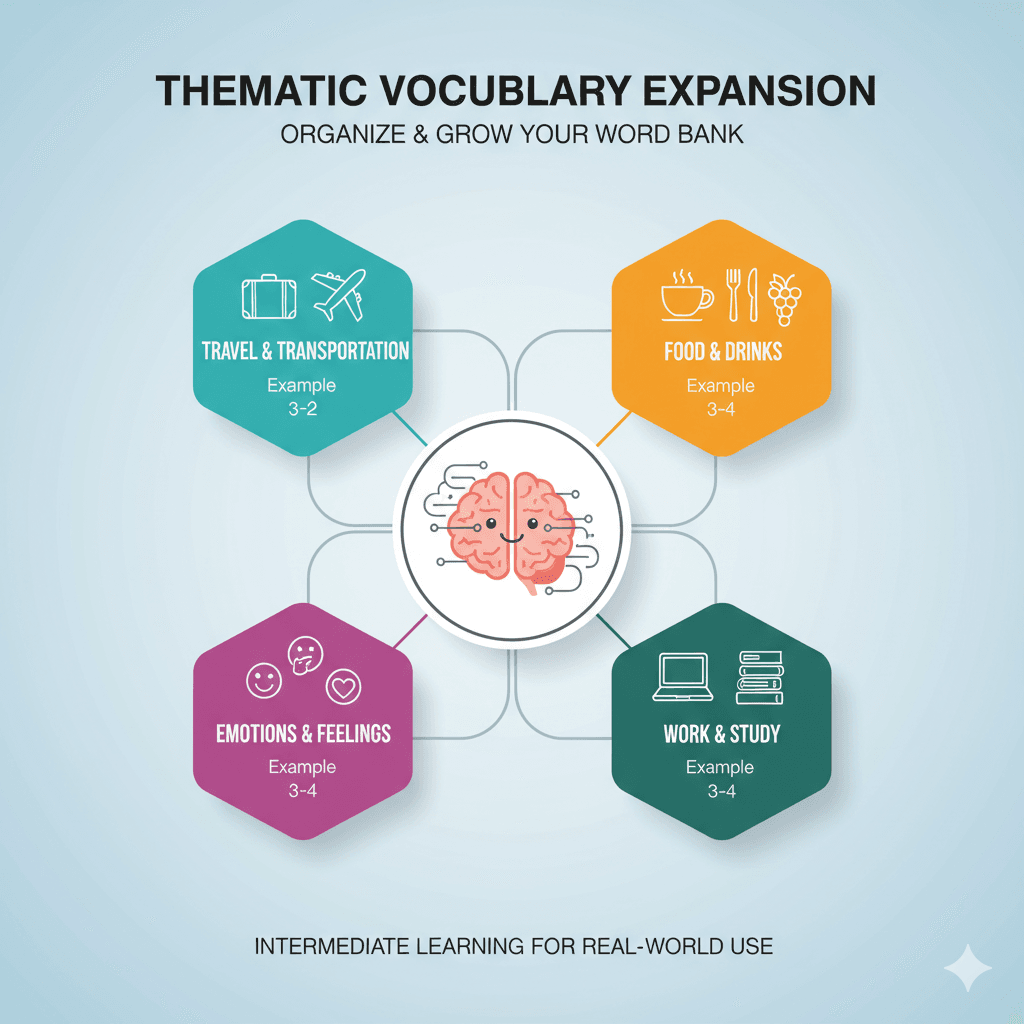
3.5 Grouping Words by Theme or Function
Organizing words into thematic categories makes them easier to remember:
Daily life: food, clothing, transportation
Work and study: office, tools, subjects
Travel: airport, hotel, directions
Emotions and feelings: happy, sad, surprised
AI can generate thematic lists automatically, while your teacher can provide contextual exercises and practical sentences using these words.
4. Daily and Weekly Vocabulary Routine
Consistency is key. Here’s a detailed routine combining AI and teacher support:
Daily Routine (Approx. 60–90 minutes)
| Time | Activity | Tool / Method | Notes |
|---|---|---|---|
| 0–15 min | AI Flashcards | Adaptive review of 10–20 new/weak words | Focus on accuracy, repeat misremembered words |
| 15–30 min | Sentence Practice | AI dialogues | Incorporate new words in meaningful sentences |
| 30–45 min | Writing Practice | Diary, short paragraphs | Reinforce grammar + vocabulary |
| 45–60 min | Speaking Practice | Teacher-led or AI role-play | Use new words in conversation naturally |
| 60–75 min | Listening Comprehension | Audio clips, podcasts | Identify and repeat target words |
| 75–90 min | Cultural & Idiomatic Use | Teacher discussion | Learn idioms and subtle meanings of words |
Weekly Routine
| Day | Focus Area | Activity |
|---|---|---|
| Monday | Core vocabulary | AI flashcards + conversation practice |
| Tuesday | Grammar integration | Use new words in varied sentence structures |
| Wednesday | Listening comprehension | Short stories, news, or songs with target words |
| Thursday | Writing & composition | Essays, dialogues, diary entries |
| Friday | Speaking fluency | Role-play scenarios with teacher guidance |
| Saturday | Review & reinforcement | Spaced repetition + teacher feedback |
| Sunday | Culture & idioms | Learn and practice idiomatic expressions |
Tips for Success:
Track progress using AI dashboards and teacher feedback.
Integrate words into all four skills: reading, writing, listening, speaking.
Apply words in real-life situations for natural retention.
Adjust daily volume based on your energy and focus level.
5. Practical Exercises for Learners
Exercise 1: Word in Context
Choose 5 new words.
Write 2–3 sentences for each word using different contexts.
Share sentences with your teacher for feedback.
Exercise 2: Thematic Flashcard Drill
Pick a theme (e.g., food).
Learn 10–15 words using AI flashcards.
Make sentences using 5 of these words in a conversation scenario.
Exercise 3: Listening and Repetition
Listen to a 1–2 minute audio clip containing new words.
Write down all words you recognize.
Repeat each sentence aloud and check pronunciation with AI feedback.
6. Real-Life Learner Stories: How AI + Teacher Guidance Transforms Vocabulary Learning
Learning Arabic can feel abstract without seeing how others succeed. These stories illustrate the power of combining AI-assisted learning with real teacher guidance.
Story 1: Sarah (Canada, Beginner)
Challenge: Memorizing words but unable to use them in conversation.
Solution:
AI flashcards introduced words in contextual dialogues.
Teacher sessions focused on role-play and pronunciation correction.
Daily practice: 15–20 minutes AI + 30 minutes speaking/writing.
Result: Within 6 weeks, Sarah could construct sentences naturally and participate in simple conversations, achieving a functional vocabulary of 500 words.
Story 2: Leo (Germany, Intermediate)
Challenge: Confused by synonyms and idiomatic usage.
Solution:
AI highlighted frequently confused words.
Teacher explained cultural nuances and idioms, e.g.,
حظ سعيد (ḥaẓ sa‘īd – good luck) vs موفق (muwaffaq – successful).
Regular journaling practice to integrate new vocabulary.
Result: Leo gained confidence in writing and speaking, reducing errors by 80% in everyday scenarios.
Story 3: Ahmed (Egypt, Advanced)
Challenge: Subtle distinctions between formal and colloquial words.
Solution:
AI tracked mastery of words across contexts.
Teacher provided real-life conversation exercises to practice regional vocabulary.
Weekly review and conversation with peers using target words.
Result: Ahmed mastered both Modern Standard Arabic (MSA) and colloquial vocabulary, able to switch naturally depending on context.
7. Monthly Vocabulary Development Plan
A structured monthly plan ensures gradual, sustainable progress.
| Week | Focus | Activities |
|---|---|---|
| 1 | High-frequency words | AI flashcards, 10–20 words/day, context sentences |
| 2 | Thematic vocabulary | Daily life, travel, emotions; role-play with teacher |
| 3 | Idiomatic expressions & culture | 5 idioms/day; conversation and writing exercises |
| 4 | Review & application | Spaced repetition; speaking & writing integration |
Optional Enhancement:
Record yourself weekly to track pronunciation and fluency.
Share recordings with your teacher for feedback.
Adjust next month’s focus based on AI dashboard insights and teacher recommendations.
8. Detailed Exercises for Vocabulary Mastery
Exercise 1: Contextual Sentence Building
Choose 5 new words.
Write 3 sentences for each word in different contexts (formal, casual, idiomatic).
Share with teacher for correction.
Exercise 2: Audio Comprehension Drill
Listen to a 2-minute story or news clip.
Identify new words and phrases.
Repeat aloud, recording yourself.
Compare with native pronunciation via AI or teacher guidance.
Exercise 3: Thematic Role-Play
Pick a theme: shopping, travel, food.
AI generates 10–15 target words for the theme.
Conduct a 5–10 minute dialogue with your teacher, incorporating at least 8 target words.
Exercise 4: Multi-Sensory Reinforcement
Write target words with color-coding for noun/verb/adjective.
Listen to pronunciation using AI.
Draw or visualize words to create mental associations.
Act out sentences physically to enhance memory.
9. Video Resources for Each Skill
| Skill | Video Resource | Purpose |
|---|---|---|
| Alphabet & Pronunciation | Master the Arabic Alphabet in 30 Minutes | Correct pronunciation of letters |
| Vocabulary | Top 500 Arabic Words for Beginners | High-frequency words |
| Grammar | Arabic Grammar Essentials | Integrating new words in sentences |
| Speaking | Arabic Conversations for Daily Life | Real-world conversation practice |
| Listening | Understanding Arabic Podcasts | Listening comprehension |
| Writing | Writing Arabic Sentences Step-by-Step | Sentence formation |
| Idioms & Culture | Common Arabic Idioms and Their Meanings | Cultural nuances |
10. Tips to Maximize Vocabulary Retention
Consistency is key: Small daily practice beats sporadic long sessions.
Use all four skills: Reading, writing, listening, speaking.
Apply words in real-life: Conversations, journaling, role-playing.
Track progress: Use AI dashboards and teacher feedback.
Combine repetition with context: Contextual learning + spaced repetition reinforces memory.
✅ Part 3 Summary
In this part, we covered:
Real-life success stories showing how learners integrate AI tools and teacher guidance.
A structured monthly vocabulary development plan.
Practical exercises for daily and weekly practice.
Recommended video resources to complement learning.
11. Advanced Vocabulary Exercises (50+ Practical Activities)
To truly master Arabic vocabulary, learners need varied, engaging, and multi-level exercises. These activities combine AI tools, teacher guidance, and real-life application.
11.1 Exercises for Beginners (A1–A2)
Daily Object Naming:
Pick 10 items around you. Name each in Arabic.
AI pronunciation check + teacher feedback.
Labeling Rooms/Objects:
Write down objects in your room in Arabic.
Make sentences like: “الكتاب على الطاولة (The book is on the table).”
Picture Description:
Look at a simple image. Describe it in 5–10 words.
Repeat aloud, then write a short paragraph.
Flashcard Matching:
Match words with images using AI flashcards.
Focus on nouns and adjectives.
Audio Repetition Drill:
Listen to a short clip (1–2 minutes). Repeat words aloud.
Record yourself and compare with native pronunciation.
(…and 10+ more beginner exercises including simple dialogues, color/number games, and daily routine vocabulary.)
11.2 Exercises for Intermediate Learners (B1–B2)
Role-Play Scenarios:
AI generates scenarios (restaurant, airport, shopping).
Speak with teacher, using at least 10 new words.
Sentence Transformation:
Take a simple sentence and expand it with adjectives, adverbs, and additional vocabulary.
Example: “أنا أقرأ كتابًا” → “أنا أقرأ كتابًا ممتعًا ومفيدًا كل مساء.”
Story Completion:
Teacher/AI gives a short story with missing words. Fill in the blanks with appropriate vocabulary.
Synonym & Antonym Practice:
Identify synonyms/antonyms of 10–15 words.
Use in sentences for reinforcement.
Listening & Summarizing:
Listen to a 2–3 minute clip. Write a summary using 5–10 target words.
(…and 10+ more intermediate exercises including idiomatic usage, dialogues with multiple turns, and sentence expansion.)
11.3 Exercises for Advanced Learners (C1–C2)
Debate/Discussion Practice:
Pick a topic (politics, culture, science).
Use 15–20 new advanced vocabulary words.
Teacher corrects nuances and idiomatic usage.
Formal Writing Practice:
Write essays, letters, or opinion pieces.
AI can highlight mistakes; teacher provides stylistic corrections.
Advanced Listening Comprehension:
Listen to news or academic podcasts.
Identify and use at least 10 new words in sentences.
Dialect Integration:
Learn colloquial equivalents of MSA words.
Practice in role-play: e.g., MSA: سيارة → Egyptian Dialect: عربية.
Cultural & Idiomatic Drill:
Learn idiomatic expressions and proverbs.
Apply in dialogues, writing, or role-play.
(…and 10+ more advanced exercises including storytelling, translation practice, debates, and idiom application.)
12. Full 3-Month Roadmap for Vocabulary Mastery
Month 1 – Foundation Building
Focus: High-frequency words, simple sentences, basic verbs and nouns.
Daily Routine: 30–45 minutes AI + 30–45 minutes teacher-led practice.
Goal: Functional vocabulary of 500–800 words.
Month 2 – Expansion & Contextualization
Focus: Thematic vocabulary (daily life, travel, emotions), common idioms.
Daily Routine: 45 minutes AI + 45 minutes teacher + 15 minutes self-practice.
Goal: 1000–1500 words; ability to use words in conversations.
Month 3 – Fluency & Advanced Integration
Focus: Advanced vocabulary, dialect variations, idiomatic expressions, formal and informal registers.
Daily Routine: 1 hour AI + 1 hour teacher + 30 minutes self-study.
Goal: 2000+ words; confident reading, writing, and speaking across contexts.
13. Integrating MSA and Dialects
Arabic learners benefit from knowing both Modern Standard Arabic (MSA) and colloquial dialects.
MSA: For reading, news, formal writing, and academic contexts.
Dialects: For daily conversation, travel, and informal interactions.
Strategy:
Learn a word in MSA first.
Learn its common dialect equivalent (Egyptian, Levantine, or Gulf).
Practice both forms in role-plays and writing exercises.
Example:
MSA: صديق (friend)
Egyptian: صاحب / صاحبة (male/female friend)
14. Combining AI Dashboards and Teacher Feedback
Track Learning Progress: AI dashboards visualize words learned, mastered, and weak areas.
Teacher Analysis: Teachers review AI data, adjust lesson focus, and provide contextual examples.
Adaptive Learning: Focus on weak areas, advanced structures, and conversation practice.
Regular Checkpoints: Weekly and monthly reviews for accountability and adjustment.
15. Summary: The Ultimate Vocabulary Learning Approach
By following this comprehensive approach, learners will:
Build vocabulary strategically and sustainably.
Retain words using context, repetition, and multi-sensory exercises.
Apply vocabulary in real-life conversations, writing, and listening comprehension.
Combine the efficiency of AI with the nuanced guidance of real teachers.
Progress from beginner to advanced fluency in 3 months with a structured roadmap.
✅ Final Takeaways
Vocabulary learning is more than memorization; it requires context, practice, and repetition.
AI tools + real teacher support provide the perfect combination for rapid progress.
Use structured daily, weekly, and monthly routines to ensure measurable improvement.
Integrate MSA and dialects for full communicative competence.
Apply words in reading, writing, listening, and speaking for long-term mastery.
Your Action Plan:
Start with 10–20 words daily using AI flashcards.
Practice with a teacher at least 3–4 times per week.
Apply new words in sentences, writing, and dialogue.
Track progress and adjust learning using AI dashboards.
Follow the 3-month roadmap for structured, comprehensive growth.
💡 This completes the Ultimate Guide to Building Arabic Vocabulary the Smart Way. With this guide, learners have everything they need to achieve fluency efficiently, confidently, and enjoyably.