Learning Arabic has always been considered both exciting and challenging. Its elegant script, flowing from right to left, and its rich grammatical structures make it one of the most fascinating languages in the world. Yet, for many non-native speakers, learning Arabic can feel like climbing a steep mountain — rewarding, yes, but demanding effort, time, and a lot of patience.
For decades, learners relied on traditional classrooms, textbooks, and rote memorization. While these methods work to some extent, they are often slow, repetitive, and sometimes discouraging. Memorizing long lists of vocabulary, mastering complex verb conjugations, and practicing conversational skills without real context can make learning feel overwhelming.
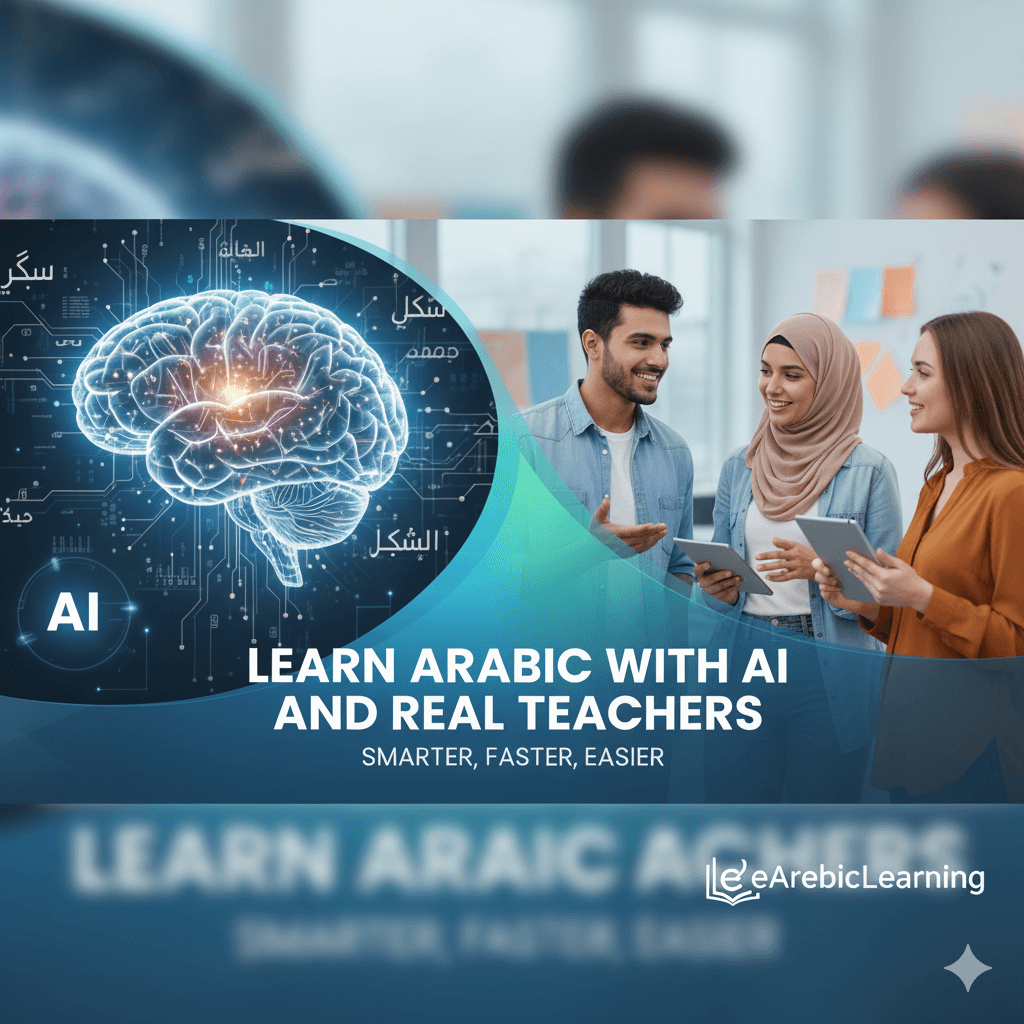
Enter Artificial Intelligence (AI) — a powerful tool that has started to transform the way we learn Arabic, making it smarter, faster, and easier than ever before. But here’s the key: at eArabicLearning, AI does not replace real teachers. Instead, it works alongside human instructors, enhancing their ability to teach you effectively while keeping lessons engaging and highly personalized.
Smarter Learning: Personalized Paths for Every Learner
One of the most remarkable benefits of AI in Arabic learning is its ability to adapt to you personally. Imagine starting a lesson and having the system immediately recognize which words, grammatical rules, or pronunciation points you struggle with. AI at eArabicLearning tracks your progress, analyzes your mistakes, and provides your teacher with detailed insights. This allows your real instructor to focus each lesson on exactly what you need — making your learning path uniquely yours.
For example, consider Sarah, a beginner learner from Canada. She could read and write simple Arabic sentences but often confused the masculine and feminine forms of adjectives. The AI system identified this recurring pattern across her exercises and highlighted it for her teacher. During her next lesson, her teacher focused on exercises tailored to her challenge, combining pronunciation drills, context sentences, and conversation practice. Within a few weeks, Sarah’s confidence and accuracy in using gendered adjectives improved dramatically.
This approach contrasts sharply with generic apps or rigid classroom settings. AI ensures that every lesson is relevant, helping you make consistent progress without wasting time on material you already know.
Faster Progress: Learning in Real Time
One of the most common frustrations in traditional Arabic learning is the slow pace. Learning vocabulary lists by heart, practicing grammar through repetitive exercises, and waiting for feedback from a teacher can feel like a never-ending cycle. AI accelerates this process by providing:
Instant feedback: AI detects mistakes in pronunciation, grammar, or vocabulary use in real time, allowing you to correct them immediately.
Contextual learning: Words and phrases are presented within real-life dialogues, news articles, or stories, helping your brain retain information more effectively.
Adaptive challenges: Exercises automatically adjust in difficulty based on your performance, ensuring that you’re always appropriately challenged.
Let’s take Ahmed’s story as an example. Ahmed, an intermediate learner from Egypt, wanted to improve his spoken Arabic for travel. He often struggled with colloquial expressions and verb conjugations in fast conversations. During AI-assisted exercises, the system flagged his errors in real-time and provided examples of correct usage. His teacher then used these insights to design interactive role-play scenarios, such as ordering food in a restaurant or asking for directions, allowing Ahmed to practice in a safe and guided environment. The result? Ahmed could confidently use everyday Arabic expressions within weeks instead of months.
Easier Access and Motivation: Learning Anytime, Anywhere
AI doesn’t just make learning faster and smarter — it makes it easier to fit into your life. Learning Arabic no longer requires traveling to a classroom or scheduling lessons around a busy day. You can practice from home, during your commute, or even on a short coffee break.
Moreover, AI keeps lessons fun and engaging. Through gamification, interactive quizzes, points, badges, and challenges, studying Arabic becomes a motivating activity rather than a chore. And while AI tracks your progress and provides feedback, your real teacher ensures that lessons are meaningful, culturally accurate, and tailored to your learning style.
Take Lina, a full-time working professional, as an example. She struggled to find time for Arabic lessons in her busy schedule. Using AI-assisted exercises at home, she could complete short, interactive sessions during her breaks. Her teacher then used the AI insights to maximize her lesson time, focusing on conversational skills and pronunciation improvement. With this approach, Lina progressed steadily without feeling overwhelmed.
Real Teachers Plus AI: The Best of Both Worlds
At eArabicLearning, all lessons are delivered by real, professional teachers, never virtual bots. The AI is a powerful assistant that enhances the teacher’s capabilities:
Tracking progress: AI monitors your exercises, quizzes, and practice sessions, providing data on areas that need improvement.
Supporting the teacher: Your instructor receives these insights to tailor lessons specifically for you.
Enhancing practice: AI can simulate interactive exercises, role-plays, and pronunciation checks that complement the teacher’s guidance.
The result is a learning experience that is fast, effective, and deeply personalized. You benefit from the expertise of a human teacher while enjoying the efficiency and interactivity AI provides.
For instance, during a lesson, AI might notice that you consistently mispronounce a particular sound. Your teacher then incorporates targeted drills and conversational exercises to address it. The combination of instant AI feedback and personalized human guidance creates a learning loop that accelerates improvement.
Daily Practice Tips for AI-Assisted Arabic Learning
Start with a short AI assessment each day: Spend 10–15 minutes completing AI-driven exercises to identify weak areas.
Follow up with your teacher: Use the insights from AI to focus on one or two targeted topics during your live lesson.
Practice speaking daily: Even 5–10 minutes of conversational practice improves fluency. AI can provide prompts and feedback between lessons.
Use real-life context: Read articles, watch videos, or listen to songs in Arabic, and ask your teacher to discuss them with you.
Track your progress visually: Many AI systems provide charts showing your improvement — use these to stay motivated.
Frequently Asked Questions (FAQ)
Q1: Are my lessons taught by AI or a real teacher?
A: All lessons are delivered by real, professional teachers. AI is only a supporting tool to help teachers personalize your learning and provide instant feedback.
Q2: How does AI make my learning faster?
A: AI identifies mistakes immediately, tracks progress, and highlights areas needing improvement, allowing your teacher to focus lessons where they matter most.
Q3: Can AI help with speaking and pronunciation?
A: Yes! AI detects pronunciation errors in real time. Your teacher then guides you through practice to ensure accuracy and fluency.
Q4: Will AI replace human teachers in the future?
A: No. AI is a tool to assist teachers, not replace them. Human guidance, cultural context, and personalized explanations remain irreplaceable.
Q5: Is AI suitable for all learning levels?
A: Absolutely. Beginners, intermediate, and advanced learners all benefit, as AI adjusts exercises to your level while your teacher ensures understanding.
Q6: How can I start learning Arabic with this AI-assisted approach?
A: You can begin with a free trial lesson at eArabicLearning here to experience how real teachers and AI work together to accelerate your learning.
Comprehensive Guide: Learning Arabic Smarter, Faster, and Easier with AI and Real Teachers
🧩 1. Why Learning Arabic Is a Unique Challenge
Arabic is one of the world’s most beautiful languages, but it can be intimidating for non-native learners. From its flowing script and right-to-left writing to its rich grammatical structures and extensive vocabulary, Arabic demands attention to detail and consistent practice. Many learners start with enthusiasm but quickly feel overwhelmed, especially when faced with:
Complex verb conjugations: Different tenses, moods, and forms depending on gender, number, and person.
Gendered nouns and adjectives: Masculine and feminine forms can be confusing.
Varied dialects: Modern Standard Arabic (MSA) differs from colloquial dialects spoken across the Arab world.
Traditional methods—textbooks, rote memorization, and classrooms—can only take you so far. They often fail to adapt to your personal learning pace, making progress slow and sometimes frustrating.
🧩 2. How AI Is Changing the Way We Learn Arabic — Smarter, Faster, Easier
(This is the expanded section we developed previously, now fully integrated with stories, tips, and practical examples.)
Smarter Learning: Personalized lessons guided by AI insights for your teacher.
Faster Progress: Instant feedback, contextual learning, adaptive exercises.
Easier Access: Learn anytime, anywhere with interactive, gamified lessons.
Real Teachers Plus AI: Human instructors use AI to enhance guidance and efficiency.
Example Story: Sarah from Canada improved her Arabic dual forms within weeks using AI insights combined with teacher guidance.
Daily Tips: Short AI exercises, targeted practice with teachers, and consistent review.
CTA: Start a free trial lesson here.
🧩 3. Mastering the Arabic Alphabet (Al-Ḥurūf al-‘Arabīyah)
The alphabet is the foundation of Arabic. Each letter has multiple forms depending on its position: isolated, initial, medial, and final. Many learners struggle with similar-looking letters, such as ب (Ba), ت (Ta), and ث (Tha).
How AI Helps:
Tracks letters you misidentify most.
Provides visual drills and flashcards.
Gives pronunciation feedback using speech recognition.
Story: Omar, a beginner from Italy, mastered غ (Ghayn) after AI flagged recurring errors and his teacher provided articulation tips.
Daily Routine:
10 minutes of AI flashcards.
5 minutes pronunciation practice.
Teacher-led review and conversation exercises.
Suggested Video: “Mastering the Arabic Alphabet in 30 Minutes” — provides a visual and audio guide.
🧩 4. Arabic Grammar Simplified
Grammar is often the most intimidating part of Arabic, but AI simplifies the process. Key grammar topics include:
Verb conjugations in past, present, future, and imperative forms.
Gendered nouns, plural forms, and dual forms.
Nominal and verbal sentence structures.
AI Support:
Detects consistent errors and patterns.
Generates contextual exercises.
Provides immediate feedback on sentence formation.
Story: Fatima struggled with dual nouns. AI identified mistakes, and her teacher designed exercises using role-play, dialogues, and real-life contexts.
Daily Tip: Focus on one grammar topic per day with AI exercises followed by teacher review.
Suggested Video: “Arabic Grammar Essentials for Beginners and Intermediates.”
🧩 5. Building a Strong Arabic Vocabulary
Vocabulary is essential to fluency. AI accelerates retention through:
Adaptive flashcards that repeat weaker words more frequently.
Contextual sentences for each word.
Integration with teacher-led conversation practice.
Story: Leo from Germany turned memorized vocabulary into functional speech using AI dialogue simulations and teacher-guided conversation practice.
Daily Routine:
15 minutes of AI vocabulary drills.
5 minutes of conversational practice with teacher.
Review challenging words daily.
Suggested Video: “Top 500 Arabic Words for Everyday Conversation.”
🧩 6. Conversational Arabic: Speaking with Confidence
Speaking is where learners often struggle the most. AI supports by:
Simulating dialogues.
Correcting pronunciation in real-time.
Highlighting sentence structure mistakes.
Story: Aisha practiced ordering at a virtual café. AI corrected pronunciation, while her teacher guided proper cultural etiquette and conversational flow.
Daily Tip: 5-minute AI conversations before lessons to maximize teacher feedback.
Suggested Video: “Arabic Conversations for Beginners — Ordering, Greetings, and Small Talk.”
🧩 7. Listening and Comprehension
AI improves listening skills by:
Providing adaptive audio exercises.
Highlighting missed or misheard words.
Increasing difficulty gradually for better comprehension.
Story: Juan, an intermediate learner, used AI to practice listening at slower speeds. His teacher gradually introduced faster dialogues, improving comprehension in real conversations.
Daily Routine:
Listen to 5–10 minutes of Arabic audio daily.
Repeat sentences aloud and check with AI feedback.
Discuss comprehension questions with your teacher.
Suggested Video: “Understanding Arabic Podcasts and News for Learners.”
🧩 8. Writing and Composition Skills
Writing combines vocabulary, grammar, and script mastery. AI assists by:
Detecting spelling and grammatical errors.
Suggesting sentence improvements.
Aligning exercises with your learning level.
Story: Hana wrote diary entries daily. AI corrected recurring mistakes, and her teacher guided proper sentence structures and expression.
Daily Tip: Write 3–5 sentences daily, review AI corrections, and discuss improvements with your teacher.
Suggested Video: “Writing Arabic Sentences: A Step-by-Step Guide for Learners.”
🧩 9. Cultural Context and Idiomatic Expressions
Arabic isn’t just a language; it’s a culture. AI highlights idioms and phrases, but teachers explain usage, context, and subtle meanings.
Example: “في كل أرضٍ ألوانها” (Every land has its colors) — AI shows examples, teacher explains figurative meaning.
Daily Tip: Learn one idiom per day, then use it in conversation with your teacher.
Suggested Video: “Common Arabic Idioms and Their Cultural Meaning.”
🧩 10. Tracking Progress and Motivation
AI dashboards track:
Vocabulary retention.
Grammar mastery.
Speaking and pronunciation accuracy.
Story: Samir monitored his dashboard for verb conjugations. His teacher adjusted lessons to challenge him appropriately while maintaining motivation.
Daily Tip: Check AI dashboards weekly and set realistic goals for the coming week.
🧩 11. Maximizing Teacher + AI Collaboration
Complete AI exercises before lessons.
Note questions or errors flagged by AI.
Practice speaking, writing, and listening in real-life contexts.
Track progress visually and celebrate small milestones.
Discuss cultural nuances with your teacher.
FAQ:
Q: Can I rely solely on AI?
A: No. AI supports your teacher, but human guidance is irreplaceable.
🧩 12. Getting Started
Sign up for a free trial lesson here.
Take an AI pre-assessment.
Schedule your first live session.
Practice daily using AI tools and teacher feedback.
Track improvement and adjust your learning path as you go.
🗓️ Daily and Weekly Arabic Learning Routine with AI + Teacher Support
Daily Routine (Approx. 1–2 hours per day)
| Time | Activity | Tool / Method | Notes / Tips | Suggested Video |
|---|---|---|---|---|
| 0–10 min | AI Alphabet Drill | Flashcards & speech recognition | Focus on 2–3 tricky letters per day | Master the Arabic Alphabet |
| 10–25 min | Vocabulary Practice | AI adaptive flashcards | Target weak words; review 10–15 words | Top 500 Arabic Words |
| 25–40 min | Grammar Exercise | AI-generated exercises | Focus on one topic daily (e.g., verb tense, dual nouns) | Arabic Grammar Essentials |
| 40–50 min | Speaking Practice (AI role-play) | Dialogue simulations | 5–10 minutes per scenario; correct pronunciation | Arabic Conversations for Beginners |
| 50–60 min | Writing Practice | Short sentences or diary entries | Apply vocabulary & grammar; AI provides corrections | Writing Arabic Sentences |
| 60–75 min | Listening Comprehension | Audio clips / AI feedback | Start slow, gradually increase speed; repeat phrases | Understanding Arabic Podcasts |
| 75–90 min | Cultural & Idiomatic Practice | Idioms + short stories | Learn 1 idiom daily; discuss with teacher | Common Arabic Idioms |
Notes:
Adjust time based on availability; even 30–45 minutes daily can be effective.
AI prepares you before live lessons; your teacher then reinforces and personalizes your learning.
Weekly Routine (1 Week Example)
| Day | Focus Area | AI Tasks | Teacher Session Focus | Extra Activity |
|---|---|---|---|---|
| Monday | Alphabet & Pronunciation | Letter drills, pronunciation check | Review difficult letters; small conversation | Practice writing letters |
| Tuesday | Vocabulary | Flashcards, contextual sentences | Conversation using new vocabulary | Listen to an Arabic song and pick new words |
| Wednesday | Grammar | Verb conjugation exercises | Apply grammar in role-play | Write 3–5 sentences using new grammar |
| Thursday | Listening & Comprehension | Audio exercises, highlight errors | Discuss comprehension, answer questions | Watch a short Arabic video |
| Friday | Speaking & Conversation | Dialogue simulations | Role-play scenarios; pronunciation & fluency | Practice speaking to a friend or record voice |
| Saturday | Writing & Composition | AI-corrected writing exercises | Review and expand writing | Translate a short paragraph into Arabic |
| Sunday | Culture & Idioms | AI idiom practice | Discuss idioms and cultural context | Read a short story in Arabic |
Tips for Success:
Consistency is key: Small, daily practice is more effective than long but infrequent sessions.
Use AI as preparation: Complete AI exercises before teacher sessions to maximize in-person guidance.
Track progress: Use AI dashboards and teacher feedback to identify strengths and weaknesses.
Apply in real life: Practice phrases with friends, in the workplace, or in online communities.
Arabic learning has entered a new era. By combining AI-assisted tools with real teacher guidance, learners enjoy a path that is:
Smarter: Lessons personalized for your exact needs.
Faster: Efficient progress through targeted exercises.
Easier: Accessible anytime, engaging, and motivating.
🧩 How This Routine Works with AI + Real Teachers
AI prepares you: Identifies weaknesses, corrects mistakes, provides exercises.
Teacher guides you: Reinforces challenging points, adds cultural context, ensures fluency.
Daily + Weekly routine: Balances different skills — reading, writing, listening, speaking, grammar, vocabulary, and culture.
Tracking progress: AI dashboards + teacher feedback help measure improvement and adjust learning plan.
Whether you are a beginner, intermediate, or advanced learner, this approach ensures that learning Arabic is effective, enjoyable, and culturally rich.
💡 Start your journey today with a free trial lesson here. Experience how AI and real teachers together