
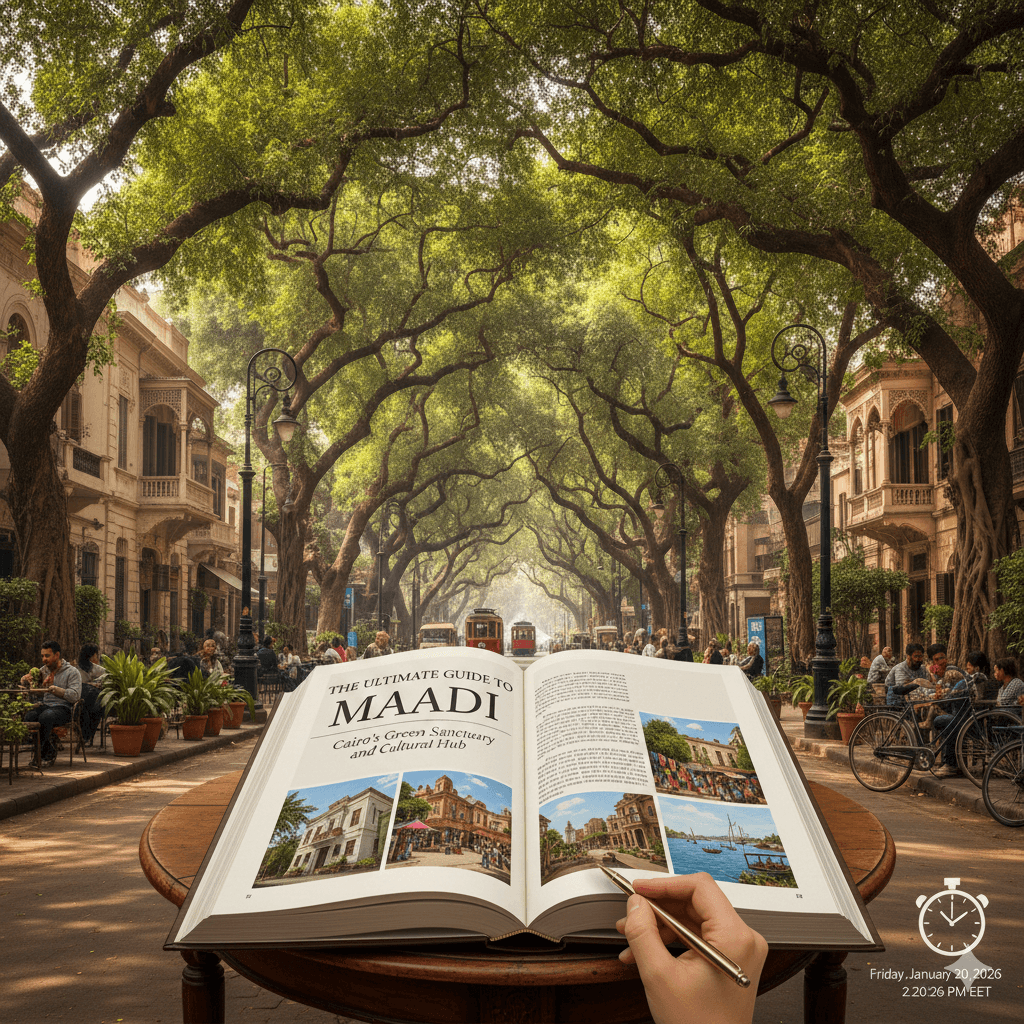
For many expats and locals alike, Cairo can be an overwhelming symphony of car horns and towering concrete. But then, there is Maadi. Entering this district feels like someone turned the volume down and the saturation up. Known as the “Garden City of the South,” Maadi offers a lifestyle that balances Egyptian tradition with a polished, international flair.
1. The Architectural Soul: Streets, Trees, and Villas
Maadi was originally designed in the early 20th century as a quiet suburb for the elite and foreign residents. That legacy lives on in its unique layout.
The “Green Lung” of Cairo: Unlike the rest of the city, Maadi is defined by its greenery. Streets like Road 18 or Road 15 are shaded by massive, decades-old trees that make walking a pleasure even in the summer heat.
The Neighborhoods: * Maadi Sarayat: The historic heart. Think grand villas, quiet squares, and the highest concentration of embassies.
Degla Maadi: The modern expat favorite. It’s filled with mid-rise apartment buildings, gyms, international schools, and trendy pet-friendly cafes.
Road 9: The commercial artery. This pedestrian-friendly street runs parallel to the Metro line and is the go-to spot for shopping, dining, and nightlife.
2. The Lifestyle: A Cosmopolitan Slow-Down
Life in Maadi is “slow” by Cairo standards. It is one of the few places in Egypt where a pedestrian culture actually exists. You will see people jogging at 6:00 AM, expats cycling to work, and locals spending hours playing backgammon (Tawla) at traditional coffee shops.
The community is incredibly diverse. You’ll meet UN diplomats, NGO workers, English teachers, and Egyptian entrepreneurs. This mix creates a “bubble” where liberal values and traditional hospitality coexist peacefully.
3. Is Maadi Safe for Foreigners?
Safety is often the primary concern for newcomers to Egypt. Maadi is widely regarded as one of the safest urban areas in Africa.
Walkability at Night: It is common to see women and families walking late at night without concern.
A Welcoming Culture: Egyptians are naturally hospitable, but Maadi locals are particularly accustomed to international guests. There is a “live and let live” attitude here that makes foreigners feel at home within days.
The “Gada’ana” Factor: If you ever find yourself in a pinch—whether it’s a flat tire or getting lost—the locals will jump to help you. It’s not just polite; it’s a point of pride for them.
4. The Culinary Map: From Street Eats to Global Feasts
Maadi is a food lover’s paradise. It offers a spectrum of flavors that caters to every budget.
Traditional Egyptian Staples
Zooba (Road 9): A modern take on Egyptian street food. Try their spicy Hawawshi (meat-stuffed bread) or their beet-infused Ta’meya.
Koshary Abou Tarek: Though the original is downtown, Maadi has plenty of spots serving this iconic mix of lentils, rice, and pasta topped with crispy onions.
Fiteer: Visit a local “Fatatry” for a savory pancake filled with Rumi cheese and basturma.
International Gems
Lucille’s: Once famously praised by Time Magazine for having the best burger in the world.
Gringos Burrito: The gold standard for Mexican food in Cairo.
White Owl: A hidden gem for pasta lovers and those seeking a cozy, boutique dining experience.
5. Bridging the Gap: Arabic with eArabicLearning
To truly inhabit Maadi—not just live in it—learning the language is your “Golden Ticket.” While you can survive with English, speaking Arabic allows you to connect with the soul of the city.
eArabicLearning, located right in the heart of Maadi, has become the premier destination for expats to bridge this gap. They understand that every student has a different goal.
Professional Modern Standard Arabic (MSA/Fusha)
If your goal is to read the news, understand legal documents, or work in diplomacy, their Fusha courses are structured and rigorous. They take you from the alphabet to complex political discourse using modern, engaging methods.
The Magic of Egyptian Colloquial (Ammiya)
If you want to joke with your grocer, understand Egyptian cinema, and feel the “pulse” of the street, Ammiya is the way to go. eArabicLearning specializes in teaching the Cairo dialect—the most widely understood dialect in the Arab world—focusing on conversation, slang, and cultural nuances.
Q & A: Everything You Need to Know
Q: Is Maadi expensive to live in? A: It depends on the area. Sarayat and Degla are premium areas with higher rents, but Zahraa Maadi and the “Old Maadi” areas offer very affordable housing options. Overall, it provides great value for the quality of life.
Q: Can I find international schools in Maadi?
A: Yes, Maadi is home to several top-tier institutions, including Cairo American College (CAC) and Maadi British International School (MBIS).
Q: How do I get around?
A: Maadi is well-connected. It has three Metro stations (Maadi, Sakanat El Maadi, and Hadayek El Maadi). Within the district, walking or using ride-hailing apps like Uber and Careem is the standard.
Q: How do I start learning Arabic in Maadi?
A: The best way is to enroll in a specialized center like eArabicLearning. They offer flexible schedules, including one-on-one sessions and group classes, focusing on both the Classical and Colloquial dialects.
Q: Is Maadi pet-friendly?
A: Absolutely. It is perhaps the most pet-friendly neighborhood in Cairo, with many parks and cafes that welcome dogs.