
⏱ 22-minute read
🎓 Evidence-Based Research
👶 Ages 4–14
🌍 Arabic as a Foreign Language
💪 Confidence Building
eArabicLearning Academic Series
Introduction: Why the Learning Setting Matters in Arabic Language Education
When a family decides to enroll their child in Arabic language instruction, one of the first questions they face is deceptively simple: should the child learn Arabic in a physical classroom, or online? This decision is often made based on practical logistics — what’s available locally, what fits the family schedule, what the budget allows. But the choice of learning environment has deeper implications than most parents realize, and it interacts powerfully with a child’s personality, learning style, age, and confidence level.
Learning Arabic is already a significant undertaking for any child. Arabic is among the most linguistically rich and structurally complex languages in the world — its unique script, its deep phonological system, its elegant root-and-pattern morphology, and the cultural universe it opens all demand careful pedagogical attention. The environment in which a child encounters this magnificent language for the first time — and continues to develop within it — will shape their relationship with Arabic for years, perhaps for life.
This guide is an honest, evidence-based, and deeply practical exploration of the differences between in-person classroom Arabic instruction and online Arabic learning for children. We examine both settings with genuine respect for their distinct strengths, acknowledge their respective limitations, and connect everything to the central goal of building children’s confidence, motivation, and genuine Arabic language ability.
At eArabicLearning, we have extensive experience in both modalities — and our conclusion is not that one is universally superior. Our conclusion is that the best Arabic learning environment is the one that is best matched to the individual child — and that excellence in teaching, creativity in activity design, and relentless focus on building confidence matter far more than whether the lesson happens in a school room or on a screen.
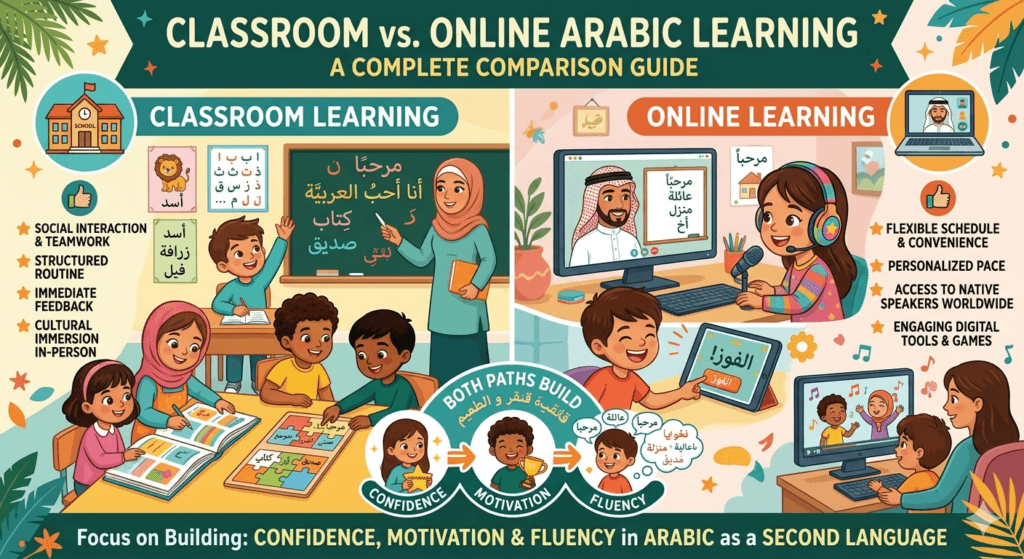
📌The central argument of this guide: Classroom and online Arabic learning environments are not in competition — they are complementary tools. Understanding the specific strengths of each helps parents and educators make better decisions, design richer activities, and build the kind of Arabic learning experiences that genuinely empower children.
What Research Says: Learning Environments and Second Language Acquisition
The question of whether physical or digital learning environments produce better language outcomes has been studied extensively over the past two decades, accelerating dramatically after the COVID-19 pandemic pushed global education online and generated a wealth of comparative data. The findings are nuanced, and they challenge simple either/or thinking.
The Research on Physical Classroom Language Learning
In-person language classrooms offer what researchers call embodied interaction — the full social and physical experience of language use in a shared space. Research consistently shows that in-person instruction offers natural advantages in prosodic development (intonation, rhythm, and stress patterns), spontaneous turn-taking in conversation, and the incidental language acquisition that happens through physical proximity to a language-rich environment. Children in physical classrooms also benefit from peer interaction — they hear each other’s Arabic, negotiate meaning together, and develop social language skills organically.
The Research on Online Language Learning
A landmark meta-analysis by Means et al. (2010) for the US Department of Education found that, on average, students in online conditions performed modestly better than those receiving face-to-face instruction. More recent research specific to language learning has identified why: online instruction tends to force more intentional lesson design, gives learners more agency over pacing, and — crucially in one-on-one formats — dramatically increases the amount of time each individual learner spends actively producing and receiving the target language.
For Arabic specifically, a 2022 study published in the Journal of Language and Education found that children in one-on-one online Arabic sessions showed significantly higher rates of oral production per session than children in group classroom settings — simply because there were no other students to take turns with. Every moment of the online lesson was “theirs.”
“The medium is less important than the pedagogy. A brilliant teacher using a Zoom connection will outperform a mediocre teacher in a state-of-the-art classroom every single time — but the medium shapes which brilliant moves are possible.”
— Adapted from research synthesis on online vs. face-to-face language instruction, CALL journal review, 2021
The Confidence Variable
Perhaps the most striking finding across both research traditions is the outsized role of foreign language anxiety — and its opposite, language learning confidence — in predicting outcomes. Research by Horwitz, Horwitz, and Cope (1986), which defined foreign language anxiety as a distinct and powerful variable in language learning, has been consistently replicated across decades and languages. For Arabic specifically, which carries a reputation for difficulty, anxiety is a particularly significant factor.
Crucially, the research shows that the learning environment has a major impact on children’s confidence and anxiety levels — and different children respond differently to classroom versus online settings. Understanding this interaction is one of the most important things an Arabic educator or parent can do.
🔬Key research finding: Foreign language anxiety is one of the strongest negative predictors of Arabic learning outcomes in children. Building confidence is not a “soft” educational goal — it is a hard prerequisite for language acquisition. The learning environment directly influences confidence levels.
The Genuine Strengths of In-Person Arabic Classroom Activities
The physical Arabic classroom, when well-designed and expertly facilitated, offers a learning environment of extraordinary richness. Its strengths are real, well-documented, and not easily replicated digitally — even with the most sophisticated technology.
Social and Peer-Based Arabic Learning
Language is fundamentally social, and the physical classroom provides the richest possible social context for Arabic language development. In a well-designed classroom, children encounter Arabic through peer interaction — they listen to each other’s Arabic, negotiate shared meaning, correct each other gently, and develop the social confidence that comes from language use among equals. Peer learning in Arabic is particularly powerful because:
- Children’s Arabic input from peers is often more comprehensible than adult Arabic — peers make similar mistakes and use similar vocabulary ranges
- Social motivation (wanting to communicate successfully with classmates) is one of the most powerful drivers of language production
- Children develop collaborative Arabic — the ability to work together, negotiate, and problem-solve in the target language
- The sense of shared Arabic learning identity (“we are all learning Arabic together”) reduces individual anxiety and builds group confidence
Tactile and Kinesthetic Arabic Activities
Physical classrooms uniquely support the full range of tactile and kinesthetic Arabic learning activities. Children can:
- Write Arabic letters in sand trays passed around the room
- Form Arabic letter shapes from clay and share them with classmates
- Move around the room for Arabic scavenger hunts and treasure trails
- Play Arabic vocabulary card games and board games with physical components
- Participate in Arabic drama and role-play with costumes and props
- Cook Arabic foods together, reading the recipe in Arabic
- Create group Arabic murals, collages, and art installations
The Shared Emotional Energy of the Arabic Classroom
There is something genuinely irreplaceable about shared human presence in a learning environment — what researchers call co-presence. When an Arabic classroom erupts in shared laughter over a funny mispronunciation, when thirty children successfully chant the Arabic alphabet together for the first time, when the collective pride of a group presentation in Arabic fills a room — these are experiences that create powerful positive associations with the Arabic language that sustain motivation over years of learning.
🏫 Classroom Arabic: Maximum Strength Activities
- Arabic Living Library: Each student becomes a “book” — a character from an Arabic story — and others “borrow” them by asking Arabic questions. Full-body social engagement.
- Arabic Market Day: The classroom transforms into a souk. Children buy and sell in Arabic using play money and real or pretend food items. Authentic communicative transaction.
- Arabic Drama Performance: Small groups rehearse and perform short Arabic skits for parents or other classes. Public performance in Arabic with shared preparation builds enormous confidence.
- Arabic Cooperative Learning Groups: Structured group activities where each child has a role defined in Arabic — the Reporter, the Recorder, the Artist, the Speaker — building both Arabic and teamwork skills.
- Whole-Class Arabic Storytelling Circles: Children sit in a circle, each adding one sentence to a collaborative Arabic story. Social creativity, speaking confidence, grammar in context.
The Genuine Strengths of Online Arabic Learning Activities
Online Arabic instruction has moved far beyond being a “substitute” for classroom learning. For many children, particularly in specific personality profiles and circumstances, online Arabic learning is not just acceptable — it is demonstrably superior. Understanding why requires looking carefully at what online environments make possible that classrooms cannot.
Unrivaled Individual Attention
In a classroom of 15 children, each child receives roughly 4 minutes of direct teacher attention per hour of instruction. In a one-on-one online Arabic session, every single minute is a direct teacher-student interaction. This is not a minor difference — it is transformative for language development.
Research on the relationship between speaking time and language development is unambiguous: the more time a learner spends actively producing the target language, the faster they develop. In a one-on-one online Arabic session, a child might produce 150–200 Arabic utterances. In a group Arabic classroom, that same child might produce 10–20. The cumulative effect of this difference over weeks and months of Arabic study is enormous.
The Privacy Advantage for Anxious Learners
For many children — particularly introverted children, anxious children, and children who have had prior negative experiences with language learning — the privacy of an online Arabic session is not a limitation but a liberation. The knowledge that no classmate is watching, judging, or laughing when they mispronounce an Arabic sound removes the social performance anxiety that is one of the greatest barriers to Arabic language production.
These children will attempt Arabic utterances in a private online session that they would never risk in a classroom setting. The psychological safety of the one-on-one environment allows them to take the linguistic risks — guessing at words, experimenting with pronunciation, producing imperfect sentences — that are essential for language acquisition.
Access to Authentic Global Arabic Content
Online Arabic instruction provides instant, seamless access to the full breadth of authentic Arabic media and cultural content. During a single online Arabic lesson, a teacher can:
- Stream an Arabic cartoon from a Moroccan children’s channel
- Show a virtual tour of the Old City of Jerusalem in Arabic
- Play a traditional Arabic song from Iraq and discuss its meaning
- Display Arabic news headlines appropriate to the child’s level
- Connect via video with a native Arabic speaker in Cairo for a brief conversation
- Use an interactive Arabic digital whiteboard with drag-and-drop vocabulary games
This richness of authentic Arabic cultural exposure is simply not achievable in most physical classroom settings without significant investment in materials and technology.
Flexibility, Pacing, and Personalization
Online Arabic instruction is inherently more flexible than classroom instruction. Sessions can be scheduled at the times when a specific child is most alert and receptive — some children are sharpest at 7am, others at 4pm. Sessions can be lengthened or shortened based on the child’s energy and engagement on a given day. Content can be instantly adjusted when a child shows unexpected knowledge in one area and gaps in another.
This degree of personalization is practically impossible in a group classroom context but is the natural operating mode of skilled one-on-one online Arabic instruction.
💻 Online Arabic: Maximum Strength Activities
- Virtual Arabic World Tour: Teacher and child “travel” digitally through Arabic-speaking countries, learning vocabulary, culture, and language associated with each location. Google Earth integration, authentic images, real Arabic signage.
- Arabic Digital Storytelling: Child narrates a story in Arabic while drawing on a shared digital whiteboard. The drawing unfolds as the story develops — a powerful creative production tool impossible to replicate in a classroom.
- Live Arabic Media Interaction: Watch an age-appropriate Arabic YouTube clip together, pause, discuss in Arabic, replay key moments, use the content for vocabulary and comprehension work. Authentic media, immediately accessible.
- Arabic Portfolio Project: Build a personal digital “Arabic World Book” across multiple sessions — a growing collection of the child’s Arabic writing, recordings, drawings, and cultural discoveries. A lasting record of achievement.
- Arabic Private Recording Studio: Child records themselves reading Arabic, telling a story, or performing a poem. Teacher gives specific feedback. Child watches their own recordings — a uniquely powerful self-assessment tool that’s easily facilitated online.
Head-to-Head Comparison: 12 Key Dimensions of Arabic Language Learning
Rather than making a blanket judgment about which environment is “better,” the most useful approach is to examine specific dimensions of Arabic language learning and assess how each environment performs.
| Dimension | 🏫 Classroom Arabic | 💻 Online Arabic | Winner |
|---|---|---|---|
| Individual speaking time | Limited — shared with 10–20 classmates | Maximum — entire session is one-on-one | Online ✦ |
| Peer social interaction | Rich — authentic peer Arabic interaction | Limited — primarily teacher-student | Classroom ✦ |
| Arabic anxiety reduction | Can increase anxiety (social judgment) | Significantly reduces performance anxiety | Online ✦ |
| Kinesthetic activities | Full physical activities, movement games | Possible but more limited physically | Classroom ✦ |
| Authentic Arabic content access | Depends on school resources | Unlimited instant access to global Arabic media | Online ✦ |
| Lesson personalization | Limited — must serve the whole class | Total — every aspect tailored to the child | Online ✦ |
| Arabic cultural immersion | Can create immersive classroom environments | Digital immersion through global media | Equal (different) |
| Pronunciation development | Good with group choral work; peer modeling | Excellent — constant individual pronunciation feedback | Online ✦ |
| Grammar instruction | Good for group discovery; peer checking | Excellent — instant tailored grammar support | Online ✦ |
| Motivation through social belonging | Strong — shared group Arabic identity | Lower — relies on teacher-student bond | Classroom ✦ |
| Scheduling flexibility | Fixed school timetable | Fully flexible — any time, any day, any timezone | Online ✦ |
| Cost effectiveness | Lower cost per session (group cost sharing) | Higher per session, but more learning per minute | Depends on goals |
💡Reading this table: Online Arabic wins on many individual learning metrics (speaking time, personalization, anxiety reduction, pronunciation). Classroom Arabic wins on social dimensions (peer interaction, shared belonging). Neither environment wins on everything — which is exactly why the wisest choice for many families is a hybrid approach combining both.
Building Children’s Confidence Through Arabic: The Science Behind Self-Belief in Language Learning
Confidence in language learning is not merely a pleasant bonus — it is a neurological and psychological prerequisite for acquisition. Understanding the science of confidence in Arabic learning is essential for designing environments and activities that genuinely build it.
Self-Efficacy Theory and Arabic Learning
Albert Bandura’s Self-Efficacy Theory (1977) proposes that a person’s belief in their ability to succeed at a specific task is one of the strongest predictors of their actual performance on that task. For Arabic learning, this means: a child who believes they can learn Arabic is dramatically more likely to successfully learn Arabic than a child of equivalent ability who doubts themselves.
Self-efficacy in Arabic learning is built through four specific mechanisms, each of which can be deliberately cultivated by both classroom and online Arabic teachers:
- Mastery experiences: Successfully completing Arabic tasks — however small — builds confidence. The first time a child reads an Arabic word, writes their name in Arabic script, or greets someone in Arabic, a brick of self-efficacy is laid. Good Arabic instruction deliberately sequences tasks so children experience regular, genuine mastery moments.
- Vicarious experiences: Watching someone similar to themselves succeed in Arabic increases a child’s belief that they can too. In classrooms, this comes from peer modeling. Online, it can come from age-appropriate Arabic learning videos showing real children speaking Arabic with joy.
- Verbal persuasion: Being genuinely told by a trusted person (a teacher, parent, or tutor) that they have what it takes to learn Arabic. Not empty praise — specific, authentic recognition of real progress (“The way you remembered that Arabic word from last week and used it today — that shows you’re really building your Arabic memory”).
- Physiological state management: Children learn to recognize and manage the physical signs of language anxiety — the stomach flutter before speaking Arabic — as normal and manageable rather than as evidence that they “can’t do it.” Both classroom and online Arabic environments can explicitly teach this meta-cognitive skill.
🌱
Growth Mindset Arabic
Teaching children that Arabic mistakes are evidence of learning, not evidence of failure. Every mispronounced ع (ayn) is a sign the brain is working hard, not a sign of inadequacy.
🏆
Celebration of Micro-Wins
Identifying and explicitly celebrating tiny Arabic achievements. The first time a child uses a new Arabic word spontaneously, that moment deserves genuine recognition — not a sticker, but authentic enthusiasm.
🛡️
Error Normalization
Creating Arabic learning environments where errors are treated as natural data points, not failures. Teachers who laugh warmly at their own Arabic “mistakes” model healthy error relationships for children.
🎯
Graduated Challenge
Sequencing Arabic tasks so each one stretches the child just slightly beyond their current comfort zone — the Vygotskian “zone of proximal development.” Always challenging, never overwhelming.
🪞
Arabic Identity Building
Helping children develop an identity as Arabic speakers — “I am someone who speaks Arabic” — rather than “I am someone who is trying to learn Arabic.” Identity-based motivation is among the most durable.
📈
Visible Progress Tracking
Showing children a concrete visual representation of how far their Arabic has come — a vocabulary chart, a letter mastery map, a recording comparison from first session to now. Concrete evidence of growth is one of the most powerful confidence builders.
Confidence-Building Activities Specifically for the In-Person Arabic Classroom
The physical classroom offers unique confidence-building opportunities that leverage its social richness. Here is a curated selection of Arabic activities specifically designed to build confidence through the mechanisms available in group in-person settings.
Arabic “Expert” Days
Each week, a different child becomes the “Arabic Expert” for a session. Their role: to teach the class something in Arabic — their favorite Arabic word, a phrase they’ve practiced at home, or a cultural fact about an Arabic-speaking country. This role reversal is profoundly confidence-building. The child moves from passive Arabic learner to active Arabic teacher — a shift in identity that has documented benefits for self-efficacy and language retention.
The key to making this work without creating anxiety is generous scaffolding: the “Expert” is given preparation time, support in choosing accessible content, and warm, enthusiastic reception from classmates. The goal is not performance under pressure but the experience of being a competent Arabic knowledge-holder.
Arabic Circle of Appreciation
At the end of each classroom Arabic session, children sit in a circle. Each child says one Arabic word or phrase they feel proud of from that lesson. The teacher validates each contribution genuinely. Simple, brief, and remarkably effective at closing each Arabic session on a note of personal achievement rather than collective assessment.
Collaborative Arabic Portfolio Wall
A dedicated section of the classroom wall is given over to a growing “Arabic Achievements Gallery” — children’s best Arabic work, displayed publicly but with consent. Seeing one’s Arabic writing or drawing on a wall that classmates see daily is a powerful public affirmation of Arabic identity and competence.
Mistakes Museum
A lighthearted classroom corner dedicated to “famous Arabic mistakes” — funny mispronunciations, creative invented Arabic words, grammatical experiments that didn’t quite work. When children see that their errors are celebrated as part of the learning process, the shame around making Arabic mistakes dissolves. The teacher contributes their own “museum pieces” too — modeling that mistakes are universal and humanizing.
Arabic Drama and Performance
Nothing builds a child’s confidence in Arabic quite like performing in Arabic for an audience that responds warmly. Arabic skits, mini plays, puppet shows, and formal presentations to parents create performance experiences that children carry with them as proof of their Arabic capability. The preparation process itself — rehearsing Arabic lines, helping classmates with their pronunciation, adjusting a script — is dense with Arabic learning.
🏫Classroom confidence principle: In group Arabic settings, the teacher’s most important confidence-building move is ensuring that every child — not just the bold and extroverted — has structured opportunities for successful Arabic production that the group witnesses and affirms. Systematic inclusion of all voices is the hallmark of a confidence-building classroom Arabic culture.
Confidence-Building Activities Specifically for Online Arabic Sessions
Online Arabic instruction has its own distinct toolkit for confidence-building — one that leverages the unique features of the one-on-one digital environment. Many of these strategies are more powerful online than they would be in a classroom precisely because of the privacy and focus that online sessions provide.
The “Arabic Safe Space” Contract
At the beginning of an online Arabic learning relationship, teacher and child explicitly establish the rules of their shared Arabic space — often visualized as a simple illustrated agreement. Typical commitments: “We laugh with Arabic mistakes, not at them.” “You are safe to try any Arabic word here, no matter how it comes out.” “Every Arabic attempt counts.” “This is our space — no one else is listening.”
This explicit contract, revisited periodically, creates the psychological safety that is the foundation of all confident Arabic language production. In a classroom, this contract must be made with 15 or 20 children simultaneously — far harder to maintain genuinely. In the one-on-one online Arabic session, it can be deeply personal and consistently honored.
The Arabic Recording Portfolio
One of the most powerful confidence-building tools available in online Arabic instruction is the audio/video recording portfolio. With a parent’s permission, a brief clip of the child speaking Arabic is saved from each session — perhaps just 30–60 seconds. Over time, these clips are compiled into a portfolio that the child can listen to.
Hearing their own Arabic from three months ago, then six months ago, then a year ago — compared to today — provides children with incontrovertible, tangible evidence of their own growth. This is perhaps the single most powerful confidence intervention available to online Arabic tutors, because it converts the abstract claim “you’ve improved” into a concrete, self-evident experience.
Arabic “Star of the Session” Moments
In each online Arabic session, the tutor deliberately creates at least one moment of genuine, specific celebration of something the child did exceptionally well in Arabic. Not generic praise (“great job!”) but specific, authentic recognition (“When you remembered that the word طبيب (doctor) has the same root as طب (medicine) — that was really impressive Arabic thinking. I want to tell you: that’s exactly how Arabic linguists think.”).
This specificity matters enormously for confidence-building. Generic praise is transparent and children dismiss it quickly. Specific recognition of a real intellectual achievement in Arabic creates a lasting sense of genuine competence.
Arabic “I Can” Wall — Digital Version
A shared digital document — the child’s own “Arabic I Can Do” list — is updated after every online session. “I can read all 28 Arabic letters.” “I can say hello in three different Arabic ways.” “I can count to 100 in Arabic.” “I can tell someone my name, age, and where I’m from in Arabic.” This accumulating document of concrete Arabic capabilities is a confidence resource the child can return to whenever they feel discouraged.
Deliberate “Easy Win” Session Starters
Every online Arabic session should begin with approximately 3–5 minutes of Arabic the child can do confidently and successfully — a review of vocabulary they know well, a song they’ve mastered, reading a passage they’ve already encountered. This deliberate “easy win” opening activates confidence before any challenging new Arabic content is introduced. Beginning from a position of competence sets the neurological and emotional tone for the entire session.
💻 Online Confidence Strategy: The “Progress Reveal”
Every 8–10 online Arabic sessions, dedicate 10 minutes to a structured “Progress Reveal.” Play a recording of the child’s Arabic from their first session. Listen together. Then the child demonstrates the same content today — dramatically, visibly improved. Then the tutor shares the written “Arabic I Can” list showing all the capabilities the child now has. Then together they set three exciting new Arabic goals for the next phase. This structured celebration of real progress is one of the most powerful motivational tools in online Arabic instruction.
Individual Differences: Which Arabic Learning Environment Suits Which Child?
There is no universally correct answer to “classroom or online Arabic?” — but there are strong patterns of fit between specific child profiles and specific learning environments. Understanding these patterns helps parents make more informed choices and helps educators design more responsive Arabic programs.
| Child Profile | Better Fit | Key Reason | Special Consideration |
|---|---|---|---|
| Highly extroverted, socially motivated | 🏫 Classroom | Social energy and peer interaction are primary motivators; performs best with an audience | Ensure classroom pace doesn’t reward speed over accuracy |
| Introverted, prefers privacy | 💻 Online | One-on-one privacy removes social performance anxiety; can take Arabic risks without audience | Gradually build social Arabic through group online activities or occasional classroom events |
| High Arabic anxiety / previous failure | 💻 Online | Safe, private environment for rebuilding Arabic confidence without social judgment | Begin with extremely low-stakes, highly successful sessions before introducing any challenge |
| Strong kinesthetic learner | 🏫 Classroom | Physical activities, movement games, and tactile Arabic materials are best in person | Supplement with home-based physical Arabic activities for online sessions |
| Highly individualized pacing needs | 💻 Online | Content advances or slows exactly to the child’s current Arabic level in real time | Ensure occasional challenge; one-on-one can inadvertently be too gentle |
| Strong social Arabic motivation | 🏫 Classroom | Arabic is meaningful when used to communicate with real peers, not just a teacher | Organize conversation partners or Arabic pen pals to supplement online sessions |
| Geographically isolated / limited local Arabic resources | 💻 Online | Access to qualified Arabic tutors regardless of location; connects to global Arabic community | Connect the child with Arabic-speaking community online to supplement teacher contact |
| ADHD / hyperactivity | Context-dependent | Classroom provides physical outlets; online provides sustained individual attention | See our separate ADHD Arabic learning guide for detailed strategies |
| Heritage Arabic learner (Arabic spoken at home) | 💻 Online | Highly personalized instruction addresses specific gap between home Arabic and formal Arabic | Leverage home Arabic as a bridge; don’t treat it as a problem to be corrected |
Age as a Variable in Environment Choice
Age intersects significantly with environment fit. Very young children (ages 3–5) tend to benefit more from physical classroom settings because their developmental stage prioritizes embodied, social, and tactile experiences. The pre-operational child’s primary mode of Arabic acquisition is through play, movement, and social imitation — all of which the physical classroom supports exceptionally well.
As children enter middle childhood (6–10) and early adolescence (11–14), online Arabic instruction becomes progressively more viable and, for many children, more effective. Their greater ability to maintain attention on a screen, to engage in text-based Arabic activities, and to benefit from focused one-on-one instruction makes them increasingly well-suited to the online Arabic learning environment.
🧩The individual difference principle: These patterns are tendencies, not rules. The most important individual difference variable in Arabic learning is not introversion/extroversion, not age, not learning style — it is the quality of the relationship between the child and their Arabic teacher. A gifted teacher who genuinely sees and cares for a specific child will outperform any environmental advantage.
The Hybrid Approach: Combining Classroom and Online Arabic for Maximum Impact
The most sophisticated and evidence-aligned answer to the classroom-vs-online question is: both, deliberately combined. A growing body of research on blended learning confirms that hybrid approaches — combining the strengths of physical and digital environments — consistently outperform either approach alone across multiple educational outcomes, including language learning.
What a Hybrid Arabic Program Looks Like
A well-designed hybrid Arabic program for children might look like this: one or two online one-on-one Arabic sessions per week with a qualified tutor, providing personalized instruction, individual speaking practice, and carefully scaffolded confidence-building; supplemented by a weekly or bi-weekly in-person group Arabic activity session focusing on peer interaction, drama, cooperative projects, and the social Arabic experiences that one-on-one instruction cannot provide.
The two modalities complement rather than duplicate each other. The individual online sessions build the personal Arabic foundation — vocabulary, grammar, pronunciation, confidence. The group sessions provide the social Arabic arena where that foundation gets put to communicative use.
🏫 Classroom Component (Weekly / Bi-weekly)
- Group Arabic drama and role-play
- Cooperative Arabic learning projects
- Peer Arabic conversation and debate
- Physical Arabic games and movement activities
- Group Arabic presentations and performances
- Arabic cultural celebrations and events
- Arabic calligraphy exhibitions
- Collaborative Arabic storytelling
💻 Online Component (2–3× weekly)
- Personalized Arabic vocabulary and grammar instruction
- Individual Arabic pronunciation coaching
- Arabic reading and writing development
- Digital Arabic world exploration
- Arabic recording portfolio sessions
- Tailored Arabic confidence-building activities
- Arabic media (cartoons, songs, news) interaction
- Individual Arabic project development
The Flipped Arabic Classroom Model
A particularly effective hybrid structure is the “flipped” model: children receive new Arabic content through online sessions or digital resources between in-person meetings, and then the in-person time is used exclusively for higher-order Arabic activities — application, creation, performance, and peer interaction — rather than initial instruction.
In Arabic terms: a child watches a teacher’s pre-recorded video introducing the Arabic colors vocabulary online before the group session. When the group meets, no time is spent on initial vocabulary introduction — instead, the session jumps directly into an Arabic color-themed cooperative art project, a color-based Arabic game, and a peer presentation about color in Arabic calligraphy. The flipped model respects both the efficiency of online instruction and the social richness of in-person learning.
Parent Guide: Choosing the Right Arabic Learning Environment for Your Child
For parents navigating the Arabic learning landscape for their children, the choice between classroom and online instruction is rarely simple. Here is a practical decision framework to help.
Questions to Ask Yourself
- Does my child have an Arabic-speaking community nearby? If yes, in-person group Arabic may offer invaluable cultural immersion and peer community. If no, online Arabic may be the only realistic access point to quality instruction.
- Is my child shy or anxious about speaking in front of others? If yes, online one-on-one Arabic is likely to be significantly less anxiety-inducing as a starting point, building confidence before any group Arabic exposure.
- Does my child thrive on peer competition and social energy? If yes, classroom Arabic offers the peer dynamic that motivates this personality type most powerfully.
- How consistent is our family schedule? Online Arabic offers scheduling flexibility that physical classroom attendance cannot — a significant practical advantage for busy families.
- What are our Arabic learning goals? Conversational confidence, academic Arabic literacy, Quranic Arabic, heritage language maintenance, and cultural connection all prioritize different activities and may fit different environments differently.
- What is the quality of the available Arabic instruction? A mediocre classroom with a poor Arabic teacher is far worse than an excellent online Arabic tutor. Quality of instruction matters more than modality.
Red Flags to Watch in Both Settings
🏫 Classroom Arabic Red Flags
- Your child comes home from Arabic class consistently discouraged or reluctant to return
- Individual speaking time is consistently under 2–3 minutes per session per child
- Error correction is public, harsh, or shame-based
- No differentiation — all children receive identical instruction regardless of level
- Arabic cultural content is superficial or stereotyped
- Your child has stopped mentioning any positive Arabic content after 2–3 months
💻 Online Arabic Red Flags
- Sessions feel like worksheets on a screen — no genuine interactivity or play
- The tutor does most of the talking; child is passive listener for most of the session
- No evidence of progress tracking or celebration of growth
- Sessions always follow an identical, rigid formula regardless of child’s state
- Tutor is not responsive to the child’s personality, interests, or confidence level
- Child shows no enthusiasm before or after online Arabic sessions after month one
The Teacher Factor: What Matters Most in Both Settings
All the research on classroom versus online language learning points to one overriding conclusion: the quality of the teacher matters more than any other variable, including the learning environment. A brilliant, caring, culturally knowledgeable Arabic teacher who genuinely connects with a child will produce extraordinary Arabic learning outcomes whether the lesson happens in a school room in Cairo or through a Zoom connection in Oslo.
What Distinguishes an Exceptional Arabic Teacher for Children
- Genuine love for the Arabic language — not just competence in it, but authentic enthusiasm for its beauty, depth, and cultural richness. Children sense this and it is contagious.
- Child-centered orientation — the lesson is designed for this specific child’s interests, personality, and current Arabic level, not for an imaginary average learner.
- Skillful error handling — the ability to provide useful, confidence-preserving feedback on Arabic errors without either ignoring them (which allows fossilization) or over-correcting (which shuts down production).
- Cultural competence — genuine knowledge of and respect for the diversity of the Arabic-speaking world, presented authentically to children rather than as a monolithic “Arab culture.”
- Adaptive creativity — the ability to spontaneously adjust the lesson when something isn’t working, invent a new Arabic activity on the spot when a child’s eyes light up at an unexpected topic, and turn a technical difficulty into a lighthearted Arabic learning moment.
- Confidence-building as a deliberate practice — not just hoping children feel confident, but actively and skillfully building confidence through specific, evidence-based strategies tailored to each child’s profile.
🌟 The eArabicLearning Teacher Standard
At eArabicLearning, we hold our Arabic tutors to a standard that goes beyond Arabic language proficiency. Every tutor we work with is evaluated on their ability to build children’s confidence, adapt to individual learning styles, create genuinely engaging Arabic activities in both physical and digital environments, and maintain the kind of warm, authentic teacher-student relationship that turns Arabic study into a lifelong passion.
We believe that children don’t just learn Arabic from teachers — they learn what it means to be an Arabic speaker. And the best Arabic teachers embody that identity in a way that invites children in.
Conclusion: The Environment Serves the Child — Not the Other Way Around
The classroom and the online Arabic lesson are two different instruments in the same orchestra — each capable of producing beautiful music, each with a distinct timbre and range, each requiring a skilled musician. The finest Arabic learning programs use both instruments, know when to feature each one, and never forget that the purpose of both is to serve the child in front of them.
What unites both environments — and what ultimately determines whether a child emerges from their Arabic education as a confident, capable Arabic speaker — is not the technology or the physical space. It is the quality of the Arabic experiences within that space: the joy in a language lesson, the safety to make mistakes, the celebration of real progress, the genuine cultural connection, and the teacher who sees a whole child and not just a student with an Arabic workbook.
Children who learn to believe in themselves as Arabic speakers — who carry with them the identity of “I am someone who speaks Arabic” — will find ways to keep learning Arabic long after the lesson ends. They will seek out Arabic music, Arabic friends, Arabic books, Arabic travel. They will pass Arabic on to their own children. They will carry a bridge between cultures inside them for the rest of their lives.
That is what excellent Arabic education — whether classroom or online — ultimately builds. Not just Arabic speakers. Arabic lovers.
“He who knows the Arabic language has gained a window to a thousand worlds.”
At eArabicLearning, we open that window — wherever the child happens to be sitting.
References & Further Reading
Bandura, A. (1977). Self-efficacy: Toward a unifying theory of behavioral change. Psychological Review, 84(2), 191–215. | Brown, H. D. (2007). Principles of Language Learning and Teaching (5th ed.). Pearson. | Horwitz, E. K., Horwitz, M. B., & Cope, J. (1986). Foreign language classroom anxiety. Modern Language Journal, 70(2), 125–132. | Krashen, S. D. (1982). Principles and Practice in Second Language Acquisition. Pergamon. | Means, B., et al. (2010). Evaluation of Evidence-Based Practices in Online Learning. U.S. Department of Education. | Vygotsky, L. S. (1978). Mind in Society. Harvard University Press. | Dörnyei, Z. (2009). The Psychology of Second Language Acquisition. Oxford University Press. | Garrison, D. R., & Kanuka, H. (2004). Blended learning: Uncovering its transformative potential. The Internet and Higher Education, 7(2), 95–105. | Ellis, R. (2008). The Study of Second Language Acquisition (2nd ed.). Oxford University Press.
Everything Parents Ask About Classroom vs. Online Arabic for Children
We’ve compiled the 10 most important questions parents ask when choosing an Arabic learning environment for their child — answered honestly, backed by research, and written to help you make the best decision for your family.
Yes — and in many measurable ways, one-on-one online Arabic learning outperforms traditional classroom instruction for children. A landmark meta-analysis by the U.S. Department of Education found that students in online learning conditions performed modestly better on average than those receiving face-to-face instruction.
For Arabic specifically, children in one-on-one online sessions produce significantly more spoken Arabic per lesson than children in group classroom settings — simply because there are no other students competing for speaking time. In a class of 15 children, each child gets roughly 4 minutes of direct Arabic interaction per hour. In a one-on-one online Arabic session, every single minute belongs to that child.
That said, classroom Arabic excels in peer interaction, social motivation, and physical kinesthetic activities. The ideal approach for most children combines both modalities. 🌙 eArabicLearning online tutoring is specifically designed to complement school-based Arabic programs.
Research on the Critical Period Hypothesis suggests that children who begin learning Arabic before age 7–8 have measurable advantages in achieving native-like Arabic pronunciation and phonological accuracy. The unique Arabic sounds — ع، ح، غ، خ — that are so challenging for adult learners are acquired naturally and effortlessly by young children with regular exposure.
However, children of any age can successfully learn Arabic:
Ages 3–6: Play-based, musical, and movement Arabic activities. Focus on oral vocabulary and Arabic alphabet recognition through art. Very short sessions (15–20 minutes).
Ages 6–10: Structured reading and writing alongside communicative activities. Alphabet mastery, basic sentence construction, cultural stories.
Ages 11–14: More explicit grammar, Arabic reading comprehension, writing, and cultural literacy. Can advance rapidly.
🌙 eArabicLearning offers age-tailored online Arabic programs for children from age 4 upward, with tutors specialized for each developmental stage.
Building confidence in spoken Arabic is one of the most important — and most overlooked — goals in children’s Arabic education. Bandura’s Self-Efficacy research shows that a child’s belief in their ability to learn Arabic is one of the strongest predictors of their actual Arabic learning outcomes. Here are the most effective strategies:
1. Normalize Arabic mistakes explicitly. Tell your child: “Every Arabic mistake is proof your brain is working hard.” Teachers who laugh warmly at their own mispronunciations model healthy error relationships.
2. Use mastery-based sequencing. Ensure your child experiences regular small Arabic wins before advancing. Every session should begin with content they can do confidently.
3. Celebrate specific achievements, not just effort. “You remembered that Arabic root from three weeks ago — that shows real Arabic thinking” is far more powerful than generic “great job!”
4. Build a visible “Arabic I Can” list. A growing record of concrete Arabic capabilities gives children tangible proof of their own progress.
5. Consider one-on-one Arabic tutoring. Research shows private sessions significantly reduce foreign language performance anxiety. 🌙 eArabicLearning specializes in confidence-building Arabic instruction.
Online one-on-one Arabic tutoring offers five significant advantages over traditional group classroom Arabic instruction:
① Maximum individual speaking time. Every minute of an online Arabic session is dedicated to one child. No turn-taking, no waiting, no being talked over. A child might produce 150–200 Arabic utterances in an online session vs. 10–20 in a class of 15.
② Dramatically reduced anxiety. The privacy of a one-on-one session removes the social performance pressure that causes foreign language anxiety — one of the biggest barriers to Arabic acquisition.
③ Full personalization. Lesson content, pace, format, and cultural focus can be tailored in real time to this specific child’s interests, personality, and Arabic level.
④ Complete scheduling flexibility. Sessions can be arranged at any time that suits the family — including evenings, weekends, school holidays, and across any timezone worldwide.
⑤ Instant access to global authentic Arabic content. Native-speaker videos, Arabic cartoons from across the Arab world, live cultural content — all instantly accessible during every 🌙 eArabicLearning session.
The most effective in-person classroom Arabic activities leverage the unique social and physical advantages of a shared learning environment. Here are the top six:
Arabic Market Day: The classroom transforms into a souk. Children buy and sell using Arabic vocabulary, numbers, and greetings with play money and real or pretend items. Authentic communicative Arabic transaction in a joyful setting.
Arabic Drama & Performance: Small groups rehearse and perform short Arabic skits for parents or other classes. Public Arabic performance with shared preparation builds enormous, lasting confidence.
Arabic Living Library: Each student “becomes” a character from an Arabic story. Classmates “borrow” them by asking Arabic questions. Full social engagement with the target language.
Arabic Cooperative Learning Groups: Structured teamwork where each child has a role defined in Arabic — Reporter, Recorder, Artist, Speaker. Builds Arabic and teamwork simultaneously.
Arabic “Expert” Days: Each week, a different child teaches the class something in Arabic — a word, a phrase, a cultural fact. The identity shift from learner to teacher is profoundly confidence-building.
Whole-Class Arabic Storytelling Circles: Children in a circle, each adding one Arabic sentence to a collaborative story. Social creativity, speaking confidence, grammar in real context.
Foreign language anxiety is one of the strongest negative predictors of Arabic learning outcomes in children — not a minor obstacle but a genuine neurological barrier that physically blocks language acquisition when it’s high. Research by Horwitz, Horwitz, and Cope (1986) established it as a distinct construct, consistently replicated across languages and cultures.
Arabic specifically triggers high anxiety in many children because of its reputation for difficulty — the unfamiliar script, unique phonemes, and complex grammar can feel genuinely overwhelming. Here’s how to reduce it:
Create a “mistake-safe” Arabic environment. Explicitly state that errors are normal, expected, and welcome. Teachers who model their own Arabic mistakes normalize error-making as part of learning.
Start with guaranteed success. Begin every Arabic session with content the child can do confidently. Entry from a position of competence sets the entire lesson’s emotional tone.
Use private one-on-one Arabic sessions. Removing the social audience is the single most effective anxiety-reduction strategy. 🌙 eArabicLearning one-on-one sessions provide this naturally.
Teach meta-cognitive awareness. Help children recognize the stomach flutter before speaking Arabic as a normal physiological response — not evidence that they “can’t do it.”
Use play-based activities. Joy naturally lowers the affective filter. A child who is laughing during an Arabic game is physiologically incapable of high anxiety simultaneously.
Yes — for most children, a hybrid Arabic program genuinely outperforms either approach alone. Research on blended learning consistently shows it produces better educational outcomes than purely in-person or purely online instruction, across subjects including language learning.
The key is using each modality for what it does best:
Online Arabic sessions (2–3×/week): Personalized vocabulary and grammar instruction, individual pronunciation coaching, Arabic reading and writing development, confidence-building activities, digital Arabic cultural exploration, and recording portfolio work. All tailored to the individual child in real time.
In-person group Arabic sessions (weekly or bi-weekly): Peer interaction and collaborative Arabic, drama and performance, physical games and movement activities, cooperative projects, group Arabic storytelling, and the social belonging that builds long-term Arabic motivation.
The online sessions build the individual Arabic foundation. The group sessions provide the social arena where that foundation gets put to authentic communicative use. 🌙 eArabicLearning online Arabic tutoring is specifically designed to function as an excellent complement to any school-based Arabic program.
Yes. 🌙 eArabicLearning offers personalized one-on-one online Arabic tutoring for children aged 4–18, taught by qualified native Arabic-speaking tutors with specialized training in child-centered Arabic pedagogy, confidence-building strategies, and play-based Arabic instruction.
Our online Arabic sessions are fully tailored to each child’s age, learning style, current Arabic level, and individual goals — whether that is:
🎯 Conversational Arabic — speaking and understanding Arabic in everyday situations
✍️ Reading and writing in Arabic script — from alphabet foundations to fluent reading
📿 Quranic Arabic — understanding the language of the Quran
🏠 Heritage language maintenance — connecting children to their Arabic-speaking family heritage
🎓 Academic Arabic preparation — preparing for formal Arabic examinations
eArabicLearning is a US-registered LLC with nearly two decades of Arabic teaching experience, a postgraduate-qualified lead instructor, verified Trustpilot reviews from parents worldwide, and students across the United States, Europe, and beyond.
The timeline for children to reach conversational Arabic proficiency depends on several factors: starting age, session frequency, native language background, and whether Arabic is encountered in daily life outside formal instruction. Here is a realistic, evidence-based guide:
3–6 months (2–3 sessions/week): Basic conversational Arabic — greetings, self-introduction, simple descriptions of family and daily activities, numbers, colors, and common objects. The child can communicate successfully in simple real-world Arabic situations.
6–18 months: Functional conversational competence — holding a simple but genuine Arabic conversation, reading basic Arabic texts with vowelization, writing familiar Arabic vocabulary correctly.
2–4 years: Advanced conversational fluency — discussing topics of personal interest in Arabic, reading unvowelized Arabic texts, writing coherent Arabic paragraphs, understanding Arabic media.
Children who start young — especially before age 8 — and maintain consistent Arabic exposure make dramatic progress that adult learners rarely match, particularly in Arabic pronunciation. 🌙 eArabicLearning‘s structured Arabic curriculum provides clear progress milestones so families can track exactly where their child is on this journey.
For introverted or anxious children, one-on-one online Arabic tutoring is typically far superior to group classroom Arabic instruction — at least as a starting point. The reason is straightforward: the primary source of Arabic anxiety in these children is social performance pressure, and the private one-on-one environment removes it entirely.
In a private online Arabic session, an introverted child will attempt Arabic words and sentences they would never risk saying in front of classmates. The knowledge that only their tutor is listening — someone who is professionally trained to respond warmly to any Arabic attempt — creates the psychological safety that is the prerequisite for genuine language production.
Research consistently shows that introverted learners often outperform extroverts in formal Arabic accuracy — written work, grammatical precision, and reading comprehension — when given the right environment. They are deep processors who internalize Arabic thoroughly; they just need a safe space to demonstrate it.
As confidence builds through successful private Arabic practice — typically over 2–4 months of consistent sessions — many previously anxious children become ready for, and even enthusiastic about, group Arabic activities. 🌙 eArabicLearning tutors are specifically trained to recognize and respond to each child’s anxiety profile, building Arabic confidence at the child’s own pace.
Still have questions? We’d love to help.
Book a free trial Arabic session for your child and see the eArabicLearning difference firsthand.