
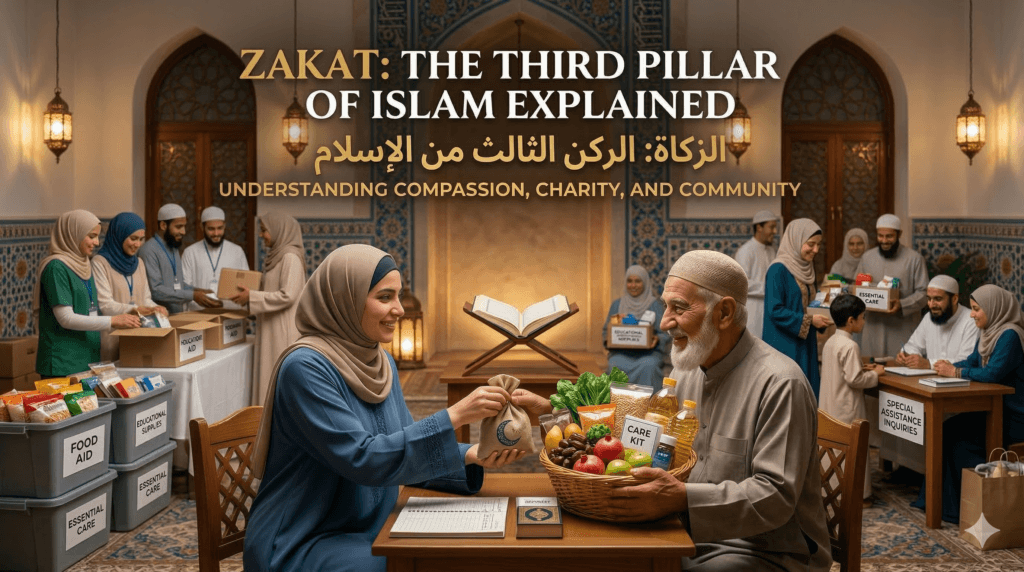
Zakat: The Third Pillar
of Islam Explained
A comprehensive, beginner-friendly guide to Zakat — its types, conditions, amounts, and the key differences between Zakat al-Mal and Zakat al-Fitr.
“And establish prayer and give Zakat (zakah).”
What Is Zakat?
Zakat (زكاة) is one of the most central acts of worship in Islam — and one of the most misunderstood. The word itself comes from the Arabic root meaning both purification (تزكية) and growth (نماء). This dual meaning is deeply intentional: by giving a portion of your wealth to those in need, you purify what remains, and your overall wellbeing — material and spiritual — grows.
Simply put, Zakat is an obligatory annual contribution that every eligible Muslim must pay on their accumulated wealth. It is not a charitable donation in the voluntary sense — it is a religious duty, as binding as the five daily prayers. Neglecting it is considered a major sin in Islamic jurisprudence.
Unlike taxes in secular systems, Zakat is rooted in a profound philosophical principle: that wealth ultimately belongs to God, and that human beings are merely trustees of it. A small, defined portion of that wealth must be returned to the community, specifically to those who need it most.
— Sahih al-Bukhari & Muslim (Hadith of the Five Pillars)
Zakat as the Third Pillar of Islam
In Islamic practice, the five pillars — Shahada (declaration of faith), Salah (prayer), Zakat (almsgiving), Sawm (fasting), and Hajj (pilgrimage) — are the foundational acts of worship that define a Muslim’s religious life. Zakat occupies the third position, and it is repeatedly mentioned alongside prayer in the Quran, often in the same verse, reflecting the inseparable relationship Islam sees between spiritual devotion and social responsibility.
Zakat was made obligatory in the second year of the Hijra (the Islamic calendar), the same year fasting in Ramadan was prescribed. From that point forward, it has been a defining feature of Muslim communities worldwide.
Spiritual Dimension
Purifies the soul from greed and attachment to material wealth.
Social Dimension
Redistributes wealth within the community, reducing inequality.
Legal Status
Obligatory (فرض) — not optional. Scholars unanimously agree on this.
The Main Types of Zakat
Zakat is not a single, uniform act. Islamic scholars have categorized it into several types depending on what is being given, when, and under what conditions. The two most commonly discussed and universally applicable types are:
Zakat al-Mal
Zakat on wealth — covering money, gold, silver, trade goods, livestock, and agricultural produce. Paid annually when specific conditions are met.
Zakat al-Fitr
A special obligatory charity paid at the end of Ramadan, before Eid al-Fitr prayer. Applies to every Muslim, regardless of their wealth level.
Beyond these two, classical Islamic law also recognizes Zakat on livestock (زكاة الأنعام), Zakat on agricultural crops (زكاة الزروع والثمار), and Zakat on minerals and buried treasures (زكاة المعادن والركاز), though the scope of this article will focus primarily on the two types most relevant to contemporary Muslims.
Zakat al-Mal: Zakat on Wealth
Zakat al-Mal is the most widely discussed form of Zakat in Islamic jurisprudence. It applies to accumulated wealth — money sitting in a bank account, trade merchandise, rental income, and more. To understand when and how to pay it, there are three core conditions that must all be satisfied simultaneously.
The Three Conditions for Zakat al-Mal
- 1
Nisab (النصاب) — Reaching the Minimum Threshold: The wealth must reach or exceed a minimum value known as the Nisab. This threshold is calculated based on either gold (85 grams of pure gold) or silver (595 grams of silver). In modern terms, this is assessed using the current market price of gold at the time of payment. Only when your total qualifying wealth equals or exceeds this threshold does Zakat become obligatory.
- 2
Hawl (الحول) — One Full Lunar Year: The wealth must have been in your possession for a complete lunar year (approximately 354 days). If you acquire wealth today and your total drops below the Nisab before a year passes, no Zakat is due that cycle. The Hijri (Islamic lunar) calendar governs this calculation, not the Gregorian calendar.
- 3
Full Ownership (تمام الملك): The wealth must be fully owned — meaning you have complete control over it. Debts owed to others can affect this calculation, and scholars have varying opinions on whether debts reduce the Zakatable amount.
The Rate of Zakat al-Mal
Once the three conditions are met, the amount due is 2.5% of the total Zakatable wealth. This rate (known as ربع العشر — “a quarter of a tenth”) has been established by scholarly consensus and applies to monetary wealth, gold held for investment purposes, silver, and trade goods.
Example: If you have $20,000 in savings that has exceeded the Nisab and been held for one full lunar year, your Zakat due is $500.
Zakat on Gold and Silver
Gold and silver occupy a special place in Zakat law because they were historically used as currency and remain stores of value today. According to a fatwa from IslamWeb’s Center for Fatwa, the rules around gold differ slightly depending on its purpose.
Gold Held for Investment or Savings
If you own gold that is not being worn — gold bars, coins, or jewelry set aside as an investment or store of value — Zakat is obligatory on it once it reaches the Nisab (85 grams of pure gold) and a full lunar year has passed.
Gold Jewelry Worn for Personal Use
This is one of the most discussed issues in Islamic jurisprudence. The majority of classical scholars (the Jumhur) — including Imams Malik, al-Shafi’i, and Ibn Hanbal in one narration — hold that jewelry worn regularly by a woman for personal adornment is exempt from Zakat. This is the preponderant (rajih) position according to many contemporary scholars, including the preference expressed in IslamWeb’s fatwas.
However, if the jewelry is worn only rarely, is stored away, or is kept with the intention of investment or eventual spending, then Zakat does apply to it according to a number of scholars.
How to Calculate Zakat on Gold of Mixed Carats
In practice, many people own gold of different karat weights (18K, 21K, 22K, 24K). The method described in the IslamWeb fatwa is straightforward:
- 1
Take the total weight in grams of each piece of gold you own.
- 2
Multiply the weight by the karat number of that piece, then divide by 24. This gives you the equivalent weight in pure gold.
Example: 50 grams of 21K gold → (50 × 21) ÷ 24 = 43.75 grams of pure gold. - 3
Add up the pure gold equivalents of all your pieces.
- 4
If the total meets or exceeds 85 grams of pure gold and a full lunar year has passed, calculate 2.5% of the current market value.
— IslamWeb Fatwa #208903, Center for Fatwa
It is also permissible, according to the preferred opinion in many fatwas, to pay the Zakat on gold in cash (using the gold’s current market value) rather than paying in gold itself, particularly when this is more beneficial for the recipient.
Zakat on Monthly Savings and Salary
One of the most common questions Muslims ask today is: how do I calculate Zakat on money I save gradually from my salary each month? This is a very practical concern, and IslamWeb’s scholars have addressed it with two valid methods.
Method One: The Cumulative Method (Easiest)
Choose a fixed Zakat anniversary date each lunar year. On that date, calculate the total amount currently in your savings account. If it meets the Nisab, pay 2.5% on the entire balance — regardless of when each portion was saved.
According to IslamWeb’s fatwa on this subject, this is the easier and more beneficial method for the poor, since it results in a larger amount being calculated and distributed. The scholars’ analysis shows that for someone saving $2,000 per month, the Zakat due in Year 1 would be approximately $600, in Year 2 approximately $1,185, and in Year 3 approximately $1,755 — accumulating meaningfully over time.
Method Two: The Individual Tracking Method
Assign each monthly saving its own one-year cycle. So the money saved in January has a Hawl that completes in January of the next Hijri year, the money saved in February completes its Hawl in February the following year, and so on. Each month, you would calculate 2.5% of the savings whose one-year cycle has completed.
While this method is technically more precise, it is considerably more complex to manage. The IslamWeb fatwa notes it is valid but difficult in practice.
What About Past Years When You Didn’t Pay?
If you accumulated savings over several years without paying Zakat, the obligation does not simply disappear — it remains a debt on your wealth. IslamWeb’s fatwa emphasizes that a Muslim must repent sincerely for delaying this obligation and should then calculate and pay all the Zakat that was due over the previous years. The retrospective calculation follows the same methods described above.
Zakat al-Fitr: The End-of-Ramadan Charity
Zakat al-Fitr is distinct from Zakat al-Mal in nearly every respect — when it is paid, what it is paid in, how much is due, and who must pay it. Understanding these distinctions is essential for every Muslim.
When Was It Prescribed?
According to the IslamWeb article on Zakat al-Fitr, this obligation was prescribed in the second year of the Hijra, the same year that fasting in Ramadan was made obligatory. It has been an unbroken practice of the Muslim community ever since, supported by multiple authenticated Hadiths.
— Ibn Umar, reported in Sahih al-Bukhari and Sahih Muslim
Who Must Pay Zakat al-Fitr?
This is one of the areas where Zakat al-Fitr differs most significantly from Zakat al-Mal. Based on the IslamWeb article, Zakat al-Fitr is obligatory on every Muslim — male or female, adult or child, mentally sound or otherwise. There is no Nisab threshold and no requirement to have held wealth for a full year.
The only two conditions are: being Muslim, and having sufficient food beyond one’s own needs and the needs of one’s dependents on the day of Eid and its eve. Scholars describe this as having “more than one’s basic essential needs” on that day — if you can afford it, you pay it.
As for family members, a father is generally responsible for paying on behalf of his young children who have no wealth of their own. If the children have their own wealth, it should ideally be paid from their wealth. Scholars differ on whether a husband must pay on behalf of his wife, with many holding that the wife pays her own Zakat al-Fitr since each person bears their own spiritual obligations.
When Is It Due and Paid?
The obligation of Zakat al-Fitr becomes due at sunset on the eve of Eid al-Fitr — the last night of Ramadan. This precise timing matters for edge cases: a child born after sunset on that night does not have Zakat al-Fitr due on them for that year, while a child born before sunset does. Similarly, someone who passes away before sunset has no Zakat al-Fitr due, whereas someone who passes away just after sunset already has the obligation.
Preferred Time of Payment
The best time to pay is on the morning of Eid, before the Eid prayer. This ensures the poor receive it in time to use it on the day of celebration. Abu Sa’id al-Khudri’s narration in Sahih al-Bukhari confirms this practice: Muslims would give it on the day of Eid, before the prayer.
Advance Payment
It is permissible to pay Zakat al-Fitr one or two days before Eid. The IslamWeb article notes that Ibn Umar (may Allah be pleased with him) would pay it one or two days early to ensure it reached the recipients in time. Paying more than two days early is a matter of scholarly disagreement.
Delayed Payment
Delaying payment until after the Eid prayer without a valid excuse is not permissible and invalidates the Zakat as Zakat — it becomes merely an ordinary charity. However, if there is a genuine excuse (such as being in a place with no means of payment or no one to receive it, or being surprised by the announcement of Eid), paying it late is acceptable.
The Prophet (peace be upon him) said: “Whoever pays it before the prayer, it is an accepted Zakat; whoever pays it after the prayer, it is an ordinary charity.”
Amount and Type of Zakat al-Fitr
The amount due is one Sa’ (صاع) of the staple food of one’s local community — per person. Historically, this was paid in dates, barley, wheat, raisins, or dried yogurt (aqit), as these were the foods commonly eaten in Madinah at the time. The principle scholars have derived from this is that the type should reflect the dominant staple food of the region where you live.
A Sa’ is a traditional unit of measurement equivalent to approximately 2.4 to 2.6 kilograms for most staple grains. This is often rounded to approximately 2.5 kg of wheat or its equivalent.
Some contemporary scholars permit paying the monetary equivalent (cash value) of the food instead, particularly when this is more practical for the recipient — and this has become the widespread practice in many Muslim communities globally.
To Whom Is Zakat al-Fitr Given?
Unlike Zakat al-Mal, which may be distributed to eight categories of recipients specified in the Quran, Zakat al-Fitr is specifically designated for the poor and the needy. This was the position favored by Ibn Taymiyyah and is widely accepted among scholars. It may not be given to those whose upkeep is already the responsibility of the person paying (such as one’s own children or spouse), and it may not be given to non-Muslims.
It is preferable to give it to poor relatives who are not among one’s direct dependents, as this combines the reward of Zakat with the reward of maintaining family ties.
Zakat al-Mal vs. Zakat al-Fitr: A Complete Comparison
The table below summarizes the key differences between the two main types of Zakat to help you understand each one at a glance.
| Feature | Zakat al-Mal (Wealth) | Zakat al-Fitr (End of Ramadan) |
|---|---|---|
| Arabic Name | زكاة المال | زكاة الفطر / صدقة الفطر |
| Who Must Pay | Muslims who meet the Nisab and Hawl conditions | Every Muslim who can afford it (no Nisab required) |
| Nisab (Minimum Threshold) | 85g of pure gold (or equivalent in silver/money) | No Nisab — only requires ability to meet basic needs |
| Hawl (Annual Cycle) | Required — wealth must be held for one full lunar year | Not required — due at a specific point in the year |
| When It Becomes Due | When Hawl completes on wealth above Nisab | At sunset on the eve of Eid al-Fitr |
| Best Time to Pay | Any time during the year once conditions are met | Morning of Eid, before the Eid prayer |
| Amount | 2.5% of total eligible wealth | One Sa’ (~2.5 kg) of staple food per person |
| What Is Given | Money, gold, trade goods (or cash equivalent) | Food (staple grain) or its cash equivalent |
| Eligible Recipients | 8 categories specified in Quran (9:60) | The poor and needy specifically |
| Primary Purpose | Purifying wealth; redistributing surplus capital | Purifying the fast; ensuring the poor can celebrate Eid |
| Applies to Children | Only if child has wealth meeting Nisab & Hawl | Yes — paid by guardian on child’s behalf |
| Calendar Used | Hijri (Islamic lunar) calendar | Tied to the end of Ramadan each year |
The Eight Categories of Zakat Recipients
The Quran specifies in Surah al-Tawbah (9:60) that Zakat al-Mal may be distributed to eight categories of people. This precise designation makes Zakat one of the most systematically structured charitable systems in any religious tradition.
Al-Fuqara’ (الفقراء)The poor — those with little or no income.
Al-Masakin (المساكين)The needy — those who have some but insufficient income.
Al-‘Amileen (العاملون)Zakat collectors and administrators.
Al-Mu’allafat Qulubuhum (المؤلفة)Those whose hearts are being reconciled to Islam.
Fil-Riqab (في الرقاب)Historically: freeing enslaved people. Now applied to similar liberation contexts.
Al-Gharimeen (الغارمون)Those overwhelmed by debt incurred in permissible ways.
Fi Sabilillah (في سبيل الله)Those striving in the path of God — interpreted broadly by scholars.
Ibn al-Sabil (ابن السبيل)The stranded traveler far from home without means.
Note: Zakat cannot be given to those whose financial support is already your legal obligation — such as your children or parents. And as noted above, Zakat al-Fitr is restricted specifically to categories 1 and 2 (the poor and needy), not all eight.
The Deep Wisdom Behind Zakat
Zakat is not simply a tax or an administrative mechanism — it is a profound act of worship with far-reaching spiritual and social dimensions.
Purifying the Fast
Regarding Zakat al-Fitr specifically, the IslamWeb article reports that the Prophet (peace be upon him) described it as “a purification for the fasting person from idle speech and inappropriate behavior” (narrated by Abu Dawud). Some scholars compared it to the prostration of forgetfulness in prayer: just as that prostration compensates for small lapses in the prayer, Zakat al-Fitr compensates for the minor shortcomings of one’s fast throughout Ramadan.
Enabling the Poor to Celebrate
One of the explicit purposes of Zakat al-Fitr stated in the Hadiths is to make the poor self-sufficient on the day of Eid, freeing them from the need to beg and enabling them to participate fully in the community’s celebration. It is one of Islam’s most elegant social equity mechanisms — ensuring that the joy of Eid is not exclusive to the wealthy.
Building Social Cohesion
Beyond the individual, Zakat serves the community. It creates bonds of solidarity and compassion between the wealthy and the less fortunate. It is not a transaction but an acknowledgment of mutual responsibility — the Islamic concept of تكافل اجتماعي (social solidarity). When wealth circulates from those who have it to those who lack it, the fabric of society is strengthened.
Spiritual Purification of Wealth
The Quran tells the Prophet (peace be upon him) to “take from their wealth a charity, to purify them and cause them to grow” (Al-Tawbah 9:103). This verse captures Zakat’s dual role perfectly: it is simultaneously an act of worship that purifies the giver’s soul and a practical mechanism that grows community wellbeing.
Muslims who regularly pay their Zakat often report that it reframes their entire relationship with money — shifting it from being an end in itself to being a tool for worship and community service.
A Final Word
Whether you are a student of Arabic and Islamic culture, a new Muslim navigating your obligations, or someone who simply wants to understand this pillar of Islamic practice more deeply, Zakat offers a window into Islam’s holistic worldview — one that refuses to separate the spiritual from the social, or the individual from the community.
If you have specific questions about your Zakat obligations, it is always best to consult a qualified Islamic scholar or a reputable fatwa center such as IslamWeb, as individual circumstances vary considerably.
📚 Sources & References
- IslamWeb Article — Ahkam Zakat al-Fitr (Rules of Zakat al-Fitr): islamweb.net/ar/article/135206
- IslamWeb Fatwa #208903 — Ahkam Zakat al-Dhahab (Rules of Zakat on Gold): islamweb.net/ar/fatwa/208903
- IslamWeb Fatwa #285505 — Kayfiyyat Hisab Zakat al-Mal al-Mudakhar min al-Ratib (Calculating Zakat on Saved Salary): islamweb.net/ar/fatwa/285505
- Sahih al-Bukhari & Sahih Muslim — Hadith of the Five Pillars; Hadith of Ibn Umar on Zakat al-Fitr.
- Quran — Surah al-Baqarah 2:43; Surah al-Tawbah 9:60, 9:103; Surah al-An’am 6:164.