
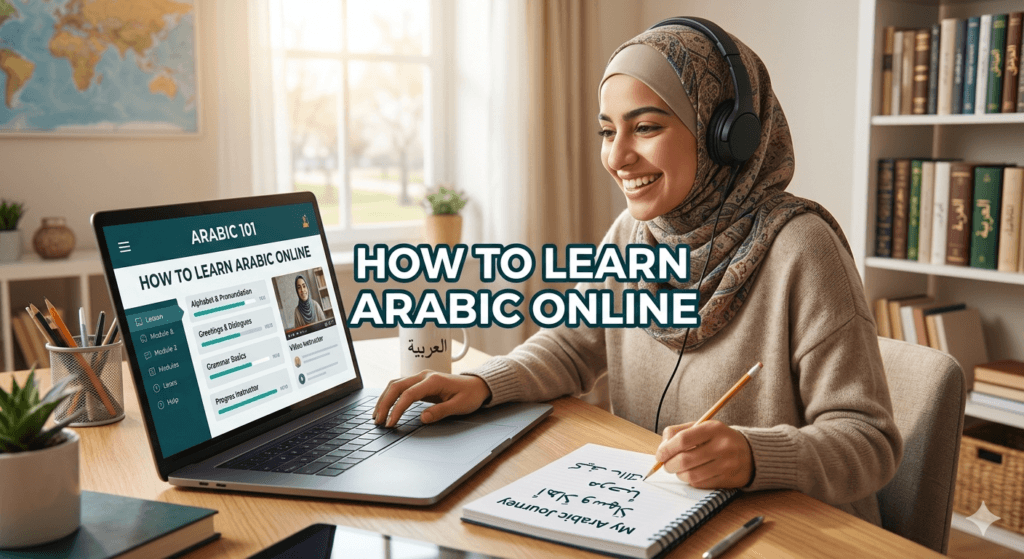
How to Learn Arabic Online:
The Complete Guide for Adults & Kids
Everything you actually need to know — from choosing the right dialect to finding the perfect teacher, with honest advice that works for total beginners and returning learners alike.
Let me start with something honest: learning Arabic online is completely achievable — but only if you approach it the right way. I’ve spent nearly two decades teaching Arabic to non-native speakers from the United States, the United Kingdom, France, Australia, and dozens of other countries. I’ve seen every type of learner succeed, and I’ve seen what holds people back.
This guide is my attempt to give you everything in one place — the real picture, not the oversimplified “just download this app!” advice you’ll find everywhere else. Whether you’re an adult who wants to travel across the Arab world, a parent searching for a great Arabic program for your child, or someone whose heart is drawn to the Quran — you’re in the right place.
Why Learn Arabic in 2026? (More Reasons Than You Think)
People learn Arabic for a wide variety of reasons, and every single one of them is valid. But what surprises most newcomers is just how many doors this language opens — doors they didn’t even know existed.
For Religious and Spiritual Growth
If you’re Muslim, learning Arabic means encountering the Quran the way it was revealed — in its original language. That shift from translated meaning to direct understanding is transformative. Students who reach that point often describe it as one of the most spiritually significant experiences of their lives. Even understanding just the short surahs in your daily prayers at a deeper level changes everything.
For Travel and Cultural Immersion
The Arab world stretches from Morocco in the west to Oman in the east — some of the most historically rich, architecturally stunning, and culinarily extraordinary countries on the planet. Knowing Arabic, even at a conversational level, transforms you from a tourist into a guest. Locals light up when a foreigner speaks their language. Doors open that no amount of money can buy.
For Business and Career
The Arab world’s GDP exceeds $3 trillion. The Gulf region alone is home to some of the world’s fastest-growing economies. Arabic-speaking professionals are in high demand across sectors including energy, finance, diplomacy, humanitarian work, journalism, and technology. If you work in any of these fields, Arabic fluency is a genuine competitive advantage.
For Heritage and Identity
Millions of second-generation Arabs in the United States, United Kingdom, France, and Canada grew up hearing Arabic at home but never fully learned it. Reconnecting with the language of your grandparents is more than linguistic — it’s deeply personal, an act of reclaiming identity and belonging.
For Kids: A Gift That Lasts a Lifetime
For Muslim families in the West especially, giving a child the ability to understand the Quran, to communicate with extended family, and to remain connected to their heritage is one of the most meaningful educational investments possible. Children who learn Arabic at a young age carry it for life — and their relationship with their faith becomes deeper and more personal as a result.
Which Arabic Should You Learn? Understanding the Dialects
One of the first questions every new learner asks is: “Are there different types of Arabic?” The answer is yes — and understanding this upfront will save you a lot of confusion.
Arabic exists on a spectrum. At one end is Classical Quranic Arabic, the language of the Quran and classical Islamic scholarship. At the other end are the spoken regional dialects that vary dramatically from country to country. In the middle sits Modern Standard Arabic (MSA, or Fusha), the formal written and broadcast language used across the Arab world today.
Formal & Written
Modern Standard Arabic (MSA)
Used in newspapers, formal speeches, education, and pan-Arab media. Understood by educated Arabs everywhere. The best choice for learners who want broad comprehension and professional use.
Most Widely Understood
Egyptian Arabic (Ammiya)
Thanks to Egypt’s enormous film, TV, and music industry, Egyptian Arabic is understood across the entire Arab world. The most practical dialect for travel and everyday conversation.
Religious & Classical
Quranic / Classical Arabic
The language of the Quran, the Hadith, and centuries of Islamic scholarship. Essential for religious understanding. Many learners are surprised by how much carries over to MSA.
Regional Varieties
Levantine, Gulf & Moroccan
Spoken in Syria, Lebanon, Jordan, the Gulf states, and North Africa respectively. Each has unique vocabulary and rhythm. Best to focus on one after establishing an MSA foundation.
If your goal is the Quran: Start with Quranic/Classical Arabic. If your goal is travel or conversation: Start with MSA or Egyptian Arabic. If you’re unsure: MSA is always a safe foundation — once you have it, picking up a dialect is significantly easier.
The Arabic Alphabet: Less Scary Than You Think
I hear it all the time: “But the alphabet looks so intimidating!” Here’s what I want you to know: most adult learners master the Arabic alphabet in one to two weeks of daily practice. It’s genuinely not as hard as it looks from the outside.
Arabic has 28 letters, all of which are consonants (Arabic is an abjad, meaning vowels are typically represented by small marks called harakat rather than separate letters). The script reads right-to-left, which takes a day or two to get comfortable with. Most letters have up to four forms depending on their position in the word — but these variations are logical and predictable.
Five Things That Make Arabic Easier Than You Expect
1. Root-based vocabulary. Arabic words are built on three-letter roots. Once you learn a root, you can often guess the meaning of dozens of related words. K-T-B, for example, relates to writing — giving you kitaab (book), maktab (office/desk), kaatib (writer), maktaba (library), and more.
2. No capitalisation. Arabic doesn’t have capital letters, which simplifies things.
3. Very consistent pronunciation. Unlike English, Arabic is phonetically regular. Once you know a sound, you know it.
4. Limited verb tenses. Arabic has past and present/future tenses. No perfect continuous progressive constructions to worry about.
5. Gender logic is consistent. Feminine nouns almost always end in ة (ta marbuta), making gender assignment more systematic than in, say, French.
Don’t try to learn the alphabet in isolation from meaning. From your very first lesson, connect letters to real words you’ll use. Seeing كتاب (kitaab, book) is far more memorable than learning the letters ك ت ا ب in the abstract.
Online Arabic Learning Methods: What Actually Works
The internet is full of Arabic learning resources — apps, YouTube channels, podcasts, flashcard decks, and online schools. Here’s an honest assessment of what works, what doesn’t, and why.
| Method | Best For | Real Progress | Personalised | Cost |
|---|---|---|---|---|
| 1-on-1 Online Lessons | All goals, all levels | ✔ High | ✔ Fully | $$–$$$ |
| Language Apps (Duolingo, etc.) | Alphabet basics, supplementary | ✘ Low for fluency | ✘ Generic | Free–$ |
| Online Group Classes | Structure on a budget | Moderate | ✘ Limited | $–$$ |
| YouTube / Free Video | Supplementary content | ✘ Low alone | ✘ None | Free |
| Textbooks (self-study) | Grammar reference | Moderate | ✘ None | $ |
The pattern is consistent across every learner I’ve seen: private one-on-one instruction is the fastest, most effective path to Arabic fluency. This isn’t a sales pitch — it’s what the research on second language acquisition says, and it’s what 19 years of teaching confirms. An experienced teacher watches you, corrects your pronunciation in real time, adjusts the pacing when you’re struggling, and accelerates when you’re thriving. No app can do that.
The Role of Apps: Supplement, Don’t Replace
I’m not saying apps are useless — they’re excellent for what they’re designed for. Anki flashcard decks are brilliant for vocabulary retention. Duolingo gets you comfortable with the alphabet in a low-stakes environment. Listening to Arabic podcasts while commuting builds passive comprehension over time. The mistake is treating any of these as a primary instruction method. They’re seasoning, not the meal.
Your Step-by-Step Roadmap to Learning Arabic Online
Here is the sequence I recommend to every new student who comes to eArabicLearning. It works whether you’re 8 or 68, whether you have 30 minutes a day or 2 hours.
Define your goal clearlyWrite down in one sentence why you want to learn Arabic. “I want to read the Quran without translation” is very different from “I want to chat with my Egyptian colleagues.” Your goal determines your curriculum, your dialect choice, and how you measure progress.
Learn the alphabet firstDon’t skip this. Even if your goal is purely conversational, being able to read Arabic will help you with vocabulary retention, dictionary use, and long-term progress. Plan one to two weeks of daily 20-minute sessions specifically for this.
Find a qualified teacherLook for a native Arabic speaker with formal teaching qualifications — not just fluency. A great teacher has training in Teaching Methodology, experience with non-native speakers, and the ability to adapt to your specific goals. This is the most important decision you’ll make.
Commit to a consistent scheduleTwo to three sessions per week of 45-60 minutes each, plus daily 15-minute review, is the sweet spot for most adult learners. Consistency matters far more than intensity. Three months of this schedule produces results that impress even the learner themselves.
Speak from Day OneThe biggest mistake language learners make is waiting until they feel “ready” to speak. You’ll never feel ready. Speak from your very first lesson — badly, hesitatingly, with mistakes — because that’s exactly how fluency is built.
Immerse yourself outside of lessonsArabic media consumption between lessons multiplies your learning. Watch Egyptian TV shows with subtitles, listen to news in Arabic on YouTube, follow Arabic social media accounts. Even passive exposure — hearing Arabic while you cook dinner — accelerates subconscious pattern recognition.
Track and celebrate milestonesSet measurable goals: “I want to have a 5-minute conversation about my job by month 3.” “I want to read a simple Arabic news headline by month 2.” Celebrating small wins maintains motivation over the long arc of language learning.
Learning Arabic Online for Kids: A Complete Parent’s Guide
🌟 Why Starting Arabic Young Is One of the Best Gifts You Can Give
Children under 10 acquire languages in a fundamentally different way from adults. Their brains are literally wired for it — they absorb pronunciation, rhythm, and intuitive grammar through exposure and play, without the self-consciousness that slows adult learners down. A child who starts Arabic at age 5 or 6 and has regular, engaging lessons will speak with near-native fluency and accent by their early teens.
For Muslim families especially, the stakes go beyond language. A child who truly understands Arabic connects with the Quran at a depth that translation simply cannot reach. They hear Allah’s words in prayer and understand them directly. That connection is priceless.
What Age Should Kids Start Learning Arabic Online?
I’ve successfully taught children as young as 4 years old in one-on-one online sessions. At that age, lessons are almost entirely play-based — songs, coloured flashcards, simple games, and stories. From age 6, children can begin light reading and writing alongside speaking. By age 8-9, a child who started early can handle a structured curriculum that progresses rapidly.
That said, it’s never too late to start. I have students who begin at 12 or 13 and, with the right motivation, catch up remarkably quickly.
How Online Arabic Lessons Work for Children
Effective online Arabic instruction for children looks very different from adult lessons. Here’s what works:
Short, focused sessions. For children under 8, 30-minute lessons are ideal. Attention spans are real — working with them rather than against them produces far better results than hour-long marathons. Children aged 9-12 can typically handle 45-minute sessions comfortably.
Visual and interactive tools. A skilled online Arabic teacher for kids uses digital flashcards, interactive storytelling, drawing activities, and games within the video lesson to keep energy and engagement high. Screen-sharing tools, virtual whiteboards, and colourful visual materials make online lessons just as engaging — sometimes more so — than in-person ones.
Positive reinforcement throughout. Children learn better when mistakes are seen as normal parts of the process. The best Arabic teachers for kids create an atmosphere of encouragement and play rather than test-like pressure.
Parent involvement is a multiplier. When parents show interest in what their child is learning — asking them to teach you a word, playing a simple Arabic game together, or listening to the lesson sometimes — the child’s motivation and retention skyrocket. You don’t need to know Arabic yourself. Just show curiosity.
What Can Kids Learn in Arabic Online?
A well-structured program for children typically covers: the Arabic alphabet (letters, sounds, and writing), basic vocabulary by themes (family, colours, numbers, animals, food), simple conversational phrases, Quranic Arabic for children (for Muslim families), basic grammar appropriate to age level, and Arabic stories and literature for young learners. By the end of a two-year program started at age 6, a motivated child typically reads, writes, and speaks basic Arabic confidently — and has a relationship with the language that will serve them for life.
How to Choose the Right Online Arabic Teacher
This is, without question, the most important decision in your Arabic learning journey. The right teacher makes the language feel alive and achievable. The wrong one makes it feel like a tedious chore.
What to Look For
Native speaker with formal teaching qualifications. Fluency in Arabic is not the same as the ability to teach it. Look for teachers who hold a degree in Arabic Language Education, Teaching Methodology, or Linguistics — not just native speakers who happen to offer lessons online.
Experience with non-native speakers. Teaching Arabic to someone who grew up in the language versus teaching it as a foreign language are completely different skills. Ask how many non-native students the teacher has worked with and across how many years.
Specialisation in your goal. A teacher who excels at Quranic Arabic instruction may not be the best fit if you want conversational Egyptian Arabic, and vice versa. Look for alignment between the teacher’s expertise and your specific learning goal.
The ability to teach children effectively. If you’re booking lessons for your child, the teacher must have experience with young learners — different energy, different methods, different pacing. Not all Arabic tutors are equally skilled with children.
A clear curriculum and lesson structure. Ask any prospective teacher: “How would you structure my first month of lessons?” A good teacher will give you a thoughtful, specific answer. Vague answers are a red flag.
Be cautious of teachers who: can’t explain their teaching methodology, have no formal qualifications, offer unrealistically cheap rates with no explanation, have no verifiable reviews or testimonials, or promise fluency in unrealistically short timeframes.
Trial Lessons Are Essential
Always take a trial lesson before committing to a package. In one session, you can assess whether the teacher’s style matches your learning personality, whether their pace feels right, whether they explain grammar in a way that makes sense to you, and whether the technology and platform work smoothly for your setup.
Realistic Progress Timelines: What to Expect and When
One of the most common frustrations with Arabic learning is misaligned expectations. Let me give you honest, realistic timelines based on what I’ve seen with hundreds of students.
Beginner Phase (Months 1-3)
By the end of month one, most students can read the Arabic alphabet, pronounce all 28 letters correctly, write basic words, and understand simple greetings and classroom instructions. By month three with consistent lessons and practice, expect basic conversational exchanges — introductions, asking and answering simple questions, reading simple texts, writing short sentences. This is real, tangible progress that most learners find motivating.
Intermediate Phase (Months 4-12)
This is where the magic starts happening. Students begin to understand spoken Arabic they encounter outside of lessons — in YouTube videos, songs, TV shows. They can hold short conversations, read simple news articles, and write structured paragraphs. For Quranic Arabic students, this is often when they begin to understand portions of their daily prayers directly, which is a profound milestone.
Advanced Phase (Year 2 and Beyond)
With consistent study, many learners reach functional fluency — meaning they can navigate most everyday situations in Arabic, read news and literature, watch TV shows without subtitles (mostly), and discuss complex topics — within two years. This is a language that rewards patience and consistency with genuine, deep proficiency.
“The best time to start learning Arabic was ten years ago. The second best time is today.”
— A sentiment shared by nearly every adult learner who wishes they started sooner
Ready to Start Your Arabic Journey?
Join thousands of students who learn Arabic online with eArabicLearning — personalized one-on-one lessons, 19 years of experience, all levels and all dialects welcome.
Book Your Free Trial Lesson →
No commitment · No credit card required · Cancel anytime
Why Thousands Choose eArabicLearning
I want to tell you a little bit about who we are — not as a corporate sales pitch, but as a human being talking to another human being about something I’ve dedicated my professional life to.
eArabicLearning is an online Arabic school that I founded after nearly two decades of teaching Arabic to non-native speakers. We are a US-registered LLC, which means international students can book and pay with complete confidence in our legitimacy and financial security. We hold a 4.9/5 rating on Trustpilot from students across the globe.
What makes us different isn’t a clever marketing claim — it’s a simple philosophy: every student is unique, and every lesson should reflect that. We don’t use one-size-fits-all curricula. We don’t rush you through a conveyor belt of lessons. We learn your goals, assess your level, understand your learning style, and build a programme that fits you.
What We Offer
One-on-one online Arabic lessons — the core of what we do. Fully personalised instruction delivered via video call, with a native Arabic teacher who holds a Bachelor’s degree in Arabic Language and a postgraduate qualification in Teaching Methodology.
Arabic for children — specialised, play-based instruction for young learners from age 4 upwards, with methods proven to work for children at different developmental stages.
Quranic Arabic — for Muslim learners who want to connect with the Quran at the level of direct understanding, whether you’re a total beginner or someone who reads fluently but doesn’t fully understand.
Modern Standard Arabic & Egyptian Arabic — for travellers, professionals, and conversational learners who want to navigate the Arab world with confidence.
Business Arabic — for professionals working with Arab clients, partners, or organisations, with a focus on formal vocabulary, professional correspondence, and industry-specific terminology.
In-person lessons in Cairo, Egypt — for students who are in Cairo and want the immersive experience of face-to-face instruction with a cultural backdrop unlike anywhere else.
“I started with zero Arabic knowledge and within six months I was reading short verses from the Quran. The teaching style is incredibly patient and structured.”
“My daughter (age 7) looks forward to her Arabic lessons every week. The teacher makes it so fun and engaging. She’s now reading simple Arabic sentences!”
“I tried Duolingo, YouTube, everything. Nothing worked until I started one-on-one lessons. The difference is night and day. Highly recommend eArabicLearning.”
“As a heritage learner who grew up hearing Arabic but never formally learned it, these lessons helped me reconnect with my roots in a way I didn’t expect.”
Practical Tips to Accelerate Your Arabic Learning
Over the years, I’ve noticed that the students who progress fastest share certain habits and mindsets. Here are the most impactful ones.
1. Make Arabic Part of Your Daily Life — Even in Small Ways
Change your phone’s language to Arabic. Label objects around your house with sticky notes in Arabic. Set your most-visited app to display in Arabic. These small environmental changes create constant low-stakes exposure that adds up remarkably over weeks and months.
2. Don’t Fear Mistakes — Seek Them Out
Linguists talk about “comprehensible input” — encountering language that’s just slightly beyond your current level. Mistakes are evidence that you’re operating in that zone. Students who are terrified of making errors learn slower than students who make dozens of mistakes per lesson and laugh about them. Your teacher’s job is to correct you. Let them.
3. Use Spaced Repetition for Vocabulary
The Ebbinghaus forgetting curve is real — without review, you forget roughly 80% of new information within 24 hours. Anki (a free flashcard app) uses spaced repetition algorithms to show you each word at the optimal moment before you forget it. Ten minutes of Anki daily between lessons will dramatically accelerate your vocabulary growth.
4. Find Arabic Content You Actually Enjoy
Sustainable language learning requires genuine enjoyment. Find Arabic content in genres you already love. If you like cooking, find Arabic cooking channels on YouTube. If you enjoy football, follow Arabic football commentary. If you love comedy, search for Egyptian stand-up or sitcoms. Learning through content you’re genuinely interested in multiplies engagement and retention.
5. Get Accountability
Tell people you’re learning Arabic. Join online Arabic learning communities. Find a language partner if you can. Accountability — knowing that other people know about your goal — is one of the most underrated drivers of consistency.
6. For Quranic Learners: Use the 10-Verse Method
Instead of trying to understand the entire Quran, pick 10 verses — ideally from the short surahs you already know by heart — and work with your teacher to achieve deep grammatical and semantic understanding of those 10 verses. Once you understand why every word is used and how it connects to the whole, your comprehension of the broader Quran accelerates rapidly because patterns repeat.
5 Common Mistakes That Slow Arabic Learners Down
These are the patterns I see holding students back most frequently. Knowing them in advance saves you months of frustration.
Mistake 1: Trying to learn multiple dialects simultaneously. This is the fastest way to confuse yourself. Pick one variety of Arabic and commit to it until you reach at least an intermediate level. Then branching out to a second dialect becomes much easier because you have a solid foundation.
Mistake 2: Spending more time on learning resources than on actual practice. Researching the “best Arabic app” for hours instead of spending 20 minutes actually studying Arabic is a form of procrastination dressed up as productivity. Action beats optimisation.
Mistake 3: Skipping the grammar entirely. Some modern language pedagogies encourage ignoring formal grammar in favour of immersion. For Arabic, this approach is particularly problematic because Arabic’s grammatical system — especially the case system (i’rab) — is deeply embedded in how the language functions. You need at least a working understanding of core grammar to progress beyond basic conversation.
Mistake 4: Relying on transliteration too long. Transliteration (writing Arabic sounds in Latin letters, like “marhaba” for مرحبا) is a useful bridge in the very early stages, but students who stay dependent on it too long never build the crucial skill of reading actual Arabic script — which limits them in almost every dimension of the language.
Mistake 5: Giving up during the intermediate plateau. Nearly every language learner hits a phase — usually around 6-9 months — where progress feels slow and the initial excitement has faded but fluency still feels distant. This is normal, universal, and temporary. Students who push through this phase consistently are the ones who achieve real fluency. Those who quit here have simply quit too early.
Best Free Tools to Supplement Your Arabic Lessons
These resources have proven genuinely useful for my students over the years — and all are free or very low cost.
Hans Wehr Arabic Dictionary (online version): The gold standard Arabic-English dictionary, now available in searchable digital form. Essential for serious learners.
Anki: Free spaced repetition flashcard software. Search for existing “Arabic vocabulary” decks or build your own from the words in your lessons.
Al-Jazeera Learning Arabic: Al-Jazeera’s dedicated Arabic learning resource, offering video lessons and articles in simplified Arabic designed for learners.
Quran.com: For Quranic learners, this site provides every verse with word-by-word translations and grammatical analysis — an extraordinary resource.
Arabic children’s YouTube channels: Channels like Liwal Junior and Kareem wa Hanin produce high-quality, educational Arabic content for young learners that works surprisingly well for adults at beginner level too.
Forvo.com: A pronunciation dictionary where native speakers have recorded every word. Perfect for checking how individual words actually sound.
Frequently Asked Questions About Learning Arabic Online
Start Learning Arabic Today
Whether you’re a complete beginner, a heritage learner, a Muslim parent wanting the best for your children, or a professional seeking a competitive edge — we have a programme designed for you.
Explore eArabicLearning →
Trusted by learners from 30+ countries · US-registered LLC · 4.9/5 on Trustpilot
Final Thoughts: Arabic Is More Achievable Than You Think
If you’ve read this far, I want you to leave with one thing above all: Arabic is learnable. Not just by some special category of “language people” — but by you, with the right guidance, the right approach, and a commitment to showing up consistently.
I’ve watched students who were convinced they were “terrible at languages” become confident Arabic speakers. I’ve watched 6-year-olds who couldn’t recognise a single Arabic letter grow into 10-year-olds who read the Quran fluently. I’ve watched adults reconnect with a heritage language they thought was lost forever. These aren’t exceptional stories — they’re the expected outcomes when learning is done properly.
Arabic isn’t just a language. It’s a key. It unlocks centuries of literature, science, philosophy, and poetry. It unlocks a deeper relationship with the Quran. It unlocks 26 countries and 420 million people. It unlocks a part of yourself, if this language is part of your heritage, that nothing else quite reaches.
Whatever brought you to this guide today — I hope it helped. And if you’d like to take the next step, eArabicLearning is here. We’d love to be part of your story.
About the Author: Mohamed Mortada is the founder of eArabicLearning, an online Arabic school serving learners across 30+ countries. He holds a Bachelor’s degree in Arabic Language and a postgraduate degree in Teaching Methodology, and has 19 years of experience teaching Arabic to non-native speakers of all backgrounds and ages.