
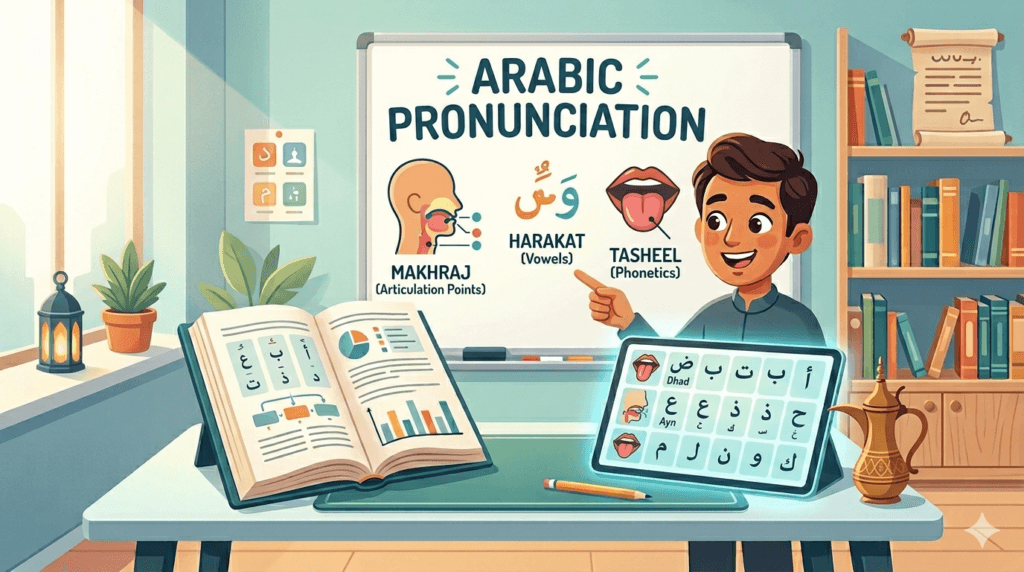
There’s a moment every Arabic learner knows. You’ve been studying for weeks. You think you’re saying the word correctly. Then a native speaker looks at you with a kind, slightly puzzled expression — and you realise the sound that left your mouth was not quite the sound that was supposed to.
Most of the time, the problem isn’t that you don’t know the word. It’s that nobody showed you where in your mouth — or throat — to make the sound.
That’s what this guide does.
Arabic has a reputation for being difficult to pronounce. Some of that reputation is earned — there are genuinely sounds in Arabic that do not exist in any major European language, and producing them correctly requires using parts of your vocal anatomy that English has never asked you to use for consonants. But most of the reputation comes from people encountering Arabic pronunciation without proper guidance: without being shown exactly where each sound is made, how the airflow works, and what the common mistakes are.
This guide covers everything. Every significant Arabic sound, grouped by difficulty and articulation point, with honest descriptions of how to produce each one, what English speakers tend to do wrong, and practical techniques for getting it right. I’ve also included the differences between Quranic pronunciation and Egyptian Arabic pronunciation — because they’re not identical, and knowing which you’re aiming for matters.
One honest note before we begin: this guide can take you a long way. But there is one thing it cannot do that a qualified teacher can — it cannot hear you. At some point in your pronunciation journey, a human ear is irreplaceable. Keep that in mind as you work through these sounds.
How Arabic Sound Production Works — The Map of Your Mouth and Throat
Before learning individual sounds, it helps enormously to understand the geography. Arabic uses articulation points that English never uses for consonant production — most notably the pharynx (the back of the throat above the larynx) and the uvula (the small fleshy structure that hangs at the very back of the palate). Understanding where these places are, and being able to find them consciously, is the prerequisite for producing the sounds made there.
Arabic consonants are produced at six main articulation points:
| Articulation Point | Location | Arabic Letters Made There | English Comparison |
|---|---|---|---|
| Bilabial | Both lips together | ب م و | Exactly like English b, m, w |
| Labiodental | Upper teeth on lower lip | ف | Exactly like English f |
| Dental/Interdental | Tongue between teeth | ث ذ | Like English “th” (think/this) |
| Alveolar | Tongue tip on ridge behind upper teeth | ت د ن ل ر ز س ص ض ط ظ | t, d, n, l similar to English; ص ض ط ظ are emphatic (no English equivalent) |
| Palatal/Velar | Back of tongue on palate or uvula | ج ك خ غ ق | ج like English j/g; ك like English k; خ غ ق have no English equivalent |
| Pharyngeal/Glottal | Deep in the throat (pharynx/glottis) | ع ح ه ء | No English consonants here — these are the hardest for English speakers |
This table is not just academic information. When you struggle with a sound, knowing its articulation point tells you exactly where to direct your attention. If your ع doesn’t sound right, the problem isn’t in your mouth — it’s in your throat. If your ص sounds like a regular س, the problem isn’t the airflow — it’s the tongue root position. The map saves you from practising in the wrong place.
The Familiar Sounds — Arabic Letters Close to English Equivalents
Let’s start with good news. Roughly half the Arabic alphabet produces sounds that English speakers already know — either identical to English sounds or very close. These letters should feel immediately accessible.
The Genuinely New Sounds — What No English Word Prepares You For
These are the sounds that separate Arabic from every language most English speakers have studied. They are not difficult because Arabic is complicated — they are difficult because the articulation points involved are simply never used for consonant production in English. Once you locate the right place and understand the airflow, they become physically producible. It just takes conscious effort and feedback.
The Emphatic Consonants — Arabic’s “Heavy” Sounds
The emphatic consonants are one of the most distinctive features of Arabic — and one of the most frequently mispronounced by beginners. There are four of them: ص (Sad), ض (Dad), ط (Ta emphatic), and ظ (Dha emphatic). Each is the “heavy” counterpart of a regular consonant.
What makes them “emphatic”? They’re produced with the same basic tongue position as their light counterpart — but simultaneously, the root of the tongue presses back and upward toward the back of the mouth, while the back of the tongue raises toward the velum. This pharyngealisation creates a dark, hollow quality that spreads to surrounding vowels, making the whole syllable sound deeper.
| Emphatic Letter | Light Counterpart | Key Difference | Example Contrast |
|---|---|---|---|
| ص Sad | س Sin (s) | Same “s” position but tongue root back, surrounding vowels darken | صَيْف (sayf — summer) vs سَيْف (sayf — sword) |
| ض Dad | د Dal (d) | Emphatic “d” — tongue root back, dark vowel quality | ضَرَبَ (ḍaraba — he hit) vs دَرَسَ (darasa — he studied) |
| ط Ta (emph.) | ت Ta (t) | Emphatic “t” — deeper and darker than regular ت | طَيِّب (ṭayyib — good) vs تَعَب (ta’ab — tiredness) |
| ظ Dha (emph.) | ذ Dhal (dh) | Emphatic “dh” — heavy version of the “this” sound | ظَلَمَ (ẓalama — he wronged) vs ذَهَبَ (dhahaba — he went) |
The practical technique for emphatic consonants: don’t try to change the consonant itself. Instead, as you produce the consonant, simultaneously push the root of your tongue backward and let your jaw drop slightly, as if saying an “o” or “u” vowel. The dark hollow quality that results — affecting both the consonant and the following vowel — is the emphatic quality you’re looking for. A teacher’s real-time feedback is the most effective way to confirm you’ve found it.
Arabic Vowels and the Harakat System
Arabic has three short vowels and three long vowels. The short vowels are written as small marks (harakat) above or below consonant letters; the long vowels are full letters. In the Quran and all beginner learning material, full harakat are written — making it significantly easier to read than unmarked everyday Arabic text.
| Mark | Name | Sound | Example | Long Vowel Version |
|---|---|---|---|---|
| بَ | Fatha — فَتْحَة | Short “a” as in “hat” | كَتَبَ kataba | Alif ا → long “aa” as in “father” |
| بُ | Damma — ضَمَّة | Short “u” as in “put” | كُتِبَ kutiba | Waw و → long “uu” as in “food” |
| بِ | Kasra — كَسْرَة | Short “i” as in “bit” | بِسْمِ bismi | Ya ي → long “ii” as in “see” |
| بْ | Sukun — سُكُون | No vowel — consonant stands alone | مِنْ min | — |
| بّ | Shadda — شَدَّة | Doubled consonant — held longer | رَبِّ Rabbi | — |
Two things about Arabic vowels that English speakers often miss. First, the length distinction is phonemic — a short “a” and a long “aa” are different sounds that can produce different words. كَتَبَ (kataba — he wrote) vs كَاتِب (kaatib — writer): the long aa in the second word is not just stylistic emphasis, it’s part of the word’s structure. Second, emphatic consonants darken the quality of surrounding vowels — the “a” after ص sounds more like “o” than the “a” after س. This is automatic and natural once emphatics are produced correctly.
Quranic vs Egyptian Arabic Pronunciation — Key Differences
One of the questions I get most often is: “I’m learning both Quranic Arabic and Egyptian Arabic — are the pronunciations the same?” The answer is: mostly similar, but with several specific differences that matter. Knowing which you’re aiming for prevents you from learning one set of habits and then having to unlearn them.
| Letter | Quranic / Classical Arabic | Egyptian Arabic | Impact |
|---|---|---|---|
| ق Qaf | Deep uvular stop — back of tongue on uvula | Glottal stop ʾ — like pause in “uh-oh” | Major — required for correct Tajweed |
| ج Jim | “j” as in jump (or “zh” per Tajweed authorities) | Hard “g” as in “go” | Major — sounds completely different |
| ث Tha | “th” as in “think” (voiceless interdental) | “t” or “s” depending on word | Moderate — matters for Quranic recitation |
| ذ Dhal | “dh” as in “this” (voiced interdental) | “d” or “z” depending on word | Moderate — matters for Quranic recitation |
| ظ Dha | Emphatic “dh” — full pharyngealised sound | Often “z” in speech | Moderate — Quranic recitation requires full emphatic |
| ع ح غ خ | Full pharyngeal/velar quality required | Same as Quranic — no simplification | No difference — required in both |
| ص ض ط | Full emphatic quality required | Same as Quranic — emphatics preserved | No difference — required in both |
Minimal Pairs — Why Getting It Right Actually Matters
A minimal pair is two words that differ only in a single sound. In Arabic, many minimal pairs exist between sounds that English speakers struggle to distinguish or produce — which means mispronouncing one sound can change your meaning entirely. This is why Arabic pronunciation is not just aesthetic. It’s functional.
Practising minimal pairs — listening to both words, then producing them and comparing — is one of the most efficient pronunciation training methods available. Your ear needs to be trained before your mouth can be corrected. Listening drills with minimal pairs sharpen the auditory distinction that your production then follows.
Six Techniques That Actually Improve Arabic Pronunciation
The most fundamental pronunciation practice technique. Choose a native speaker model — for Quranic Arabic, a Quran reciter like Mishary Rashid Alafasy or Abdul Rahman Al-Sudais; for Egyptian Arabic, a clear-speaking actor or presenter from Egyptian media. Listen to a single word or short phrase. Pause. Reproduce it yourself as closely as possible. Then play the original again and compare critically. Where does your version diverge?
The loop should be short — one word, one phrase — and repeated many times rather than working through long stretches of audio. The goal is conscious comparison and incremental correction, not passive exposure. Even 10 minutes of focused mimicry daily produces measurable pronunciation improvement within weeks.
Most learners have never heard themselves speak Arabic critically. The experience is almost always revealing — and useful. Record yourself reading a passage you know well, or producing specific sounds you’re working on. Listen back without looking at the text. What do you actually hear? Is the Ayn coming from the throat or from the mouth? Does the emphatic Sad sound heavy or like a regular sin?
Recording and playback is particularly valuable for sounds like ع and ح, which learners often think they’re producing correctly because the effort feels right — but the output doesn’t match. The recording tells the truth. Do this weekly and save the recordings — the progress over three months is often more encouraging than daily practice feels.
When learning a new difficult sound — especially ع, ح, ق, and the emphatics — practice the sound in complete isolation before attempting it in a word. Produce just the consonant, repeatedly, until the articulation position feels consistent and the output sounds close to the native model. Then add a simple vowel: ʿa, ʿi, ʿu. Then a simple syllable with a familiar consonant on each side.
This slow-build approach prevents the common mistake of learning a word with a difficult sound before the sound itself is stable — which often means the word gets memorised with the incorrect pronunciation embedded. Fix the sound first; the word acquisition follows much more cleanly.
Use the minimal pairs in the section above. Listen to both words of each pair, focus on the difference, then try to produce both. The goal is not just to know intellectually that ص and س are different — it’s for your ear to hear the difference immediately and your mouth to produce it reliably on demand. Spend five minutes per session on minimal pairs relevant to the sounds you’re currently working on.
The pairs most worth drilling early: ص/س, ع/regular vowel, ح/ه, ق/ك, ط/ت. These cover the most common confusions and the most significant meaning distinctions.
For learners whose Arabic goal is Quranic — whether Quranic comprehension, Tajweed study, or simply praying with correct recitation — working on pronunciation through the Quran itself is both spiritually meaningful and linguistically effective. Take a surah you know well. Listen to a professional recitation. Follow along in the mushaf, noticing every sound. Then recite slowly, focusing on each sound individually.
The short surahs of Juz Amma are ideal for this because they’re brief, well-known, and contain most of the common Arabic sounds. Al-Ikhlas contains ق (Qaf), Al-Fatiha contains every sound category. Working through these surahs as pronunciation exercises rather than just recitation practice is a distinctly Islamic approach to Arabic phonetics that connects learning to worship.
Every technique in this guide builds toward one goal: producing sounds that a native Arabic speaker recognises as correct. The only way to know whether you’ve reached that goal — consistently, not just occasionally — is to have a qualified native speaker listen to you and respond. Not a recording. Not an app. A person who can hear the difference between your ع and a regular vowel, between your emphatic ص and a light س, and who can tell you specifically what to adjust.
The most efficient timing for this feedback is early — in your first two to four weeks of pronunciation work, before incorrect habits solidify. A teacher who focuses one or two sessions entirely on pronunciation correction in the early weeks will save you months of working against ingrained incorrect patterns later. This is not a luxury. It is the single highest-return pronunciation investment available.
The Most Common Pronunciation Mistakes — and How to Fix Them
1. Pronouncing ع (Ayn) as a regular vowel
This is by far the most common mistake, and it matters because ع appears in some of the most fundamental words: العَرَبِيَّة (Arabic), عَلَيْكُم (upon you), الرَّكْعَة (rak’a — prayer unit), عِبَادَة (worship). A learner who produces ع as a regular “a” or “o” is not just mispronouncing — they’re producing a different sound entirely. The fix: do isolated Ayn drills using the straining technique described above, record yourself, and get teacher feedback within the first month.
2. Substituting ح (Ha heavy) with ه (Ha soft)
Both letters are romanised as “h” in most transliteration systems, which encourages the mistake. But they are different sounds: ه is a simple breath from the mouth, like English “h”; ح is a rougher, pharyngeal friction from deep in the throat. Using ه where ح is required changes both the pronunciation and the meaning of words. Practice by exaggerating the throat-push quality of ح until it feels distinct from the soft ه.
3. Producing emphatic consonants with no heaviness
A learner who reads ص as a regular “s,” ط as a regular “t,” and ض as a regular “d” is producing half the Arabic sound system incorrectly — and may not even know it, because transliteration doesn’t always differentiate emphatics from their light counterparts. The fix: learn emphatics as distinct sounds from day one, practise the tongue-root-back technique described above, and drill minimal pairs to confirm the distinction is audible.
4. Using English “r” for Arabic ر (Ra)
English “r” is a retroflex sound — the tongue curls backward and doesn’t touch the roof of the mouth. Arabic ر is a tap or trill — the tongue tip briefly touches the alveolar ridge (like a Spanish “r”). In Arabic recitation, particularly in Quranic Arabic, the ر has specific rules about when it’s “heavy” (like in Arabic: الرَّحْمَن) and when it’s “light.” Using an English-style retroflex “r” throughout is immediately noticeable to native speakers.
5. Ignoring vowel length distinctions
English does not use vowel length phonemically — the difference between a short “a” and a long “aa” never changes a word’s meaning in English. In Arabic, it does. الكِتَاب (al-kitaab — the book) vs الكِتَب (al-kitab — the books, broken plural) differ in a vowel length. Neglecting to hold long vowels for their full duration produces mispronunciation and, in some cases, meaning changes. Practise long vowels deliberately, especially after emphatic consonants where they tend to be shortened incorrectly.
“I had been studying Arabic for four months before my teacher pointed out that my ع was completely wrong — I was producing a regular ‘a’ vowel every single time. I thought I was saying العَرَبِيَّة. I was saying something else entirely. Two weeks of focused Ayn drills with my teacher’s ear guiding me, and it clicked. That was three years ago. Now it’s completely natural. I just wish someone had caught it in week one.”
— Thomas K., student at eArabicLearning, Germany
📚 The Complete eArabicLearning Library — Build Your Full Arabic Foundation
Arabic Alphabet: All 28 Letters + 2-Week PlanLearn the shapes alongside the sounds
Arabic Grammar: The 7 Core ConceptsHow the language is structured
Arabic Vocabulary Strategy + 100 Essential WordsBuild words with correct pronunciation
Why Understanding the Quran Changes EverythingPronunciation in Quranic context
Arabic for New MuslimsSalah pronunciation from day one
Egyptian Arabic for BeginnersEgyptian-specific pronunciation features
MSA vs Egyptian vs Gulf ArabicHow pronunciation varies by dialect
Learn Arabic as an Adult: The Honest RoadmapAdult pronunciation learning timeline
Best Apps to Learn Arabic 2026Which apps help with pronunciation?
Arabic for Heritage SpeakersPronunciation activation for heritage learners
Arabic for BusinessProfessional pronunciation standards
Learn Arabic from Scratch — Full GuideComplete beginner roadmap including pronunciation
Your Pronunciation Needs a Human Ear — Not Just a Guide
This guide shows you what to aim for. A qualified Arabic teacher shows you whether you’re hitting it — and exactly what to adjust when you’re not. Real-time pronunciation feedback in the first weeks of learning saves months of correcting ingrained habits later.
Your first lesson is free. It can be a pronunciation-focused session: you speak, your teacher listens, and by the end you’ll know exactly which sounds need the most attention and the specific technique to fix each one.
Quranic Arabic · MSA · Egyptian Arabic · Pronunciation focus available · All levels · 30+ countries
Frequently Asked Questions: Arabic Pronunciation
A Final Word About the Sounds You’ll Struggle With
Every Arabic learner has their sound. The one that resists. The one that sounds right in their head and wrong in the recording. The one that a native speaker keeps gently redirecting with a patient smile. For most English speakers, it’s the ع. For some, it’s the emphatic consonants. For others, it’s the uvular ق or the difference between ح and ه.
Whatever your sound is — the one that this guide has helped you identify but hasn’t yet fixed — here’s what twenty years of teaching has shown me: every single one of these sounds is physically producible by a healthy adult English-speaking vocal tract. None of them require anything your anatomy doesn’t have. They require knowing where to direct your attention, consistent deliberate practice, and — most importantly — someone who can hear whether you’ve got it.
That combination of understanding, practice, and feedback is the whole of Arabic pronunciation learning. This guide gave you the first. The second is yours to commit to. The third — a free lesson away.