
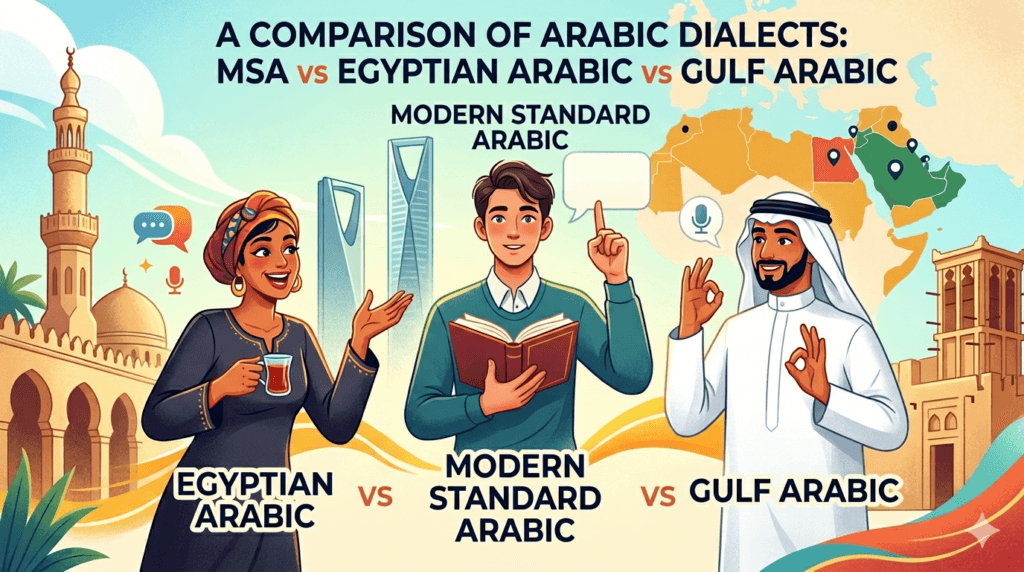
“I want to start learning Arabic. But — which Arabic exactly? I keep reading about MSA, Egyptian Arabic, Gulf Arabic, Levantine, Classical, Quranic… and I don’t know where to begin.”
If you’ve ever typed something like that into a search engine and walked away more confused than when you started, this guide is for you. I’m going to settle the question once and for all — clearly, honestly, and with no agenda other than helping you make the right decision for your situation.
After twenty years of teaching Arabic — MSA, Quranic, Egyptian, Gulf, Levantine — to adult beginners, heritage speakers, Muslim converts, diplomats, journalists, and curious language enthusiasts, I’ve had this conversation hundreds of times. The confusion is completely understandable. Arabic is genuinely not one language — it’s a family of closely related varieties that share roots but differ in important ways. Getting this decision wrong doesn’t ruin everything, but getting it right can save you months of misdirected effort.
By the end of this guide, you will know exactly which Arabic variety to start with, why, and what your long-term learning path looks like. Let’s get into it.
The Arabic Language Landscape: What You’re Actually Choosing Between
Before comparing the options, it helps to understand why they exist at all. Arabic is what linguists call a “diglossia” — a situation where a formal, standardised variety of a language (in this case, Modern Standard Arabic) coexists alongside multiple spoken regional varieties (the dialects), and speakers use different varieties for different situations.
The reason this happened is history. When Islam spread from the Arabian Peninsula across North Africa, the Middle East, and beyond in the 7th and 8th centuries, the Quran’s Arabic became the prestige language of an enormous civilisation — used for religion, scholarship, literature, and government. But the people living across these diverse regions went on speaking their own evolving vernaculars. Over centuries, the gap between the written formal language and the spoken everyday language widened, producing today’s situation: a single written standard understood by educated people everywhere, and dozens of regional dialects understood locally.
In practice, what you’re choosing between as a learner is not thirty separate languages — it’s a much simpler landscape once you understand the structure. Here are the five varieties that matter for learners:
Quranic / Classical Arabic — the Arabic of the Quran, 7th-century pre-Islamic poetry, and the classical Islamic scholarly tradition. The foundation from which all modern varieties descend.
Modern Standard Arabic (MSA) — the formal written standard used across all 26 Arabic-speaking countries today. The direct descendant of Classical Arabic, modernised for contemporary use.
Egyptian Arabic — the spoken dialect of Egypt (104 million people), the most widely understood dialect across the Arab world due to Egypt’s cultural dominance in media and cinema.
Gulf Arabic (Khaleeji) — the spoken dialects of Saudi Arabia, the UAE, Qatar, Kuwait, Bahrain, and Oman. Most relevant for those living or working in the Gulf region.
Levantine Arabic — the spoken dialects of Syria, Lebanon, Jordan, and Palestine. Melodically distinctive and widely recognised due to Lebanese and Syrian media influence.
Now let’s look at each one in depth.
Modern Standard Arabic (MSA): What It Is and Who Needs It
Modern Standard Arabic (MSA)
Modern Standard Arabic is the formal written and spoken variety of Arabic used across all 26 Arabic-speaking countries. You’ll find it in newspapers, official government documents, formal speeches, academic publications, international broadcasts (Al Jazeera, BBC Arabic), and formal business correspondence. It is taught in schools throughout the Arab world as the “correct” written language.
Here’s the important thing most beginners don’t know: no one speaks MSA as their native, everyday language. An Egyptian person and a Lebanese person might speak to each other in MSA in a formal setting — a conference, a news interview — but at home, with family and friends, they switch to their local dialect. MSA is a lingua franca of literacy and formality, not of daily life.
What MSA gives you is extraordinary breadth: the ability to read Arabic content from Morocco to Oman, to write to any Arabic speaker formally, to follow formal news and media, and to have a grammatical foundation that makes learning any dialect faster.
MSA is the right choice for you if you want to read Arabic newspapers, books, or academic texts; if you work in diplomacy, journalism, international development, or any field that requires formal Arabic communication; or if you want a foundation that opens the entire Arabic-speaking world to you in written form. It’s also the right starting point if you’re not yet sure which region or dialect you’ll eventually need.
Quranic & Classical Arabic: The Language of the Quran
Quranic / Classical Arabic
Quranic Arabic is the language of the Holy Quran as revealed to the Prophet Muhammad ﷺ. It is also the language of pre-Islamic Arabic poetry, the classical hadith literature, and the great works of Islamic scholarship in jurisprudence (fiqh), Quranic interpretation (tafsir), and Arabic grammar (nahw). It is the most revered variety of Arabic in the Muslim world and the oldest variety documented with literary precision.
What makes Quranic Arabic distinct from MSA: it uses some grammatical structures and vocabulary that are archaic by MSA standards, its literary style is uniquely compressed and layered in meaning, and its orthographic conventions sometimes differ from modern Arabic writing. Understanding the Quran at depth — not just recognising words but understanding how they interact — requires specific study of its language, not just general MSA.
The remarkable thing about Quranic vocabulary is its concentration: the Quran contains roughly 77,400 words, but the 300 most frequent word-forms account for approximately 70–80% of the text. This means targeted vocabulary study has an extraordinarily high return rate.
Quranic Arabic is the right choice if your primary motivation is understanding the Quran directly — hearing a verse in Salah and understanding its meaning without translation; reading a passage in the Mushaf and grasping what it says. It’s also the right choice for anyone pursuing Islamic scholarship or wanting to engage with the classical Islamic intellectual tradition.
“I had recited Surah Al-Rahman probably ten thousand times. The day I understood what كُلُّ مَنْ عَلَيْهَا فَانٍ meant — really understood it, in Arabic — I stopped mid-recitation and had to sit down. Nothing prepared me for that.”
— Amina K., student at eArabicLearning, United States
Egyptian Arabic: The World’s Most Recognised Arabic Dialect
Egyptian Arabic
Egyptian Arabic is the spoken dialect of Egypt’s 104 million people — and by a significant margin, the most widely understood spoken Arabic dialect across the Arab world. The reason: Egypt’s dominance in Arab cinema, television, and music from the 1940s onward has meant that generations of Arab people across Morocco, Saudi Arabia, Iraq, Lebanon, and everywhere in between grew up watching Egyptian films and listening to Egyptian songs. Egyptian Arabic has become the de facto lingua franca of informal spoken Arabic.
Egyptian Arabic differs from MSA in several ways: the letter ق (qaf) is typically pronounced as a glottal stop (like the pause in “uh-oh”) in Egyptian, the letter ج (jim) is pronounced as a hard “g” (as in “go”), many grammatical endings from MSA are dropped in speech, and everyday vocabulary includes words not found in classical sources. But the grammar is fundamentally the same Semitic structure — a person with strong MSA can follow Egyptian Arabic faster than a beginner with no Arabic background.
Egyptian Arabic is the dialect most likely to be understood wherever you travel in the Arab world — making it an ideal first dialect for learners who want broad conversational reach rather than hyper-specific regional connection.
Key Features of Egyptian Arabic That Differ from MSA
| Feature | Modern Standard Arabic | Egyptian Arabic |
|---|---|---|
| Pronunciation of ق | “q” (back of throat) | Glottal stop ʾ (like “uh-oh”) |
| Pronunciation of ج | “j” (as in French Jean) | Hard “g” (as in “go”) |
| Word for “now” | الآن (al-aan) | دلوقتي (dilwa’ti) |
| Word for “good” | جيد (jayyid) | كويس (kwayyes) |
| Grammatical case endings | Fully marked (rafa’, nasb, jarr) | Generally dropped in speech |
| Future tense marker | سـ (sa-) prefix | هـ (ha-) prefix |
| Negation | لا (la) / لم (lam) | مش (mish) / ماـش (ma-sh circumfix) |
Gulf Arabic: The Language of the Arabian Peninsula
Gulf Arabic (Khaleeji)
Gulf Arabic — collectively called Khaleeji — is spoken across Saudi Arabia, the UAE, Qatar, Kuwait, Bahrain, and Oman, with significant variation between these countries and even between regions within them. It is spoken by approximately 35–40 million people natively, making it a smaller community than Egyptian Arabic but one of enormous economic and geopolitical significance given the Gulf’s oil wealth and global business prominence.
Gulf Arabic retains some classical Arabic features that other dialects have dropped, making it in some ways closer to MSA than Egyptian Arabic is. It also has significant Persian, Hindi, Urdu, and English loanwords reflecting the Gulf’s centuries as a maritime trade hub. The variety differs considerably across the region: Saudi Najdi Arabic, Emirati Arabic, Qatari Arabic, and Kuwaiti Arabic are all related but notably distinct in vocabulary and sound.
For learners, the most practical consideration is specificity: Gulf Arabic is highly valuable if you are living, working, or doing business in a specific Gulf country, and somewhat less useful as a general-purpose dialect if your Arabic connections are not region-specific. Egyptian Arabic will get you further, faster, across the broader Arab world — but in the Gulf itself, making the effort to speak Khaleeji builds relationships and earns respect in ways that Egyptian Arabic (however widely understood) cannot fully replicate.
Levantine Arabic: The Dialect of the Fertile Crescent
Levantine Arabic
Levantine Arabic covers the closely related dialects of Syria, Lebanon, Jordan, and Palestine — collectively spoken by approximately 40 million people. It is one of the two most commonly learned Arabic dialects globally (alongside Egyptian), and for good reason: Lebanese and Syrian media, music, and cultural output have given Levantine Arabic a wide recognition across the Arab world even outside its home region.
Levantine Arabic is often described as melodically beautiful — it has a distinctive rhythm and intonation that many learners find appealing. It carries significant French influence (particularly Lebanese) from the Ottoman and mandate periods, as well as Turkish and English loanwords. The grammar is somewhat simpler than formal MSA in spoken use, and the vocabulary is distinctive enough from Egyptian that learners need specific study of Levantine if that’s their target region.
Levantine is the best choice for learners with personal, family, professional, or cultural connections to Syria, Lebanon, Jordan, or Palestine. It’s also the second-best choice (after Egyptian) for learners who want broad conversational reach across the Arab world without a specific regional focus.
The Quick Decision Guide: Which Arabic Is Right for YOU
Here is the framework I use with every new student. Answer the question honestly — not what sounds most impressive, but what you actually want to achieve — and the right answer will be clear.
🎯 Match Your Goal to Your Arabic Variety
Daily prayers mean more, Ramadan is transformed, Islamic scholarship becomes accessible
Newspapers, academic texts, formal correspondence, Al Jazeera, official documents
Conversations, travel, social situations — broadest reach across Arab world
Building local relationships, navigating daily life, professional respect
Heritage, family connection, regional cultural engagement
Long-term learner who wants both reading and speaking across the Arab world
Combine spiritual motivation with real-world conversational ability
Exploring Arabic, not sure where it will lead
Can You Learn More Than One? The Honest Answer
Yes — but not simultaneously at first. Here is the realistic picture.
The varieties of Arabic share so much underlying structure — the same root system, the same basic grammatical logic, the same script — that learning one does genuinely help with the others. An MSA learner who has spent a year building a solid grammatical foundation will find Egyptian Arabic vocabulary and conversational patterns much easier to pick up than a complete beginner. A Quranic Arabic learner who knows the classical vocabulary will find MSA faster to absorb. The investment in any Arabic variety pays forward into others.
The mistake beginners make is trying to learn two varieties simultaneously from day one. It causes confusion at the level of sounds, vocabulary, and grammar — particularly when one variety uses a feature that another doesn’t. The result is a hybrid that neither native speakers of MSA nor dialect speakers recognise as natural. This is not a hypothetical — I’ve seen it slow down dozens of learners significantly.
The recommended sequence for dual learners
| Primary Goal | Start With | Add Later | When to Add |
|---|---|---|---|
| Quran + daily conversation | Quranic Arabic | Egyptian Arabic | After 6–9 months of Quranic foundation |
| Reading + conversation | MSA | Egyptian Arabic | After 9–12 months of MSA |
| Conversation + Quran | Egyptian Arabic | Quranic Arabic | After 6 months of dialect foundation |
| Gulf life + formal Arabic | Gulf Arabic | MSA | After 6 months of Gulf dialect comfort |
Your teacher is the right person to judge when you’re ready to introduce a second variety. The general signal is that your first variety has become reasonably automatic — you’re not actively thinking about basic grammar and vocabulary when speaking or reading. At that point, the cognitive space is available to begin absorbing something new without the two interfering with each other.
Common Myths That Confuse Arabic Beginners
Dialects are not corrupted MSA — they are natural evolutions of Classical Arabic, developed organically over centuries of daily use, shaped by local history, trade, and culture. Egyptian Arabic, Levantine Arabic, and Gulf Arabic are linguistically complete, rule-governed varieties, not lazy approximations of a standard. Every native Arabic speaker speaks a dialect natively. MSA is a prestige variety with specific uses; it is not “more Arabic” than the dialects.
Speaking MSA in casual conversation in an Arab market, family home, or social gathering is like speaking very formal written English in a pub — technically understood, but noticeably strange and sometimes off-putting. Native speakers will understand you, but they may feel addressed in a register that doesn’t match the situation. For genuine social connection, dialect use signals respect and cultural effort in ways MSA cannot.
Spoken dialects are conventionally not written in formal contexts — newspapers and books use MSA. But dialects are absolutely written in informal contexts: text messages, social media, chat applications, and internet content across the Arab world are full of dialect writing. Egyptian Arabic, Levantine Arabic, and Gulf Arabic all have widely recognised informal written forms using Arabic script, and occasionally Latin script (known as “Arabizi”). Dialects have no official orthographic standard, but they are very much written.
The choice of which Arabic to start with is pragmatic and revisable. Many successful Arabic learners began with one variety, built a foundation, and then successfully added others. The choice matters for your first 6–12 months of learning — it helps you avoid confusion and build coherent skills. After that foundation, the Arabic language family opens up in all directions. Your starting variety is a door in — not the only room in the house.
The exact opposite is closer to the truth. Egyptian Arabic is the most widely understood spoken dialect across the Arab world — not by every individual, but by a very high proportion of Arabic speakers who grew up with Egyptian media. A learner who speaks Egyptian Arabic in Morocco, Saudi Arabia, Lebanon, or Iraq will be understood. The dialect that is least likely to be understood outside its home region is, ironically, some of the less-exposed Gulf or Moroccan varieties.
Not Sure Which Arabic Is Right for You?
A 10-minute conversation with a qualified Arabic teacher is worth more than hours of online research. At eArabicLearning, we help every new student identify the right variety, the right pace, and the right curriculum for their specific situation — before they commit to a single lesson.
Book a free trial lesson. No payment. No commitment. Just clarity.
MSA · Quranic Arabic · Egyptian Arabic · All levels · 30+ countries served
Frequently Asked Questions: MSA vs Egyptian Arabic vs Gulf Arabic
The Bottom Line
The Arabic dialect question doesn’t have one universal right answer — but it always has a right answer for you specifically. The key is to stop treating this as an abstract linguistic puzzle and start treating it as a personal, practical decision rooted in your actual life and goals.
Want to understand the Quran? Quranic Arabic. Want to speak with people across the Arab world? Egyptian Arabic. Want formal reading and writing ability? MSA. Living in the Gulf? Gulf Arabic. Connected to Syria, Lebanon, Jordan, or Palestine? Levantine. Not sure? MSA is the safest foundation. Any of these is a worthy investment — none of them is a wrong answer for its intended purpose.
What is a wrong answer is continuing to research the question without making a decision. Every month you spend deliberating is a month you’re not learning. The Arabic you start with doesn’t trap you — it gives you a foundation that makes everything else faster.
If you’d like one honest conversation about which variety fits your specific situation before you commit to anything, book a free trial lesson. We’ll ask you three questions and tell you exactly where to start.