
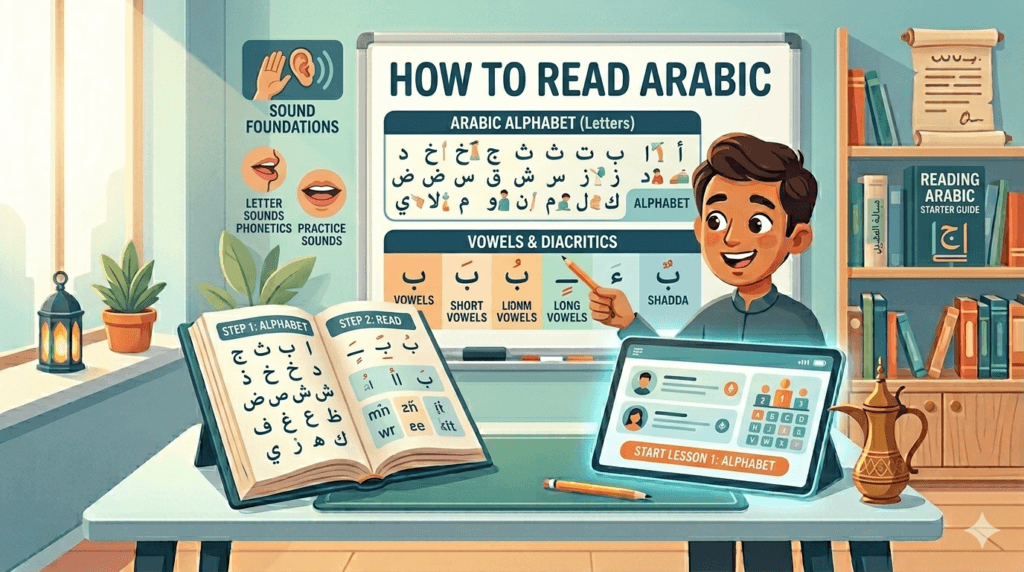
You learned the alphabet. You can name every letter, point to them on a page, maybe write a few. Then you sit down with an actual Arabic text — a page of the Quran, a simple sentence in a textbook — and the letters you know so well seem to dissolve into something unreadable.
You’re not alone. This is where most Arabic learners get stuck. And the reason isn’t that the alphabet is hard. It’s that knowing letters and reading Arabic are two different skills.
This guide is about the second one.
Learning to read Arabic involves a specific journey — not a straight line from “I know the letters” to “I can read fluently,” but a progression through distinct stages, each with its own challenges and its own techniques. Skip a stage and the next one doesn’t make sense. Rush through a stage and you build habits that slow you down later.
After two decades of teaching Arabic reading — from the first stumbling syllable to reading the Quran with comprehension — I’ve watched every mistake and every breakthrough. This guide maps the path clearly: what stage you’re at, what to work on, what common errors to avoid, and what resources will actually help.
One thing upfront: this guide focuses on reading vowelled Arabic first — Arabic written with the small marks (harakat) that show the vowels. The Quran is written this way. Beginner textbooks are written this way. It’s the most learnable form of Arabic script, and it’s the right place to start. Unvowelled Arabic — the kind you find in newspapers and most everyday text — comes later, and we’ll cover that too.
Vowelled vs Unvowelled Arabic — The Distinction That Changes Everything
The single most important thing to understand before you begin reading Arabic is the difference between vowelled and unvowelled text — because they’re not the same reading challenge at all. Most beginners don’t realise this distinction exists until they encounter it unexpectedly, and it causes a lot of unnecessary confusion.
✅ Vowelled Arabic (with harakat)
بِسْمِ اللَّهِ الرَّحْمَٰنِ الرَّحِيمِ
⚠️ Unvowelled Arabic (without harakat)
بسم الله الرحمن الرحيم
The Quran — and this is one of its practical gifts to Arabic learners — is always written with full harakat. Every vowel, every doubled consonant, every absence of vowel is explicitly marked. This makes Quranic text dramatically easier for beginners to read correctly than everyday unvowelled Arabic. A beginner who knows the alphabet and vowel marks can decode Quranic text from their first weeks of practice. That same beginner would struggle significantly with a newspaper headline.
The practical advice: focus entirely on vowelled text for your first three to six months of reading practice. Don’t be discouraged when you encounter unvowelled Arabic and can’t read it — that’s a later stage, and it’s supposed to be hard at first. Build your vowelled reading fluency first. The unvowelled skill develops on top of that foundation.
The 5 Stages of Arabic Reading Development
Arabic reading doesn’t develop in a straight line. It progresses through distinct stages, and understanding which stage you’re at helps you choose the right practice and avoid the frustration of expecting stage-4 fluency when you’re still building stage-2 skills.
Here are the five stages, what characterises each one, and roughly how long each takes:
| Stage | What You Can Do | What You’re Building | Typical Timeline |
|---|---|---|---|
| 1. Letter Recognition | Identify isolated letters; recognise letters in their four positional forms within words | Visual pattern matching for Arabic script | Week 1–3 |
| 2. Vowelled Word Decoding | Sound out vowelled words letter by letter; read familiar words correctly | Letter-sound correspondence in connected text | Week 3–8 |
| 3. Vowelled Text Reading | Read complete vowelled sentences; read short passages slowly but correctly | Word recognition, basic fluency, meaning connection | Month 2–4 |
| 4. Sight-Word Recognition | Recognise high-frequency words instantly without decoding; reading pace increases | Lexical access — words recognised as wholes, not decoded letter by letter | Month 3–9 |
| 5. Unvowelled Reading | Read Arabic text without harakat; infer vowels from vocabulary and grammar knowledge | Contextual reading, orthographic knowledge | Month 6–24+ |
Most Arabic learners get stuck between stages 2 and 3 — they can decode letters in isolation or simple words but can’t maintain that across a full sentence. The exercises in the following sections are specifically designed to move through each transition.
Stage 1: Letter Recognition in Connected Text
Letter Recognition in Connected Text
Most people who say they’ve “learned the alphabet” have learned letters in isolation — they can name the letter ب (Ba) when they see it standing alone. But in actual Arabic text, Ba connects to surrounding letters and changes its shape: بـ (initial), ـبـ (medial), ـب (final). Stage 1 is about recognising the same letter across all its positional forms in actual connected words.
The challenge at this stage is not knowing the letters — it’s recognising them when they’re connected, when they’re small, when they’re dense with diacritical marks, and when they appear in unfamiliar combinations. This is slower and harder than most people expect when they’ve just finished an alphabet course.
For a complete treatment of all 28 letters in their four positional forms, see our Arabic Alphabet Complete Guide — particularly the section on positional forms and the six non-connector letters.
Stage 2: Decoding Vowelled Words
Decoding Vowelled Words
Decoding is the process of converting written letters and vowel marks into sounds — essentially, sounding out a word you haven’t seen before. At Stage 2, you encounter a vowelled Arabic word and work through it systematically: identify the first letter, read its vowel mark, produce the sound; move to the next letter, read its vowel mark, produce the sound; continue until the word is complete.
This feels slow at Stage 2 — sometimes excruciatingly slow, especially with longer words that have multiple vowel marks, shadda (doubled consonants), and unfamiliar letter combinations. This is normal. Decoding speed increases with practice. The goal at this stage is not speed — it’s accuracy. Every time you decode a word correctly, you’re building the neural pathway between that visual pattern and the sound it represents.
Start with three-letter words (the root words of Arabic — كَتَبَ، قَرَأَ، ذَهَبَ) because their structure is simple and the patterns recur constantly. Then move to longer words. Read the same words multiple times — the fifth time you decode a word is faster than the first, and the twentieth time, it starts to become recognition rather than decoding.
The vowel system is covered in our Alphabet guide (harakat section) and our Grammar guide (the case endings system). Understanding what each harakat signals grammatically — not just phonetically — significantly accelerates reading comprehension.
Stage 3: Reading Vowelled Sentences and Short Texts
Reading Vowelled Sentences and Short Texts
Stage 3 is where reading becomes meaningful rather than purely mechanical. You’re no longer decoding individual letters — you’re reading words, connecting them into sentences, and understanding what they mean. This is also where Arabic reading becomes deeply rewarding, because the texts you’re reading carry real content.
The most powerful Stage 3 reading material for Muslim learners: the surahs you already know by heart. When you know Al-Fatiha or Al-Ikhlas perfectly by sound, reading them becomes a process of matching familiar audio to visual text — which is dramatically easier than reading unfamiliar content, and which simultaneously reinforces both reading and comprehension. Every learner should start Stage 3 by reading the surahs they’ve already memorised.
The technique: read aloud, slowly, with full attention to every word’s meaning. Don’t rush past words you recognise — slow reading at Stage 3 builds the foundation for fast reading later. Connect the pronunciation to the meaning simultaneously: don’t just decode sounds, understand what you’re saying as you say it.
Stage 4: Building Sight-Word Recognition
Building Sight-Word Recognition
Sight-word recognition is what separates slow, effortful reading from fluent reading. In English, you don’t decode “the” or “and” or “because” — you see them and know them instantly. Fluent Arabic reading works the same way: high-frequency words are recognised as wholes, not processed letter by letter.
The key insight: you can’t choose which words become sight words — it happens through repetition. Words you encounter frequently enough become automatically recognised. For Arabic learners, this means the most efficient path to reading fluency is maximising exposure to the highest-frequency Arabic words in vowelled text.
🎯 Start here: The 20 most frequent words in the Quran — make these sight words first
These 20 words appear thousands of times in the Quran. A learner who recognises them instantly — without decoding — reads the Quran dramatically faster and with more cognitive capacity available for comprehension. Use Anki with production cards (see the Arabic, know the meaning instantly) to build this recognition. See our complete Arabic vocabulary guide for the full 100-word frequency list and the optimal Anki setup.
Stage 5: Moving to Unvowelled Arabic
Moving to Unvowelled Arabic
Unvowelled Arabic is what the real world looks like: Arabic street signs, social media posts, news articles, most Arabic books (except religious texts and children’s books), and informal written communication. Without harakat, the reader must supply the vowels from their knowledge of vocabulary and grammar.
The readiness test for Stage 5: can you read a Quranic surah you know well from a vowelled Mushaf at a comfortable pace, with good pronunciation accuracy? If yes, you’re ready to begin Stage 5 alongside continued Stage 3 and 4 practice.
The bridge strategy: start by reading texts whose content you already know — specifically, Quranic surahs you’ve memorised. Cover the harakat with your hand or use a printed copy without them. Try to read the surah from memory, using only the consonantal skeleton for confirmation. This is the gentlest possible introduction to unvowelled reading because the audio version is already in your memory.
From there: simple Arabic children’s books (most are written without harakat but use simple vocabulary), the Simple Arabic Wikipedia (ar.simple.wikipedia.org), and Arabic newspaper headlines — short, topical, and written with vocabulary patterns that repeat. Build up slowly, accepting that unvowelled reading will feel significantly harder than vowelled reading for a long time. This is normal and expected.
Reading the Quran: The Most Meaningful Reading Practice
For Muslim learners — and many non-Muslim Arabic learners who want to understand Islamic culture — the Quran occupies a special place in Arabic reading development. It is simultaneously the most spiritually significant text they will ever read in Arabic and one of the most pedagogically well-suited texts for beginner readers.
Why the Quran is ideal reading practice:
- Always fully vowelled — every mark on every letter is present, with no guessing required
- Consistent vocabulary — the same words appear hundreds of times, accelerating sight-word development faster than any other Arabic text
- Short surahs available — Juz Amma (the 30th part) contains surahs as short as 3 verses, giving manageable daily reading practice
- Familiar from memory — most Muslim learners already know many surahs by sound, creating the ideal vowelled reading bridge
- Audio widely available — listening while reading (via Quran.com, Mishary Alafasy on YouTube, etc.) develops the sound-script connection efficiently
- Spiritually motivating — reading the Quran is worship. The motivation to persist through difficulty is deeper than with any secular text
“I had been saying I would ‘read the Quran properly’ for years. Then I actually sat down with Al-Fatiha — a surah I’ve recited thousands of times — and tried to read it from the text, slowly, understanding each word. It took me twenty minutes for seven verses. A month later, I could read it in two minutes with full understanding. Six months later, I’m reading a page of Quran a day. None of that would have started if I hadn’t learned that the first pass is supposed to be slow.”
— Yasmin A., student at eArabicLearning, United Kingdom
What 15 Minutes of Daily Arabic Reading Practice Looks Like
The most common reason Arabic reading stalls is infrequent, irregular practice. Reading fluency is a skill that builds through consistent exposure over time — not through occasional intensive sessions. Fifteen minutes every day is worth more than two hours on the weekend.
Here is a realistic 15-minute daily Arabic reading routine for a learner at the Stage 2–3 transition:
| Time | Activity | Purpose |
|---|---|---|
| 0–5 min | Read a short vowelled passage aloud — 5 to 10 Quranic verses or 1 paragraph from a graded reader | Building decoding fluency and phonological awareness |
| 5–8 min | Sight-word recognition flash — go through 20 high-frequency word cards as fast as possible | Building automatic word recognition |
| 8–12 min | Re-read the same passage faster — same text, second pass, focus on meaning | Developing reading comprehension alongside fluency |
| 12–15 min | Listening while reading — listen to a native reader reciting the same passage while you follow in the text | Connecting sound to script, reinforcing correct pronunciation |
This routine builds all three components of reading simultaneously: decoding accuracy (pass 1), lexical access speed (sight-word drilling), reading comprehension (pass 2 with meaning), and phonological-visual connection (listening while reading). It costs fifteen minutes. It produces measurable improvement within weeks.
The 6 Mistakes That Stall Arabic Reading Progress
Best Resources for Every Reading Stage
| Resource | Level | Best For | Cost |
|---|---|---|---|
| The Quran (physical Mushaf with harakat) | Beginner | Best first reading material — fully vowelled, consistent vocabulary, spiritually meaningful | Free / low cost |
| Quran.com | All levels | Word-by-word translation + audio while reading — the single best free reading comprehension tool | Free |
| Maha Arabic Readers series | Beginner | Graded readers — short vowelled stories at controlled vocabulary levels. Ideal Stage 3 material | Paid (affordable) |
| Madinah Arabic (madinaharabic.com) | Beginner Intermediate | Free structured reading texts with vowelling — accompanying the famous Madinah Arabic books | Free |
| Anki — Arabic vocabulary decks | All levels | Sight-word recognition building — the words in reading are the same high-frequency words in Anki | Free (desktop) |
| Corpus Quran (corpus.quran.com) | Intermediate | Grammatical annotation of every Quranic word — for understanding what you’re reading, not just decoding it | Free |
| Simple Arabic Wikipedia | Intermediate | Unvowelled Arabic with simple sentence structure — Stage 5 transition material | Free |
| Arabic children’s books | Intermediate | Often unvowelled but simple vocabulary — ideal for Stage 5 unvowelled practice | Low cost |
📚 The Complete eArabicLearning Skills Library — Every Step of the Journey
Arabic Alphabet: All 28 LettersThe foundation for everything on this page
Arabic Pronunciation: Complete GuideRead aloud correctly — sounds + script together
Arabic Vocabulary: Strategy + 100 WordsThe sight words that make reading fast
Arabic Grammar: The 7 Core ConceptsUnderstanding the harakat you’re reading
Why Understanding the Quran Changes EverythingReading with comprehension — the goal
How to Improve Arabic Speaking SkillsReading aloud connects to speaking
Arabic for New MuslimsReading Salah Arabic from day one
Arabic for Heritage SpeakersReading for heritage learners who speak but can’t read
Learn Arabic as an Adult: The Honest RoadmapWhere reading fits in the adult learner journey
Egyptian Arabic for BeginnersReading Egyptian dialect in text and social media
Best Apps to Learn Arabic 2026Apps that support Arabic reading practice
MSA vs Egyptian vs Gulf ArabicWhich Arabic to read for your goal
Reading Arabic With Understanding — That’s Where a Teacher Makes the Difference
Decoding letters alone is mechanics. Reading with comprehension — knowing what every word means, why every vowel mark is there, how each sentence connects to the next — that’s what a qualified teacher builds with you, verse by verse, passage by passage.
Your first lesson is free. Tell your teacher you want to work on reading, and they’ll assess exactly which stage you’re at and what will move you forward fastest.
Book My Free Arabic Reading Lesson →
Quranic Arabic · MSA · Egyptian Arabic · All levels · Reading-focused sessions available · 30+ countries
Frequently Asked Questions: How to Read Arabic
The Moment It Changes
Every Arabic reader I’ve ever worked with can identify the moment it changed. The moment the letters stopped being obstacles and started being language. It’s different for different people — for some it happens at week six, for others at month four. But it does happen.
It usually arrives quietly. You’re reading a verse you’ve read fifty times, and instead of decoding it — letter by letter, mark by mark — you just… read it. You see the word and know it. You see the sentence and understand it. The mechanical effort drops away and something that actually feels like reading begins.
That moment is not the end of the journey. It’s the beginning of a different, deeper one — where Arabic reading stops being a skill you’re developing and starts being something you actually do. Where you open the Quran and find, instead of text that resists you, words that open.
The path to that moment is the five stages above. The fifteen minutes a day. The vowelled text before the unvowelled. The re-reading. The listening while reading. It’s all ordinary practice leading to an extraordinary result.
Start today. Al-Fatiha. Seven verses. Read them slowly, aloud, with full attention to every mark.