
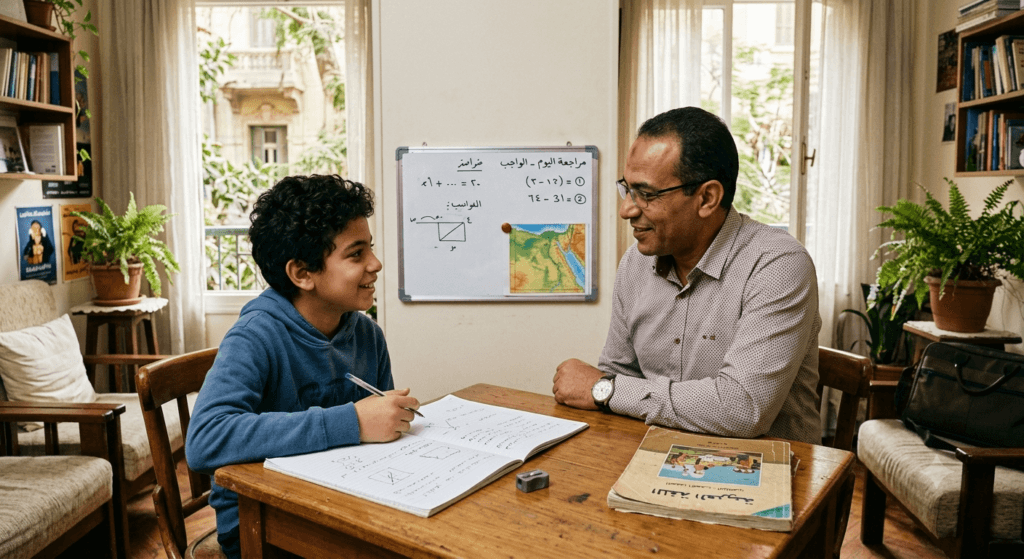
Arabic Classes for Kids in Maadi: What Actually Works for Ages 8–18
By Muhammad Mourtada — Founder, eArabicLearning · Native Egyptian Arabic
teacher with 20+ years of experience · 📚 Learn Arabic For Kids
Quick answer: The best Arabic classes for kids in Maadi
combine two things most parents don’t realize need to be separated: conversational
Egyptian Arabic for daily life, and Modern Standard Arabic (MSA) for reading,
writing, and formal structure. For children already enrolled in an international
school, the most effective programs are built to support — not compete with —
the school’s own curriculum and homework load, usually through one or two
focused sessions a week rather than a full second academic subject.
If you’ve lived in Maadi for a year or two, you’ve probably already had the
moment: your eight-year-old can order koshary from the guy on Road 9 better
than you can, but can’t read a single word of the menu. Or your fifteen-year-old
understands every joke her friends make in Arabic but freezes the second a
teacher asks her to write a sentence. That gap — spoken fluency racing ahead of
literacy, or the reverse — is close to universal among expat kids growing up
here, and it’s exactly what a well-built Arabic program is supposed to close.
This guide walks through what actually works: how to choose between
conversation and MSA, how lessons fit around an international school schedule,
what a realistic week looks like at different ages, and the mistakes we see
parents make most often after two decades of teaching families in Maadi.
🎯 Ready to start? Book a free trial Arabic lesson
for your child with a native teacher in Maadi.
Why Arabic Still Matters for Kids Who Are Already Fluent in English
Parents sometimes ask us, reasonably, why they should bother with formal
Arabic lessons at all. Their child is enrolled at Cairo American College or
Maadi British International School, spends every day surrounded by Arabic-speaking
staff and classmates, and seems to be picking things up fine on their own.
Here’s the pattern we see after years of teaching in Maadi: passive exposure
builds listening comprehension and a fair amount of vocabulary, but it rarely
builds reading, writing, or grammatical structure — the parts of a language
that don’t just happen through osmosis. A child who’s lived in Maadi since age
six might speak conversational Egyptian Arabic more naturally than their
parents ever will, and still be functionally unable to read a street sign,
because nobody ever taught them the alphabet in a structured way.
There’s also a longer-term consideration. Kids who grow up abroad and never
formalize the local language often lose most of it within a few years of
leaving — the accent and vocabulary fade fast without deliberate reinforcement.
Structured lessons, even light ones, are what make Arabic a lasting skill
rather than a temporary side effect of living in Cairo.
And for teenagers specifically, there’s a practical university angle: a
documented, assessable level in Arabic — something a private tutor or school
can’t casually vouch for without structure — carries real weight on college
applications and language-credit exams, especially for students applying to
programs with a Middle East studies, international relations, or language
concentration.
Egyptian Arabic vs. Modern Standard Arabic for Kids — Which Comes First?
Quick answer: Most children living in Maadi benefit from
starting with conversational Egyptian Arabic, since it’s what they hear every
day and gives them fast, motivating wins. MSA is layered in once basic
literacy and confidence are in place — usually a few months in, and often
sooner for kids already reading well in English.
This is the single most common question we get from parents, and it’s
worth understanding the actual difference before choosing:
| Aspect | Egyptian Arabic (Ammiya) | Modern Standard Arabic (MSA / Fusha) |
|---|---|---|
| What it’s for | Daily conversation — friends, staff, shopping, the street | Reading, writing, formal contexts, cross-regional communication |
| Where kids hear it | Constantly, throughout Maadi and Cairo generally | Rarely in casual settings — mainly in books, news, and school |
| Best for | Younger children (8–11), kids wanting quick social confidence | Older children and teens, kids needing reading/writing skills |
| Learning curve | Faster spoken progress, since it matches lived experience | Slower start, but builds transferable literacy and grammar |
| Typical use case | A 9-year-old wanting to talk to friends and staff comfortably | A 16-year-old preparing for university-level Arabic credit |
In practice, we rarely teach one in complete isolation. A typical program
for an 8- to 11-year-old might run 70% conversational Egyptian Arabic and 30%
foundational alphabet and reading in MSA. By the young-teen years, that ratio
often flips, especially for a student aiming at a school Arabic requirement
or an eventual language exam.
How Arabic Lessons Fit Around an International School Schedule
This is where a lot of well-intentioned plans fall apart. Parents enroll
their child in Arabic lessons on top of an already full school week — sports
practice, homework, a second language requirement at school itself — and the
Arabic lessons are the first thing to get dropped when November gets busy.
The programs that actually last are built as support, not as a
second curriculum. That usually means:
- One to two sessions a week, not five — enough for steady
progress without becoming another subject to dread. - Scheduling around, not against, school commitments —
late afternoon or early evening slots after the school day ends, or weekend
sessions for families who prefer to keep weekdays clear. - Coordinating with the school’s own Arabic class where one
exists. Several international schools in Maadi offer a basic Arabic-as-
a-foreign-language block; a private tutor who knows what’s being covered
there can reinforce it instead of duplicating or contradicting it. - Realistic pacing during exam periods — a program that
can flex to lighter sessions during a child’s school exam weeks, rather than
insisting on a fixed unchangeable schedule.
One family we’ve worked with — a British diplomatic household with two
children at different schools in Degla Maadi — split lessons deliberately:
their younger child did two 45-minute conversational sessions a week focused
on daily Arabic and vocabulary games, while their teenager did one longer
weekly session focused on MSA reading, timed specifically around her school’s
own Arabic exam schedule so the two never competed for the same week’s
attention.
🎯 Want to see exactly what our Cairo program includes? Explore the in-person Arabic program in Maadi
What a Week of Arabic Lessons Actually Looks Like, by Age
Ages 8–11: Building the Foundation Through Play and Conversation
At this age, the goal is confidence and enjoyment more than formal grammar.
A typical week might include one 45-minute conversational session focused on
everyday vocabulary — food, family, school, weekend plans — built around
games, simple stories, and short dialogues, plus one shorter session
introducing the Arabic alphabet through writing practice and read-aloud
picture books. Homework, if any, is light: a handful of words to review, not
a worksheet packet.
Ages 12–14: Splitting Time Between Speaking and Reading
Early teens generally handle a slightly heavier structure well — often two
sessions a week, one leaning conversational (practicing real scenarios: ordering
at a café on Road 9, chatting with a doorman, describing a weekend) and one
building MSA reading and basic grammar. This is also the age where connecting
lessons to something a student already enjoys — a show, a game, a hobby —
tends to matter more than at younger ages, since motivation starts depending
more on relevance and less on novelty.
Ages 15–18: Structured MSA With a Clear Goal
Older teens tend to do best with a defined target: a school exam, a
university language-credit test, or simply a self-set fluency goal before
graduating and possibly leaving Egypt. Sessions at this age lean more heavily
toward MSA grammar, reading comprehension, and structured writing, usually
one to two sessions weekly of 60 minutes each, with conversational Egyptian
Arabic folded in as a secondary track to keep spoken skills from going stale
while the reading and writing work intensifies.
Choosing a Class Format: Private, Small Group, or Hybrid
Format matters as much as content for kids, arguably more than it does for
adult students. A private one-on-one lesson lets pacing match the child
exactly — useful for a shy child, a child behind their peers, or a child with
a specific gap (say, strong speaking but weak reading). A small group of two
to four similarly aged children, often other expat kids in Maadi facing the
same gap, can work better for a more social child, since peer motivation and
light competition often keep a young learner engaged longer than a one-on-one
setting does.
A hybrid approach — one private session for targeted correction, one small
group session for conversation practice — is increasingly common among
families we work with, and tends to combine the personalization of private
tuition with the social element that keeps kids showing up.
Online lessons can supplement in-person ones well, particularly during
travel, school breaks abroad, or short stretches when a family is away from
Maadi. But for children specifically, most instructors — including our own
teaching team — find in-person sessions considerably more effective for
sustained attention and pronunciation correction, especially under age 12.
What Arabic Classes for Kids Cost in Maadi
Pricing depends on format, session length, and whether lessons are private
or small group. As a general guide at the time of writing: private one-on-one
sessions for children in Maadi typically run somewhat lower than adult private
rates, given shorter session lengths (usually 45 rather than 60 minutes), while
small-group sessions cost less per child than private lessons because the cost
is shared. Multi-month packages, common for families settled in Maadi
long-term, generally bring the effective per-session cost down further.
These figures move over time and depend on your child’s age, the format you
choose, and current availability, so treat any number as a starting point
rather than a quote. Contact us directly
for current pricing based on your child’s age and schedule.
Maadi In-Person vs. Online vs. Hybrid — Which Fits Your Family?
| In-Person (Maadi) | Online | Hybrid | |
|---|---|---|---|
| Best for | Younger children, kids needing pronunciation correction and sustained attention | Travel periods, summer breaks abroad, older self-motivated teens | Families wanting consistency plus flexibility around trips or exams |
| Pros | Strongest engagement, real-time correction, social element with peers | No commute, easy to keep going while traveling | Best of both — doesn’t fully pause during travel |
| Cons | Requires a fixed local schedule slot | Harder to hold a young child’s attention over a screen | Slightly more coordination to arrange |
| Cost range | Standard in-person rate | Generally similar or slightly lower | Blended, depending on split |
Most families settled in Maadi long-term default to in-person lessons as
the core, with online sessions kept in reserve for summer travel or a family
trip abroad — rather than choosing one format exclusively.
Common Mistakes Parents Make — And How to Avoid Them
Quick answer: The most common mistakes are starting MSA
too early for a young child, treating Arabic lessons as a full second subject
instead of light support, picking a tutor with no specific experience teaching
children, and stopping the moment school gets busy instead of simply
lightening the schedule.
- Starting with MSA grammar before conversation. A young
child taught formal grammar before they can say a simple sentence out loud
tends to disengage quickly. Speaking confidence first, structure second,
almost always works better for kids under 12. - Overloading the schedule. Two well-paced sessions a week
beat five rushed ones. Burnout, not lack of talent, is the most common reason
kids quit. - Choosing a teacher experienced only with adults. Teaching
methodology for children is a distinct skill — pacing, patience, and framing
lessons as engaging rather than academic all differ significantly from
adult instruction. Ask directly how many child students a teacher currently
works with before committing. - Dropping lessons entirely instead of adjusting them.
During a school’s exam season, lightening the load (shorter sessions, review
instead of new material) keeps momentum without adding pressure — quitting
outright means starting over later. - Ignoring the reading-writing gap. A child who speaks
Arabic comfortably but was never taught to read it will not “pick it up”
on their own past a certain point. Literacy needs deliberate teaching, even
for a child who sounds fluent.
Frequently Asked Questions
How much do Arabic classes for kids cost in Maadi?
Costs vary by format and age — private lessons generally cost more per
session than small-group classes, and multi-month packages typically lower
the effective rate. Contact us for current pricing specific to your child’s
age and schedule.
Is 8 the right age to start, or can older teens start from scratch too?
Eight is a strong starting age because children at this stage pick up
conversational patterns quickly and enjoy game-based learning. That said,
teenagers starting from zero at 15 or 16 do just as well with a program
paced for their age — the material and approach simply shift toward more
structured, goal-oriented lessons rather than play-based ones.
Should my child learn Egyptian Arabic or Modern Standard Arabic first?
For most children living in Maadi, conversational Egyptian Arabic first
makes sense, since it matches what they hear daily and builds quick
confidence. MSA is introduced once basic speaking comfort and early literacy
are in place, usually within the first few months.
Will Arabic lessons interfere with my child’s international school workload?
Not if the program is built as light support rather than a second subject.
One to two well-paced sessions a week, scheduled around school hours and
adjusted during exam periods, generally fits comfortably alongside a full
school schedule.
How do I know if my child is actually progressing?
A good program includes a starting placement assessment and periodic
informal check-ins so you can see concrete movement — new vocabulary used
spontaneously, reading a short passage independently, holding a longer
conversation — rather than vague reassurance that “they’re doing great.”
Can lessons combine online and in-person as our schedule shifts?
Yes. Many families keep in-person lessons as the default and shift
temporarily to online sessions during summer travel or a trip abroad, then
return to in-person once back in Maadi, without losing continuity with the
same teacher.
Does eArabicLearning teach Quranic Arabic to kids as well?
Yes, though it’s a distinct program from conversational and MSA lessons.
If Quranic Arabic and tajweed are part of what you’re looking for, our
guide to choosing a Quranic Arabic teacher for your family
covers that separately.
What if my child already speaks some Arabic but struggles with reading or writing?
This is one of the most common profiles we see among kids raised in Maadi
— strong listening and speaking, weak literacy. A placement assessment
identifies exactly where the gap sits, and lessons focus specifically on
reading and writing rather than repeating conversational material the child
has already absorbed.
The Bottom Line
Kids growing up in Maadi have an advantage almost no classroom-only
learner gets: daily, real exposure to Arabic all around them. What usually
turns that exposure into an actual skill — one that lasts past childhood — is
a light, well-paced program that separates conversation from literacy, fits
around school rather than competing with it, and adjusts as your child gets
older. It doesn’t need to be complicated, and it definitely doesn’t need to
be a second full subject. It just needs to be consistent.
🎯 Start your child’s Arabic journey with a native teacher —
book a free trial lesson today.