
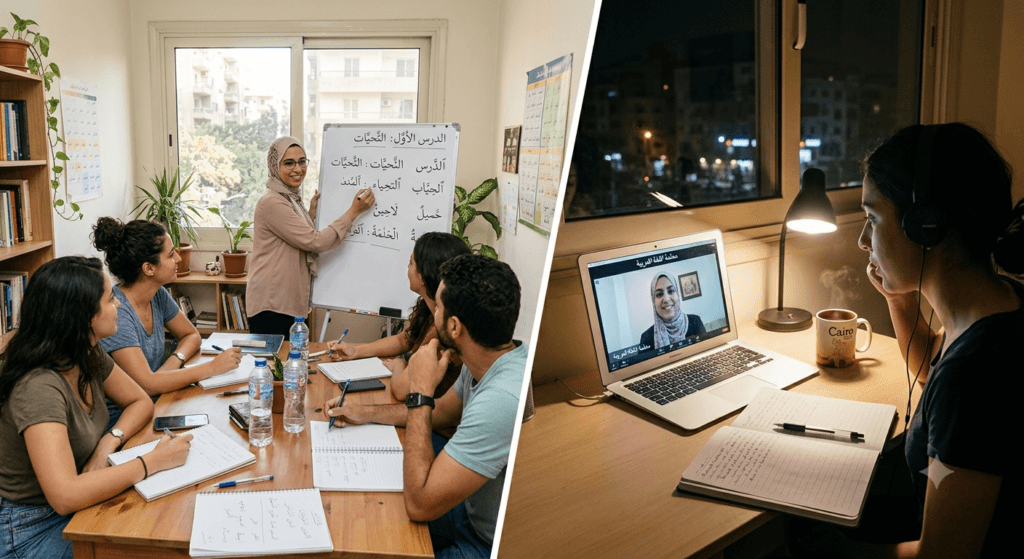
Cairo vs Alexandria vs Online: Which Way to Learn Arabic Actually Fits You?
If you’ve been going back and forth between moving to Cairo, choosing Alexandria instead, or just starting Arabic lessons online from wherever you already live — you’re not overthinking it. This is a real decision with real trade-offs, and the “right” answer depends less on which city sounds nicer and more on your schedule, your budget, and how fast you actually need to progress.
Short answer, right up front: Cairo (specifically Maadi) is the strongest choice for full immersion and daily practice outside class, Alexandria suits learners who want a quieter, coastal pace with still-solid access to native speakers, and online is the right call if relocation isn’t realistic yet but you don’t want to lose momentum. The rest of this guide breaks down exactly when each option wins.
We’ve taught Arabic to expats, diplomats, and study-abroad students <sup>for over 20 years</sup>, both in our Maadi center and through our online program, so this isn’t a theoretical comparison — it’s based on watching thousands of students choose one path, sometimes switch, and tell us what actually worked.
🎯 Not sure yet which fits you? Book your free trial Arabic lesson with a native teacher and we’ll help you figure it out on the call.
Quick Answer: Which One Should You Pick?
- Choose Cairo (Maadi) if you’re relocating, want daily immersion, and need Arabic for real life — errands, work, relationships — not just conversation practice once a week.
- Choose Alexandria if you want an in-person, native-teacher experience with a slower pace, lower cost of living, and easy beach access, and you don’t need Cairo’s expat infrastructure.
- Choose online if you’re not moving to Egypt anytime soon, want to build a strong foundation first, or need a flexible schedule around work or family.
- Combine two of them if you want the best of both — many of our students start online, then finish with an immersion block in Maadi.
Why This Decision Matters More Than People Expect
Arabic isn’t like French or Spanish, where an app and a weekly class can get you conversational in a few months. Between Modern Standard Arabic (MSA) and the Egyptian Arabic (Cairene) dialect, plus a script that takes real repetition to internalize, where and how you study changes your timeline more than almost any other factor.
A learner doing thirty minutes online twice a week will progress. A learner doing the same lessons while living in Maadi, ordering food in Arabic, and chatting with a doorman every day will progress two to three times faster — not because the lessons are different, but because the exposure outside class is doing half the work.
That’s the real trade-off underneath “Cairo vs Alexandria vs online”: it’s immersion versus flexibility, and cost versus convenience.
Option 1: Learning Arabic in Cairo (Maadi)
Cairo is Egypt’s largest city and its practical center of gravity — government, business, diplomacy, and the largest concentration of long-term expats in the country. Maadi specifically has become the default base for foreign residents: leafy streets, international schools nearby, a large diplomatic and NGO community, and enough day-to-day infrastructure (grocery delivery, ride-hailing, familiar cafes) that you’re not fighting culture shock and Arabic homework at the same time.
Who Cairo fits best:
- Diplomats and their families on a multi-year posting
- Remote workers relocating to Egypt long-term
- Study-abroad students doing a semester or summer immersion
- Anyone who wants Arabic for real daily use, not just travel phrases
What makes Cairo different from just “studying in Egypt”: the volume of daily interaction. A trip to a Maadi grocery store, a conversation with a taxi driver, a WhatsApp message to a landlord — every one of these becomes low-stakes practice. Our teachers regularly build homework around that exact week’s real-life encounters, which you simply can’t replicate from abroad.
If you want the deeper picture of what makes Cairo specifically work for Arabic learners, we cover it in more detail in our guide to learning Arabic in Cairo, and our Maadi-specific breakdown walks through the neighborhood itself — safety, transport, and where our center sits in relation to the expat community.
Option 2: Learning Arabic in Alexandria
Alexandria is Egypt’s second city and its Mediterranean face — calmer, more affordable, and culturally distinct from Cairo’s density and pace. For learners who want in-person instruction and daily immersion without Cairo’s traffic and cost, Alexandria is a legitimate option, particularly for shorter stays or learners prioritizing lifestyle alongside study.
Who Alexandria fits best:
- Learners who want a quieter pace and lower daily cost than Cairo
- Short-term immersion trips (a few weeks to a couple of months)
- Students who want beach access and a smaller-city feel alongside Arabic study
- Anyone less dependent on a large expat/diplomatic support network
The trade-off: Alexandria has a smaller foreign community than Maadi, fewer international amenities, and — depending on your program — potentially less flexibility in scheduling around a smaller local teaching team. For many learners this is a fair exchange for cost and calm; for others, especially those who want a built-in expat social circle while studying, Cairo remains the stronger fit.
Option 3: Learning Arabic Online
Online Arabic instruction has closed most of the gap that used to exist between remote and in-person learning — especially for building MSA foundations, grammar, reading, and structured vocabulary. What it can’t fully replace is the ambient exposure: overhearing Arabic, being forced to use it under real pressure, picking up dialect quirks that never make it into a textbook.
Who online fits best:
- Learners not relocating to Egypt in the near term
- K-12 families and heritage speakers maintaining or building Arabic from home
- Busy professionals who need flexible scheduling around work hours
- Anyone wanting to build a strong base before an eventual immersion trip
Where online genuinely competes with in-person: one-on-one lessons with a dedicated native teacher, consistent weekly rhythm, and no commute or relocation cost. Where it falls short: the unplanned, unscripted practice that comes from simply living somewhere Arabic is spoken.
Egyptian Arabic vs MSA — Does Your Location Change What You Should Study?
Not directly, but it does change how naturally you absorb it. If your goal is conversational Egyptian Arabic (the Cairene dialect), being physically in Cairo means every outing reinforces what you learned in class. Studying the same dialect from abroad still works — you’re just relying entirely on your lessons and media exposure (Egyptian TV, music, podcasts) to do the reinforcement your surroundings would otherwise handle for free.
| Egyptian Arabic (Cairene) | Modern Standard Arabic (MSA) | |
|---|---|---|
| Best for | Daily conversation, relationships, living in Egypt | Reading, news, formal writing, Quranic study, pan-Arab communication |
| Where it’s reinforced fastest | Cairo, in daily life | Anywhere — classroom-driven regardless of location |
| Difficulty | Easier spoken fluency, less formal grammar upfront | Steeper grammar curve, more transferable across the Arab world |
| Who it’s for | Expats, spouses, long-term residents | Students, researchers, diplomats needing formal register, heritage learners |
Most of our Cairo-based students actually study a blend — MSA for structure and literacy, Egyptian Arabic for real conversation — which our teachers can calibrate whether you’re in Maadi or joining online.
🎯 Want to see exactly what our Cairo program includes? Explore the in-person Arabic program in Maadi
Side-by-Side Comparison: Cairo vs Alexandria vs Online
| Cairo (Maadi) | Alexandria | Online | |
|---|---|---|---|
| Best audience fit | Relocating expats, diplomats, long-term residents, study-abroad students | Short-to-medium stays, budget-conscious learners, quieter pace | Non-relocating learners, busy professionals, families abroad |
| Immersion level | Highest — daily real-world reinforcement | High, smaller expat network | Structured lessons only, no ambient exposure |
| Approximate monthly cost* | Higher (course + Cairo cost of living) | Moderate (course + lower cost of living) | Lowest (course fees only, no relocation cost) |
| Flexibility | Fixed schedule around center hours, some flexibility for private lessons | Similar, smaller scheduling pool | Highest — schedule around your own time zone and work |
| Community/support | Largest expat & diplomatic network | Smaller, more local | None built-in, but access to online student community |
| Time to conversational fluency | Fastest for spoken Egyptian Arabic | Fast, slightly slower than Cairo on average | Slowest for spoken fluency, comparable for reading/grammar |
*Cost ranges vary by program length, accommodation choice, and lifestyle — these are general guides only, not fixed quotes. Contact us for current pricing specific to your situation.
Real Students, Real Choices
The diplomat’s spouse: relocating to Maadi for a three-year posting, she needed Arabic for daily life — the market, the kids’ school, neighbors — not an exam. In-person Cairo classes plus daily errands got her conversational within four months, faster than she expected, mostly because every lesson had homework she’d already half-completed just by living there.
The remote worker planning a move: based in the US, working remotely for a company relocating him to Cairo in eight months, he started online to avoid arriving with zero foundation. By the time he landed in Maadi, he switched to in-person lessons and skipped straight past the beginner phase most newcomers go through.
The study-abroad student: on a one-semester program, she split her time — structured MSA grammar online before arrival, then Egyptian Arabic immersion once she landed in Cairo. That sequencing meant her in-person time focused entirely on speaking practice instead of catching up on basics.
None of these are unusual patterns — they’re close to the three most common paths our students actually take.
Can You Combine Two of These? (Yes, and It Often Works Best)
This is one of the most underrated options: start online to build a foundation, then transition to Cairo (or Alexandria) once you’re ready to relocate or travel. Or the reverse — do an immersion trip to Maadi, then maintain momentum with online lessons once you’re back home. Our teachers are the same across both formats, so nothing gets lost switching between them; your lesson history and progress carry over.
🎯 Ready to start? Book your free trial Arabic lesson with a native teacher — online, in Maadi, or both.
Common Mistakes Learners Make When Choosing
- Picking based on romance, not logistics — Alexandria’s coastline is lovely, but if your job, visa, or family situation ties you to Cairo, fighting that reality slows you down.
- Assuming online can’t get you conversational — it can, especially for MSA and grammar; the gap is narrower than most people think, particularly with consistent one-on-one lessons.
- Assuming immersion alone is enough — living in Cairo without structured lessons plateaus fast. Immersion accelerates learning; it doesn’t replace it.
- Not planning the transition — if you know you’ll eventually move to Egypt, starting online months in advance (rather than starting from zero on arrival) saves real time.
So, Which One Is Right for You?
Ask yourself three questions:
- Am I relocating to Egypt in the next few months, or not? If yes, lean Cairo or Alexandria. If no, start online.
- Do I need Arabic for daily survival, or for structure and literacy? Daily survival favors Cairo’s immersion. Structure and reading favor a strong online foundation first.
- What’s my budget and timeline? Cairo is the fastest path to fluency but the highest cost; online is the most flexible and affordable; Alexandria sits between the two.
There’s no wrong answer here — only a better or worse fit for where you are right now. If you’re still unsure, that’s exactly what a free trial lesson is for: a real teacher can help you map out the right sequence for your specific situation rather than guessing from a blog post.
🎯 Start learning Arabic with a native teacher — book your free trial lesson today
Frequently Asked Questions
Is it better to learn Arabic in Cairo or online? Cairo offers faster spoken fluency through daily immersion; online offers flexibility and lower cost with no relocation required. If you’re moving to Egypt soon, Cairo wins. If you’re not relocating yet, start online and transition later.
What’s the real difference between studying in Cairo and Alexandria? Cairo has a larger expat and diplomatic community, more international infrastructure, and the fastest immersion. Alexandria is calmer, generally more affordable, and still offers real in-person instruction with native teachers, just with a smaller foreign community.
Can I combine online and in-person Arabic lessons? Yes — many students start online to build a foundation, then move to in-person immersion in Maadi once they relocate or travel, or do the reverse after an immersion trip ends. Your teacher and progress carry over between formats.
Is Maadi a good base for foreign Arabic students in Cairo? Yes. Maadi has the largest concentration of expats and diplomats in Cairo, along with strong transport links, familiar amenities, and a safety profile that suits families and long-term residents.
How much does it cost to study Arabic in Cairo vs Alexandria vs online? Online is generally the lowest cost since there’s no relocation involved. Cairo tends to be the highest due to cost of living, with Alexandria falling in between. Exact figures depend on program length and accommodation — contact us for current pricing.
Do I need to be in Egypt to learn Egyptian Arabic well? No, but it helps significantly. Egyptian Arabic can be learned to a strong conversational level online through consistent lessons and media exposure; being in Cairo simply accelerates that process through daily reinforcement.
Which option is best for diplomats and study-abroad students specifically? Cairo, generally — the existing diplomatic and academic community in Maadi provides both instructional and social infrastructure that shortens the adjustment period, which matters most for time-limited postings or semesters.
How do I switch from online lessons to in-person study in Cairo later? Easily, if you’re already studying with the same program — your lesson history, level, and teacher relationship transfer directly, so you’re not restarting once you arrive.