
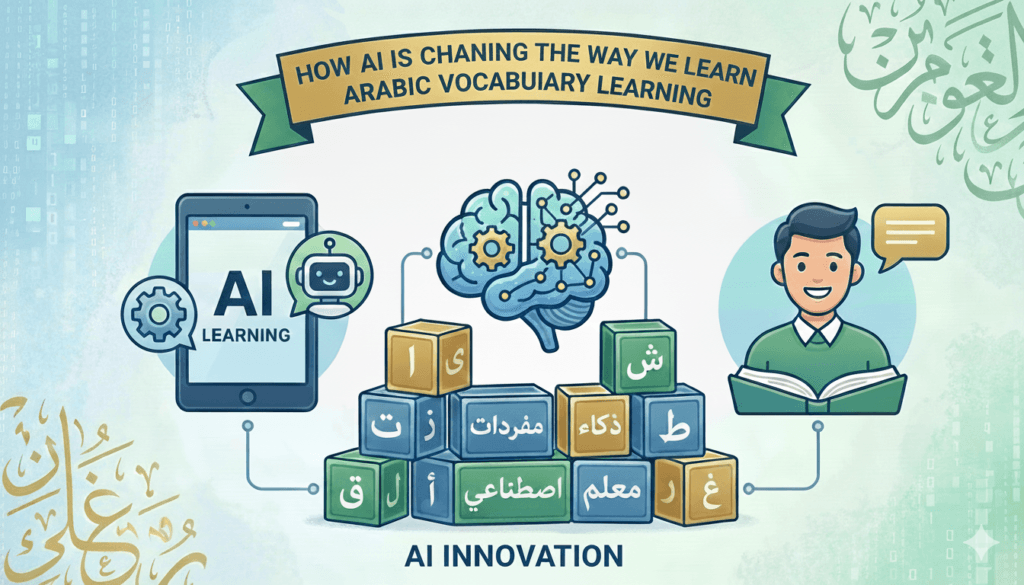
Artificial Intelligence is changing how people learn languages — but Arabic is a special case.
AI is not just speeding things up.
It’s changing the learning process itself: how words are introduced, practiced, reviewed, and remembered.
The problem?
Most learners don’t understand what AI should change — and what should never change when learning Arabic vocabulary.
This article explains what is actually different now, what has improved, and where AI still falls short.
Before AI: Why Arabic Vocabulary Learning Was Slow
Traditional Arabic vocabulary learning relied heavily on:
Long word lists
Dictionary memorization
Translation-based learning
Passive exposure
This caused three major problems:
Words were memorized but quickly forgotten
Learners couldn’t retrieve vocabulary in real situations
Vocabulary was disconnected from grammar and usage
Arabic’s root system made this even harder for non-native learners.
What AI Changed First: Access to Explanation
The biggest early impact of AI was instant explanation.
Today, learners can:
Ask why words share the same root
Compare similar words instantly
Get multiple examples on demand
Understand patterns instead of memorizing forms
This matters deeply in Arabic, where:
One root can generate dozens of related words
Meaning depends on pattern and context
Small changes create major shifts in usage
AI reduced confusion — but explanation alone doesn’t create mastery.
AI and Context-Based Vocabulary Learning
One of the most important changes AI introduced is context generation.
Instead of isolated words, learners can now see:
Words inside realistic sentences
Vocabulary grouped by themes
Usage variations across situations
This aligns perfectly with how vocabulary is actually retained:
Words stick when they are used, not when they are listed.
However, AI-generated context still needs human verification — especially in Arabic.
Personalized Vocabulary Practice (A Real Breakthrough)
Before AI, personalization was limited.
Now, AI can:
Adjust examples to learner level
Focus on weak vocabulary areas
Generate targeted practice instantly
Support spaced repetition systems
This allows learners to practice what they need, not what the textbook assumes.
But personalization without structure leads to randomness — a common mistake.
AI Reduced Fear, Not Effort
One underrated change: psychological safety.
Learners now:
Practice without fear of embarrassment
Ask “simple” questions freely
Repeat explanations endlessly
Experiment more with language
This is powerful — especially for speaking-related vocabulary.
But reduced fear should not mean reduced discipline.
Where AI Still Fails Arabic Learners
Despite progress, AI still struggles with:
Natural collocations
Dialect accuracy
Cultural nuance
Subtle word choice
Long-term learning paths
Arabic vocabulary is not just linguistic — it’s cultural and contextual.
This is where human teachers remain irreplaceable.
The Shift: From Memorization to Systems
The real change AI brought is system thinking.
Smart learners now:
Learn vocabulary by roots and patterns
Practice retrieval, not recognition
Connect vocabulary with grammar early
Use AI to reinforce, not lead
This mirrors the core idea of the pillar article:
AI works best when it supports a structured learning system.
How Teachers and AI Now Work Together
The most effective modern approach looks like this:
Teachers design the learning path
Vocabulary is introduced in meaningful groups
AI explains, drills, and reinforces
Teachers correct, refine, and contextualize
Learners review using spaced repetition
AI increased speed.
Teachers protect accuracy.
What Hasn’t Changed (And Never Will)
Despite all innovation:
Vocabulary still requires repetition
Usage still matters more than meaning
Context still beats translation
Human correction still saves time long-term
AI didn’t remove effort — it removed wasted effort.
Final Thought: AI Changed the Tools, Not the Goal
The goal is still the same:
To understand, retrieve, and use Arabic vocabulary naturally.
AI simply gave learners:
Faster feedback
Better explanations
Smarter practice
When used wisely, AI doesn’t replace teachers —
It amplifies good teaching.
Related Pillar Article
👉 The Ultimate Guide to Building Arabic Vocabulary the Smart Way (AI + Teachers)
✅ FAQs – How AI Is Changing the Way We Learn Arabic Vocabulary
1. How has AI changed Arabic vocabulary learning?
AI has made explanations faster, practice more personalized, and vocabulary learning more contextual. Learners now understand patterns and roots more easily, instead of memorizing isolated words.
2. Does AI make learning Arabic vocabulary easier?
AI reduces confusion and wasted effort, but it does not remove the need for repetition, structure, or correction. Learning Arabic vocabulary is still a disciplined process.
3. Is AI better than traditional methods for learning Arabic words?
AI improves traditional methods but does not replace them. The best results come from combining AI tools with structured courses and teacher guidance.
4. What is the biggest benefit of AI for Arabic learners?
The biggest benefit is instant explanation and personalized practice. Learners can explore word roots, patterns, and usage on demand.
5. What are the limitations of AI in Arabic vocabulary learning?
AI still struggles with dialect accuracy, natural collocations, cultural nuance, and long-term learning paths. These areas require human teachers.
6. Has AI replaced memorization in Arabic learning?
No. AI has shifted learning away from blind memorization toward system-based learning, but repetition and retrieval practice are still essential.
7. Is AI more useful for Modern Standard Arabic or dialects?
AI is generally more reliable with Modern Standard Arabic. Dialects require cultural and spoken context that AI alone cannot consistently provide.
8. Will AI eventually replace Arabic teachers?
No. AI can support learning, but it cannot design effective learning paths, correct subtle usage errors, or adapt teaching strategies like experienced teachers.