
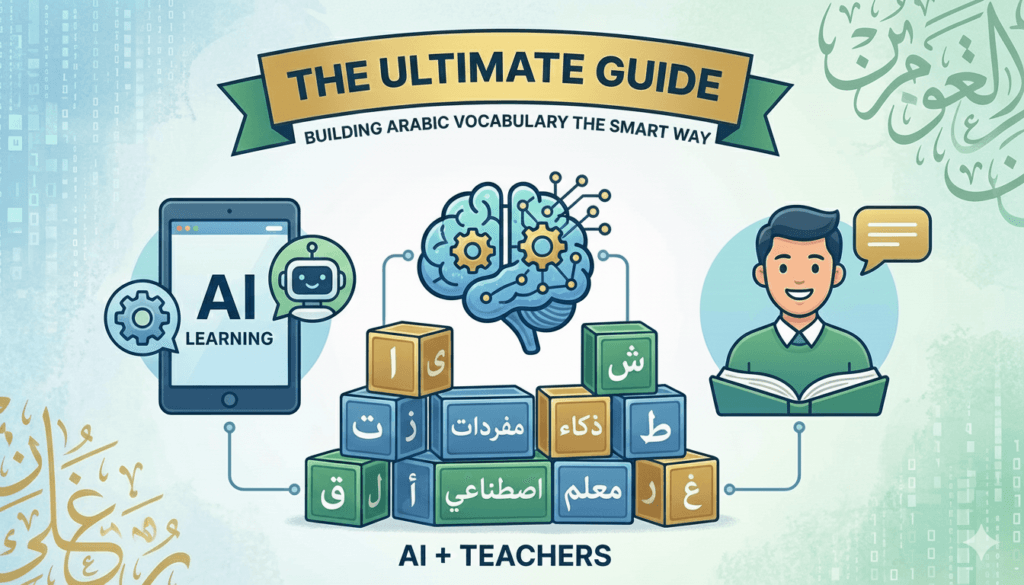
Learning Arabic vocabulary is not about collecting words like trading cards. It’s about building usable language—words you can understand, retrieve, and apply naturally when reading, listening, speaking, and writing.
Many learners fail not because Arabic is “too hard,” but because they follow inefficient methods: memorizing random word lists, over-focusing on grammar, or relying entirely on apps without human feedback.
This guide explains how Arabic vocabulary actually sticks, why combining AI tools with real teachers works best, and how learners at eArabicLearning.com can build vocabulary faster, deeper, and more sustainably.
This is not theory. It’s a system.
Why Arabic Vocabulary Is the Real Foundation of Fluency
Grammar explains how Arabic works. Vocabulary determines whether you can use it at all.
You can know every verb pattern and still fail in conversation if you lack words. Native speakers don’t hear grammar—they hear meaning. Vocabulary carries meaning.
Arabic vocabulary is especially demanding because:
Words change meaning by context and register
There is a gap between Modern Standard Arabic (MSA) and dialects
Many words share roots but differ in usage, tone, and form
This is why Arabic vocabulary learning must be strategic, not random.
(For learners who want to understand why memorization alone fails, this topic is explored in depth in our cluster article on learning Arabic vocabulary effectively without word lists.)
Arabic Words Are Not Neutral Labels (Context Matters)
Arabic words carry social and emotional weight.
A simple example:
سعيد – formal, written, neutral
فرحان – spoken, emotional, everyday
Both mean “happy.” Only one sounds natural in daily conversation.
Learning Arabic words in context—sentences, dialogues, stories—is non-negotiable. This is why contextual learning is a core principle at eArabicLearning.com and why we dedicate a full guide to Arabic words in context.
Words learned without context are remembered weakly and used incorrectly.
The Smart Way: AI + Real Teachers (Not One or the Other)
Modern Arabic vocabulary learning works best when AI handles repetition and tracking, while teachers handle meaning and nuance.
What AI Does Exceptionally Well
AI-powered Arabic learning tools help learners by:
Tracking which words you forget
Applying spaced repetition automatically
Presenting vocabulary inside sentences and dialogues
Providing instant feedback on spelling and usage
This makes AI ideal for daily vocabulary exposure and review.
(We break this down fully in our guide on AI Arabic vocabulary learning.)
What Real Teachers Do That AI Cannot
Teachers provide what algorithms cannot:
Cultural context and idiomatic usage
Pronunciation correction at a fine-grain level
Real-life examples from authentic Arabic
Accountability and motivation
At eArabicLearning.com, teachers use AI data to teach smarter, not harder.
This human layer is why learners retain vocabulary instead of cycling through the same words endlessly.
How to Learn Arabic Vocabulary Effectively (The Core Principles)
These principles are consistent across beginner, intermediate, and advanced learners.
1. Learn High-Frequency Arabic Words First
Not all vocabulary is equal.
A few hundred high-frequency Arabic words unlock a huge percentage of daily communication. AI tools help identify these words automatically, which is why we recommend starting here before niche vocabulary.
(This approach is expanded in our article on Arabic vocabulary routines.)
2. Learn Words in Context, Not Isolation
Instead of:
كتاب = book
Learn:
أنا أقرأ كتابًا مفيدًا
Context creates memory hooks. Your brain remembers meaningful usage, not definitions.
This is why our lessons integrate:
Sentences
Short dialogues
Realistic role-play
3. Use Spaced Repetition (Without Managing It Yourself)
Spaced repetition works because it aligns with how memory decays.
AI systems at eArabicLearning.com automatically:
Review weak words more often
Delay strong words
Optimize timing without learner effort
We explain this scientifically and practically in our guide on spaced repetition for Arabic vocabulary.
4. Activate Vocabulary Through Speaking and Writing
Passive recognition is not mastery.
True vocabulary acquisition requires:
Speaking the word
Writing the word
Hearing it used naturally
Teachers play a crucial role here, turning passive knowledge into active language.
Daily and Weekly Arabic Vocabulary System (Realistic, Not Extreme)
Consistency beats intensity.
A strong daily system includes:
AI vocabulary review (10–20 minutes)
Sentence or dialogue practice
Speaking or writing with a teacher
Weekly routines add:
Listening practice
Review sessions
Cultural and idiomatic usage
This structure is detailed step by step in our daily and weekly Arabic vocabulary routine article.
MSA vs Dialects: How Vocabulary Should Be Learned
Arabic learners don’t need to choose between Modern Standard Arabic and dialects. They need both, learned in the correct order.
MSA builds structure, literacy, and comprehension
Dialects enable real conversation and social fluency
At eArabicLearning.com, learners:
Learn the MSA word
Learn the common dialect equivalent
Practice both in context
This strategy is explained fully in our guide on MSA vs Arabic dialect vocabulary.
Practice Is Where Vocabulary Becomes Permanent
Exercises matter—but only when they’re structured.
Effective Arabic vocabulary exercises include:
Contextual sentence building
Listening and repetition
Thematic role-play
Multi-sensory reinforcement
We’ve compiled these into a practical resource:
50+ Arabic vocabulary exercises for all levels.
A 3-Month Roadmap to Strong Arabic Vocabulary
Vocabulary growth should be planned, not accidental.
A realistic roadmap:
Month 1: High-frequency words + simple sentences
Month 2: Thematic vocabulary + conversation
Month 3: Idioms, dialects, and advanced usage
This roadmap is broken down clearly in our 3-month Arabic vocabulary plan.
Why eArabicLearning.com Is Built Around Vocabulary (Not Just Lessons)
Many platforms teach Arabic lessons. Few build vocabulary systems.
At eArabicLearning.com:
AI tracks every word you learn
Teachers activate vocabulary in real contexts
Lessons adapt based on actual performance
Vocabulary is integrated across reading, writing, listening, and speaking
This is why learners stop “studying Arabic” and start using Arabic.
Final Takeaway: Vocabulary Is the Lever
Arabic fluency does not come from grammar alone.
It comes from usable, contextualized, reinforced vocabulary.
The smartest approach is not AI or teachers.
It is AI plus teachers, each doing what they do best.
This guide is your reference point.
The cluster articles linked throughout it go deeper into each component.
Arabic becomes manageable when vocabulary is taught systematically, humanely, and intelligently.
And that’s exactly what we do at eArabicLearning.com.
1. What is the best way to learn Arabic vocabulary?
The most effective way to learn Arabic vocabulary is by combining contextual learning, spaced repetition, and active use in speaking and writing. Learning words in sentences and real conversations leads to faster retention than memorizing isolated lists.
2. How many Arabic words do I need to be fluent?
Basic conversational Arabic requires around 500–800 high-frequency words. Comfortable fluency across reading, listening, speaking, and writing usually requires 2,000–3,000 words learned in context.
3. Is memorizing Arabic vocabulary lists effective?
Memorizing word lists alone is inefficient. Words learned without context are easily forgotten or misused. Vocabulary sticks best when learned through sentences, dialogues, listening, and real communication.
4. Can AI help me learn Arabic vocabulary?
Yes. AI tools are excellent for spaced repetition, tracking weak words, and presenting vocabulary in context. However, AI works best when combined with real teachers who explain nuance, pronunciation, and cultural usage.
5. Do I need a teacher to learn Arabic vocabulary?
A teacher is not optional for long-term progress. Teachers help learners apply vocabulary correctly, understand idioms, distinguish similar words, and use Arabic naturally in real situations.
6. Should I learn Modern Standard Arabic or a dialect first?
Start with Modern Standard Arabic to build structure and comprehension, then add a dialect for real-life conversation. Learning both together, with clear separation, produces the best results.
7. How long does it take to build strong Arabic vocabulary?
With a structured system using AI tools and regular teacher practice, learners can build a strong functional vocabulary in 2–3 months and continue expanding steadily afterward.
8. What makes Arabic vocabulary difficult for learners?
Arabic vocabulary is challenging due to context-dependent meanings, differences between formal and spoken Arabic, root-based word families, and cultural nuances. These challenges disappear with proper guidance and structured practice.