
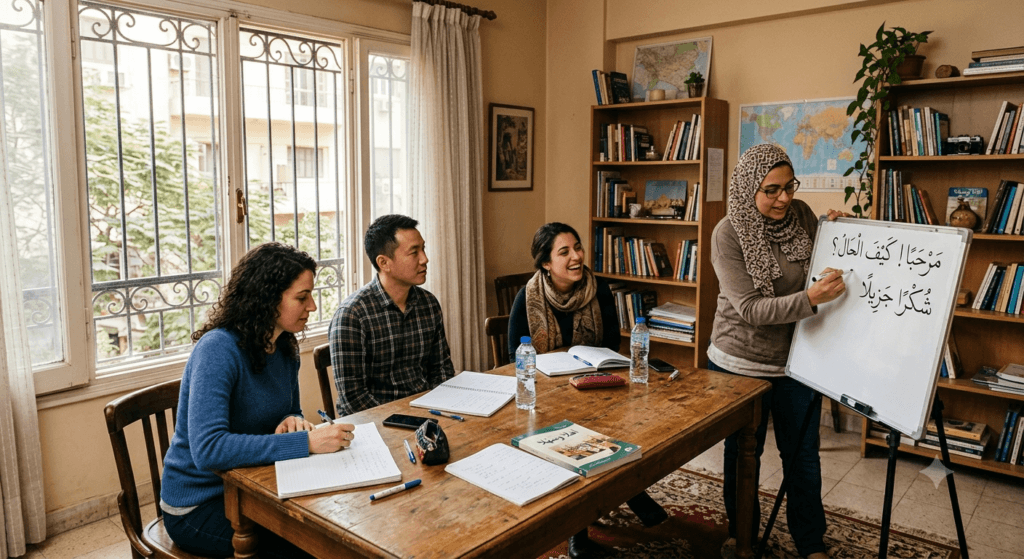
Want to Learn Arabic in Cairo? Here’s What Nobody Tells You Before You Arrive
Cairo is one of the best cities in the world to learn Arabic. It’s also one of the easiest cities to spend three months in and make almost no real progress — if you go about it the wrong way.
I’ve been teaching Arabic to foreigners here for over 20 years, most of them in Maadi. I’ve worked with diplomats who needed functional Egyptian Arabic in six weeks, study-abroad students who arrived with two years of university MSA and couldn’t follow a single conversation at the corner shop, and remote workers who relocated to Cairo without a plan and ended up frustrated. The patterns repeat themselves.
This guide is for anyone who wants to learn Arabic in Cairo and do it properly: right neighborhood, right dialect, right structure, realistic costs, and none of the usual guesswork. Whether you’re arriving next month or still in the planning stage, this is what actually matters.
🎯 Already decided? Book your free trial Arabic lesson with a native teacher in Cairo and start this week.
Why Cairo Is One of the Best Places in the World to Learn Arabic
There’s a short answer and a longer one. The short answer: Cairo is home to 20 million Arabic speakers, the Arab world’s most influential media and film industry, and a daily-life environment where Arabic is unavoidable — on the metro, in the market, with your building’s doorman, in every café. You cannot hide from the language here. That’s the point.
The longer answer has to do with Egyptian Arabic specifically. Egyptians have been producing Arabic-language films, television, and music since the 1920s. As a result, the Cairene dialect is the most widely understood spoken Arabic across the entire Arab world — from Morocco to the Gulf. When you learn Egyptian Arabic in Cairo, you’re not just learning a local dialect. You’re learning the version of spoken Arabic that a Lebanese shopkeeper, a Jordanian colleague, and a Moroccan taxi driver will all follow without difficulty.
That’s a practical advantage most learners don’t think about until later.
Cairo also has something that Gulf cities and even Beirut don’t offer in the same way: a long, established history of hosting foreign learners. The American University in Cairo has been running Arabic programs since the 1920s. Dozens of embassies have trained staff here for decades. The infrastructure for teaching Arabic to adult foreign learners — experienced teachers, tested methods, real-world practice environments — is mature in a way it isn’t in cities that have only recently become popular with international students.
And the cost of living helps enormously. A month of intensive Arabic study in Cairo, including accommodation, food, and transport, typically costs a fraction of what an equivalent program would run in Europe or even Jordan. That matters because the single most important variable in language acquisition is time — and affordability lets you stay longer.
Why Maadi Is the Best Base for Foreign Arabic Learners in Cairo
Cairo is a city of around 20 million people. It is not, on first arrival, a relaxing place to be. Choosing the right neighborhood is genuinely important — not just for comfort, but because where you live directly affects how much Arabic you practice outside class.
Maadi is the right neighborhood for most foreign Arabic learners. Here’s why.
Safety and walkability
Maadi sits south of central Cairo along the east bank of the Nile. It’s tree-lined, relatively quiet by Cairo standards, and walkable in a way that most of the city isn’t. You can walk to the market, to cafés, to your Arabic lesson, and back — and every one of those walks is an opportunity to practice. That daily, low-stakes exposure is exactly what you need in the early weeks, when you’re still too self-conscious to attempt full conversations but you can at least order a coffee, ask the price of something, or say good morning to the shopkeeper.
An established expat and diplomatic community
Several embassies maintain residential compounds in or near Maadi. International schools, multinational company offices, and NGO headquarters are spread through the area. This means two things for Arabic learners: first, you’ll find a ready-made community of other foreigners who are navigating the same learning curve; second, the neighborhood is genuinely used to people who don’t speak Arabic yet — which reduces the friction of early-stage immersion without removing the exposure.
Authentic Egyptian Arabic, not tourist Arabic
There’s a version of Arabic that Egyptians produce for tourists — slower, simplified, sometimes mixed with broken English. Maadi is residential, not touristic, so the Arabic you hear every day is the Arabic Egyptians actually speak with each other. That’s the version you need if your goal is real fluency rather than getting by at the pyramids.
Proximity to the rest of Cairo
Maadi isn’t isolated. Downtown Cairo, Islamic Cairo, Khan el-Khalili, and the Egyptian Museum are accessible by metro in 20–30 minutes. Weekend excursions into the older parts of the city — which are dense with visual Arabic in signs, street names, and shop fronts — naturally extend your learning week without requiring any extra effort.
If you’re planning to study at eArabicLearning’s in-person center, Maadi is exactly where we’re based. It’s not an accident — it’s the neighborhood that has consistently worked best for the students we’ve taught over two decades.
🎯 Want to see what our Cairo program includes? Explore the in-person Arabic program in Maadi.
Egyptian Arabic vs Modern Standard Arabic — Which Should You Study in Cairo?
This question trips up more learners than almost anything else. And the confusion is understandable, because most Arabic textbooks, university courses, and online platforms teach Modern Standard Arabic (MSA) by default — presenting it as “proper” Arabic and treating spoken dialects as secondary.
That framing is unhelpful. Here’s the actual difference.
Modern Standard Arabic (MSA) — called فصحى (fuṣḥā) in Arabic — is the formal written register of the language. You’ll find it in newspapers, official documents, Arabic literature, religious texts, and news broadcasts. It’s understood across all Arabic-speaking countries, but nobody grows up speaking it as their first language. Think of it roughly like Latin in relation to modern European languages: it’s the common root, widely studied, but not what anyone uses over dinner.
Egyptian Arabic — called عامية (ʿāmmiyya), specifically the Cairene dialect — is the spoken language of daily life in Egypt. It’s what your neighbors, colleagues, taxi drivers, shopkeepers, and friends use. It differs from MSA in pronunciation, vocabulary, and grammar — enough that a learner who studied only MSA can genuinely struggle to understand a normal Cairo conversation.
| Feature | Egyptian Arabic (Cairene) | Modern Standard Arabic (MSA) |
|---|---|---|
| Where you’ll hear it | Streets, cafés, markets, daily conversation | News, official documents, formal speeches, religious texts |
| Best for | Living in Cairo, making friends, navigating daily life | Reading, writing, Quranic Arabic, formal diplomacy, academia |
| Grammar for beginners | Simpler verb forms, no case endings in speech | More complex grammar rules, formal case system in writing |
| Regional reach | Widely understood across Arab world due to Egyptian media | Understood in writing and formal speech across all Arab countries |
| Typical learner | Expats, diplomats, students living in Egypt | Academics, journalists, Quran students, formal diplomacy |
| Speed to conversational use | Faster — less formal grammar overhead | Slower for speaking; faster for reading Arabic script |
So which one do you actually study in Cairo?
For most foreigners living in or relocating to Cairo, Egyptian Arabic comes first — because it’s what daily life demands. MSA runs alongside it for reading and writing, in proportions that depend on your specific goals. If you need Arabic for Quranic understanding or academic reading, MSA gets more time. If your goal is to function at work, build friendships, and feel at home in the city, Egyptian Arabic is the priority.
The learners I’ve seen plateau fastest are the ones who studied only MSA for years and never built any comfort with spoken Egyptian. They can read a menu. They can’t order from it without sounding stiff, and they can’t follow the waiter’s response. That’s a fixable problem — but it costs time.
Our guide on learning Egyptian Arabic online goes into more depth on the specific sounds and vocabulary patterns that make the Cairene dialect distinct if you want to get a feel for it before arriving.
What a Typical Week of Arabic Immersion in Maadi Looks Like
People often picture language immersion as simply “being somewhere” — as if proximity to Arabic speakers is enough. It isn’t. The students who make the fastest progress combine structured lessons with deliberate daily practice. Without structure, immersion tends to plateau at survival-level fairly quickly.
Here’s a realistic immersion week at our Maadi center, based on a student studying 15–20 hours per week:
Monday — Placement and orientation. A short spoken and written assessment finds your actual level, which is often different from what you expect. Many people who’ve done several months of online study or app-based learning find they’re stronger in reading/writing than speaking, and weaker in listening comprehension than they’d hoped. The first lesson is calibrated to where you actually are, not where the syllabus assumes you should be.
Tuesday — Functional vocabulary + real-world task. Morning lesson covers a specific theme — ordering food, taking public transport, asking for prices, basic social phrases. In the afternoon, you complete a small assignment in Maadi itself: buy something at a local market using only Arabic, ask a shopkeeper a question, navigate the metro to a specific stop. It sounds simple, but these small missions are where the vocabulary moves from “recognized” to “usable.”
Wednesday — Grammar and pronunciation. A more structured session on the patterns underneath the vocabulary: how verbs work, how sentences are built, how specific Arabic sounds (ع, غ, خ, ح) are produced. Pronunciation work at this stage matters more than most learners think — errors that get embedded early are harder to shift later.
Thursday — Conversation focus. Almost entirely speaking: guided roleplay, free conversation with your teacher, and for students who want it, a short exchange with a local resident in Maadi. The goal is to get comfortable producing Arabic under slight pressure, with corrections offered after rather than mid-sentence.
Friday — Review and cultural context. A lighter session combining review of the week’s material with a cultural or historical topic — often tied to a planned weekend excursion. Going to the Egyptian Museum? We do a quick session on how to read and understand the Arabic labels and descriptions you’ll encounter there. Heading to Islamic Cairo? A few phrases and cultural notes make the visit richer and turn sightseeing into listening practice.
Weekend. Optional, but students who use weekends for short trips — even just to different Cairo neighborhoods — come back on Monday noticeably more comfortable. Travel compresses a lot of Arabic into a short time: reading signs, asking directions, negotiating prices, chatting with people you’ll never see again. Low stakes, high exposure.
For a more detailed breakdown of how multi-week immersion programs are structured, our piece on intensive Arabic courses in Cairo walks through the week-by-week progression from beginner to conversational.
The Real Cost of Studying Arabic in Cairo
Cost is almost always the second question after “which dialect should I learn?” — and it’s worth being direct about it rather than vague.
Cairo is genuinely affordable by Western standards. That’s not marketing language — it’s arithmetic. Here are realistic figures based on what students actually spend in Maadi (as of the time of writing; please contact us directly for current program pricing, as tuition and living costs shift):
| Expense | Typical range (USD/month) | Notes |
|---|---|---|
| Group Arabic course (15–20 hrs/week) | $500 – $1,000 | Varies by group size and program type |
| Private one-on-one lessons | $15 – $30/hour | Higher for business or Quranic Arabic specialization |
| Shared apartment in Maadi | $400 – $800/month | Furnished, includes utilities typically |
| Studio or 1-bedroom apartment | $600 – $1,200/month | Higher-end expat buildings with security |
| Food (eating in + local restaurants) | $200 – $400/month | Cooking at home keeps this toward the lower end |
| Local transport | $30 – $80/month | Metro, rideshare apps, occasional taxi |
| SIM card + mobile data | $5 – $15/month | Data allowances are generous by Western standards |
Put together, a student studying intensively while living modestly in Maadi can expect total monthly costs — tuition, housing, food, and transport — somewhere between $1,100 and $2,200. Compare that to equivalent immersion programs in Jordan, Morocco, or any European country, and Cairo is almost always significantly cheaper.
One thing I tell every prospective student: don’t make the decision on price alone. A slightly higher-priced program with a teacher experienced in working with adult foreign learners will get you to conversational ability faster — and faster progress often means a shorter (and ultimately cheaper) total stay. Three months of good teaching beats six months of mediocre teaching at half the price.
For all current pricing on our Maadi programs, contact us through the Cairo program page — figures are updated regularly and vary by program type and duration.
Visa and Logistics for Foreign Students in Egypt
Visa rules change, so treat what follows as a general orientation rather than legal advice. Always confirm current requirements with the official Egyptian e-visa portal or your nearest Egyptian consulate before booking travel.
Short-term study (a few weeks to one month)
Most Western nationalities can enter Egypt on a tourist visa — either on arrival at major airports or through the official Egyptian e-visa portal before departure. At the time of writing, these typically allow a 30-day stay and can often be extended once at a local passport office. The Mogamma building in central Cairo handles visa extensions for residents of the greater Cairo area, including Maadi.
A 30-day tourist visa is enough for a short immersion program or the Arabic immersion camp experience.
Longer-term study (two months or more)
If you’re planning an extended stay — common for diplomatic family members, remote workers, or serious study-abroad students — a longer-stay or student residency visa is the appropriate route. As a general guide, your Arabic school can provide:
- An enrollment confirmation letter on official letterhead
- A course schedule showing weekly hours and program duration
- Guidance on which district office handles visa extensions for your area
Rules around student visas for language study have varied over the years, so get up-to-date guidance from both the official portal and your school before assuming a specific route is available.
Practical logistics
Housing: Many students arrange short-term furnished accommodation before arrival and look for a longer lease once they can view apartments in person. Maadi has a reasonable supply of furnished flats aimed at the expat and diplomatic community.
SIM card: Available at the airport and across the city on your first day. Egyptian mobile data is inexpensive and fast enough for video calls, which matters if you’re working remotely or maintaining online lessons alongside in-person study.
Banking: Most students rely on international debit cards and cash for daily expenses. Opening a local bank account is generally only practical and worthwhile for stays of six months or more.
Cultural adjustment: Worth flagging because it surprises people. The first week in Cairo is often harder emotionally than linguistically — different pace, different social rhythms, a city that operates in ways that take getting used to. That adjustment is part of the immersion, and navigating it in imperfect Arabic is some of the fastest learning you’ll do. It’s uncomfortable in the right way.
Cairo vs Alexandria vs Online — Which Option Suits You?
Three realistic options for learning Arabic at a serious level in 2026. None of them is universally best; which one fits depends on your life circumstances right now.
| Factor | Cairo (Maadi) | Alexandria | Online |
|---|---|---|---|
| Immersion intensity | Highest — large city, constant Arabic exposure | High, but slower pace and smaller expat network | None outside lessons — depends on self-discipline |
| Cost of living | Low-to-moderate by Western standards | Slightly lower than Cairo in most categories | No relocation cost; lesson fees only |
| Expat/diplomatic community | Large and well-established (especially Maadi) | Smaller, more local-focused | No physical community |
| Pace of city | Fast, dense, demanding | More relaxed, Mediterranean feel | Your own environment |
| Best for | Diplomats, study-abroad students, relocating professionals | Learners wanting coastal living, quieter setting | Those who can’t travel; maintaining progress between trips |
| Access to experienced teachers | Extensive, with adult-learner specialization | Available, generally smaller pool | Extensive via video lessons with eArabicLearning |
| Speed to conversational level | Fastest due to constant immersion | Fast, somewhat less intense | Slower without immersion; consistent with daily lessons |
Cairo (Maadi) wins on immersion intensity and support infrastructure. Alexandria works well for learners who want a coastal pace and don’t need the scale of Cairo’s expat network. Online remains the right choice for anyone who can’t relocate right now but wants structured, consistent progress with a native teacher.
The combination that works best for many students: start online to build a foundation in the Arabic alphabet, basic vocabulary, and pronunciation. Travel to Maadi for an intensive immersion period — anywhere from four weeks to several months. Then continue online after returning home to maintain and build on what you’ve established. Each phase reinforces the others.
eArabicLearning runs programs in all three formats. The transition between online and in-person study is designed to be seamless — your teacher already knows where you are and what you need when you arrive.
🎯 Start learning Arabic with a native teacher — book your free trial lesson today.
Common Mistakes Arabic Learners Make in Cairo — and How to Avoid Them
After two decades of teaching in Maadi, I’ve watched the same avoidable mistakes come up again and again. None of them is about intelligence or aptitude. They’re almost all about planning.
Arriving with only MSA and expecting to follow conversations
University Arabic programs teach MSA. It’s a solid foundation for reading and grammar. It is not Egyptian Arabic. I’ve had students arrive with two or three years of formal MSA study — genuinely impressive grammatical knowledge — who couldn’t follow a conversation between two Egyptians speaking at normal speed. The gap between formal Arabic and spoken Egyptian is real. The fix is to add Egyptian Arabic practice before you arrive, not after you’re already frustrated. Our Egyptian Arabic beginner guide is a good starting point.
Relying on immersion alone without structured lessons
Living in Cairo without structured Arabic lessons is like moving to a gym without a program. You’re in the right environment, but without guidance, most learners plateau at a basic survival level and stay there for months. You overhear Arabic constantly, but you can’t extract patterns from it without a framework. Lessons provide the framework. Immersion fills it in. You need both.
Waiting until you’re “ready” to come
This one is worth saying directly. I regularly hear from prospective students: “I wanted to be more conversational before I came.” That’s backwards. You become conversational by being here, not by preparing to be here. Coming to Maadi with a beginner’s foundation and a month of structure will do more for your Arabic than another year of solo study at home.
Underestimating the first two weeks
The hardest part of arriving in Cairo often isn’t the language — it’s the city itself. Different pace, different social norms, a level of noise and intensity that can be genuinely disorienting. That adjustment period is completely normal, and it passes. But students who don’t expect it sometimes interpret the disorientation as evidence that Arabic is too hard or the program isn’t working. Give it two weeks before drawing conclusions. The curve is steep, then it flattens, then things start to feel natural in a way that’s hard to describe until you’re on the other side of it.
Choosing the cheapest option without asking about experience
Teaching Arabic to Egyptian schoolchildren is a different skill from teaching Arabic to adult foreign learners. The methodology, the pacing, the explanations, the patience with pronunciation — all different. A teacher with genuine experience working with adult non-native speakers will adapt to your needs in real time. Ask specifically about that experience before enrolling.
Not using the core vocabulary as an anchor
Students who arrive in Cairo having internalized a solid base of high-frequency Arabic words — even just 200 to 300 — progress noticeably faster in the first month. The lesson time that would otherwise go to introducing basic vocabulary can go straight to applying it in Egyptian Arabic patterns. It’s worth doing before you get on the plane.
What Students Actually Experience in Maadi
Three patterns that repeat themselves, drawn from students I’ve worked with over the years (details adjusted for privacy):
The study-abroad student with too much MSA and not enough street Arabic
A Canadian student arrived with two years of university Arabic, strong grammar, solid reading. She froze in her first conversation with a shopkeeper. We spent the first two weeks running Egyptian Arabic immersion alongside her existing MSA foundation — pronunciation work, dialect-specific vocabulary, and the kind of fast, informal sentence structures that don’t appear in textbooks. By week four, she was holding short conversations without switching to English. By the end of her semester, she described it as “the first time Arabic felt like something I actually spoke rather than something I studied.”
The diplomat’s spouse with unpredictable scheduling
An American woman relocating to Cairo with her husband’s embassy posting needed flexibility above everything else — embassy social events, early schedule changes, childcare. We built a private twice-weekly lesson plan focused on practical Egyptian Arabic: household situations, social small talk, reading official correspondence in MSA. After four months, the shift she noticed most wasn’t vocabulary — it was that she’d started initiating conversations rather than waiting to be addressed.
The remote worker testing a relocation
A British freelancer moved to Maadi to work remotely while exploring whether Egypt might work as a longer-term base. His lessons ran in the Cairo evenings to accommodate UK business hours. He focused almost entirely on Egyptian Arabic for daily life — markets, transport, building a relationship with neighbors — with light MSA for paperwork. Within ten weeks, he was handling most daily errands in Arabic and had largely stopped treating Maadi as a temporary experiment.
Different goals, different starting points, similar trajectory. Structured lessons plus daily-life exposure in Maadi tends to produce results that neither element produces alone.
Frequently Asked Questions
How much does it cost to learn Arabic in Cairo?
A group immersion program in Maadi typically runs between $500 and $1,000 per month for 15–20 hours of instruction per week. Private one-on-one lessons range from $15 to $30 per hour. Add shared apartment rental ($400–$800/month), food ($200–$400/month), and transport ($30–$80/month), and a realistic total monthly budget for intensive study in Maadi sits between $1,100 and $2,200. That’s considerably less than equivalent programs in Jordan, Morocco, or Europe. For current program-specific pricing, contact eArabicLearning directly — figures are updated regularly.
Is Maadi safe for foreign students?
Maadi is widely regarded as one of Cairo’s safest and most expat-friendly districts. It has hosted foreign families, embassy staff, and international students for decades. Normal urban precautions apply, but the neighborhood’s residential character, walkability, and established international community make it a straightforward base for first-time arrivals in Cairo.
Should I study Egyptian Arabic or Modern Standard Arabic in Cairo?
Egyptian Arabic first, if daily life and conversation are your goals — it’s what you’ll hear around you every day. MSA alongside it for reading, writing, and formal situations. Most students in Maadi benefit from both, weighted according to their specific purpose for being in Cairo. If Quranic Arabic or academic reading is your primary goal, the balance shifts toward MSA from the start.
Do I need prior Arabic knowledge to join an immersion program in Cairo?
No. Programs in Maadi place students based on a short assessment and accommodate complete beginners through advanced learners. Absolute beginners start with the Arabic alphabet, pronunciation, and basic survival phrases. Having 200–300 high-frequency words already memorized before arrival helps significantly, but it’s not a requirement.
How long does it take to become conversational in Arabic in Cairo?
With structured immersion of 15–20 hours of instruction per week combined with daily life in Cairo, most motivated beginners reach basic conversational ability — able to handle everyday situations without switching to English — within 8 to 12 weeks. Comfortable conversational fluency for work and social life generally requires 4 to 6 months of consistent in-person study. The timeline depends on your starting level, what you do between lessons, and whether you’re splitting attention between Egyptian Arabic and MSA or focusing on one.
What visa do I need to study Arabic in Egypt?
Most Western nationalities can enter on a tourist visa (on arrival or via the Egyptian e-visa portal) for stays of up to 30 days, which can usually be extended once. For stays of two months or more, a student or longer-stay residency visa is more appropriate. Your Arabic school can typically provide an enrollment letter to support the application. Visa rules change, so always confirm current requirements with the official Egyptian e-visa portal before booking travel.
Can I combine online and in-person lessons?
Yes, and many students do. The most common approach: build a foundation online before arriving in Cairo, study in person during your time in Maadi, then continue online after returning home. eArabicLearning’s online and in-person programs are designed to work together — your teacher knows your level and history regardless of which format you’re in.
How is learning Arabic in Cairo different from learning online?
Online Arabic lessons build vocabulary, grammar, and reading skills effectively — and they’re the right choice when you can’t travel. In-person study in Cairo adds something online can’t fully replicate: constant, unavoidable real-world exposure. Ordering food, navigating the metro, overhearing conversations, reading street signs — all of that happens around your lessons and compounds them. Listening comprehension and speaking confidence tend to improve significantly faster in-person, specifically because of that daily exposure.
Final Thoughts
Learning Arabic in Cairo works because the city doesn’t let you avoid the language. Every errand is a listening exercise. Every conversation attempt — however halting — is more valuable than another hour with an app. Maadi gives you the structure and safety to build from, and the rest of Cairo gives you the volume of exposure that actually produces fluency.
The students who come here and do well aren’t the ones with the best language aptitude. They’re the ones who combine a proper program with the willingness to use their Arabic outside class — badly at first, and then less badly, and then, fairly suddenly, well enough that it stops being work.
If you’re considering it, stop considering and start. The language doesn’t get easier from a distance.
🎯 Start learning Arabic with a native teacher — book your free trial lesson today.