
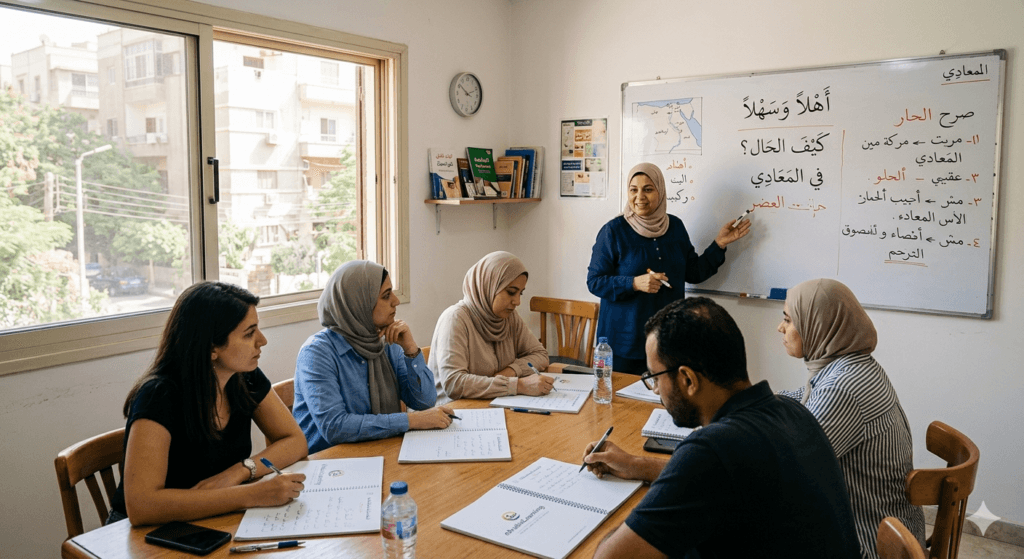
Intensive Arabic Course Cairo: What the Weeks Actually Look Like as You Progress
Quick answer: An intensive Arabic course in Cairo typically runs 15–25 hours of instruction per week over a structured multi-week arc — usually 4, 8, or 12 weeks — with each block tied to a specific proficiency target (beginner, elementary, intermediate) rather than just “more lessons.” Most programs open with a placement test, then restructure your weekly mix of grammar, conversation, and dialect work as you move up a level, so week 9 looks meaningfully different from week 1, not just harder.
If you’ve already read about why Cairo — and specifically Maadi — is a good place to study Arabic, you’ve probably hit the same wall I see in almost every consultation call: people can picture a week of lessons, but not the program. They don’t know what changes between week 2 and week 10, how a placement test actually works, or whether 15 hours a week is “intensive” or just “normal.” That gap between picking a destination and understanding the actual course structure is exactly what trips up a lot of otherwise well-prepared students before they ever book an intensive Arabic course in Cairo.
This guide is for the planning stage right before that: you’ve decided Cairo (likely Maadi) is where you want to study, and now you need to know what an intensive program actually does with your time, week by week, as you move from absolute beginner toward genuine conversational ability.
Ready to see where you’d start?
👉 Book your free Arabic lesson here — most placement conversations happen in this first session.
What Does “Intensive” Actually Mean in an Arabic Course?
Quick answer: In Cairo, “intensive” generally means 15–25 hours of structured instruction per week (versus 4–8 hours for part-time study), delivered through a mix of small-group and private sessions, with weekly progress checkpoints rather than a single end-of-course test.
The word gets used loosely across the industry, so it’s worth being precise. A genuinely intensive program has three features that a casual “a few lessons a week” setup usually doesn’t:
- Daily contact hours. Most intensive tracks meet five days a week (Sunday–Thursday, following the Egyptian work week), not two or three.
- Built-in checkpoints. Rather than waiting until the end of a 12-week block to find out if you’ve actually progressed, intensive programs check proficiency every 2–4 weeks and adjust your track accordingly.
- Deliberate skill rotation. Grammar, listening, speaking, and reading aren’t taught as separate, unrelated subjects — they’re sequenced so each week’s grammar point shows up in that same week’s conversation practice.
In my own classrooms in Maadi, the difference shows up fastest in speaking confidence. A student doing 5 hours a week of casual lessons over three months will usually know more vocabulary, on paper, than a student doing 20 intensive hours a week for three weeks. But the intensive student is almost always more willing to actually use what they know — because the pace doesn’t leave room for the hesitation that builds up between widely spaced lessons.
Takeaway: Intensive isn’t just “more hours” — it’s a structure where contact hours, checkpoints, and skill sequencing are all designed around moving you to the next proficiency level on a predictable schedule.
How Proficiency Levels Map Onto an Intensive Arabic Course in Cairo
Quick answer: Most structured intensive programs in Cairo organize content around recognizable proficiency bands — often aligned loosely with the ACTFL (American Council on the Teaching of Foreign Languages) scale — moving from Novice through Intermediate, with each band typically taking 4–8 weeks of intensive study to move through, depending on your starting point and hours per week.
You don’t need to memorize a formal framework to benefit from one. What matters is that your course has some way of describing “where you are” and “what’s next” beyond “beginner” and “advanced.” Here’s roughly how an intensive Cairo program tends to break this down:
| Proficiency stage | Typical focus | Rough weeks of intensive study to reach it (from zero) |
|---|---|---|
| Novice | Alphabet, sound system, survival phrases, basic greetings | Weeks 1–3 |
| Novice High / Elementary | Simple present-tense sentences, daily routines, numbers, shopping language | Weeks 4–6 |
| Intermediate Low | Connected speech on familiar topics, past tense, simple narration | Weeks 7–10 |
| Intermediate Mid | Holding short unscripted conversations, handling minor complications (a wrong order, a missed bus) | Weeks 11–14 |
A useful outside reference here is ACTFL’s proficiency guidelines, which many language programs — including university Arabic departments — use as a common benchmark, even if they don’t follow it rigidly. It won’t tell you exactly how fast you will move, but it gives you a vocabulary for asking your school the right questions: “What level am I at now, on this kind of scale, and what does the next one require?”
Muhammad Mourtada, who has run Arabic immersion programs in Maadi for over two decades, puts it this way: “Students obsess over hitting ‘fluent.’ I’d rather they obsess over hitting the next clearly defined level. Fluent is vague. Intermediate Mid is something I can actually test and plan a week around.”
Takeaway: A good intensive course doesn’t just promise progress — it can tell you, in concrete terms, which proficiency band you’re in now and what specific skills move you to the next one.
Week 1: Placement, Goal-Setting, and the Alphabet Sprint
Quick answer: Week one of an intensive Arabic course in Cairo is built around a placement assessment (spoken and written) followed by either an alphabet-and-sound-system sprint for true beginners, or a calibration week for anyone with prior study, before the “real” curriculum begins in week two.
This is the week most students underestimate. They expect to dive straight into conversation; instead, week one is mostly diagnostic.
Day-by-day shape of week 1
- Day 1 — Placement testing. A short spoken interview plus a written component (for anyone with prior exposure to Arabic script) determines whether you start at true zero, “false beginner” (some prior study, little speaking ability — extremely common), or an intermediate track.
- Days 2–3 — Alphabet and sound system (for true beginners) or a calibration unit (for false beginners). True beginners spend these two days on the 28 letters of the Arabic alphabet, the handful of sounds that don’t exist in English, and basic greetings. False beginners instead get a fast-moving review designed to surface exactly which grammar points and vocabulary have actually stuck versus which were memorized and forgotten.
- Day 4 — Goal-mapping session. This is where your specific reason for being in Cairo — study abroad, a diplomatic posting, remote work relocation — actually shapes the course. A diplomat’s spouse focused on household and social Arabic gets a different weekly mix than a graduate student preparing to read primary sources.
- Day 5 — First real conversation lab. Even absolute beginners leave week one able to introduce themselves, greet a neighbor, and order a coffee — deliberately, so the first weekend in Maadi already includes a few real, usable interactions.
Common misconception: that an intensive course “wastes” week one on testing instead of teaching. In practice, skipping this step is one of the most common reasons students plateau later — they end up in a track that’s either too easy (boring, slow progress) or too hard (overwhelming, also slow progress).
Takeaway: Week one isn’t slower-paced because the course is easing you in gently — it’s diagnostic, and getting the diagnosis right is what makes weeks 2 through 12 actually efficient.
Weeks 2–4: Building the Novice-to-Elementary Foundation
Quick answer: Weeks 2–4 of an intensive program typically focus on present-tense sentence structure, numbers, daily routines, and high-frequency vocabulary, with daily “missions” in Maadi designed to put each day’s classroom material into immediate real-world use.
This block is where the rhythm of an intensive course becomes clear. A typical day during weeks 2–4 looks like:
- Morning (2–3 hours): Grammar and vocabulary instruction — present-tense verb forms, question words, basic sentence patterns.
- Midday: A guided “mission” — a specific, small task using that morning’s material. Order a particular dish using only Arabic, ask three shopkeepers on Road 9 for prices, describe your daily routine to a conversation partner.
- Afternoon (1–2 hours): Pronunciation drills and listening practice using authentic Egyptian audio — radio, short video clips, or recordings of natural conversation.
By the end of week 4, most students can handle a short, predictable exchange — introducing themselves, describing where they live, asking simple questions — without translating in their head first. That’s the Elementary milestone referenced in the table above.
One detail that surprises new students: this block usually leans more heavily on Egyptian Arabic (the Cairene dialect) than Modern Standard Arabic, even in programs that will eventually balance both. The reasoning is practical — daily survival vocabulary in Cairo is dialect-driven, and early wins in real conversations build the confidence that carries students through the harder grammar still ahead.
Takeaway: The first real curriculum block prioritizes usable daily Arabic over comprehensive grammar, on the theory that early conversational wins matter more for momentum than early grammatical completeness.
Weeks 5–8: Intermediate Transition and the MSA/Egyptian Arabic Split
Quick answer: Weeks 5–8 typically introduce past tense, more complex sentence structure, and — for most students — a more deliberate split between Egyptian Arabic for speaking and Modern Standard Arabic (MSA) for reading and writing, based on individual goals identified back in week one.
This is usually the point where a program asks you (or re-asks you) the question that shapes the rest of your course: how much of your remaining time should go toward Egyptian Arabic versus MSA?
| Student goal | Typical Egyptian Arabic / MSA split, weeks 5–8 |
|---|---|
| Daily life, relationships, long-term living in Cairo | 70% Egyptian Arabic / 30% MSA |
| Reading news, official documents, broader Arab-world communication | 40% Egyptian Arabic / 60% MSA |
| Quranic Arabic or religious study as primary goal | 20% Egyptian Arabic / 80% MSA-adjacent classical study |
| Balanced — daily life plus some formal reading ability | 55% Egyptian Arabic / 45% MSA |
This is also where past tense, more complex question forms, and connected narration (“first I did X, then Y happened”) get introduced — the building blocks of actually telling a story rather than just labeling things.
A pattern I’ve watched repeat for years: students who try to split their attention 50/50 from week one, before they’ve built any real conversational base in either, tend to progress more slowly than students who lean hard into Egyptian Arabic first and add MSA once daily conversation feels less effortful. The reverse — MSA first, dialect later — works for students whose primary goal genuinely is reading and formal study, but it usually means a longer adjustment period once they’re actually living day to day in Maadi.
Takeaway: Weeks 5–8 are where your specific reason for learning Arabic should visibly start shaping your weekly schedule — if it isn’t, that’s worth raising with your program directly.
Weeks 9–12: Intermediate Conversation and Handling the Unexpected
Quick answer: The final stretch of a typical 12-week intensive arc shifts emphasis from controlled exercises to unscripted conversation — handling minor complications, expressing opinions, and following real conversations at natural speed — which is the practical definition of “comfortable” rather than “fluent.”
By this stage, the daily structure usually shifts. Less time goes to new grammar; more goes to conversation labs, often with people outside the immediate teacher-student relationship — a language exchange partner, a planned interaction with a shopkeeper that isn’t scripted in advance, a short unscripted discussion about a news topic.
This is also where the “common mistakes” that show up earlier in a program (treating Egyptian Arabic and MSA as interchangeable, over-relying on an English-speaking social bubble, rushing past the alphabet) tend to surface as gaps if they weren’t caught earlier — which is part of why the checkpoint structure mentioned at the start of this guide matters so much.
A realistic week 11, for comparison with week 2
| Week 2 | Week 11 | |
|---|---|---|
| New grammar introduced | Present-tense basics | Minimal — mostly nuance and idiom |
| Conversation format | Scripted roleplay | Largely unscripted |
| Typical task | Order a coffee using a memorized phrase | Discuss what happened during a misunderstanding at the bank |
| Error correction style | Frequent, on basic structure | Occasional, on nuance and word choice |
Takeaway: The later weeks of an intensive course aren’t about learning more rules — they’re about removing the scaffolding (scripts, predictable topics, constant correction) that made earlier weeks manageable.
Full-Time vs. Part-Time Intensive Tracks: Which Fits Your Timeline?
Quick answer: Full-time intensive tracks (20–25 hours/week) typically move a beginner to Intermediate Low in 8–10 weeks; part-time intensive tracks (10–15 hours/week) usually take 14–18 weeks to cover the same ground, with the gap mostly explained by how much real-world practice time sits between lessons.
| Factor | Full-time intensive (20–25 hrs/week) | Part-time intensive (10–15 hrs/week) |
|---|---|---|
| Best for | Study-abroad students, dedicated relocation periods, sabbaticals | Remote workers, diplomatic spouses managing a household, working professionals |
| Weeks to reach Intermediate Low (from zero) | Roughly 8–10 weeks | Roughly 14–18 weeks |
| Risk of plateau between sessions | Lower — daily reinforcement | Higher — requires more self-directed practice between lessons |
| Schedule flexibility | Limited — usually fixed daily blocks | Higher — sessions can shift around work or family demands |
Neither track is objectively better. A diplomat’s spouse managing school pickups and embassy events genuinely cannot do 25 hours a week, and forcing that pace usually backfires — burnout shows up as missed sessions, not faster learning. A study-abroad student with a single semester, on the other hand, often benefits from the full-time track precisely because the clock is the constraint, not the energy.
Takeaway: Choose your track based on your actual weekly availability over the full course, not your most motivated week — consistency matters more than intensity on any single day.
See where your timeline could realistically take you. 👉 Explore the in-person Arabic program in Cairo
Common Mistakes Students Make With Intensive Arabic Courses
Quick answer: The most frequent mistakes are skipping the placement step, choosing a track length based on vacation time rather than realistic goals, ignoring the Egyptian Arabic/MSA split question, and assuming more weekly hours always equals faster progress regardless of fatigue.
Mistake 1: Choosing course length around a flight, not a goal
A two-week “intensive” course is a real and valuable thing — but it’s a taste of immersion, not enough time to move a full proficiency level for most beginners. Going in with that expectation set correctly avoids a lot of disappointment.
Mistake 2: Skipping or rushing the placement test
Some students, eager to start “real” lessons, push to skip placement entirely. This almost always costs more time later, once a mismatched track becomes obvious in week three or four.
Mistake 3: Assuming more hours per day always helps
Past a certain point — often around 5–6 hours of formal instruction in a single day — additional hours produce diminishing returns, particularly for adult learners balancing fatigue, jet lag, or cultural adjustment. A well-structured 20-hour week, spread across five days, generally outperforms a compressed 20-hour week crammed into three.
Mistake 4: Not revisiting the MSA/Egyptian Arabic split mid-course
Goals shift. A student who arrived focused purely on daily conversation sometimes discovers, by week 6, that they also need to read official Arabic documents for a visa extension or a lease. A good program should let that split move, not lock it in from day one.
Takeaway: Most problems with intensive courses come from mismatched expectations going in, not from the teaching itself — getting the track length, pacing, and dialect split right at the start prevents most of the friction later.
Real Examples: Three Students, Three Intensive Tracks
These are composite examples, adjusted for privacy, reflecting patterns seen repeatedly in Maadi-based intensive programs.
Laila, a graduate student from Spain, had one semester before a research trip and chose the full-time track — 22 hours a week for 10 weeks. Her goal-mapping session in week one flagged that she’d eventually need to read primary source documents, so her MSA proportion increased earlier than typical, starting around week 5 instead of week 7. By week 10, she could follow a moderately paced unscripted conversation and read simplified news text with occasional dictionary use.
Daniel, a remote software developer from Australia, relocated to Maadi without a fixed end date and chose a part-time track — 12 hours a week — built around his work hours. His placement test revealed he was a “false beginner”: two years of app-based study had given him decent vocabulary recognition but almost no speaking ability. His program spent extra time in weeks 1–2 specifically rebuilding speaking confidence rather than reteaching vocabulary he already half-knew. By week 16, he was comfortable handling daily errands and casual conversations with neighbors entirely in Egyptian Arabic.
Priya, a diplomat’s spouse from the United States, needed a track that could flex around embassy events and school pickups. Her program used a part-time intensive structure with sessions clustered into two longer blocks per week rather than five shorter daily sessions, which suited her schedule better even at a similar total weekly hour count. Her goal-mapping in week one prioritized household and social Arabic over reading, so her track stayed close to 75% Egyptian Arabic throughout.
Takeaway: The structure of an intensive course should bend around the student’s actual constraints and goals — track length, daily hour distribution, and the dialect split are all adjustable, and a program unwilling to adjust any of them is a warning sign.
Intensive Course vs. Casual Lessons vs. Self-Study: A Quick Comparison
Quick answer: Intensive courses move students through proficiency levels fastest because of daily contact hours and structured checkpoints; casual weekly lessons are more sustainable for very long timelines but progress more slowly; self-study alone rarely produces real speaking ability without one of the other two.
| Factor | Intensive course (15–25 hrs/week) | Casual lessons (3–6 hrs/week) | Self-study only (apps, books) |
|---|---|---|---|
| Speed to Intermediate Low | 8–14 weeks | 6–12 months | Rarely reached without structured speaking practice |
| Speaking confidence | Builds fast due to daily use | Builds slowly, more gaps between sessions | Usually a major weak point |
| Best for | Fixed-timeline relocations, study abroad, dedicated immersion periods | Long-term residents with steady but limited weekly time | Building vocabulary alongside one of the other two approaches |
| Cost intensity | Higher per month, often lower per total course due to faster completion | Lower per month, spread over a longer total timeline | Lowest direct cost |
Takeaway: None of these approaches is “wrong” — they suit different timelines and budgets — but only intensive and casual teacher-led formats reliably build real speaking ability, with intensive simply compressing the same progress into far fewer total weeks.
Frequently Asked Questions
How many hours a week is a typical intensive Arabic course in Cairo?
Most intensive programs run 15–25 hours of instruction per week, usually spread across five days (Sunday–Thursday, following the Egyptian work week). Full-time tracks sit at the higher end of that range, while part-time intensive tracks — designed for remote workers or those managing other responsibilities — typically run 10–15 hours a week and simply take longer to reach the same proficiency milestones.
How long does an intensive Arabic course in Cairo usually take?
Course length is typically organized in blocks of 4, 8, or 12 weeks. A complete beginner on a full-time track can usually expect to reach an early Intermediate level within roughly 8–10 weeks, while a part-time intensive track covering the same proficiency ground often takes 14–18 weeks. These ranges depend heavily on prior exposure to Arabic, consistency outside of lessons, and how much of the week is split between Egyptian Arabic and Modern Standard Arabic.
Do I need to take a placement test before starting?
Yes, virtually all structured intensive programs begin with a short spoken and written placement assessment, even for complete beginners. This determines whether you start at true zero or as a “false beginner” — someone with prior exposure but limited speaking ability, which is extremely common among students who’ve relied mainly on apps before arriving in Cairo.
What’s the difference between an intensive course and regular weekly lessons?
An intensive course is defined less by total hours and more by structure: daily contact, built-in checkpoints every few weeks, and a deliberate sequencing of grammar, listening, and speaking within each week. Regular weekly lessons (often 1–3 sessions a week) can still be effective over a longer timeline, but the spacing between sessions generally slows the pace of measurable progress.
Will an intensive course focus on Egyptian Arabic or Modern Standard Arabic?
Most well-structured intensive programs in Maadi cover both, with the proportion shifting based on your goals. Students focused on daily life and relationships in Cairo typically spend significantly more time on Egyptian Arabic (the Cairene dialect), while those preparing for formal reading, religious study, or broader Arab-world communication weight their schedule more toward Modern Standard Arabic.
Can I do an intensive Arabic course part-time if I’m working remotely?
Yes. Part-time intensive tracks are specifically designed for remote workers, diplomatic spouses, and others who can’t commit to a full daily schedule. These tracks typically run 10–15 hours a week, often clustered into fewer, longer sessions rather than daily blocks, and simply extend the overall timeline needed to reach the same proficiency milestones as a full-time track.
Is an intensive course too overwhelming for a complete beginner?
Not when it’s structured properly. A good program builds in a diagnostic and calibration period (typically the first week) specifically so complete beginners aren’t thrown into material beyond their level, and most include built-in checkpoints to catch and adjust pacing issues before they compound over several weeks.
Final Thoughts: Choosing the Right Intensive Arabic Course Structure
After two decades of running these programs in Maadi, the single biggest predictor of a student’s success isn’t talent, age, or even prior language background — it’s whether the course structure actually matches their timeline and their reason for being here. An intensive Arabic course in Cairo that moves a study-abroad student with a single semester through a tight 10-week full-time arc looks nothing like the right program for a diplomat’s spouse balancing school pickups, and it shouldn’t.
What both need is the same underlying thing: a clear sense of which proficiency level they’re starting at, what the next one requires, and a weekly structure that bends around their actual life rather than forcing their life around a generic template.
Ready to find out where you’d start?
👉 Book your free Arabic lesson here or explore the full in-person program in Cairo
Related reading:
- Learn Arabic in Maadi, Cairo: The Complete Guide for Expats, Diplomats, and Study-Abroad Students
- Studying Arabic in Cairo: A Practical Guide for Expats, Diplomats, and Study-Abroad Students
- Egyptian Arabic for Beginners: The Complete Guide
- The Ultimate Guide to Maadi: Cairo’s Green Sanctuary and Cultural Hub