
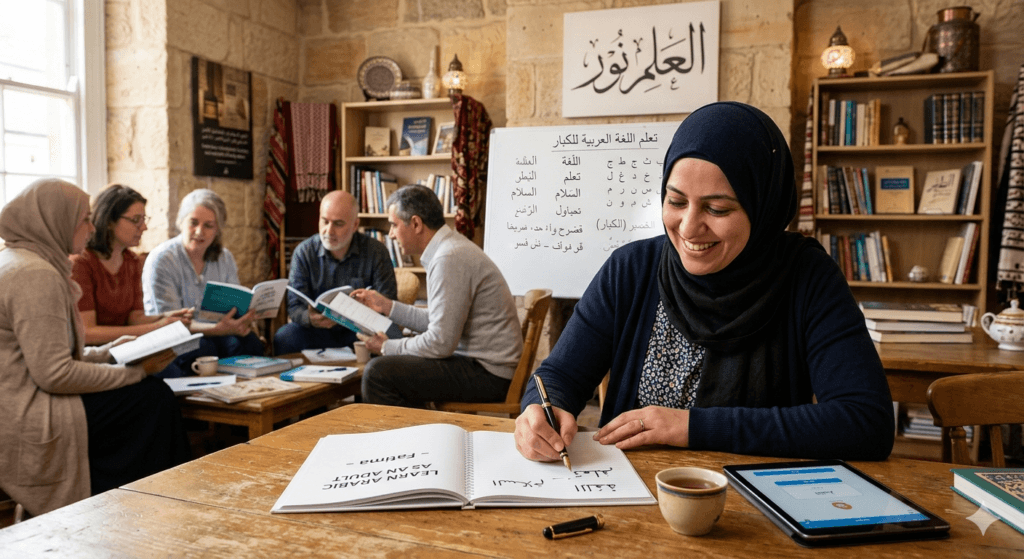
“I’m 38. Is it too late for me to actually learn Arabic?”
That’s the message I receive more than any other. And after twenty years of teaching Arabic to adults — from their late twenties to their early seventies — I want to give you the honest, complete answer that most language learning websites won’t.
The short answer: no, it is not too late. But the honest answer is more interesting than that — and more useful. Because the question itself contains an assumption that’s worth examining before you invest a single minute of your time.
When adults ask “is it too late to learn Arabic,” what they’re really asking is: “Can I actually get somewhere with this, given everything working against me — my busy life, my imperfect memory, the years I’ve already spent not starting?” That’s a much more specific and answerable question. And the answer, based on two decades of teaching adult beginners, is: yes, you can. But only if you approach it the right way.
This guide is the honest roadmap I wish every adult learner had before they started. No false promises. No “you’ll be fluent in 90 days” nonsense. Just what actually works, what you can realistically expect, and how to give yourself the best possible chance of getting where you want to go.
The Fear That Keeps Adults from Starting — and Why It’s Wrong
There is a version of this story I’ve seen play out so many times that it’s become painfully familiar. Someone decides they want to learn Arabic. They feel a pull toward it — spiritual, cultural, professional, or some mixture of all three. They look into it for a while. Then they think about how long it will take, and how old they already are, and somewhere in that calculation they quietly decide it’s not worth starting. The moment passes. The aspiration remains a vague “one day.”
This pattern isn’t about Arabic specifically. It’s about a particular kind of self-limiting belief that attaches itself to language learning more than almost any other skill. We have a cultural narrative that says language acquisition is for children — that adults who try are fighting against their own biology and are probably going to end up embarrassed or defeated. And because Arabic is genuinely challenging, that narrative feels extra compelling when it’s the language in question.
The narrative is wrong. Not encouragingly wrong, not “technically wrong but there’s truth in it” wrong — just wrong. Here’s what the actual evidence says.
Research into adult second language acquisition consistently shows that adults don’t lose the ability to learn languages. What changes is the mechanism of acquisition — not the ceiling. Children acquire language unconsciously and effortlessly through massive exposure, often without knowing what they’ve learned until they’re doing it. Adults acquire language differently: more deliberately, more analytically, with more effort applied to each new pattern. But deliberately and analytically are not handicaps. In many important dimensions of language learning — grammar comprehension, vocabulary retention through strategic study, reading, and the speed at which formal rules become clear — adults significantly outperform children.
The one area where children genuinely have an edge is pronunciation: children who begin a language before puberty are more likely to acquire a native-like accent, because the brain’s sound-processing plasticity is higher before age 12. But accent is only one small dimension of language competence — and in Arabic, even a noticeable foreign accent does not prevent fluency, comprehension, or deep connection with the language and its texts.
“I started Arabic at 52. I had convinced myself for years that I was too old and too busy. What I discovered is that the years I spent reading and learning other things gave me something I couldn’t have had at twenty — I knew how to study, I had the patience to sit with difficulty, and I understood why the language mattered. Three years later I read the Fatiha in Salah and understood every word. That’s not a small thing.”
— Hassan B., student at eArabicLearning, United Kingdom
What Actually Changes in the Adult Brain — And What Doesn’t
Let’s be specific, because vague reassurance doesn’t help you plan. Here is what the neuroscience actually says about what changes between childhood and adulthood in the context of language learning.
What genuinely changes
Phonological plasticity decreases. The brain’s sensitivity to new sound categories — the sounds of a foreign language — is highest in infancy and declines through childhood and adolescence. This is why an adult learning Arabic is more likely to have an accent than a child who grew up hearing it. In Arabic specifically, the “heavy” emphatic consonants (ص, ض, ط, ظ) and the sounds ح, غ, ع, خ are genuinely difficult for English speakers to produce naturally — and a child who starts at five has an easier path to sounding native than an adult who starts at forty. With a good teacher and dedicated practice, adults can reach very accurate pronunciation — but a noticeable accent in these sounds is common and entirely fine.
The implicit acquisition channel narrows. Young children absorb grammar rules unconsciously just by being exposed to language — they don’t “learn” that sentences have subjects and verbs, they just start doing it correctly. Adults mostly can’t do this. Most adult Arabic learners need grammar to be explicitly explained before they can use it correctly. This is actually a manageable difference: Arabic has rich, systematic grammar that is very amenable to explicit instruction.
What does NOT change
Everything else. Your capacity to learn vocabulary does not decline meaningfully until well into old age, and even then, strategic study methods compensate enormously. Your ability to learn reading and writing is entirely unaffected — adults often learn to read Arabic script faster than children because they understand what they’re doing and why. Your ability to understand grammar through explanation is actually better as an adult. Your motivational depth — your reason for wanting to learn Arabic — is typically far stronger and more sustainable as an adult than as a child who is learning because they’ve been enrolled.
The Advantages Adults Have That Children Never Will
This is the section that tends to surprise people. Not only is adult language learning possible — there are specific, significant advantages that adult learners have over children that are rarely discussed.
A Lifetime of Vocabulary to Connect To
When you learn the Arabic word for “mercy” (رحمة), you connect it to every context in which you’ve ever encountered mercy — philosophical, literary, emotional, spiritual. A five-year-old has none of that. Every new Arabic word you learn hooks into a vast existing network of meaning that makes it stick faster and deeper.
Genuine, Powerful Motivation
Adult learners choose Arabic because they deeply want something it offers — a connection to the Quran, a heritage, a career, a relationship. That intrinsic motivation drives consistency through difficulty in a way that “my parents enrolled me” never can. Motivation is the single biggest predictor of long-term success in language learning.
The Ability to Learn Strategically
Adults can study the 300 most frequent Quranic words and know they’re making the highest-return investment possible. Children learn whatever they encounter. Adults can use spaced repetition software, choose the right variety of Arabic, track their progress, and adjust their approach. Strategic learning is a superpower adults have that children lack entirely.
Cultural and Contextual Depth
Understanding Arabic isn’t only about grammar and vocabulary — it’s about the civilisation, the faith, the history, the literature that the language carries. Adults bring a lifetime of reading, travel, spiritual practice, and human experience to this encounter. That depth of engagement produces a relationship with Arabic that is qualitatively different from, and in many ways richer than, a child’s early acquisition.
Patience and Long-Term Thinking
Most adults who decide to learn Arabic are not in a hurry. They have a realistic sense of timelines. They know that anything worth having takes consistent effort over time. This patience — which children simply don’t have — is one of the most underrated advantages in language learning.
Literacy and Grammar Intuition
Adults are skilled readers and writers in at least one language. Learning the Arabic script, understanding what a grammatical case is, grasping the concept of a root system — all of this is far faster for an adult who already has a sophisticated understanding of how language works than for a child who is still building these concepts from scratch.
Which Arabic Should You Learn? How to Choose for Your Real Goal
Arabic is not a single, monolithic language — it exists on a spectrum from Classical Quranic Arabic through to Modern Standard Arabic through to regional spoken dialects. One of the most important decisions you’ll make as an adult learner is which variety to prioritise — and the answer depends entirely on your real, specific goal.
| Your Goal | Best Starting Variety | Why |
|---|---|---|
| Understand the Quran directly | Quranic / Classical Arabic | Every hour of study returns directly to your goal. The Quran’s vocabulary is concentrated and learnable systematically. |
| Communicate with Arab people in daily life | Egyptian Arabic dialect | Egyptian Arabic is the most widely understood spoken dialect due to Egypt’s cultural influence across the Arab world. |
| Read Arabic news, write formal correspondence, academic study | Modern Standard Arabic (MSA) | MSA is the written standard across 26 countries — used in formal media, education, and official communication. |
| Work in a Gulf country (UAE, Saudi Arabia, Qatar) | MSA + Gulf dialect exposure | Business environments use MSA formally; social interactions use Gulf or Levantine dialects. Dual approach is most practical. |
| Connect with heritage (family, culture) | The dialect of your family’s origin | Speaking the same dialect as your parents or grandparents creates emotional connection that MSA alone cannot. |
| All of the above | Classical Arabic as foundation | Classical/MSA is the shared root of all varieties. A strong Classical foundation makes learning any dialect significantly faster. |
The Adult Arabic Learning Roadmap: Stage by Stage
Here is the pathway I recommend to every adult student who walks into their first lesson with eArabicLearning. It’s been refined over two decades and it works across every variety of Arabic and every type of learner.
How Long Does It Actually Take? Honest Timelines for Adults
I will give you the honest answer, which is more nuanced than the “fluent in 90 days” promises that should immediately make you suspicious of any program offering them.
The US Foreign Service Institute — which has trained diplomats in Arabic for decades — estimates 2,200 classroom hours to professional working proficiency for English speakers. That sounds daunting. But most people learning Arabic don’t need professional diplomatic proficiency — they need meaningful, functional comprehension in their specific area of interest.
| Goal | Study Hours Needed | Realistic Timeframe (2 lessons/wk + daily review) |
|---|---|---|
| Read the Arabic alphabet fluently | 15–25 hours | 2–4 weeks |
| Understand Surah Al-Fatiha and Juz Amma directly | 50–100 hours | 3–6 months |
| Basic conversational ability in Egyptian dialect | 150–300 hours | 6–12 months |
| Working comprehension of most Quranic text | 300–500 hours | 12–18 months |
| Read and understand Arabic news articles | 400–600 hours | 18–24 months |
| Professional / advanced proficiency | 2,000–2,200 hours | 4–6 years |
Two important caveats. First, these are estimates for consistent, quality study — not time spent half-engaged with an app while doing something else. An hour of focused study with a good teacher is worth more than four hours of passive exposure. Second, the timeline compresses significantly with intensive study — a learner who dedicates 10 hours per week moves roughly four times faster than one who dedicates 2.5 hours per week.
How to Fit Arabic Into a Real Adult Life
This is the practical question that matters most for most adult learners — not whether they could learn Arabic if they had unlimited time, but how to make meaningful progress while working full time, raising a family, and dealing with everything else life involves.
The answer is not “find more hours.” The answer is to use the hours you have more intelligently.
The Minimum Viable Routine
This is the smallest consistent practice that still produces real progress. It’s designed for people with genuinely busy lives:
- 2 lessons per week with your teacher (90 minutes total) — This is the engine. Everything else is fuel for it. Two focused, personalised lessons per week is the minimum for genuine progress.
- 15 minutes of Anki vocabulary review daily — Build this into an existing habit: morning coffee, lunch break, commute, before bed. 15 minutes per day is 90 minutes per week of vocabulary retention — more valuable than you might expect.
- One “Arabic moment” daily (5–10 minutes) — This is flexible: recite a surah slowly and think about the meaning, listen to one Arabic song or clip, read back through your last lesson notes, or write five Arabic words from memory. Just one moment that keeps Arabic present in your day.
That’s it. Two lessons, 15 minutes of Anki, one Arabic moment. Roughly 2.5–3 hours per week. It doesn’t sound like much — but consistency at this level over 12 months produces results that feel genuinely significant. The people who don’t progress aren’t doing more than this and failing. They’re doing nothing for three weeks, then doing a lot in a burst of enthusiasm, then doing nothing again. Consistency is everything.
Making Use of Existing Time
- Commute listening: Arabic podcasts, Quranic recitation, or Arabic music on the way to work turns dead time into immersion time.
- Prayer time (for Muslim learners): You’re already standing in Salah five times a day. With even basic Quranic Arabic knowledge, those minutes transform from recitation into conversation.
- Cooking or exercise: Arabic audio — whether educational content or entertainment — runs in the background without competing with what you’re doing.
- Reading before sleep: Five minutes with an Arabic vocabulary list or a short passage from the Quran is a calming, meaningful end to a day.
The Five Mistakes Adult Learners Make That Kill Progress
I’ve watched learners take years longer than necessary because of these five patterns. Recognising them in advance saves enormous time and frustration.
Mistake 1: Waiting for the “Right Time” to Start
The right time does not exist. There will always be a new job starting, a family obligation, a home renovation, a busy month, a better Arabic course launching soon. Every year you wait is a year of potential progress you don’t get back — and a year in which the aspiration sits quietly generating low-level guilt rather than genuine satisfaction. Start now, even imperfectly. Two lessons a month is better than zero lessons. Beginning and adjusting is infinitely better than not beginning.
Mistake 2: Trying to Learn Arabic “Generally”
Arabic in general is too large to approach all at once. Adults who try to learn “Arabic” without a specific, concrete goal — Quranic comprehension, conversational Egyptian dialect, business MSA — tend to drift through materials that don’t build on each other and never develop real depth in any direction. Get specific. What specific thing do you want to be able to do in Arabic? That specificity shapes everything: which vocabulary to prioritise, which grammar to study first, which teacher to look for, what progress looks like.
Mistake 3: Relying on Apps as the Primary Method
Apps are useful supplements. Duolingo can make the Arabic alphabet less scary. Anki is excellent for vocabulary retention. YouTube channels provide passive exposure. But no app has ever produced an Arabic speaker at a meaningful level on its own. Apps cannot correct your specific errors, explain why a grammatical rule works, adapt to your confusion in real time, or respond to your actual questions. They are seasoning. A qualified teacher is the meal. Using apps without a teacher is like eating only side dishes.
Mistake 4: Quitting at the Plateau
Every language learner hits a period — usually somewhere between three and eight months in — where progress suddenly feels invisible. You’re no longer learning new letters or basic vocabulary; the novelty has worn off. The intermediate stage of Arabic is genuinely difficult and sometimes discouraging. This is the moment most adult learners give up. But here is what’s actually happening during a plateau: the brain is consolidating. It’s organising and deepening what you already know rather than adding new surface-level knowledge. Breakthroughs consistently follow plateaus. The students who quit here are often weeks away from a significant leap forward.
Mistake 5: Comparing Progress to Children or Native Speakers
The most demoralising thing an adult Arabic learner can do is compare themselves to a child who grew up hearing Arabic or a native speaker of the language. The comparison is meaningless: different starting conditions, different mechanisms, different contexts. The only meaningful comparison is between you at the beginning of this month and you at the end. Are you slightly more able to read, understand, or speak Arabic than you were thirty days ago? That’s the only metric that matters.
Myths About Arabic That Discourage Adults Before They Begin
Arabic does have vowels — they’re written as small marks (harakat) above and below letters rather than as separate letters in the alphabet. Crucially, the Quran and all learning materials for beginners are written with full vowel markings, which makes reading far more accessible than casual Arabic text suggests. Most learners read vocalised Arabic confidently within two to four weeks.
Yes, Arabic has many dialects — but choosing one is simple: choose the variety that matches your goal. For Quranic understanding: Classical Arabic. For Egypt, Sudan, and the most widely understood spoken variety: Egyptian Arabic. For formal reading and writing: Modern Standard Arabic. A ten-minute conversation with a qualified teacher will clarify exactly where you should start and why.
Arabic grammar is complex — but it is also extraordinarily systematic. The root-and-pattern system, once understood, makes vocabulary intuitive in a way that English’s etymological chaos never is. The case system is learnable through consistent application. Every grammatical feature of Arabic that challenges English speakers is finite and teachable. “Complex” and “impossible” are not the same thing, and conflating them has stopped more people than it should.
Immersion helps — but living in an Arab country without structured study produces surprisingly little progress; most expats in Cairo or Dubai learn only survival phrases over years of residence. Structured, intentional study with a qualified teacher — online or in person — produces far better results than accidental exposure. The internet has made excellent Arabic instruction available to everyone, everywhere.
The Quran’s language is one of the most celebrated literary and linguistic achievements in human history — scholars, translators, and language enthusiasts of every background have been moved by it. Converts to Islam, people of Arab heritage from non-religious families, academics, and linguists have all found deep meaning in learning Quranic Arabic as adults. The language doesn’t require a childhood of exposure to reveal its depth to a sincere adult learner.
Ready to Start Your Arabic Journey?
Join adult learners from 30+ countries who chose eArabicLearning — fully personalised one-on-one lessons with qualified teachers, designed specifically for how adults learn best.
Whether you’re 25 or 65, a complete beginner or a returning learner, we’ll build a roadmap that fits your life, your schedule, and your real goal.
No commitment · No payment required · One lesson to see if it clicks
Frequently Asked Questions About Learning Arabic as an Adult
One Last Thing Before You Close This Tab
You came to this article carrying a question. Maybe it was “is it too late?” Maybe it was a more specific version: “can I, specifically, with my life and my schedule and my imperfect memory, actually do this?”
The honest answer is: yes. Not easily, and not instantly. But genuinely, meaningfully, and in ways that will matter to you far beyond what you can currently imagine.
Arabic is not a language you learn and then store in a drawer. It’s a language that changes the way you engage with everything connected to it — the Quran, the faith, the culture, the history, the 420 million people who carry it as their first tongue. Every stage of progress in Arabic is a door that opens onto something more, not a destination you arrive at and stop.
The people who never start — who decide at 35 or 45 or 55 that the window has closed — don’t save themselves from failure. They simply make the decision for themselves that they’ll never know what was on the other side. That’s a choice. So is starting today.
If you’d like to take the first step, book a free trial lesson. One lesson. No payment. No commitment. Just an honest conversation about where you are, where you want to go, and what it realistically looks like to get there.