
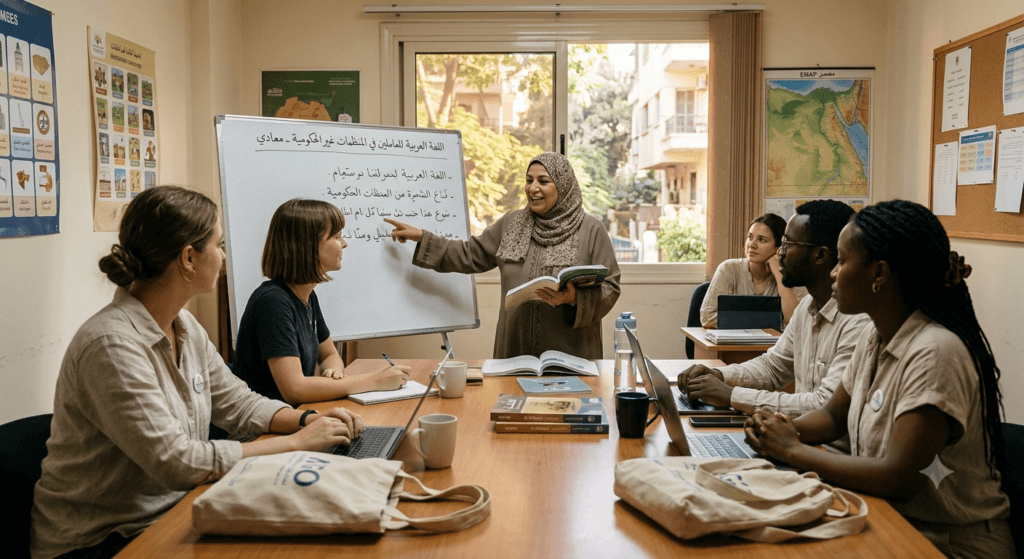
Arabic Classes for NGO Workers in Cairo: What Actually Helps You Do the Job
Most Arabic courses aren’t built for the way you actually use the language. You don’t need to order coffee in Arabic — you probably already can. You need to run a coordination meeting, follow a partner’s explanation of a delay in the field, or read an official letter from a government counterpart without waiting three hours for a translation. Arabic classes for NGO workers in Cairo exist for exactly that gap: the space between tourist Arabic and the specific, high-stakes Arabic your role actually demands.
I’ve taught Arabic in Maadi for over 20 years, and a meaningful share of my students over that time have come from the humanitarian and international-organization world: protection officers, WASH engineers, program coordinators, M&E specialists, security advisors, country directors. They rarely arrive needing the same thing a tourist or a study-abroad student needs. They need Arabic that works under time pressure, in front of colleagues, in a language register that shifts depending on whether they’re in a village outside Cairo or writing a formal note to a ministry.
This guide walks through what that actually looks like: why Cairo and specifically Maadi make sense as a base, how Egyptian Arabic and Modern Standard Arabic split across your actual responsibilities, what a realistic training week looks like around field missions and irregular hours, and the mistakes that slow humanitarian professionals down more than any grammar rule ever will.
🎯 Ready to see what your Arabic training could look like? Book your free trial Arabic lesson with a native teacher in Cairo.
Why NGO and Humanitarian Staff Need a Different Kind of Arabic Training
Cairo hosts one of the largest concentrations of international NGOs, UN agencies, and diplomatic missions anywhere in the Middle East and North Africa region. If your organization has a presence in Egypt, there’s a strong chance your office sits within a short distance of Maadi, Garden City, or Zamalek — all neighborhoods with decades of history hosting exactly this kind of staff.
What makes Arabic training for this group different isn’t the grammar. It’s the range. On a single working day, an NGO staff member might:
- Sit in a coordination meeting conducted partly in English, partly in Arabic, where switching costs you the thread of the conversation
- Visit a community partner or field site where Egyptian Arabic is the only language spoken
- Read or draft correspondence with a government ministry, written in formal register
- Debrief informally with local staff over lunch, where the register drops entirely into casual Cairene Arabic
A general “survival Arabic” course prepares you for none of that particularly well, because it’s built around travel scenarios — hotels, taxis, restaurants. A course built for NGO staff starts from your actual week and works backward: what do you need to say, understand, and read, and in which register, to do your job with less friction and fewer moments of relying entirely on a colleague to translate.
That said, general fluency still matters as the foundation. Our guide on Egyptian Arabic for expats in Cairo covers the baseline survival skills that any foreign resident needs before layering on role-specific vocabulary — pronunciation, core grammar, and the everyday phrases that make daily life in Cairo function.
Why Maadi Works as a Base for NGO and International Staff
Maadi didn’t become the default neighborhood for Cairo’s international community by accident. A few practical reasons keep coming up with the NGO and humanitarian staff I’ve taught over the years:
Proximity to where the work happens
Many international organizations, embassies, and UN agency offices sit in or near Maadi, Garden City, and the surrounding districts. For staff already commuting from or through the area, in-person lessons close to the office — or close to home — remove a real barrier: the fifteen extra minutes of travel that turn “I’ll fit in a lesson” into “I’ll do it next week.”
A daily-life environment that reinforces the classroom
Maadi is residential and walkable, which matters more than it sounds. Ordering from a local restaurant, chatting with your building’s bawab (doorman), or asking a shopkeeper a question are all small, low-stakes moments of practice that compound over weeks. For staff who spend long days speaking English at the office, that outside-the-classroom exposure is often what actually moves the needle on spoken confidence.
An established international and diplomatic community
Maadi has hosted embassy staff, NGO workers, and international families for decades. That means the neighborhood is genuinely used to foreign residents at every stage of the Arabic-learning curve — which takes some of the self-consciousness out of early, imperfect attempts at conversation.
🎯 Want to see what our Cairo program includes? Explore the in-person Arabic program in Maadi.
Egyptian Arabic vs Modern Standard Arabic — Which Do NGO Staff Actually Need?
This is the single most common question I get from new humanitarian and NGO students, and the honest answer is: both, in different proportions depending on your role.
| Situation | Egyptian Colloquial Arabic | Modern Standard Arabic (MSA) |
|---|---|---|
| Field visits and community meetings | Primary — this is what’s actually spoken | Rarely used in casual field conversation |
| Internal coordination with local staff | Primary, especially in informal settings | Used in more formal internal meetings |
| Government correspondence and official letters | Not used | Primary — the expected register |
| Reading news, reports, or public statements | Not used | Primary |
| Building day-to-day trust with community members | Primary — signals respect and effort | Can feel distant or overly formal |
| Typical learner focus | Field staff, program staff, community liaisons | Policy staff, donor-facing roles, government liaison staff |
In practice, most program and field-facing staff get the fastest return from prioritizing Egyptian Arabic first, since it’s what actually gets used in the moments that build trust with communities and local partners. MSA gets layered in afterward for reading and formal writing. Staff in more policy-facing or donor-relations roles sometimes flip that priority, leaning earlier into MSA for written correspondence while building conversational Egyptian Arabic more gradually.
Neither register is optional if you’re staying in Cairo for more than a few months. The staff who plateau fastest are usually the ones who only ever learn one.
Field and Sector Vocabulary: What a General Course Won’t Teach You
A generic Arabic course teaches you how to ask for directions. It won’t teach you the vocabulary that comes up in a coordination meeting, a needs assessment, or a conversation with a community partner about a distribution schedule. That gap is exactly where sector-specific Arabic training pays for itself.
Depending on your specific role and sector — protection, health, WASH, food security, education, shelter, or general coordination — your vocabulary needs will differ, but a few categories come up across almost every NGO role in Cairo:
- Meeting and coordination language: agenda, follow-up, action point, timeline, focal point, stakeholder — the connective vocabulary that keeps a coordination meeting moving
- Community engagement phrases: respectful, culturally appropriate ways to introduce yourself, explain your organization’s role, and ask sensitive questions
- Official and administrative Arabic: the register used in permits, official letters, and correspondence with government counterparts
- Everyday operational Arabic: logistics, scheduling, and the practical vocabulary that keeps day-to-day work moving without constant translation support
A good instructor builds this vocabulary around your actual sector rather than a generic list, which is why a placement conversation at the start of any program matters — it’s the difference between a course that’s technically about Arabic and one that’s actually useful for your Tuesday morning.
What a Realistic Training Week Looks Like Around Field Work
NGO and humanitarian staff rarely keep a predictable nine-to-five schedule, so a training structure built around a fixed weekly timetable often falls apart within the first month. What works better, in my experience, is a private lesson format that flexes around your actual calendar:
Two to three private sessions per week, scheduled around field missions and coordination calls rather than a fixed slot. A session that has to move because a field visit ran long doesn’t derail the whole program — it just shifts.
A mix of in-person and online delivery. In-person sessions in Maadi work well when you’re based in Cairo for a stretch; online sessions keep momentum going during field deployments, R&R, or travel, without losing continuity with the same teacher.
Homework built around your actual week, rather than generic exercises. If you have a community meeting coming up, the lesson beforehand can walk through the specific vocabulary and phrasing you’ll likely need, and the lesson afterward can debrief what worked and what didn’t.
For a sense of how a more structured, intensive schedule looks for learners who do have consistent weekly hours available, our piece on the Arabic immersion camp in Egypt walks through a fuller multi-week structure, which some organizations use for staff during onboarding or a slower period between missions.
🎯 Want to see exactly what our Cairo program includes? Explore the in-person Arabic program in Maadi.
Cost of Arabic Training for NGO and Humanitarian Staff in Cairo
Cost questions usually come with a second layer for this audience: is this a personal expense, or does it fall under a staff development or language training budget line? Both are common, and the answer shapes how a program gets structured.
As a general guide (figures as of the time of writing — please contact us directly for current program pricing, as these shift over time):
| Format | Typical range (USD) | Notes |
|---|---|---|
| Private one-on-one lessons | $15 – $30/hour | Higher for specialized sector vocabulary or senior staff coaching |
| Structured monthly program (in-person, Maadi) | $500 – $1,000/month | Depends on weekly hour commitment |
| Hybrid online/in-person program | Varies by split | Useful for staff who travel frequently between field and Cairo |
Many organizations do support language training as part of staff development, particularly for roles with heavy field or community-facing responsibilities. If that’s a route you’re exploring, having a clear program outline and a realistic hour-and-cost estimate makes the internal approval conversation considerably easier — something we’re glad to help put together for you or your HR team.
Visa and Logistics Considerations for NGO Staff Studying Arabic in Cairo
Visa and work authorization rules change, and they vary significantly by nationality, organization, and the specific type of posting, so treat what follows as general orientation rather than a substitute for guidance from your own organization or Egyptian authorities.
Most NGO and humanitarian staff arrive in Egypt with visa and work authorization already arranged through their organization, well before Arabic lessons enter the picture. If you’re newly relocating and still finalizing that process, your organization’s HR, security, or administrative team is the right first point of contact — they’ll typically already be familiar with the current requirements for your specific type of posting.
A few practical notes that come up often with this group specifically:
- Scheduling around onboarding: the first few weeks after arrival are usually consumed by security briefings, office setup, and orientation. Many staff find it easier to start Arabic lessons once that initial onboarding period has settled, rather than trying to add lessons into an already packed first week.
- Field deployment gaps: if your role involves periodic field deployments outside Cairo, a hybrid in-person/online structure keeps lessons continuous rather than restarting each time you’re back in the city.
- Reassignment: if your posting has a defined end date, it’s worth discussing that timeline with your instructor early, so the program can be paced toward a realistic, useful level of Arabic by the time you rotate out rather than toward an open-ended target.
Common Mistakes NGO and Humanitarian Staff Make Learning Arabic in Cairo
After two decades of teaching in Maadi, a handful of patterns repeat themselves specifically with this professional group.
Treating Arabic as a “someday” priority
Humanitarian work runs on urgency, and language training is the first thing that gets pushed to “next month” when a crisis or deadline hits. The staff who actually build usable Arabic are the ones who protect two or three fixed hours a week, even a modest commitment, rather than waiting for a quiet period that rarely arrives.
Relying entirely on translation support
Having a colleague or translator available is genuinely useful, and no one expects fluency overnight. But staff who lean on translation for every interaction — including the small, low-stakes ones — miss the daily repetition that builds real comfort. Even attempting the easy exchanges yourself, badly at first, accelerates progress noticeably.
Learning only MSA because it feels more “professional”
Some staff assume MSA is the serious, correct choice and Egyptian Arabic is somehow less legitimate. In practice, MSA alone leaves you unable to follow a normal field conversation or casual coordination chat, which is where a large share of relationship-building actually happens. Both registers matter; neither is more “correct” than the other.
Underestimating how much local staff notice the effort
Attempting Arabic — including making mistakes — tends to be read very positively by Egyptian colleagues and community members. It signals respect and genuine engagement rather than a purely transactional presence. Staff who hold back out of fear of sounding imperfect miss out on that goodwill.
Choosing a generic course over one that adapts to their sector
A course built around hotel and restaurant vocabulary will get you through a holiday, not a coordination meeting. Ask any prospective teacher directly whether they’ll build lessons around your actual role and sector, or whether you’ll be working through a fixed generic curriculum regardless of your job.
What This Looks Like in Practice
A few patterns from students I’ve worked with over the years (details adjusted for privacy):
A protection officer relocating from Amman. She arrived with reasonable MSA from a university program but had never used Egyptian Arabic conversationally. We built her lessons around community meeting scenarios and the specific vocabulary that came up in her weekly field visits. Within two months, she was conducting introductory portions of community sessions herself rather than opening entirely through a translator.
A WASH engineer on a short-term technical posting. With only four months in Cairo, we focused almost entirely on practical field and technical-coordination vocabulary rather than broad general fluency, alongside enough MSA to read basic official correspondence. It wasn’t comprehensive Arabic — it was targeted, and it covered what his role actually required.
A program coordinator managing a small Cairo-based team. Her biggest need wasn’t field Arabic — it was confidence in internal team meetings that shifted fluidly between English and Arabic. We worked on listening comprehension and the specific coordination vocabulary her team used daily, which let her follow meetings without constant recaps from colleagues.
Different roles, different starting points, the same underlying pattern: targeted Arabic training built around an actual job produces results faster than a generic course ever does.
🎯 Start learning Arabic with a native teacher — book your free trial lesson today.
Frequently Asked Questions
Do Arabic classes for NGO workers in Cairo differ from general expat Arabic classes?
Yes. NGO and humanitarian staff typically need two registers at once: Egyptian Arabic for community engagement, field visits, and building trust with local partners, and Modern Standard Arabic for official correspondence, reports, and coordination with government counterparts. A general expat course usually leans toward one or the other. A program built for NGO staff blends both from day one and adds sector-specific vocabulary that a generic course won’t cover.
How much Arabic do I actually need for humanitarian work in Egypt?
It depends on your role. Program and field staff who meet regularly with community members benefit enormously from conversational Egyptian Arabic, even at a basic to intermediate level. Staff in more office-based or donor-facing roles often need less spoken fluency but more comfort reading official Arabic documents. Most NGO staff in Cairo find that 3 to 6 months of structured lessons, combined with daily exposure, gets them to a genuinely useful working level.
Is Maadi a practical base for NGO and international organization staff in Cairo?
Yes. Maadi has hosted embassies, UN agencies, and international NGOs for decades, offering practical infrastructure, walkability, and an established international community alongside genuine daily exposure to Egyptian Arabic.
Can Arabic lessons be scheduled around field missions and irregular NGO working hours?
Yes. Private lessons are the more practical format for most humanitarian staff, since they can flex around field missions, donor deadlines, and last-minute coordination calls, and can shift between in-person and online delivery as needed.
Should NGO workers learn Modern Standard Arabic or Egyptian Colloquial Arabic first?
Most NGO staff based in Cairo benefit from starting with Egyptian Colloquial Arabic, since it’s what’s used in daily coordination and community interactions, with Modern Standard Arabic layered in for official documents and formal reports.
What visa or work authorization do NGO staff need to study Arabic in Cairo?
This depends on your organization, nationality, and posting, and requirements do change. Most staff already have visa or work authorization arranged through their organization. Always confirm current requirements with your organization’s HR or security team.
Do I need any prior Arabic knowledge to start these classes?
No. Programs start with a short placement assessment and build a plan around your actual level, from complete beginner to someone with rusty university Arabic.
Can lessons continue if I’m reassigned to another country after my Cairo posting?
Yes. Many staff continue lessons online after leaving Cairo. Since Egyptian Arabic is the most widely understood spoken dialect across the region, the foundation built in Maadi tends to transfer well to other postings.
Final Thoughts
Arabic training that’s built around your actual job — not a generic travel curriculum — is what closes the gap between “I studied some Arabic once” and “I can run this meeting myself.” For NGO and humanitarian staff based in Cairo, that means Egyptian Arabic for the field and the relationships, Modern Standard Arabic for the official record, and a schedule flexible enough to survive contact with a real humanitarian calendar.
If your role in Cairo involves community work, coordination, or field visits, the Arabic you build over even a few months will change how much of your job you can do without relying on someone else to translate.
🎯 Start learning Arabic with a native teacher — book your free trial lesson today.