
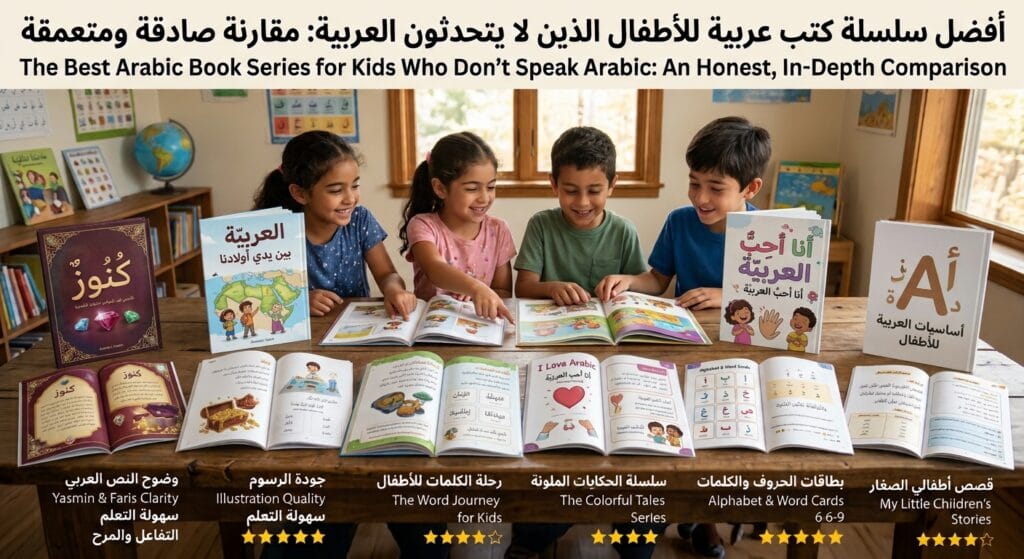
The Best Arabic Book Series for Kids Who Don’t Speak Arabic: An Honest, In-Depth Comparison
By Muhammad Mourtada — Founder, eArabicLearning · Native Egyptian Arabic teacher with 20+ years of experience · Updated October 2026
Quick answer: For children who don’t speak Arabic at home, the strongest full-curriculum choices are Arabic at Our Children’s Hands (ages 5–18, very well sequenced), I Love Arabic / Uhibbu al-Arabiyyah (12 levels with workbooks and teacher’s books, popular in Islamic schools), and Al-Arabiyyah lil-Nashi’in (a long-established, goal-driven series). Madinah Arabic Course for Children is the gentlest and easiest for parents to teach from. For script literacy and little learners, Gateway to Arabic and Arabic Without Tears are excellent companions. No book replaces a teacher, but the right series makes every lesson far more effective.
In this guide
- Why the choice of series matters so much
- How we compared the books
- The series, one by one
- Side-by-side comparison tables
- Quality, topics, objectives, sequencing, and child-fit in depth
- Which series fits which child
- A 10-minute checklist for judging any Arabic book
- Frequently asked questions
Why the choice of series matters so much
If you’ve ever stood in front of a shelf (or a screen) full of “Arabic for kids” books, you know the feeling. They all have bright covers. They all promise fun. And they are not the same at all.
Some are really alphabet primers. Some are full school curricula with twelve levels, workbooks, and teacher’s guides. Some are designed for a child who hears Arabic at home on weekends; others assume the child has never heard it. Pick the wrong one and a child can spend a year on material that is too easy, too hard, or aimed at a goal your family doesn’t have.
After more than twenty years of teaching Arabic to non-native learners, including many children, I’ve seen how much the book shapes the first two years. A well-built series gives a child small, steady wins. A badly matched one quietly teaches them that “Arabic is hard,” and that belief is much harder to undo than a missed letter.
So let’s compare the main series properly.
How we compared the books
We looked at each series through five lenses that parents and teachers actually care about:
- Quality: Is the content accurate, clearly presented, and well produced (illustrations, fonts, vowel marks, exercises)?
- Topics: Do the themes match a child’s world: family, school, food, animals, play, community, and faith?
- Coverage of learning goals: Does it build listening, speaking, reading, and writing, or only some of them?
- Organization of goals and skills: Is there a clear scope and sequence, with revision and assessment built in?
- Suitability for children: Age fit, pacing, workload, and how easy it is for a parent to use at home.
A quick honest note: the facts below (levels, ages, components) come from the publishers’ own descriptions and standard catalog information, while the judgments are our editorial opinion, based on years in the classroom. Editions and printings change, so always look at a sample unit before you buy.
The series, one by one
1. Arabic at Our Children’s Hands (العربية بين يدي أولادنا)
What it is: A modern series from Arabic For All, written for non-native learners aged 5 to 18. It is presented as the children’s counterpart of the widely used Arabic at Your Hands adult series. The authors are Dr. Abdulrahman Al-Fawzan and Dr. Muhammad Al-Sheikh, and the program is organized in 12 graded levels, with student books, teacher’s books, and exercises and tests.
What it aims to do: According to the publisher, it trains children to say and write correct Arabic sentences, recognize Arabic sounds, and communicate with native speakers in a range of situations. The vocabulary load is described as around 2,000 common words, drawn mostly from everyday situations.
Where it shines: Sequencing and clarity. Each level builds visibly on the last, and the aims are written in terms of what the child can do. It’s one of the more convincing options if you want one continuous path from age 5 to the teen years.
Watch out for: It works best with a teacher or a confident parent; the structure is designed for guided classroom use rather than casual browsing.
2. I Love Arabic / Uhibbu al-Arabiyyah (أحب العربية)
What it is: A 12-level series for non-Arabic-speaking children aged roughly 6 to 18. Every level includes three books: a Student’s Book, a Workbook, and a Teacher’s Book. It is widely used in full-time Islamic schools in North America and elsewhere.
What it aims to do: Build spoken and written communication through listening, speaking, reading, and writing together. The text is fully vowelled (tashkeel), the workbooks add practice and games, and a review follows every few lessons.
Where it shines: Built-in revision and assessment, and a very complete teacher-support package. For schools and homeschooling parents who want a “one box, whole year” program, this is hard to beat. It also teaches Arabic through Arabic, which is demanding at first but pays off in listening skills.
Watch out for: The Arabic-only approach can overwhelm a child who has had zero exposure. Many families do best starting with an alphabet primer or a few months of live lessons first.
3. Al-Arabiyyah lil-Nashi’in (العربية للناشئين)
What it is: A long-established course for non-Arabic-speaking children by Dr. Mahmoud Ismail Sini, Dr. Nashif Mustafa Abdulaziz, and Dr. Mukhtar Tahir Hussein, produced in the Gulf region. The full set runs to 24 books (12 levels, each with a textbook and workbook).
What it aims to do: Its stated goals are refreshingly broad: helping children love Arabic, read aloud correctly with understanding, build a large working vocabulary, learn about Arab and Islamic culture, eventually study other school subjects in Arabic, and support Quran recitation and understanding.
Where it shines: It has a clear educational philosophy and has been studied in academic research against textbook-quality standards. A comparison study of its first volume with the Arabic at Your Hands adult course found the two approaches quite close, with the latter slightly ahead in sequencing of materials.
Watch out for: The look and feel can seem more traditional than newer series, depending on the edition. Children raised on colorful apps may need a little more motivation from the teacher.
4. Madinah Arabic Course for Children
What it is: A 7-book series by Dr. V. Abdur Rahim, adapted from his famous adult Madinah Arabic course. It is full-color, A4-sized, and uses large fonts and plenty of pictures. It is aimed at children meeting Arabic for the first time who can at least recognize letters and sounds.
Where it shines: Simplicity and ease of teaching. Early levels are short (Level 1 has 11 chapters; Level 2 has 17 chapters over about 72 pages), printed on paper you can write on in pencil, and light enough that a parent with basic Arabic can teach from it. A teacher’s module is also available.
Watch out for: It’s a gentler, narrower program with fewer levels. It’s a wonderful foundation, but older children usually need to move to a fuller series afterward.
5. Gateway to Arabic and Arabic Without Tears (Imran Hamza Alawiye)
What they are: Two different tools from the same author. Gateway to Arabic is a progressive course for learners from non-Arabic-speaking environments, spanning a broad age range, and it focuses on reading and writing (Book 1 builds the script skills; Book 2 follows for those who’ve mastered the basics; there is also a handwriting book). Arabic Without Tears is a colorful series for younger learners, designed for parents or teachers working closely with a child, using a “key words” approach with numbers, colors, and everyday vocabulary.
Where they shine: Script literacy and early confidence. Arabic Without Tears is lovely for the 4–7 range, and Gateway is a strong companion for children who need a clear route into reading and handwriting.
Watch out for: Neither is a complete four-skills school curriculum on its own. Think of them as excellent foundations or supplements.
6. Early-years and “Arabic in the West” programs
For ages 3–6 there are kindergarten-level programs (for example the Arabic in Kindergarten books and the follow-on series written for children growing up in Western countries). These combine songs, picture-led vocabulary, and simple conversations, and are written with children who only meet Arabic once or twice a week in mind. For Quran reading specifically, many families also use the traditional Noorani Qaidah primer, which trains accurate letter sounds and reading, but is a reading primer rather than a language curriculum.
Side-by-side comparison: the facts
| Series | Typical age | Levels | Components | Main emphasis |
|---|---|---|---|---|
| Arabic at Our Children’s Hands | 5–18 | 12 | Student, teacher, exercises/tests | Balanced four skills, strong progression |
| I Love Arabic | 6–18 | 12 | Student, workbook, teacher | Four skills, revision, school use |
| Al-Arabiyyah lil-Nashi’in | Children and early teens | 12 (24 books) | Textbook + workbook | Reading, vocabulary, culture, Quran support |
| Madinah Arabic for Children | Primary years | 7 | Textbook + teacher’s module | Gentle foundations, easy teaching |
| Gateway to Arabic | Broad age range | Multiple books | Books, handwriting, audio | Reading and writing |
| Arabic Without Tears | Younger learners | Short series | Parent-guided books | Key words, first vocabulary |
Side-by-side comparison: our editorial assessment
This table is our professional judgment, not a scientific score. “Strong” means it clearly delivers; “Solid” means good with caveats; “Limited” means it isn’t the main goal of the series.
| Series | Quality and production | Topic variety | Goal coverage (4 skills) | Organization of skills | Child-friendliness |
|---|---|---|---|---|---|
| Arabic at Our Children’s Hands | Strong | Strong | Strong | Strong | Solid (best with guidance) |
| I Love Arabic | Strong | Solid | Strong | Strong | Solid (Arabic-only start is tough) |
| Al-Arabiyyah lil-Nashi’in | Solid | Strong | Strong | Solid | Solid |
| Madinah Arabic for Children | Solid | Solid | Limited (reading/vocabulary heavy) | Solid | Strong (easy for parents) |
| Gateway to Arabic | Solid | Limited | Limited (reading/writing) | Strong | Solid |
| Arabic Without Tears | Solid | Solid | Limited | Solid | Strong (for little ones) |
Quality: what to look for beyond the cover
Good quality in an Arabic book is about more than pretty illustrations. Check three things:
- Vowel marks (tashkeel): Beginners need them on every word. Series that fade them out gradually, as the child grows, are doing it right.
- Fonts and spacing: Large, clear letters with generous spacing matter more than decorative fonts. Little eyes tire quickly.
- Exercise variety: Matching, listening, tracing, short writing, and speaking tasks keep children engaged better than page after page of the same drill.
The full-curriculum series (Arabic at Our Children’s Hands and I Love Arabic) are the most thoroughly produced, because they come with workbooks and teacher resources. The primers are simpler but often more inviting for the very young.
Topics: do they match a child’s real world?
Children learn words they care about. All of the major series open with the familiar: family, home, school, food, clothes, animals, body parts, and daily routines, then move toward community, travel, nature, and stories. The differences are in flavor:
- Al-Arabiyyah lil-Nashi’in and Madinah Arabic for Children put a lot of weight on Islamic and Arab culture.
- I Love Arabic and Arabic at Our Children’s Hands mix everyday situations with cultural and faith content.
- Early-years programs lean on songs, colors, numbers, and picture vocabulary.
Whichever series you choose, you can top up vocabulary with themed lessons from our blog: meals of the day, transportation, hobbies, sports, the seasons, natural elements, holidays, and action words.
Learning goals: which series really cover all four skills?
A genuine language program trains listening, speaking, reading, and writing together. Here’s the honest picture:
- Full four-skills programs: Arabic at Our Children’s Hands, I Love Arabic, and Al-Arabiyyah lil-Nashi’in all state communication goals across all four skills, plus grammar awareness in context.
- Reading-first programs: Madinah Arabic for Children and Gateway to Arabic concentrate on decoding, vocabulary, and writing. Speaking is something the teacher or parent must add.
- Early vocabulary builders: Arabic Without Tears and the kindergarten programs build a bank of words and listening familiarity, but not sentence-level fluency.
One crucial caveat: every series above teaches Modern Standard Arabic (MSA). That’s the right choice for reading, writing, school, and the Quran, but it isn’t what people say on the street. If your child will chat with cousins in Cairo or Amman, add some dialect. We explain the difference in our Egyptian Arabic section.
Organization of goals and skills: scope and sequence
This is where the big series earn their reputation. A good scope and sequence means:
- clear unit goals (“by the end, the child can introduce their family”),
- a steady drip of new letters, words, and structures,
- regular review so nothing is forgotten, and
- tests or checkpoints you can actually use.
I Love Arabic is especially strong on regular evaluation, and Arabic at Our Children’s Hands is especially clear on progressive aims across its twelve levels. Gateway to Arabic has a neat, step-by-step build of the script. Madinah Arabic for Children is short and tidy, but it has fewer levels, so the destination is closer.
Suitability for children: age, pace, and parents
Here is where family reality matters most:
- Ages 3–6: Choose picture-led, short-session material (kindergarten programs, Arabic Without Tears, early Madinah levels).
- Ages 6–9: The sweet spot for starting any of the big series at Level 1, ideally with a teacher.
- Ages 10–14: Older beginners can often move faster through Arabic at Our Children’s Hands or I Love Arabic, but may find early-years content babyish. Pick a series that was written for their age band.
- Teens: Consider a teen-appropriate level, or Gateway to Arabic for a quick path into reading and writing.
Also consider what you can do at home. If you don’t read Arabic, a series with audio and a complete teacher’s book makes a huge difference, and a live teacher makes the biggest difference of all. Our guide for parents of kids in Maadi explains how we combine structured materials with live lessons, and the story of learning Arabic through play shows why fun matters so much.
Which series fits which child?
- “My child has never seen Arabic letters.” Start with a primer such as Arabic Without Tears or Madinah Arabic for Children Level 1, then move up.
- “We want one program for the next ten years.” Arabic at Our Children’s Hands or I Love Arabic.
- “We’re homeschooling and want teacher guides and tests.” I Love Arabic.
- “The goal is reading the Quran with understanding.” Pair a language series with a Quran-reading primer, and read our guide on choosing a Quranic Arabic teacher.
- “My child is 12 and a total beginner.” Gateway to Arabic for the script, then a full series from a level that fits their age.
- “I’m a parent with little Arabic.” Madinah Arabic for Children is the least intimidating.
Books are only half the story
No textbook can hear your child’s pronunciation, notice that the letter ع is coming out as أ, or adjust when a child is tired. The most successful children I’ve taught combined three things: a solid series, short and frequent practice (15–25 minutes, several days a week), and a live teacher for speaking and correction.
Add easy reading as soon as they can decode simple words; our collection of easy Islamic stories in Arabic for kids is a good place to start, and you can browse more in our Learn Arabic for Kids and Arabic Books sections. If an adult in the house wants to learn alongside the children, see our roundup of the best Arabic books for non-native adults and our Learn Arabic from Scratch guide.
A 10-minute checklist for judging any Arabic book
Before buying, open a sample unit and ask:
- Is the target age clearly stated, and does the content match it?
- Are all four skills practiced, or only reading?
- Are vowel marks used consistently for beginners?
- Does each lesson state a clear goal?
- Is there regular review and assessment?
- Is there audio, so the child hears correct pronunciation?
- Is there a teacher’s book or answer key?
- Are the topics relevant to this child’s life?
- Can the child complete a lesson in 20 minutes without frustration?
- Is the Arabic MSA, dialect, or both, and does that match your goal?
If a book scores well on most of these, it’s a safe bet.
Final thoughts
There is no single “best” series for every child, but there is a best fit for yours. Full curricula like Arabic at Our Children’s Hands and I Love Arabic give long-term structure; Al-Arabiyyah lil-Nashi’in offers a rich, goal-driven path; Madinah Arabic for Children, Gateway to Arabic, and Arabic Without Tears are wonderful for foundations. Choose by age, starting point, and the help you can give at home, and keep the first months joyful.
If you’d like a native teacher to place your child in the right level and make the books come alive, you’re welcome to book a free live Arabic lesson. You can also browse our Top 100 Arabic Learning FAQs.
Frequently asked questions
What is the best Arabic book series for children who don’t speak Arabic?
There isn’t one winner, but Arabic at Our Children’s Hands and I Love Arabic are the strongest full curricula for non-native children, offering 12 graded levels and teacher support. Madinah Arabic Course for Children is the easiest for parents to teach from, and Arabic Without Tears suits the youngest learners.
At what age should my child start a structured Arabic series?
Children can begin with picture-based, play-focused material from about age 3 to 4. Most full curricula start comfortably at 5 to 7, when children can handle letters and short writing tasks.
Should I choose Modern Standard Arabic books or dialect books?
Choose Modern Standard Arabic (MSA) for reading, writing, schooling, and the Quran, because all major children’s series teach it. Add a spoken dialect, such as Egyptian Arabic, if your child will talk with family or friends in a specific country.
Do these series also teach the Quran?
They build Arabic reading and language skills that support Quran study, and some include Islamic content. For accurate recitation with tajweed, most families add a dedicated Quran-reading primer and a qualified teacher.
Can my child learn Arabic from books alone?
Books give structure, vocabulary, and reading practice, but speaking and pronunciation need feedback. Children progress fastest when a good series is combined with short regular practice and live lessons with a native teacher.
How do I know if a level is too hard or too easy?
If your child can’t recognize most letters or words without help, step back a level or add a primer. If they finish pages easily and look bored, move forward or add reading and speaking activities.
What is the difference between Arabic at Our Children’s Hands and I Love Arabic?
Both are 12-level series for non-native children. Arabic at Our Children’s Hands stresses clear progressive goals and sentence-building, while I Love Arabic stresses a three-book package per level (student, workbook, teacher), regular evaluation, and full-vowel text for school use.
Are there Arabic books for toddlers and preschoolers?
Yes. Kindergarten-level programs for ages 3 to 5 and parent-guided series like Arabic Without Tears use pictures, key words, songs, and short activities suited to young attention spans.
How much time should my child spend on Arabic each week?
For primary-age children, short sessions of about 15 to 25 minutes, several days a week, work better than one long weekly session. Consistency matters more than length.
Do I need the teacher’s book?
If you don’t read Arabic, the teacher’s book and audio are very helpful, because they show how to present each lesson and check answers. If you’re using a live teacher, they will usually handle this for you.