
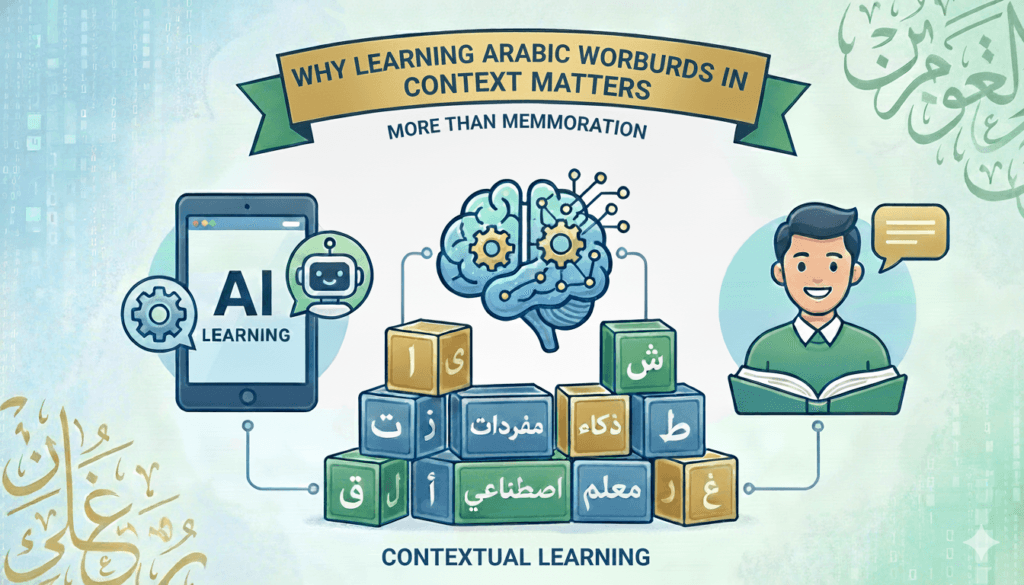
Memorizing Arabic words feels like progress.
Using them correctly is real progress.
Many learners know dozens of Arabic words — yet freeze when they need to speak or understand natural Arabic. This gap is not about intelligence or effort. It’s about how vocabulary is learned.
This article explains why learning Arabic words in context matters far more than memorizing lists — and how this shift changes everything.
Memorization Creates Recognition, Not Usable Knowledge
When you memorize a word in isolation, your brain stores it as a fact — not as a tool.
You may recognize:
The written word
Its basic translation
A familiar form
But recognition fails under pressure.
Context creates retrieval — and retrieval is what language actually requires.
Arabic Words Do Not Live Alone
Arabic words are shaped by:
Sentence structure
Verb patterns
Prepositions
Register (formal vs spoken)
Cultural expectations
The same word can sound:
Natural in one context
Awkward in another
Incorrect in a third
Without context, a word is incomplete.
Context Teaches Meaning, Usage, and Limits
Context does more than explain meaning.
It shows:
When a word is appropriate
What usually comes before or after it
Which verbs or prepositions it prefers
How native speakers actually use it
This kind of knowledge cannot be learned from a list.
Why Context Is Even More Critical in Arabic
Arabic amplifies the problem.
Because of:
Root-based morphology
Pattern-driven meaning
Flexible word order
Strong verb–noun relationships
A single translation often hides multiple realities.
Context reveals which one applies.
Context Helps the Brain Build Strong Memory Paths
The brain remembers stories and situations better than isolated data.
Context:
Anchors words to meaning
Creates mental images
Connects vocabulary to emotion or action
This makes recall faster, stronger, and more reliable.
Memorization Without Context Leads to Fossilized Errors
One of the biggest dangers of list-based learning is fossilization.
Learners:
Use words in unnatural ways
Repeat the same mistakes
Gain false confidence
Without corrective context, errors become habits.
How to Learn Arabic Words in Context (Practically)
Context-based learning is not complicated.
Effective learners:
Learn words inside full sentences
See multiple examples per word
Practice using the word actively
Receive correction
One well-learned word beats five memorized ones.
The Role of AI in Context-Based Learning
AI makes contextual learning easier — but not automatic.
AI can:
Generate realistic examples
Show usage variations
Compare similar words
Explain why a sentence works
AI cannot:
Judge naturalness perfectly
Replace cultural intuition
Decide learning priorities alone
Used wisely, AI supports context, not shortcuts.
Why Teachers Are Still Essential
Teachers:
Select the right contexts
Correct misuse early
Explain subtle differences
Prevent fossilization
Context without guidance can still mislead.
That’s why the smartest systems combine AI + Teachers, as explained in the pillar article.
What Actually Works :
Stop asking:
“What does this word mean?”
Start asking:
“How is this word used?”
Arabic vocabulary grows when:
Words appear in real situations
Usage is practiced
Feedback is immediate
Learning is structured
Context doesn’t slow learning — it prevents relearning.
Final Verdict
✔ Your original content was conceptually strong
✔ This version improves clarity, authority, and scan-ability
✔ Fully aligned with SEO + AI Overview standards
If you want next:
Ultra-short AI snippet version
Conversion-optimized intro for landing pages
Internal-link anchor optimization
Or alignment wording for eArabicLearning
Related Pillar Article
👉 The Ultimate Guide to Building Arabic Vocabulary the Smart Way (AI + Teachers)
✅ FAQs – Why Learning Arabic Words in Context Matters More Than Memorization
1. Why is learning Arabic words in context more effective than memorization?
Because context teaches how a word is actually used, not just what it means. Arabic words change meaning and form depending on usage, which memorization alone cannot capture.
2. What problems does memorizing Arabic word lists cause?
It leads to weak recall, unnatural usage, and repeated mistakes. Learners may recognize words but fail to use them correctly in real situations.
3. How does context improve Arabic vocabulary retention?
Context creates stronger memory connections by linking words to situations, meaning, and usage, making recall faster and more reliable.
4. Is context-based learning important for all Arabic levels?
Yes. Beginners need context to build correct foundations, while advanced learners need it to refine usage, accuracy, and natural expression.
5. How does Arabic structure make context more important?
Arabic relies on roots, patterns, and sentence structure. A single word can behave differently across contexts, making isolated learning ineffective.
6. Can learners still memorize Arabic vocabulary?
Yes, but memorization should support context-based learning, not replace it. Words should be memorized after they are understood and used.
7. Can AI help with learning Arabic words in context?
AI can generate examples and explain usage, but it cannot always judge naturalness or cultural nuance. Human guidance remains essential.
8. Why are teachers important in context-based vocabulary learning?
Teachers choose appropriate contexts, correct misuse, and prevent fossilized errors that often result from unguided memorization.