
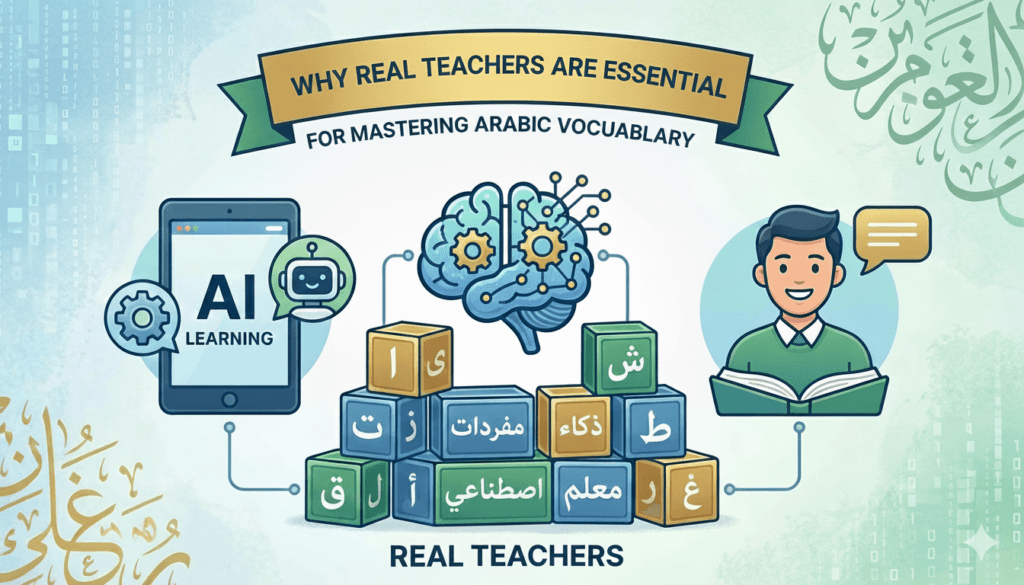
In the age of AI apps, flashcards, and automated learning tools, it’s tempting to believe that technology alone can teach you Arabic vocabulary. Algorithms promise speed. Apps promise efficiency. Some even promise fluency.
Reality check: Arabic vocabulary is not just data. It’s judgment, context, culture, and correction.
And that’s where real teachers become essential—not optional.
This article explains why human teachers are still the backbone of serious Arabic vocabulary mastery, how they complement AI tools, and how combining both is the smartest path forward.
Arabic Vocabulary Is Not Just “Words + Meanings”
Arabic looks deceptively simple at first. One word, one translation—right?
Wrong.
A single Arabic root can generate:
Multiple nouns
Several verbs
Formal and informal uses
Meanings that shift by context, tone, or region
For example, AI can tell you that a word means “to know.”
A teacher explains:
When it sounds natural
When it sounds strange
When it sounds rude
When natives never actually use it
Vocabulary without human explanation becomes brittle knowledge. It breaks the moment you try to speak or listen.
Teachers Teach Usage, Not Just Meaning
AI tools excel at:
Repetition
Speed
Pattern recognition
Teachers excel at:
Explaining why a word works here but not there
Correcting subtle but critical mistakes
Teaching collocations (words that naturally go together)
Showing real-life usage instead of textbook Arabic
A learner might memorize:
“I want” = أريد
A teacher adds:
When to soften it
When to replace it
When it sounds too direct
When natives avoid it entirely
That layer cannot be automated reliably—especially in Arabic.
Arabic Has Levels. Teachers Navigate Them.
Arabic isn’t one language. It’s a system:
Modern Standard Arabic (MSA)
Regional dialects
Formal vs informal speech
Written vs spoken vocabulary
AI often mixes levels without warning.
Teachers don’t.
A good teacher tells you:
“This word is correct, but nobody says it.”
“This works in writing, not in conversation.”
“This is Gulf Arabic, not Egyptian.”
“This will confuse people if you say it aloud.”
Without that guidance, learners accumulate technically correct but practically useless vocabulary.
Teachers Prevent Fossilized Mistakes
One of the most dangerous things in language learning is getting used to being wrong.
AI tools:
Often accept approximate answers
Rarely stop you mid-sentence
Can’t always detect unnatural phrasing
Teachers:
Interrupt early
Correct immediately
Explain the correction
Make sure the mistake doesn’t harden into habit
In Arabic, small vocabulary errors can completely change meaning.
Fixing them early saves months of unlearning later.
Teachers Adapt to You, Not the Average Learner
AI systems teach based on probabilities.
Teachers teach based on observation.
A real teacher can:
Slow down when you’re overwhelmed
Push you when you’re coasting
Change examples based on your goals
Notice confusion you didn’t articulate
If you’re learning Arabic for:
Islamic studies
Daily conversation
Academic reading
Business communication
A teacher adjusts vocabulary selection accordingly.
AI usually does not.
The Smart Model: Teachers + AI (Not Teachers or AI)
This is where platforms like eArabicLearning.com take the lead.
The smartest learners don’t choose sides. They combine strengths:
AI handles:
Repetition
Review
Vocabulary tracking
Spaced repetition systems
Teachers handle:
Context
Correction
Explanation
Real communication
Together, they form a closed learning loop:
Learn → Practice → Correct → Reinforce → Apply
Remove the teacher, and the loop breaks.
What Happens When Learners Rely on AI Alone?
Common outcomes:
Large passive vocabulary, weak speaking
Confusion between MSA and dialects
“I understand but can’t respond”
Technically correct sentences that sound unnatural
Frustration after initial progress
These learners don’t fail because they’re lazy.
They fail because Arabic punishes shortcuts.
Why This Matters for Long-Term Fluency
Vocabulary mastery isn’t about how many words you know.
It’s about:
How quickly you retrieve them
How naturally you use them
How accurately you adapt them
Teachers shape intuition.
AI accelerates repetition.
Fluency lives in the space between.
How This Article Connects to the Main Pillar
This article is part of the larger framework explained in:
👉 The Ultimate Guide to Building Arabic Vocabulary the Smart Way (AI + Teachers)
That pillar article shows:
How AI and teachers work together
How to structure vocabulary learning
How to avoid common traps
How to build usable Arabic, not theoretical knowledge
Every serious vocabulary strategy eventually leads back to one truth:
Technology scales learning. Teachers make it human.
Final Thought (No Sugar-Coating)
If Arabic vocabulary were just memorization, apps would be enough.
It isn’t.
Arabic is logic, culture, sound, and judgment layered onto words.
Only humans teach judgment well.
Use AI aggressively.
But anchor your learning to real teachers—or accept slower, shakier progress.
That’s the reality.
FAQs – Why Real Teachers Are Essential for Mastering Arabic Vocabulary
1. Can AI tools replace Arabic teachers completely?
No. AI tools are excellent for repetition and vocabulary review, but they cannot fully replace real teachers. Arabic vocabulary depends heavily on context, usage, tone, and cultural awareness—areas where human teachers are essential.
2. Why is Arabic vocabulary harder to learn than other languages?
Arabic vocabulary is built around roots, patterns, and multiple language levels (MSA and dialects). A single word can change meaning depending on context, grammar, or region, which makes guidance from experienced teachers critical.
3. Is learning Arabic vocabulary with a teacher faster than using apps alone?
Yes, in the long term. Teachers prevent mistakes from becoming habits, explain usage clearly, and guide learners toward the most practical vocabulary, saving months of confusion and relearning.
4. How do teachers help with Modern Standard Arabic and dialects?
Teachers clearly separate formal Arabic (MSA) from spoken dialects and explain when and where each word is used. AI tools often mix these levels, which can confuse learners.
5. What is the best way to combine AI and teachers for Arabic vocabulary?
The best method is to use AI for spaced repetition, review, and tracking progress, while relying on teachers for explanation, correction, and real-life usage. This combination creates faster and more stable vocabulary mastery.
6. Can beginners learn Arabic vocabulary without a teacher?
Beginners can start with AI tools, but without a teacher they often develop weak pronunciation, incorrect usage, and limited speaking ability. Early guidance from a teacher builds a stronger foundation.
7. Why does Arabic vocabulary need context-based learning?
Many Arabic words change meaning depending on sentence structure, formality, and situation. Teachers provide real examples and explanations that make vocabulary usable, not just memorized.