
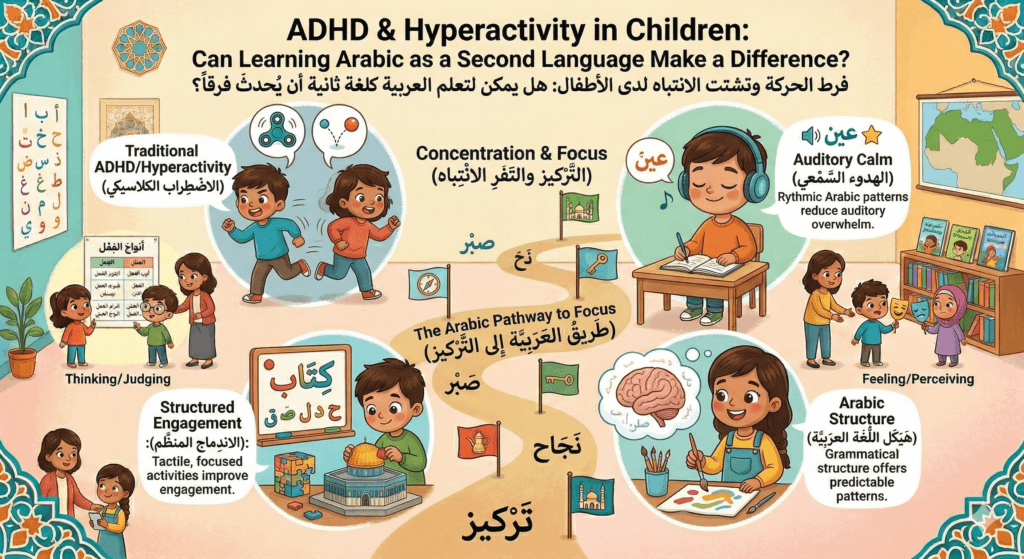
ADHD & Hyperactivity in Children:
Can Learning Arabic as a Second Language Make a Difference?
A deep-dive into the neuroscience of attention, the unique cognitive demands of Arabic language acquisition, and evidence-based strategies for teaching Arabic to children with ADHD and hyperactivity.
⏱ 20-minute read
🎓 Evidence-Based
👶 Ages 4–14
🧠 Neuroscience-Informed
Introduction: ADHD and the Language Learning Challenge
Let’s start with a truth that every parent of an ADHD child knows deeply: getting your child to sit still and focus on anything for more than a few minutes can feel like negotiating a peace treaty. Now imagine asking that same child to learn one of the world’s most complex and beautiful languages — Arabic. A language with a completely different alphabet, written right to left, with sounds that don’t exist in English, and a grammar system built on a remarkable root-and-pattern architecture.
Sounds impossible, right? That’s what most people would assume.
But here at eArabicLearning, we’ve seen something remarkable happen when children with ADHD and hyperactivity are introduced to Arabic in the right way: something clicks. Something about the novelty, the visual richness, the physical engagement of writing the script, or the rhythmic cadences of Arabic sounds catches their endlessly curious minds — and holds on.
This article is our attempt to explore that phenomenon seriously and scientifically. We’ll look at what ADHD actually is neurologically, why second language learning has unique effects on attention and executive function, why Arabic specifically has features that can be therapeutic and engaging for hyperactive learners, and most importantly — what you as a parent or teacher can do about it.
⚠️Important note: This article is educational and informational in nature. It does not constitute medical advice. ADHD is a complex neurodevelopmental condition that requires professional diagnosis and management. Learning Arabic is presented here as a supplementary enrichment activity, not a clinical treatment.
Understanding ADHD: What Actually Happens in the Brain
Attention Deficit Hyperactivity Disorder (ADHD) is one of the most common neurodevelopmental disorders in children. According to the American Psychiatric Association’s DSM-5, it is characterized by persistent patterns of inattention, hyperactivity, and impulsivity that interfere with functioning or development. But to truly understand how to help ADHD children learn Arabic, we need to go deeper than the diagnostic checklist — we need to understand the neuroscience.
The ADHD Brain: A Neuroscience Overview
The brains of children with ADHD differ from neurotypical brains in several important ways. Research using neuroimaging (fMRI and structural MRI) has identified consistent differences in:
- Prefrontal cortex development: Children with ADHD show delayed maturation of the prefrontal cortex — the area responsible for planning, impulse control, working memory, and sustained attention. This is not a deficit in intelligence; it is a developmental timing difference.
- Dopamine regulation: The brain’s reward circuitry in ADHD children is less sensitive to conventional, slow-reward activities. ADHD brains are wired to seek immediate stimulation and novelty because their dopamine systems require higher levels of stimulation to register satisfaction.
- Default Mode Network (DMN): In neurotypical brains, the DMN (associated with mind-wandering and daydreaming) deactivates during tasks. In ADHD brains, the DMN often remains active during tasks, creating competition between task-focused and default-mode thinking — which manifests as apparent inattention.
- Cerebellar differences: The cerebellum, involved in motor control and timing, also shows differences in ADHD, which partly explains why many ADHD children have fine motor differences — relevant for Arabic script writing.
🧠 The ADHD Brain Is Not Broken — It’s Different
A crucial reframe: ADHD brains are often described in deficit terms. But many researchers now emphasize that ADHD represents a different cognitive style, not simply a broken version of neurotypical cognition. ADHD children often show:
- Exceptional creativity and divergent thinking
- Hyperfocus capability — intense concentration on genuinely interesting tasks
- High energy and enthusiasm that can be channeled into learning
- Strong pattern recognition in novel environments
- Remarkable resilience and adaptability
The challenge for educators and parents is not to “fix” the ADHD brain but to build learning environments that work with its natural architecture.
The Three Presentations of ADHD
The DSM-5 identifies three presentations of ADHD, each of which requires somewhat different approaches in the Arabic learning context:
- Predominantly Inattentive Presentation: The child struggles to sustain attention, follow multi-step Arabic instructions, complete Arabic worksheets, or maintain focus during a 30-minute Arabic lesson. They may appear dreamy or easily distracted. Often underdiagnosed, especially in girls.
- Predominantly Hyperactive-Impulsive Presentation: The child is constantly in motion, speaks out of turn, rushes through Arabic writing without care, and finds sitting still during Arabic lessons intensely difficult. High energy, impulsive responses.
- Combined Presentation: The most common form — displays significant features of both inattention and hyperactivity-impulsivity. Requires a multi-pronged approach in Arabic instruction.
ADHD, Bilingualism, and Second Language Acquisition: What the Research Says
The intersection of ADHD and bilingual language learning is an active and fascinating area of research. For years, there was concern — sometimes communicated to parents as advice — that bilingualism might “confuse” or overload children with ADHD. The evidence now strongly contradicts this view.
Does Bilingualism Harm ADHD Children?
A growing body of research suggests that bilingualism does not harm ADHD children — and may actually offer cognitive benefits. A landmark study by Engel de Abreu et al. (2014) found that bilingual children showed advantages in certain aspects of executive function compared to monolinguals. Since executive function (working memory, cognitive flexibility, inhibitory control) is precisely the domain most affected in ADHD, this finding has significant implications.
The “bilingual advantage” hypothesis suggests that the constant practice of managing two languages — knowing which one to use when, suppressing the non-target language — provides a form of cognitive exercise for the prefrontal cortex. For ADHD children whose prefrontal cortex development is delayed, this gentle, consistent exercise may have developmental value.
“Managing two language systems requires constant cognitive monitoring and control — precisely the skills that are underdeveloped in ADHD. The question is whether this practice, maintained over years, can strengthen those very systems.”
— Adapted from Bialystok, Craik, & Luk (2012), Psychological Science
Language Learning and Executive Function
Learning a second language consistently exercises three core components of executive function that are central to ADHD management:
| Executive Function Component | How Arabic Learning Exercises It | ADHD Relevance |
|---|---|---|
| Inhibitory Control | Suppressing the native language response to produce an Arabic word or structure | ADHD children struggle with impulse inhibition; this provides structured inhibition practice |
| Working Memory | Holding Arabic vocabulary, grammar rules, and phonological information simultaneously during communication | Working memory deficits are core to ADHD; language tasks exercise this capacity |
| Cognitive Flexibility | Switching between Arabic and native language contexts, adapting to different Arabic registers (MSA vs colloquial) | Cognitive rigidity in ADHD; flexibility practice through language switching may help |
| Sustained Attention | When Arabic activities are intrinsically motivating, they can elicit the ADHD “hyperfocus” state | ADHD attention is novelty-seeking; Arabic’s genuine novelty can sustain engagement |
🌱Research highlight: A 2021 study in the Journal of Attention Disorders found that children with ADHD who participated in structured second language learning programs showed improvements in sustained attention scores over an academic year, compared to a control group. While Arabic was not the specific language studied, the executive function pathways involved are language-independent.
Why Arabic Specifically Can Engage and Benefit ADHD Children
Not all languages offer the same cognitive and sensory experiences to learners. Arabic has several distinctive features that make it uniquely well-positioned to engage the ADHD brain — when taught correctly. Let’s explore them one by one.
Visual Novelty & Beauty
The Arabic script is immediately visually striking. For ADHD brains that are wired to respond to novelty and aesthetic stimulation, the first encounter with Arabic calligraphy can spark genuine fascination. The script does not look like anything the child has seen before.
Fine Motor Engagement
Writing Arabic letters requires deliberate, slow, precise hand movements — connected, flowing strokes. This physical engagement activates kinesthetic learning channels and requires a quality of focused attention that benefits ADHD children through embodied practice.
Rich Phonological Texture
Arabic’s unique sounds — ع، غ، ح، خ، ص، ض — are genuinely different from anything an English-speaking child has heard. This phonological novelty captures attention and activates deep listening, which is excellent practice for auditory focus.
Pattern-Based Morphology
Arabic is built on a root-and-pattern system (الجذر الثلاثي). Many ADHD children who struggle with rote memorization excel at pattern recognition — and Arabic’s morphological system rewards exactly this cognitive strength.
Cultural Richness
Arabic opens doors to extraordinary cultural content: One Thousand and One Nights, the traditions of Ramadan and Eid, Arabic music, food, and geography across 22 diverse countries. ADHD children often thrive when learning is embedded in rich, meaningful cultural context.
Rhythmic & Musical Qualities
Arabic has natural musicality — in its poetry (الشعر), Quranic recitation (التجويد), and even everyday speech. The rhythmic nature of Arabic learning activities (chanting, nasheeds, tajweed) can regulate arousal levels in hyperactive children.
The Hyperfocus Opportunity
One of the most powerful and underutilized features of the ADHD brain is hyperfocus — the ability to enter a state of intense, sustained concentration on something that is genuinely captivating. Parents and teachers who have witnessed hyperfocus know how remarkable it is: the same child who “can’t focus for five minutes” can spend three hours absorbed in a video game or a LEGO project.
Arabic, for many children, can trigger hyperfocus. The combination of visual beauty, cultural richness, genuine challenge, and meaningful rewards (being able to read a word in the Quran, understand an Arabic cartoon, write their name in Arabic script) creates the conditions for deep engagement. An ADHD child in hyperfocus mode is one of the most effective learners in the room.
💡Key insight: The ADHD brain doesn’t lack the ability to focus — it has a different threshold for what merits attention. Arabic, taught with creativity and cultural depth, can consistently clear that threshold.
Arabic Calligraphy as a Therapeutic Learning Tool for ADHD
If there is one single activity at the intersection of Arabic language learning and ADHD management that deserves special attention, it is Arabic calligraphy (الخط العربي). This ancient art form has become, somewhat unexpectedly, one of our most powerful tools at eArabicLearning for engaging children who struggle with conventional language instruction.
The Neuroscience of Writing and Attention
Research on handwriting and learning consistently shows that the physical act of forming letters by hand engages far more of the brain than typing. For ADHD children specifically, the slow, deliberate, connected strokes of Arabic calligraphy require and reinforce:
- Sustained fine motor attention: You cannot rush Arabic calligraphy. The brush or reed pen demands slow, controlled movement — a built-in pace regulator for hyperactive children.
- Visuospatial focus: Placing letters correctly on the page, maintaining proportions, and flowing one letter into the next requires constant visual monitoring.
- Mindfulness-like states: Multiple teachers and therapists have observed that children with ADHD enter a noticeably calm, focused state during Arabic calligraphy — similar to what mindfulness-based interventions aim to produce.
- Immediate, visible reward: The finished calligraphy piece is beautiful. For ADHD children who need immediate reinforcement, the visual reward of a completed Arabic calligraphy piece is deeply satisfying.
🖌️ Arabic Calligraphy & Occupational Therapy: A Natural Partnership
Several occupational therapists working with ADHD children have begun incorporating Arabic or other non-Latin script calligraphy into therapeutic programs precisely because the unfamiliarity of the script removes the anxiety of “getting it right” that comes with native-language writing. The child can be a pure beginner, removing the performance pressure that inhibits ADHD children so often.
Occupational therapists note that the flow state experienced during calligraphy helps regulate the sympathetic nervous system — calming the physiological arousal that is part of hyperactivity.
Practical Calligraphy Integration in Arabic Lessons
At eArabicLearning, we recommend introducing Arabic calligraphy not as a separate artistic activity but as an integrated part of Arabic letter learning. When a child learns the letter ب (ba), they don’t just trace it — they draw it beautifully, embellish it, color it. The Arabic letter becomes a piece of art before it becomes a phoneme in a word.
This approach has several ADHD-friendly advantages: the activity is hands-on, visually rewarding, produces a tangible product, takes an appropriate amount of time (not too short, not too long), and creates a personal connection to the Arabic letters that purely phonetic instruction cannot match.
Specific Challenges: ADHD and Arabic as a Foreign Language
Honesty requires us to also address the genuine challenges that children with ADHD face in Arabic learning. Understanding these challenges is the first step toward designing instruction that mitigates them.
Challenge 1: The Arabic Script Learning Curve
Learning the Arabic alphabet is genuinely demanding. Arabic has 28 letters, most of which change form depending on their position in a word (initial, medial, final, and isolated forms). For children with ADHD — whose working memory is often stretched thin and whose attention to detail can be inconsistent — the script presents a real challenge.
Mitigation: Introduce Arabic letters in small clusters (2–3 letters per session maximum), use multi-sensory approaches (draw in sand, trace with fingers, form with clay), and use letter connections and visual stories to make each letter memorable. Never rush the script foundation.
Challenge 2: Sustained Attention During Instruction
A standard 45-minute Arabic lesson assumes a level of sustained attention that many ADHD children simply cannot maintain — not won’t, but genuinely cannot, due to neurological architecture. Expecting an ADHD child to sit through a 45-minute Arabic grammar explanation will produce frustration on both sides.
Mitigation: Break Arabic sessions into micro-chunks of 7–12 minutes each, with movement breaks between. Research on ADHD and learning consistently shows that shorter, more frequent practice beats longer, less frequent sessions for this population.
Challenge 3: The Right-to-Left Directionality
Arabic is written from right to left — the opposite of English. For ADHD children who already struggle with directionality and spatial organization in their native language (directional errors in reading and writing are common in ADHD), this reversal can be initially disorienting.
Mitigation: Use physical cues consistently — a small sticker on the right side of the notebook to indicate “start here.” Practice right-to-left tracking with finger tracing before introducing actual Arabic letters. Frame it as a superpower: “You’re learning to read in a different direction — that’s really cool!”
Challenge 4: Working Memory Load in Arabic Grammar
Arabic grammar is complex. Even basic sentence construction requires holding in mind: noun gender (masculine or feminine), number (singular, dual, or plural), definiteness (definite article ال or not), and case (for formal/Modern Standard Arabic). This is a heavy working memory load for any child — and ADHD children have reduced working memory capacity by definition.
Mitigation: Use implicit, communicative approaches to grammar before formal explicit instruction. Children can internalize gender agreement through massive exposure to correct Arabic before they consciously study the rule. Reduce explicit grammar demands in early stages; let functional communication drive progress.
Challenge 5: Impulsivity and Accuracy
ADHD children’s impulsivity often manifests as rushing — blurting out the first Arabic word that comes to mind rather than thinking through the grammatically correct response, or writing Arabic letters quickly without care for correct form. This can lead to the formation of bad habits that are hard to correct later.
Mitigation: Build in processing time deliberately. Use the strategy of “think quietly for 5 seconds before you answer” as a consistent classroom ritual. Model this pause yourself. Frame it as “thinking in Arabic” — normalizing the pause as part of the language experience rather than as a sign of struggling.
Evidence-Based Teaching Strategies for ADHD Arabic Learners
Here is a comprehensive, evidence-informed strategy framework for teaching Arabic to children with ADHD and hyperactivity. These strategies are grounded in both ADHD management research and second language acquisition theory.
The MOVE Principle for ADHD Arabic Instruction
We use the acronym MOVE to organize our pedagogical approach for ADHD Arabic learners:
- M — Multisensory Engagement: Every Arabic concept should be introduced through multiple sensory channels simultaneously. See the Arabic letter, hear it pronounced by a native speaker, write it by hand, feel it traced on the palm, and hear it in a word that has meaning. The brain of an ADHD child is not wired for purely auditory instruction — it needs full sensory activation.
- O — Ownership and Choice: Giving ADHD children genuine choice in their Arabic learning dramatically increases engagement. Let them choose which Arabic topic to explore, which Arabic word to illustrate for their vocabulary book, or which Arabic-speaking country they want to “visit” through a cultural project. Autonomy activates the ADHD brain’s reward system.
- V — Varied Pacing and Format: No single Arabic activity format should last more than 10–12 minutes in a lesson for ADHD learners. Rotate between oral drills, writing activities, listening tasks, movement-based vocabulary games, and visual activities. Variety is not just a pedagogical nicety for ADHD children — it is a neurological necessity.
- E — Explicit Positive Reinforcement: ADHD children’s dopamine systems require more frequent positive signals than neurotypical children. Praise every genuine effort in Arabic — a correctly written letter, a remembered Arabic word, a brave attempt at pronunciation. Use tangible reward systems (sticker charts, points toward a small prize) if intrinsic motivation needs scaffolding. Connect each success to the child’s identity: “You are becoming an Arabic speaker!”
Specific Strategy Toolkit
| Strategy | Description | Why It Works for ADHD |
|---|---|---|
| Arabic Movement Vocabulary | Act out Arabic verb meanings with the whole body (e.g., jump when you hear “يقفز”, sleep when you hear “ينام”) | Kinesthetic learning channels attention; movement releases dopamine |
| Arabic Alphabet Song & Chant | Use rhythmic, repetitive Arabic alphabet chants and songs — particularly those with a clear beat | Rhythm regulates arousal; music activates reward circuits; repetition builds memory without boring drilling |
| Arabic Letter Art | Let children draw and decorate each Arabic letter as an art project before phonetics instruction | Aesthetic reward, fine motor engagement, immediate tangible product — all ADHD-friendly |
| Sand Tray Writing | Write Arabic letters in a shallow tray of sand or salt — erasable, tactile, forgiving | Tactile input improves focus; the forgiving medium removes perfectionism pressure |
| Arabic Story Immersion | Use richly illustrated Arabic stories; read aloud with dramatic expression and pause to discuss | Narrative context sustains attention; visual–verbal dual coding strengthens memory |
| Gamified Arabic Flashcards | Speed-based Arabic vocabulary card games, memory matching games with Arabic words and images | Competition and game structure create the novelty and urgency that activate ADHD attention |
| 5-Minute Arabic Micro-Sessions | Short daily 5-minute Arabic immersion bursts — one word, one phrase, one letter — throughout the day | Distributed practice beats massed practice for all learners; especially effective for ADHD |
| Arabic Cultural Projects | Build an Arabic “world book” — drawings of Arab foods, clothes, landmarks, animals, with Arabic labels | Project-based learning allows hyperfocus; integrates multiple subjects; produces a meaningful artifact |
| Video Modeling in Arabic | Short Arabic YouTube cartoons or native-speaker videos (2–5 minutes) as lesson starters or rewards | Screen-based novelty captures ADHD attention; native speaker input is invaluable for phonology |
| Peer Arabic Teaching | Have the ADHD child teach a sibling, parent, or stuffed animal an Arabic word they just learned | Teaching consolidates memory; the social/performance aspect motivates ADHD children; builds confidence |
Designing the Ideal Arabic Lesson for a Child with ADHD
What does an ADHD-optimized Arabic lesson actually look like in practice? Here is a sample 30-minute Arabic lesson structure for a child aged 7–10 with ADHD, designed around the neurological principles we’ve discussed.
📋Sample 30-Minute ADHD-Optimized Arabic Lesson Structure
- 0–3 min — Energizing Arabic Warm-Up: Start with an Arabic alphabet chant or song — something physical and fun. Clap along to the rhythm, jump when you say a specific letter. This burns off initial hyperactive energy and primes the brain’s phonological processing. Never start a lesson by asking the child to sit quietly and listen.
- 3–10 min — Visual–Tactile Letter or Vocabulary Focus: Introduce or review 1–2 Arabic letters or 4–5 Arabic words using multi-sensory materials. Use picture cards, sand tray writing, and verbal repetition simultaneously. Keep the pace brisk and engaging.
- 10–12 min — MOVEMENT BREAK: Non-negotiable. Even 2 minutes of physical movement dramatically resets ADHD children’s attention capacity. Jump in place, do 10 star jumps, walk to get a glass of water. Frame it as “charging our Arabic brains.”
- 12–20 min — Creative Arabic Activity: The longest single block. This could be a calligraphy session for a new letter, drawing and labeling an Arabic scene, listening to an Arabic story with comprehension questions, or a structured Arabic vocabulary game. The key is that it’s genuinely engaging and produces something tangible.
- 20–27 min — Oral Arabic Practice: Brief conversational activity — asking and answering simple Arabic questions, role-playing a scenario (at the Arabic market, greeting a friend in Arabic), or reciting a short Arabic poem or rhyme. Social and performative elements boost ADHD engagement.
- 27–30 min — Celebration & Preview: Review what was learned today in Arabic (the child tells you, not the other way around — retrieval practice). Celebrate with genuine enthusiasm. Preview what’s coming next time: “Next lesson, we’re going to learn how to count in Arabic and play a number game.” Anticipation is motivating for ADHD children.
Key Lesson Design Principles
- Maximum activity segment = 10–12 minutes (for ages 6–10), 15 minutes (for ages 11–14)
- Always include at least one physical movement element per lesson
- End on a high — the last memory of the lesson should be positive and energetic
- Use visual schedules: a simple visual representation of the lesson plan helps ADHD children know what’s coming, reducing anxiety about transitions
- Minimize transition time between activities — have all materials ready before the lesson starts
- Give one instruction at a time in Arabic lessons — never “list” multiple directions simultaneously
Parent’s Complete Action Guide: Supporting Your ADHD Child’s Arabic Journey
Parents are the most powerful resource an ADHD child has. Your involvement in your child’s Arabic learning — even in small, consistent ways — can make an enormous difference. Here is a practical, week-by-week guide to getting started.
Week 1–2: Creating the Arabic-Ready Environment
- Set up a dedicated, minimal-distraction Arabic corner — a small desk or table away from screens and toys. Keep it simple, calm, and associated only with Arabic.
- Purchase basic Arabic materials: a lined Arabic practice notebook, colorful markers for calligraphy, a simple Arabic alphabet poster for the wall.
- Begin playing Arabic children’s music quietly in the background during play time — passive exposure primes the ear before formal study begins.
- Learn 5 Arabic words yourself and use them naturally: “مرحبا” (hello), “شكراً” (thank you), “يلا” (let’s go), “ماشي” (okay), “بيتنا” (our house).
Week 3–4: Building the Habit Structure
- Establish a consistent, short daily Arabic micro-session: 5–10 minutes at the same time every day. Consistency of time reduces ADHD resistance to starting.
- Use a visual “Arabic Progress Chart” on the wall — a calligraphy-themed chart where your child adds a sticker for each Arabic letter mastered.
- Introduce one Arabic children’s YouTube channel. Watch one short episode together each week and discuss it (even in English — this is about exposure).
- Play “Arabic of the Day” — each morning at breakfast, introduce one Arabic word. Repeat it throughout the day in natural contexts.
Managing Frustration — For Both of You
There will be days when your ADHD child refuses Arabic practice, meltdowns occur over a tricky letter, or you feel like no progress is being made. This is completely normal and expected. Here is how to navigate it:
- Never force Arabic during a dysregulation episode. An ADHD brain in meltdown mode is physiologically incapable of learning. Wait until calm is restored, then return to Arabic gently.
- Celebrate consistency over perfection. A child who practiced Arabic for 3 minutes every day for a month has done something remarkable — even if each session was imperfect.
- Reframe “I can’t do this” to “I can’t do this YET.” Growth mindset language is particularly important for ADHD children, who are prone to learned helplessness after repeated academic difficulties.
- Take breaks without guilt. If Arabic causes significant stress for more than a week, step back, reassess the approach, and restart with something simpler and more fun.
- Connect Arabic to your child’s interests. Does your child love dinosaurs? Find Arabic words for dinosaurs. Love cooking? Try a simple Arabic recipe that requires reading Arabic labels. Love superheroes? Find Arabic dubbed cartoons featuring their favorite characters.
Technology Tools and Digital Resources for ADHD Arabic Learners
Used thoughtfully, technology can be one of the best tools for ADHD Arabic learners. The key word is “thoughtfully” — screen time guidelines and technology boundaries still apply. But within appropriate limits, digital Arabic learning tools offer ADHD-friendly features that traditional instruction sometimes cannot.
What to Look for in Arabic Apps for ADHD Children
- Short session design: Apps that offer 5–10 minute focused sessions rather than requiring extended engagement
- Immediate feedback: Instant correct/incorrect signals satisfy the ADHD need for immediate reinforcement
- Progress visualization: Clear visual progress indicators that show how many Arabic letters or words have been learned
- Gamification: Points, badges, and level systems that provide the novelty and reward structure ADHD brains respond to
- Audio-visual integration: Hearing Arabic words spoken correctly alongside seeing them written — dual coding at its best
- Customization: Ability to focus on specific Arabic vocabulary topics relevant to the child’s interests
Online Arabic Tutoring for ADHD Children
One-on-one online Arabic tutoring — like the sessions offered through eArabicLearning — is often the ideal formal Arabic instruction format for ADHD children, for several reasons:
- The tutor can instantly adapt the pace, format, and energy of the session to the child’s state in real time
- There are no social distractions from other children — the ADHD child can be 100% engaged with the teacher
- Lesson length and content can be flexibly shortened if the child is dysregulated that day
- Home-based learning removes the additional sensory load of commuting to a physical classroom
- Video-based sessions allow the use of screen-sharing for visual Arabic materials, interactive games, and virtual Arabic calligraphy tools
🌐eArabicLearning approach: Our tutors who work with ADHD children receive specialized guidance on pacing, positive reinforcement, multi-sensory Arabic instruction, and crisis de-escalation. We match each child with a tutor whose personality and teaching style complements their needs — because the tutor-student relationship is one of the most important variables in outcomes for ADHD learners.
Real-World Scenarios: What This Looks Like in Practice
To make these principles concrete, let’s look at three composite scenarios based on the kinds of children and families eArabicLearning educators work with. These are illustrative examples, not specific individuals.
Scenario A: Ahmed, Age 8 — Combined ADHD, Heritage Arabic Learner
Ahmed is an Egyptian-American child with combined-type ADHD. His parents speak Arabic at home but have struggled to teach him Arabic formally because he “won’t sit still long enough.” He was introduced to Arabic through a combination of calligraphy and Arabic folktale sessions.
The breakthrough came when Ahmed’s tutor discovered that he loved drawing and had a strong visual-spatial aptitude. Arabic calligraphy — presented as art rather than writing practice — became Ahmed’s entry point. He spent the first three sessions simply exploring letter shapes with broad-tipped markers, no phonetics required. By session four, he was asking “What does this letter say?” — the intrinsic curiosity that is the most powerful engine of Arabic acquisition had been ignited. Within six months, Ahmed could read basic Arabic words and write all 28 letters in beautiful connected script.
Scenario B: Zara, Age 10 — Inattentive ADHD, Non-Heritage Arabic Learner
Zara is a British-Pakistani girl with primarily inattentive ADHD — she doesn’t appear hyperactive but struggles enormously with sustained focus. She wanted to learn Arabic to understand the Quran better but found conventional Arabic classes overwhelming and began to believe she “couldn’t learn Arabic.”
Zara responded exceptionally well to an audio-first Arabic approach: short, story-based Arabic listening sessions (5–7 minutes) followed by illustrated vocabulary activities. Her natural love of literature and story — common in inattentive ADHD children with strong verbal intelligence — made Arabic storytelling an ideal modality. Her tutor discovered that Zara could sustain attention for up to 20 minutes during a compelling Arabic story, far exceeding her typical attention window. This “hyperfocus” on narratives became the spine of her Arabic curriculum.
Scenario C: Karim, Age 6 — Hyperactive ADHD, Beginning Arabic
Karim is an energetic, physically restless 6-year-old whose parents enrolled him in eArabicLearning primarily because of their own cultural connection to Arabic, and secondarily in the hope that structured Arabic learning might build his concentration and self-regulation skills.
At age 6 with significant hyperactivity, Karim’s Arabic sessions are entirely play-based: movement vocabulary games, Arabic letter treasure hunts around the house, singing Arabic number songs while jumping on a small trampoline, and “cooking” pretend food with Arabic labels. His sessions are 15 minutes maximum, twice per week. Progress is slow by traditional metrics — but he can now identify 12 Arabic letters, count to ten in Arabic, and greet people with “مرحبا يا…” followed by their name. More importantly, he associates Arabic with joy and energy rather than frustration and failure.
Conclusion: Arabic Learning Can Be Part of the ADHD Solution
ADHD is not a barrier to learning Arabic. Approached thoughtfully, with neuroscience-informed strategies, the unique features of Arabic language learning — its visual novelty, its sensory richness, its cultural depth, its fine motor demands, and its pattern-based architecture — can actually work powerfully with the ADHD brain rather than against it.
The ADHD child is not waiting to be fixed before they can learn Arabic. They are waiting for Arabic instruction that meets them where they are: that is dynamic, multisensory, culturally meaningful, paced for their neurological reality, and delivered by someone who sees their potential rather than their diagnosis.
At eArabicLearning, we believe every child — regardless of neurological profile — deserves access to the beauty and richness of the Arabic language. Our commitment is to keep developing, researching, and sharing the pedagogical approaches that make Arabic learning genuinely accessible to all children, including those who need us to think a little differently about how we teach.
The Arabic word for patience is صَبْر (ṣabr). It is one of the most celebrated virtues in Arabic culture. Teaching an ADHD child Arabic requires صَبْر — and so does learning it. But the rewards, for both teacher and child, are extraordinary.
Every child can learn Arabic.
Q: Can children with ADHD & Hyperactivity learn Arabic as a second language successfully? J: Yes, absolutely. Research and practical evidence from “eArabicLearning” show that when taught with the right strategies, children with ADHD can excel in Arabic. The language offers unique features—such as visual novelty in its script, engaging fine motor demands, and pattern-based morphology—that can actually trigger the ADHD “hyperfocus” state and sustain interest more effectively than other languages.
Q: What are the cognitive benefits of learning a second language like Arabic for children with ADHD? J: Learning a second language directly exercises the prefrontal cortex—the brain area responsible for “executive functions” (working memory, cognitive flexibility, and impulse control), which is often delayed in ADHD development. Managing two language systems forces the brain to monitor input and suppress the non-target language, providing a consistent “cognitive workout” that can strengthen these focus-related neural pathways over time.
Q: Why is Arabic Calligraphy specifically considered a therapeutic learning tool for children with ADHD? J: Arabic calligraphy requires slow, deliberate, flowing hand movements to connect the letters correctly. This physical engagement acts as a natural pace regulator for hyperactive children, demanding sustained visuospatial focus. Many educators and therapists observe that children with ADHD enter a noticeably calm, mindful state during calligraphy—similar to meditative states—which helps regulate physiological arousal.
Q: What are the main challenges for an ADHD child learning Arabic, and how can they be overcame? J: The primary challenges include a heavy load on working memory due to script variation and grammar complexity, as well as difficulty sustaining focus during traditional lesson lengths. These are best overcame using the MOVE principle: Multisensory engagement (see, hear, do), Ownership/Choice in topics, Varied pacing/Format (changing activity type every 10 minutes), and Explicit reinforcement to satisfy the ADHD brain’s reward system.
Q: How can parents support their ADHD child’s Arabic learning journey at home? J: Parents are crucial. Your support includes:
Environment: Set up a dedicated, minimal-distraction Arabic study corner.
Consistency over Length: Establish daily “micro-sessions” (5–10 minutes) rather than long, infrequent ones.
Connection: Link Arabic to the child’s existing passions (e.g., Arabic names for dinosaurs).
Perspective: Celebrate every effort and reframe mistakes as “not yet” rather than failure. Patience (ṣabr) is key.
Q: Is online Arabic tutoring effective for children with ADHD? J: Often, it is the ideal format. One-on-one online tutoring removes social distractions from other students and allows the tutor to adapt the lesson pace and content flexibly, based on the child’s arousal level in real-time. Video sessions also allow for dynamic, screen-based Arabic materials and gamified content that cater to the ADHD need for immediate feedback and novelty.
References & Further Reading
American Psychiatric Association. (2013). Diagnostic and Statistical Manual of Mental Disorders (5th ed.). | Barkley, R. A. (2015). Attention-Deficit Hyperactivity Disorder: A Handbook for Diagnosis and Treatment (4th ed.). Guilford. | Bialystok, E., Craik, F. I. M., & Luk, G. (2012). Bilingualism: Consequences for mind and brain. Trends in Cognitive Sciences, 16(4), 240–250. | Diamond, A. (2013). Executive functions. Annual Review of Psychology, 64, 135–168. | Engel de Abreu, P. M. J., et al. (2014). Bilingualism enriches the poor. Psychological Science, 25(4), 943–952. | Faraone, S. V., et al. (2015). Attention-deficit/hyperactivity disorder. Nature Reviews Disease Primers, 1, 15020. | Krashen, S. D. (1982). Principles and Practice in Second Language Acquisition. Pergamon. | Shaw, P., et al. (2007). Attention-deficit/hyperactivity disorder is characterized by a delay in cortical maturation. PNAS, 104(49), 19649–19654.