
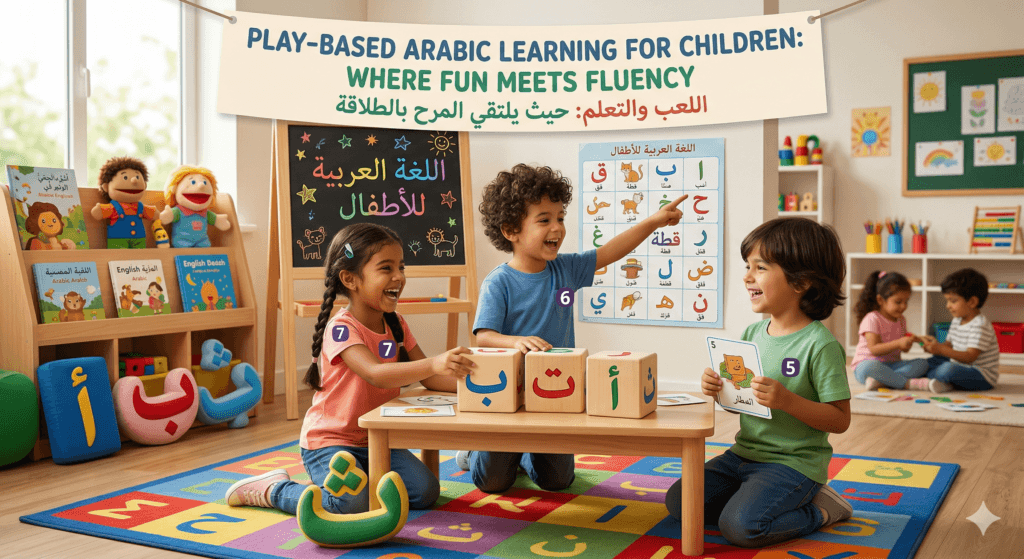
Play-Based Arabic Learning for Children:
Where Fun Meets Fluency
A comprehensive academic guide to teaching Arabic as a second language through play — covering the neuroscience of playful learning, gamification in online Arabic education, individual learning differences, and evidence-based strategies that make every lesson an adventure children actually look forward to.
⏱ 22-minute read
🎓 Evidence-Based
👶 Ages 3–14
💻 E-Learning Focus
🌍 Arabic as a Foreign Language
Introduction: The Case for Play in Arabic Language Learning
Picture this: a seven-year-old sits in front of a screen for her online Arabic lesson. In one scenario, her teacher asks her to copy the Arabic alphabet five times, then fill in a worksheet matching letters to sounds. In another scenario, her teacher has set up a virtual Arabic market — the child “shops” for fruit, greets the shopkeeper with “صباح الخير”, counts her virtual dirhams, and laughs when she mispronounces “تفاحة” (apple) and hears it in a funny voice.
Which child is learning more Arabic? Almost certainly the second one. And more importantly — which child will be back for her next Arabic lesson with enthusiasm rather than dread?
Play is not the opposite of learning. For children — especially those between the ages of 3 and 12 — play is learning. It is the primary mode through which the developing brain makes sense of the world, builds relationships, tests hypotheses, acquires language, and develops social-emotional competence. When we strip play out of language education, we strip out the very conditions that the human brain evolved to learn in.
This is true for all children learning any language. But it has special significance for Arabic as a Foreign Language (AFL) instruction, where the novelty of the script, the unfamiliarity of the sounds, and the cultural distance from children’s daily experience all create barriers that play-based approaches are uniquely equipped to dissolve.
At eArabicLearning, play is not an add-on to our Arabic curriculum — it is its backbone. In this comprehensive guide, we explore the science, the strategies, and the practical implementation of play-based Arabic learning in both traditional and online educational settings, with careful attention to the individual differences that make each child’s Arabic learning journey unique.
🎯Who is this guide for? Parents enrolling their children in Arabic classes, online Arabic tutors, Arabic teachers in schools and language centers, curriculum designers, and anyone passionate about making Arabic accessible, joyful, and effective for young learners.
The Neuroscience of Play and Language Acquisition
To understand why play-based Arabic instruction works so powerfully, we need to understand what happens in a child’s brain during play — and how those neurological processes overlap almost perfectly with the conditions needed for language acquisition.
The Brain During Play: A Neurological Overview
Play activates a remarkably broad constellation of brain networks. Neuroscientist Jaak Panksepp identified the PLAY system as one of seven primary emotional systems in the mammalian brain — meaning that the urge to play is as fundamental and neurologically ancient as hunger or fear. When children play, the following occur simultaneously:
- Dopamine release: The brain’s reward neurotransmitter floods the prefrontal cortex and limbic system, creating positive emotional states that reinforce whatever behavior triggered the play — including Arabic vocabulary just encountered during a game.
- Hippocampal activation: The hippocampus — the brain’s primary memory consolidation structure — is more active during emotionally salient, novel, and socially engaged experiences. Play checks all three boxes. Arabic words learned during joyful play are significantly more likely to enter long-term memory.
- Prefrontal cortex development: Complex play — especially rule-based games — exercises the prefrontal cortex’s executive functions: planning, working memory, inhibitory control, and cognitive flexibility. These same functions are essential for Arabic grammar acquisition.
- Reduced cortisol: Stress hormones are incompatible with optimal learning. Play is one of the most effective cortisol regulators in childhood. A child at play is a child whose brain is chemically primed for new learning.
- Mirror neurons: Social play activates the mirror neuron system — the neurological foundation of imitation and empathy. This system is directly implicated in phonological acquisition: children “mirror” the sounds they hear, which is exactly how Arabic pronunciation develops.
“Play is the highest form of research.”
— Albert Einstein (widely attributed); and deeply consistent with modern neuroscience of learning
Language Acquisition and Play: The Natural Connection
Stephen Krashen’s Input Hypothesis (1982) proposes that language is acquired when learners receive comprehensible input — language that is slightly above their current level but understandable through context. Play is the ideal vehicle for comprehensible Arabic input because:
- Context makes meaning: During a play scenario, a child who hears “خذ الكرة الحمراء!” (Take the red ball!) understands the instruction through the physical context of the game, even before they know the Arabic words — exactly the kind of comprehensible input Krashen describes.
- Low affective filter: Krashen’s Affective Filter Hypothesis states that anxiety raises a “filter” that blocks language acquisition. Play lowers this filter to near zero — children who are laughing and competing in a game are simply not monitoring their Arabic performance with the self-consciousness that inhibits learning.
- Repetition without boredom: Effective language learning requires dozens of encounters with each new word before it enters long-term memory. Play achieves repetition organically — a child might hear and use “يمين” (right) and “يسار” (left) twenty times during a single navigation game without ever feeling drilled.
- Negotiation of meaning: When children play together and communicate in Arabic, they naturally negotiate meaning — asking for clarification, rephrasing, pointing, gesturing. This negotiation is one of the most powerful engines of language acquisition.
🧠 What Neuroscience Tells Arabic Educators
The neurological ideal for Arabic language learning in children includes: emotional engagement, social interaction, physical or sensory activity, novelty and surprise, immediate feedback, and a sense of agency. Play delivers all of these simultaneously — which is why no amount of worksheet-based Arabic instruction can compete with a well-designed Arabic learning game for a young child.
- Emotions tag memories — joyful Arabic encounters are remembered longer
- Social interaction activates language processing more deeply than solo study
- Novelty primes the brain’s attention systems for new learning
- Immediate feedback in games mimics the error-correction cycle essential for acquisition
- Agency (choosing what to do next) activates the brain’s intrinsic reward pathway
Learning Theories Behind Play-Based Arabic Instruction
Play-based Arabic instruction is not just intuitively appealing — it is grounded in some of the most robust and widely-accepted theories in educational psychology and language pedagogy. Understanding these theoretical foundations helps educators design Arabic play activities that are not just fun, but genuinely effective.
Vygotsky and the Zone of Proximal Development
Lev Vygotsky’s theory of the Zone of Proximal Development (ZPD) is perhaps the most directly applicable framework for play-based Arabic learning. Vygotsky argued that the most powerful learning occurs in the zone between what a child can do independently and what they can do with support. He famously argued that “in play, a child always behaves beyond his average age, above his daily behavior; in play it is as though he were a head taller than himself.”
In Arabic learning terms, this means that during play, children consistently attempt and achieve Arabic language use that they would not attempt in formal instruction. A child who “cannot” construct an Arabic sentence in a grammar exercise will spontaneously do so in a pretend-play context where the communicative need is real and immediate.
Piaget’s Constructivism
Jean Piaget’s constructivist theory holds that children construct knowledge through active interaction with their environment rather than passive reception of information. Play is the quintessential Piagetian activity — the child is always doing, testing, exploring, and building meaning. Arabic learning through play aligns perfectly with this constructivist principle: children don’t just hear Arabic words; they use them in self-constructed scenarios and thereby build genuine communicative competence.
Communicative Language Teaching (CLT)
The dominant paradigm in contemporary language pedagogy is Communicative Language Teaching (CLT), which holds that the primary goal of language instruction is developing the ability to use the language for real communicative purposes. Play is inherently communicative. When children negotiate, argue, collaborate, and pretend in Arabic, they are doing exactly what CLT prescribes — using Arabic for genuine communication rather than performing decontextualized exercises.
Task-Based Language Teaching (TBLT)
Task-Based Language Teaching proposes organizing language instruction around meaningful tasks — things the learner does with the language, not things they do about the language. A well-designed Arabic play activity is precisely a language task: “Go on an Arabic treasure hunt and find the objects I describe,” “Teach your puppet to count in Arabic,” “Set up an Arabic restaurant and take orders from customers.” These are real tasks that require Arabic use to complete.
📚Key theoretical synthesis: Vygotsky gives us the “stretch zone” principle (play makes children reach higher in Arabic), Piaget gives us the “active construction” principle (children build Arabic knowledge by doing), CLT gives us the “real use” principle (Arabic must be used for genuine communication), and TBLT gives us the “task completion” principle (Arabic activities should have a real-world purpose). Play-based Arabic instruction satisfies all four simultaneously.
Six Types of Play and Their Role in Arabic Language Learning
Play is not a single thing. Developmental psychologists have identified multiple distinct types of play, each with different neurological and learning characteristics. Understanding these types helps Arabic educators design a rich, varied play curriculum that addresses all dimensions of Arabic language development.
🎭
Pretend / Dramatic Play
Children create imaginary scenarios: a market, a doctor’s office, a spaceship. This is the richest form for Arabic language use — it requires sustained communication, negotiation, and improvisation in the target language.
🎲
Rule-Based Games
Board games, card games, and structured competitive games where children must follow Arabic instructions, name Arabic vocabulary to advance, or answer Arabic questions to score points. Excellent for grammar and vocabulary consolidation.
🏗️
Constructive Play
Building, creating, and making things — with Arabic labels, Arabic instructions, and Arabic narration of the construction process. Arabic calligraphy, Arabic illustrated books, and Arabic craft projects all fall here.
🏃
Physical / Movement Play
Running, jumping, and moving in response to Arabic commands, Arabic songs, and Arabic directional games (Simon Says in Arabic, treasure hunts with Arabic clues). Critical for kinesthetic learners.
🎵
Musical & Rhythmic Play
Arabic songs, chants, clapping games, and rhymes. Music activates a completely different neural pathway for language storage — Arabic vocabulary in a song is processed and stored differently, and often more durably, than the same vocabulary in a list.
🧩
Exploratory / Sensory Play
Discovering Arabic through senses: feeling letter shapes in clay, tracing letters in sand, tasting Arabic foods and learning their names, smelling Arabic spices and labeling them. Multi-sensory Arabic input creates richer neural memory traces.
Importantly, these types of play are not mutually exclusive. The richest Arabic learning experiences often combine several types simultaneously — a constructive activity (building an Arabic city from cardboard boxes) that incorporates dramatic play (the children are the city’s inhabitants), musical elements (an Arabic neighborhood song), and physical movement (delivering “mail” to different Arabic-labeled buildings).
Play-Based Arabic in the Online Classroom: The Digital Dimension
The shift to online and hybrid Arabic education has accelerated dramatically in recent years. For many families worldwide, online Arabic instruction — through platforms like eArabicLearning — is the primary or sole mode of formal Arabic study. This creates both challenges and extraordinary opportunities for play-based instruction.
The Unique Possibilities of Online Arabic Play
Online Arabic learning environments are not simply inferior substitutes for physical classrooms. They offer capabilities that physical classrooms cannot match:
- Instant access to global Arabic media: Arabic cartoons, songs, stories, and cultural content from across the Arab world are a click away, bringing authentic Arabic into every lesson.
- Interactive whiteboard play: Digital whiteboards allow Arabic letter drawing, drag-and-drop vocabulary games, and shared creative activities that are often more engaging on screen than on paper.
- Screen-sharing Arabic games: Browser-based Arabic games, virtual flashcard battles, and collaborative Arabic story-building can be shared directly in the online lesson.
- Recorded Arabic performances: Children can record themselves speaking or singing in Arabic and watch the playback — a powerful combination of performance motivation and self-assessment.
- Virtual Arabic world-building: Digital tools allow the creation of virtual Arabic environments — an Arabic-speaking village, a digital souk — that provide rich communicative play contexts.
- Chat and emoji Arabic: Using the lesson chat for simple Arabic exchanges, emoji-Arabic associations, and quick Arabic word games adds a social media familiarity that resonates with older children.
Overcoming the Screen Limitation: Keeping Play Physical Online
One legitimate challenge of online Arabic play is the loss of physical, tactile engagement. Research consistently shows that embodied learning — learning through the body — is particularly effective for young children. Here are strategies to preserve physical play elements in online Arabic settings:
- Hybrid movement activities: The child stands up and moves at home in response to online Arabic instructions. “اقفز!” (Jump!), “العب كرة!” (Play ball!), “افتح الباب!” (Open the door!). The teacher sees the movement; the child connects Arabic language to physical action.
- Show-and-tell Arabic: The child brings objects from home to show on camera, and the teacher helps them learn the Arabic names. This simple activity combines physical objects with communicative Arabic in a highly engaging way.
- Off-screen Arabic mini-tasks: During the lesson, the teacher sends the child on a brief mission: “Find something red in your house and bring it back! Say its name in Arabic when you return.” 60 seconds off-camera, high excitement on return.
- Pre-prepared play kits: Parents are provided with a simple “Arabic play kit” — a small bag with objects for the week’s vocabulary theme (fruits, animals, colors). The child has physical props to use during the online lesson.
- Arabic crafting on camera: Simple craft activities completed during the online lesson — drawing and labeling an Arabic scene, folding an Arabic letter origami — combine hands-on creation with language learning.
🌐 The eArabicLearning Online Play Philosophy
At eArabicLearning, we train our online Arabic tutors in what we call “digital play facilitation” — the art of creating genuinely playful, energetic, and engaging Arabic lessons through a screen. This is not about using more technology; it’s about using technology intelligently to create the conditions for natural, joyful Arabic language acquisition. The best online Arabic lesson, like the best in-person Arabic lesson, should feel like an adventure, not an obligation.
Gamification: Turning the Entire Arabic Learning Journey into an Adventure
Gamification — the application of game design principles to non-game contexts — has transformed educational technology over the past decade. For Arabic language learning, gamification is not just a motivational trick; when designed thoughtfully, it restructures the entire learning experience in ways that align with how children’s brains naturally acquire language.
Core Gamification Elements for Arabic Learning
| Game Element | Arabic Learning Application | Psychological Mechanism |
|---|---|---|
| Points & Scoring | Earn points for each correctly pronounced Arabic word, each completed Arabic sentence, each letter written accurately | Immediate positive reinforcement; dopamine release upon scoring |
| Levels & Progression | Move from “Arabic Explorer” → “Arabic Adventurer” → “Arabic Champion” as proficiency develops | Mastery motivation; clear developmental pathway; reduces overwhelm |
| Badges & Achievements | “Alphabet Master” (learned all 28 letters), “Market Merchant” (can buy and sell in Arabic), “Story Teller” (told a story in Arabic) | Recognition of specific achievements; identity as an Arabic learner |
| Quests & Missions | Each Arabic lesson is a “mission”: rescue the lost Arabic words, explore the Arabic kingdom, solve the Arabic mystery | Narrative engagement; purpose and direction; curiosity activation |
| Challenges & Leaderboards | Weekly Arabic vocabulary challenges; friendly competition with classmates or siblings | Social motivation; healthy competition; visibility of progress |
| Streaks & Consistency Rewards | “You’ve practiced Arabic 7 days in a row! You’ve earned the Golden ب badge!” | Habit formation; loss aversion (don’t break the streak!) |
| Surprises & Unlockables | Complete the Arabic colors unit and unlock a secret Arabic dance video, or a new Arabic story | Anticipation and surprise; variable reward schedule (most powerful reinforcement) |
The Narrative Approach: Arabic as an Epic Story
The most sophisticated application of gamification to Arabic learning is the narrative approach — framing the entire Arabic learning journey as an ongoing story in which the child is the hero. Rather than discrete lesson topics, the child is on a continuous quest: they are a young explorer traveling through the Arabic-speaking world, learning the language and customs of each region they visit.
In this framework, learning Arabic numbers means unlocking the secrets of an ancient Arabic library. Learning Arabic food vocabulary means surviving in a vibrant Egyptian market. Learning Arabic greetings means negotiating passage through the gates of a mysterious Arabian city. The language learning becomes the adventure itself — not a preparation for some future adventure.
⚠️A critical nuance: Gamification works best when the game elements are aligned with genuine Arabic language learning objectives — not when they replace them. Points for quantity of Arabic output (how many words said) are less effective than points for quality of Arabic communication (did the child successfully convey a meaning in Arabic?). Design your Arabic gamification to reward authentic language use, not just performance metrics.
Individual Differences and Playful Arabic Learning: One Size Does Not Fit All
Even within a play-based Arabic approach, children differ enormously in what kinds of play engage them, how much structure they need, what social contexts they prefer, and which sensory channels they learn through best. A truly excellent play-based Arabic program acknowledges and responds to these individual differences.
Age-Related Differences in Arabic Play
| Age Group | Dominant Play Type | Arabic Learning Focus | Best Online Format |
|---|---|---|---|
| 3–5 years | Sensory, movement, simple pretend play | Oral vocabulary, basic phrases, Arabic songs, letter recognition through art | Very short (15 min), animated, physical, no written demands |
| 6–8 years | Dramatic play, simple rule-based games, constructive | Alphabet & reading foundations, basic sentences, cultural stories | 25–30 min, game-rich, story-based, simple writing activities |
| 9–11 years | Rule-based games, competitive, collaborative projects | Reading & writing development, grammar through use, vocabulary expansion | 35–40 min, varied formats, competitive elements, projects |
| 12–14 years | Social play, creative projects, strategic games | MSA reading comprehension, written expression, cultural literacy, idioms | 40–45 min, discussion, debate, media projects, peer interaction |
Learning Style Differences in Arabic Play
Children’s sensory learning preferences — while not as rigid as early “learning styles theory” suggested — do influence which play-based Arabic activities engage them most effectively. A thoughtful Arabic educator designs activities that draw on multiple sensory channels while also identifying and leaning into each child’s strongest modality.
- Visual learners are captivated by Arabic calligraphy, illustrated Arabic stories, colorful Arabic letter art, Arabic map exploration, and visual vocabulary flashcard games.
- Auditory learners thrive with Arabic songs, rhymes, storytelling, call-and-response chanting, and listening to Arabic stories with comprehension games.
- Kinesthetic learners need to move — Arabic Simon Says, physical Arabic vocabulary mime games, building Arabic letters from clay, Arabic treasure hunts, and cooking Arabic recipes with narration.
- Social learners need a partner or audience — Arabic conversation games, group Arabic competitions, peer teaching of Arabic vocabulary, and performing Arabic skits.
- Reflective/analytic learners prefer structured play — Arabic crosswords, Arabic word detective games, pattern-finding in Arabic morphology, logical Arabic puzzles.
Personality and Arabic Play Engagement
Beyond sensory preferences, personality plays a major role in how children engage with Arabic play. An introverted child may love solo Arabic calligraphy play but find group Arabic role-play acutely uncomfortable. An anxious child needs low-stakes, non-competitive Arabic games before being ready for faster-paced competitive activities. An extroverted child will thrive in oral Arabic games but may resist quiet Arabic reading activities.
The key insight is that there is no single “right” type of Arabic play for all children. The Arabic play curriculum should be diverse enough to engage the full spectrum of personalities and learning preferences — offering competitive and cooperative options, high-energy and quiet activities, solo and social play, structured and open-ended exploration.
🎯 The “Arabic Play Menu” Approach
Rather than requiring all children to do the same Arabic play activity, consider offering a “menu” of Arabic play options within a given lesson or week. Children select activities that appeal to them — all of which address the same Arabic learning objectives through different play modalities. This approach maximizes engagement across individual differences while maintaining curriculum coherence.
40+ Play-Based Arabic Activities by Age Group
Here is an extensive, practical library of play-based Arabic activities organized by age group. Each activity is briefly described with its primary Arabic learning objective. These can be adapted for both in-person and online Arabic instruction.
🌱 Ages 3–6: Foundational Play Activities
- Arabic Alphabet Song & Dance: Sing the Arabic alphabet to a catchy tune with a different movement for each letter group. Oral phonological awareness.
- Arabic Color Hunt: Teacher says a color in Arabic; child runs to find something that color in their home/classroom. Color vocabulary + movement.
- Arabic Animal Sound Parade: Each child “becomes” an Arabic-named animal, making its sound while wearing a simple mask. Animal vocabulary + dramatic play.
- Sticker Arabic Counting: Count out loud in Arabic while placing stickers on a chart. Numbers + fine motor + oral practice.
- Arabic Puppet Play: Simple puppets with Arabic names interact in basic conversations. Basic phrases + dramatic play.
- Arabic Body Map: Point to and name body parts in Arabic while dancing or exercising. Body vocabulary + kinesthetic.
- Feed the Monster Arabic: A “monster” (box with a face) only eats items whose Arabic name the child can say. Vocabulary + game.
- Arabic Playdough Letters: Form Arabic letters out of playdough while saying their names. Letter recognition + fine motor + tactile.
- Arabic Listening Walk: Teacher narrates a walk through an Arabic-speaking place; child mimes the described actions. Listening comprehension + movement.
- Arabic Bedtime Story: Simple Arabic picture book read aloud with dramatic expression and child participation in repeated phrases.
🌿 Ages 6–9: Building Fluency Through Play
- Arabic Treasure Hunt: Clues in simple Arabic lead from one location to the next. Reading + comprehension + excitement.
- Virtual Arabic Market: Online role-play buying and selling items, negotiating prices, greeting customers in Arabic. Transactional language + numbers.
- Arabic Bingo: Students have bingo cards with Arabic words; teacher calls definitions or pictures. Vocabulary + listening + competitive game.
- Arabic Word Detective: Find the “hidden” Arabic words in a picture scene. Vocabulary + reading + visual attention.
- Arabic Story Relay: Each child adds one sentence to a collaborative Arabic story. Speaking + grammar + creativity.
- Arabic Crossword Kids: Simple Arabic crossword with picture clues. Reading + spelling + vocabulary.
- Arabic Cooking Show: Child presents a “cooking show” demonstrating a simple recipe using Arabic vocabulary for actions and ingredients.
- Arabic Letter Yoga: Each pose corresponds to an Arabic letter shape. Alphabet + kinesthetic + mindfulness.
- Arabic Simon Says (قال سيمون): Classic game in Arabic — listening comprehension + commands + quick response.
- Arabic Rhyme Race: Find Arabic words that rhyme with a given word. Phonological awareness + vocabulary + competitive fun.
- Arabic Emoji Stories: Write a short story using emojis, then translate it into Arabic sentences. Writing + vocabulary + creativity.
- Arabic Culture Project: Research and present one Arab country — food, flag, animals, famous places — using Arabic labels and simple Arabic sentences.
🌳 Ages 9–12: Deeper Engagement
- Arabic Debate Game: Simple structured debate on a fun topic (cats vs. dogs) in Arabic. Speaking + argumentation + vocabulary.
- Arabic Comic Strip: Draw and write a comic strip with Arabic speech bubbles. Writing + creativity + grammar.
- Arabic News Anchor: Child presents a short “news broadcast” in Arabic about family, school, or world events. Speaking + structure + confidence.
- Arabic Root Puzzle: Find all words in a list that share the same Arabic root. Morphology + pattern recognition + vocabulary depth.
- Arabic Recipe Reading: Read an authentic Arabic recipe, identify vocabulary, then explain it in English/Arabic mix. Reading comprehension + food culture.
- Arabic Pen Pal: Exchange written Arabic messages with an Arabic-speaking peer. Writing + real communication + cultural exchange.
- Arabic Song Analysis: Listen to an Arabic pop song, identify vocabulary, discuss the theme. Listening + cultural literacy + vocabulary.
- Arabic Escape Room: Online Arabic escape room where puzzles require Arabic reading and comprehension to solve. Reading + problem-solving + high excitement.
- Arabic Proverb Illustration: Illustrate a famous Arabic proverb and explain its meaning. Cultural literacy + vocabulary + creative expression.
- Arabic Market Research: Design a product, create its Arabic name, write its advertising slogan in Arabic. Creativity + writing + cultural business context.
🌲 Ages 12–14: Advanced Play
- Arabic TED-Talk Style Presentation: 3-minute presentation on any topic in Arabic. Speaking + structure + advanced vocabulary.
- Arabic Historical Roleplay: Take on the role of a historical Arabic-speaking figure and speak in first person. History + oral language + research.
- Arabic Social Media Campaign: Design a mock Arabic Instagram campaign for a cause they care about. Writing + visual literacy + real-world application.
- Arabic Mystery Story Writing: Write a mystery short story in Arabic. Narrative writing + grammar + advanced vocabulary.
- Arabic Film Review: Watch a short Arabic film clip and write/deliver a review in Arabic. Listening + critical thinking + writing.
- Arabic Calligraphy Exhibition: Create a personal Arabic calligraphy piece with personal significance; present and explain it. Art + culture + personal expression.
- Arabic Poetry Slam: Write and perform an original Arabic poem. Phonology + vocabulary + emotional expression + confidence.
- Arab World Geography Game: Advanced competitive game on Arab countries, capitals, geography, and culture — all in Arabic. Cultural literacy + reading + competition.
Designing the Perfect Playful Arabic E-Lesson: A Practical Framework
Knowing that play-based Arabic instruction is valuable is one thing. Designing a 30-45 minute online Arabic lesson that is genuinely playful, pedagogically sound, and individually responsive is another. Here is our practical framework for building exceptional play-based Arabic e-lessons.
The SPARK Framework for Arabic Lesson Design
✨ S.P.A.R.K — Our Play-Based Arabic Lesson Formula
- S — Surprise Opening: Every lesson begins with something unexpected that immediately captures attention and creates positive anticipation.
- P — Play Activity Core: The central learning activity is structured as a game, creative project, or dramatic scenario with a genuine communicative Arabic purpose.
- A — Authentic Arabic Use: At least one moment in the lesson where the child uses Arabic for genuine, personally meaningful communication — not just correct-answer responses.
- R — Reflection Moment: Brief, child-led review of what Arabic was learned — “Tell me the most fun Arabic word from today.” Retrieval practice through reflection.
- K — Kinesthetic Close: End with physical energy — a quick Arabic movement game, an Arabic song, a chant — that sends the child away energized and positive about Arabic.
A Sample 35-Minute Play-Based Online Arabic Lesson (Age 8, Theme: Animals)
The Mystery Box
Teacher holds up a closed box and shakes it mysteriously. “هناك حيوان سري في الصندوق!” (There’s a secret animal in the box!) The child asks yes/no questions in Arabic to guess what’s inside. High anticipation, immediate Arabic use, low-stakes entry into the lesson.
Arabic Animal Safari
Using a shared digital whiteboard showing a jungle scene, the teacher and child go on a “safari.” Teacher spots animals and the child names them in Arabic, moves them around the scene, and creates short Arabic sentences: “القرد يأكل الموزة” (The monkey eats the banana). New animal vocabulary introduced through discovery.
Arabic Animal Mime
Teacher calls out an Arabic animal name; child mimes that animal as convincingly as possible. Quick, physical, fun — resets attention for the next activity. Child also guesses the teacher’s mimes.
Design Your Arabic Zoo
Child draws their dream zoo on paper (or using a digital drawing tool) and adds Arabic labels for each animal and area. Teacher asks questions about the zoo in Arabic, child responds. Creates a personal, tangible Arabic artifact — the zoo page goes in their “Arabic World Book.”
Arabic Animal News Report
Child presents their zoo as a news anchor: “مرحبا، أنا [name] من حديقة الحيوانات العربية…” (Hello, I am [name] from the Arabic zoo…) and describes three animals. Teacher films/screenshots for their “Arabic portfolio.” Real performance, real Arabic, genuine pride.
Arabic Animal Song + Preview
End with an Arabic animals song with actions. Then the exciting preview: “Next lesson, we’re going to discover which Arabic animal is the fastest in the Arabic desert — and you’ll need to solve a mystery to find out.” Child leaves curious and wanting more.
The Teacher’s Role: Facilitator, Performer, and Play Partner
In a play-based Arabic classroom — online or physical — the teacher’s role is fundamentally different from the traditional “sage on the stage” model. The Arabic teacher in a play-based environment must wear three distinct hats, often switching between them within a single lesson.
Hat 1: The Facilitator
As a facilitator, the Arabic teacher sets up the play conditions — designs the game, creates the scenario, prepares the materials — and then steps back to let the child’s natural curiosity and creativity drive the Arabic language use. The facilitator observes, takes notes on language development, and intervenes only to provide scaffolding when the child is stuck, not to correct every error.
In online Arabic facilitation, this means having all digital materials prepared, testing all technical tools before the lesson, and designing the lesson with enough flexibility to follow the child’s interests when they emerge.
Hat 2: The Performer
Great play-based Arabic teachers are performers. They use exaggerated facial expressions, dramatic voices, physical energy, and theatrical enthusiasm to make Arabic feel alive and exciting. Online, this is even more critical: the screen reduces energy. The best online Arabic teachers know how to “perform” through the camera in a way that reaches children across the digital distance.
This doesn’t mean being a clown or being inauthentic. It means being fully present, genuinely enthusiastic, and willing to be silly for the sake of a child’s Arabic learning. When a teacher makes a deliberate “mistake” in Arabic and lets the child correct them, both parties are playing — and both are learning.
Hat 3: The Play Partner
Sometimes the Arabic teacher joins the play as an equal participant — they are the customer in the Arabic market, the reporter interviewing the child about their Arabic zoo, or the monster who only speaks Arabic and must be taught English words by the child. As a play partner, the teacher models authentic Arabic use in a non-pressured way and creates genuine communicative need.
🎓Teacher development note: Play-based Arabic teaching is a learnable skill set, not an innate gift. eArabicLearning invests in ongoing professional development for our tutors in playful pedagogy, child-centered Arabic instruction, and creative online lesson design. The quality of play-based Arabic instruction depends heavily on the teacher’s training and mindset — not just their Arabic language proficiency.
For Parents: Building a Playful Arabic Home Environment
Research consistently shows that the home environment is one of the most powerful predictors of children’s language learning outcomes. Parents who create Arabic-rich, playful home environments dramatically accelerate and sustain their children’s Arabic acquisition — even without formal teaching expertise.
The “Arabic Everywhere” Principle
The most effective thing parents can do for their child’s Arabic is to make Arabic a natural, joyful presence in daily home life rather than a formal study subject. This means:
- Arabic background music during meals, play time, or driving
- Arabic labels on common household objects (fridge = الثلاجة, door = الباب, window = الشباك)
- One Arabic “word of the day” introduced at breakfast, used naturally throughout the day
- Arabic counting during everyday activities — counting stairs, counting fruit at the market
- Watching one short Arabic cartoon together each week and talking about it
- Arabic bedtime stories — many beautiful Arabic children’s books are available in dual-language formats
Weekly Playful Arabic Family Routines
| Activity | Frequency | Time | Arabic Focus |
|---|---|---|---|
| Arabic cooking together | Monthly | 1 hour | Food vocabulary, measurements, numbers, imperative verbs |
| Arabic cartoon viewing | Weekly | 15–20 min | Listening comprehension, cultural content, vocabulary |
| Arabic word of the day | Daily | 2 min | Vocabulary breadth, habit formation |
| Arabic story time | 2–3x/week | 10–15 min | Listening, vocabulary, cultural stories |
| Arabic art project | Bi-weekly | 30 min | Calligraphy, Arabic labels, cultural crafts |
| Arabic music & singing | Several times/week | 5–10 min | Phonology, vocabulary, cultural music |
Challenges in Play-Based Arabic Learning — and How to Overcome Them
Honesty requires us to acknowledge the genuine challenges of implementing play-based Arabic instruction, particularly in online settings and with children who have specific learning differences or resistance to formal Arabic study.
Challenge 1: “Play Doesn’t Feel Like Real Learning”
Parent concern: “My child is just playing — are they actually learning Arabic?”
Response: Document the learning explicitly. Keep a record of Arabic vocabulary and structures acquired through each play activity. Share this with parents after each online Arabic lesson. The evidence quickly demonstrates that play-based Arabic learning is not less rigorous — it is more effective at building the kind of Arabic proficiency that children can actually use.
Challenge 2: Managing Energy and Focus in Online Play
Challenge: Online play activities can escalate in energy, making it harder to maintain focus on the Arabic learning objective.
Response: Design online Arabic play with clear “start” and “stop” signals, brief focus checkpoints (“Pause the game — what’s the Arabic word for what you just found?”), and smooth transitions between activities. Practice the ritual of “play mode” and “focus mode” as distinct states the child can move between.
Challenge 3: Children Who Resist Play (Yes, They Exist)
Challenge: Some children — particularly older children, or those with high conscientiousness — actually prefer formal instruction and may resist play-based Arabic approaches, seeing them as “babyish.”
Response: For these children, use their preference as a starting point. Offer structured, rule-based Arabic games (Arabic chess-style strategy games, formal Arabic crosswords and puzzles) that feel “serious” and intellectually engaging. The play element is still present; the aesthetic is more aligned with their personality. Never force play on a child who feels patronized by it — this is counterproductive.
Challenge 4: Maintaining Arabic Language Focus During Free Play
Challenge: During open-ended Arabic play scenarios, children often drift into their native language when they don’t know the Arabic word, effectively excluding Arabic from the activity.
Response: Establish clear “Arabic zones” during play — specific activities where Arabic is the only language used, with visual cues (an Arabic flag on the screen, a special “Arabic hat”) that signal this mode. Outside Arabic zones, bilingual interaction is fine. This boundary management keeps Arabic use consistent without making the overall activity anxious or restrictive.
Conclusion: Play Is Not a Reward for Finishing Arabic — It Is the Arabic
The title of this section states our deepest conviction plainly: play is not something children get to do after they finish their Arabic work. For children, play is the work. It is the vehicle through which the human brain, in its natural developmental state, acquires language, builds knowledge, develops social competence, and constructs identity.
When we teach Arabic through play, we are not compromising rigor for the sake of fun. We are aligning our pedagogy with the neurological reality of how children’s brains actually learn — and in doing so, we make Arabic acquisition faster, deeper, more durable, and more joyful than any worksheet ever could.
The online environment, far from being a limitation, offers extraordinary opportunities for playful Arabic learning that were simply impossible a generation ago: virtual Arabic worlds, instant access to authentic Arabic media, digital Arabic games, and the ability to connect a child in London with a native Arabic-speaking tutor in Cairo in real time.
At eArabicLearning, play-based Arabic instruction is not a trend we’ve adopted. It is a commitment rooted in two decades of Arabic teaching experience, grounded in the best available research in neuroscience, developmental psychology, and second language acquisition, and expressed every day in the lessons our tutors design and deliver to children across the world.
Because at the end of the day, the Arabic lesson that a child runs to — not from — is the one that changes their life.
The Arabic language begins with play.
Frequently Asked Questions: Play-Based Arabic Learning for Children
What is play-based Arabic learning, and why is it effective for children? Play-based Arabic learning is an educational approach where language acquisition happens naturally through games, imaginative scenarios, and interactive activities rather than rote memorization. It is highly effective because play is a child’s primary mode of learning, particularly during the critical developmental window of ages 0 to 7. Studies show that 75% of children learn faster when content is delivered through play, as it lowers anxiety, provides comprehensible input, and encourages authentic communication in Arabic.
How does gamification improve online Arabic classes for kids? Gamification applies game design elements—such as points, levels, and narrative adventures—to Arabic lessons. This approach yields a 3× higher retention rate compared to traditional memorization. When children engage in gamified Arabic learning, their brains release dopamine, which creates positive emotional states that reinforce vocabulary and grammar acquisition. It turns a standard lesson into an epic quest where children actively want to participate.
What types of play are used to teach Arabic as a Foreign Language (AFL)? There are six primary types of play utilized in an effective Arabic curriculum:
Pretend/Dramatic Play: Creating imaginary scenarios like an Arabic market to practice conversational skills.
Rule-Based Games: Board or card games that consolidate vocabulary and grammar rules.
Constructive Play: Building and creating crafts while using Arabic instructions and labels.
Physical/Movement Play: Kinesthetic activities like “Simon Says” in Arabic to connect language with physical action.
Musical & Rhythmic Play: Singing Arabic songs and chants to store vocabulary in different neural pathways.
Exploratory/Sensory Play: Using tactile experiences, like tracing Arabic letters in sand, to create rich memory traces.
Can play-based Arabic instruction work in an online classroom? Absolutely. Online platforms offer unique tools for play-based learning, such as digital whiteboards, interactive browser games, and instant access to global Arabic media. To keep children physically engaged, online Arabic tutors utilize hybrid movement activities, show-and-tell with household objects, and off-screen mini-tasks. The goal is to facilitate a digital environment that feels like a natural, joyful adventure rather than a static screen session.
How do individual differences impact how a child learns Arabic through play? A well-designed play-based curriculum offers a “menu” of activities to accommodate different ages, personalities, and learning styles. For example, visual learners thrive with colorful Arabic calligraphy and digital maps, auditory learners excel with Arabic storytelling and songs, and kinesthetic learners need movement-based vocabulary games. By tailoring the play type to the child, educators can maximize engagement and retention.
How can parents create a playful Arabic learning environment at home? Parents can dramatically accelerate their child’s language acquisition by integrating the “Arabic Everywhere” principle. This includes playing Arabic background music, labeling common household objects in Arabic, introducing a fun “Arabic word of the day,” and reading dual-language bedtime stories. You do not need formal teaching expertise to build a joyful, Arabic-rich home environment.
Why is Arabic an important language for children to learn today? With over 420 million speakers worldwide, Arabic is the 5th most spoken language on earth. Learning Arabic opens doors to a rich cultural heritage, global communication, and future career opportunities. Teaching it through play ensures that children build a positive, lifelong relationship with the language from their very first lesson.
References & Further Reading
Bruner, J. S. (1983). Child’s Talk: Learning to Use Language. Norton. | Brown, H. D. (2007). Principles of Language Learning and Teaching (5th ed.). Pearson. | Ginsburg, K. R. (2007). The importance of play in promoting healthy child development. Pediatrics, 119(1), 182–191. | Krashen, S. D. (1982). Principles and Practice in Second Language Acquisition. Pergamon. | Panksepp, J. (1998). Affective Neuroscience: The Foundations of Human and Animal Emotions. Oxford. | Piaget, J. (1962). Play, Dreams and Imitation in Childhood. Norton. | Vygotsky, L. S. (1978). Mind in Society: The Development of Higher Psychological Processes. Harvard. | Willis, J. (2007). Brain-based teaching strategies for improving students’ memory, learning, and test-taking success. Childhood Education, 83(5), 310–315. | Long, M. H. (2015). Second Language Acquisition and Task-Based Language Teaching. Wiley-Blackwell.