
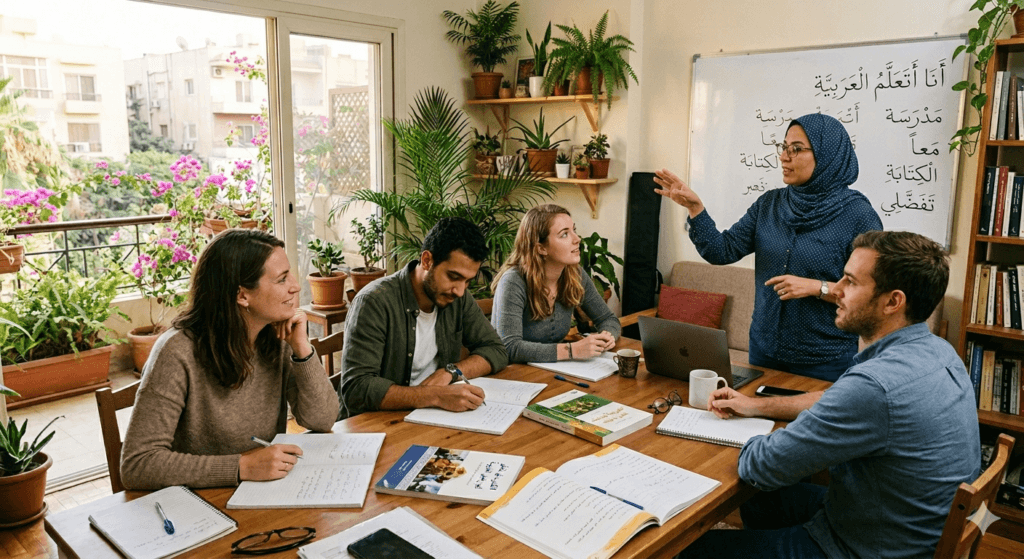
Studying Arabic in Cairo: A Practical Guide for Expats, Diplomats, and Study-Abroad Students

You’ve downloaded the apps. You’ve drilled flashcards on the metro and memorized whole dialogues at your kitchen table. And yet the moment a Cairo taxi driver asks where you’re headed, your mind goes blank. If that sounds familiar, you’re not alone — and you’re also closer to fluency than you think. Studying Arabic in Cairo means combining structured lessons with daily immersion in one of the world’s great Arabic-speaking cities, where every coffee order, every “ezzayak?” from a neighbor, and every street sign becomes part of your classroom. This guide walks you through what that actually looks like: where to live, what it costs, how the visa process works, and how to avoid the mistakes most foreign learners make.
What’s in this guide
- Why Cairo is one of the best places to study Arabic
- Egyptian Arabic vs. Modern Standard Arabic
- Why Maadi is a great base for foreign students learning Arabic
- Studying Arabic in Cairo in-person vs. online
- The cost of studying Arabic in Cairo and Maadi
- Visa and logistics for foreign students in Egypt
- What a typical week of Arabic immersion in Cairo looks like
- Cairo vs. Alexandria vs. online — which fits you
- Common mistakes and misconceptions
- Self-study vs. teacher-led immersion
- Real student journeys
- How to choose the right Arabic program in Cairo
- FAQ
Ready to practice with a native teacher in Cairo?
Why Cairo Is One of the Best Places to Study Arabic
Egypt has been a center of Arabic learning for over a thousand years, and that history is still visible everywhere — from the calligraphy above shop doors to the Quranic recitation drifting out of neighborhood mosques. But the bigger draw for most students isn’t history. It’s repetition. When you’re studying Arabic in Cairo, you don’t just study the language for an hour and move on; you negotiate in it, joke in it, apologize in it, and get lost and ask for directions in it, all in the same afternoon.
For learners of Modern Standard Arabic (MSA) — the formal register used in news, books, religious texts, and official documents across the Arabic-speaking countries — Cairo offers constant reinforcement. Egyptian television, newspapers, and public signage move fluidly between MSA and the local dialect, so your ear adjusts to both registers without you even trying. For learners focused on Egyptian Arabic (the Cairene dialect), Cairo is effectively the source: Egyptian films, music, and comedy have shaped how this dialect is understood across the wider Arab world for decades, which is part of why it remains one of the most widely understood varieties of spoken Arabic.
And then there’s the everyday texture of the city itself. The Arabic alphabet stops being an abstract chart of 28 letters once you’re reading it on bus routes, menus, and pharmacy signs every single day. Arabic vocabulary sticks differently when a word is attached to a smell, a place, or a person rather than a flashcard. And Arabic conversation — the part most learners find hardest — becomes unavoidable, in the best possible way.
Egyptian Arabic vs. Modern Standard Arabic: What’s the Difference, and Which Should You Learn?
This is, by far, the question Muhammad Mourtada hears most often from new students. “People arrive thinking they have to choose one or the other, like it’s a fork in the road,” he says. “After twenty years of teaching, I can tell you it’s not a fork — it’s two lanes on the same road, and most people end up needing both eventually.”
| Aspect | Modern Standard Arabic (MSA) | Egyptian Arabic (ECA / Cairene dialect) |
|---|---|---|
| Where it’s used | News, books, religious texts, formal speeches, official documents, most Arabic-speaking countries | Daily conversation, markets, taxis, social media, Egyptian film and music |
| Best for | Arabic Grammar foundations, Quranic Arabic readers, diplomats, journalists, academics | Living comfortably in Cairo, building relationships, understanding humor and everyday speech |
| Learning curve | Steeper grammar, more formal vocabulary, very systematic | Easier spoken fluency early on, less formal grammar to master upfront |
| Geographic reach | Understood (with regional accents) across the entire Arab world | Widely understood across the Arab world due to Egyptian media’s influence, but most “native” in Egypt |
| Typical learner | Study-abroad students, researchers, those studying Quranic Arabic | Expats, NGO workers, diplomats’ families, long-term residents |
In practice, eArabicLearning’s most common combination for students studying Arabic in Cairo is an MSA foundation (using a structured grammar sequence) paired with weekly conversation sessions focused on Egyptian Arabic. That way, you can read a newspaper headline and also understand what your neighbor is actually saying when they invite you for tea.
Why Maadi Is a Great Base for Foreign Students Learning Arabic
Ask any long-term expat in Cairo where they’d recommend a first-time visitor settle in, and Maadi comes up constantly. It earned its nickname, “the Garden City of the South,” for a reason: tree-lined streets, a slower pace, and a layout that dates back to its origins as a planned residential suburb for international residents in the early twentieth century.
For students studying Arabic in Cairo, Maadi offers a few practical advantages:
- Safety and walkability. Maadi is consistently described by long-term residents as one of the more relaxed parts of Cairo, with a genuine pedestrian culture — joggers at dawn, families out in the evening, and cafés that stay lively well into the night.
- An established international community. Maadi has long been home to embassy staff, UN and NGO workers, and international school families, which means English (and several other languages) is widely spoken alongside Arabic — useful for those first nerve-wracking weeks before your Arabic catches up.
- Accessibility. Maadi sits along the Cairo Metro line, making it straightforward to reach downtown, other neighborhoods, and Cairo International Airport without needing a car.
- A built-in practice ground. Road 9, Maadi’s main commercial strip, is packed with small shops, cafés, and restaurants — exactly the kind of low-stakes environment where you can try out new vocabulary with a friendly shopkeeper.
“In my experience, students who base themselves somewhere like Maadi tend to relax into Cairo faster,” Mourtada notes. “They’re not fighting culture shock and grammar homework at the same time. Once the day-to-day logistics feel manageable, the Arabic starts moving much faster.”
Studying Arabic in Cairo In-Person vs. Online: A Side-by-Side Comparison
| Factor | Studying Arabic Online | Studying Arabic In-Person in Cairo |
|---|---|---|
| Flexibility | High — study from anywhere, any time zone | Lower — tied to a location and often a class schedule |
| Real-world practice | Limited to your lesson time | Constant — markets, transport, neighbors, daily errands |
| Cost | Generally lower (no travel, accommodation, or visa costs) | Higher overall, but often comparable per-lesson rates |
| Cultural immersion | Minimal beyond the lesson itself | Continuous — food, festivals, neighborhoods, relationships |
| Best for | Beginners building a base, busy professionals, testing the waters | Accelerating fluency, study-abroad programs, long-term relocation |
One common misconception is that in-person study automatically means faster progress. It doesn’t — not by itself. A student who shows up in Cairo, takes their lessons, and then spends every evening speaking English with other expats won’t progress dramatically faster than someone studying diligently online. The advantage of studying Arabic in Cairo comes from combining structured lessons with deliberate, daily use of the language outside the classroom. Cairo simply makes that “outside the classroom” part unavoidable — if you let it.
Ready to practice with a native teacher in Cairo?
The Cost of Studying Arabic in Cairo and Maadi
One of the biggest draws of studying Arabic abroad in Egypt, compared to many other study-abroad destinations, is that the overall cost of living remains relatively accessible by Western standards — though this has been shifting in recent years, so it’s worth budgeting with some flexibility rather than relying on outdated figures you might see in older blog posts or forum threads.
Course Fees
Arabic instruction in Cairo is typically priced either by the hour (for private, one-on-one tutoring) or as a monthly package (for structured group or intensive programs). Group and intensive programs often bundle 50–60 hours of instruction per month, while private lessons offer maximum flexibility but at a higher per-hour rate. Programs designed for children typically run fewer weekly hours and may include supervision, meals, or cultural activities as part of the package.
Accommodation in Maadi and Around Cairo
Accommodation costs vary enormously depending on whether you choose a homestay, a shared apartment with other students, or a private furnished flat. Maadi tends to sit at the higher end of Cairo’s rental market precisely because of the qualities discussed earlier — safety, greenery, and an international community — but it’s still generally more affordable than equivalent neighborhoods in major Western cities. Shorter-term furnished rentals (a few weeks to a couple of months) are widely available and are often the most practical option for study-abroad students and short-term immersion programs.
Daily Living Costs
Day-to-day expenses — local transport, street food and casual restaurants, groceries from neighborhood markets, and domestic travel — remain one of the more affordable parts of the budget for most foreign students. Eating where locals eat, using the metro and ride-hailing apps, and shopping at neighborhood greengrocers (a great source of Arabic vocabulary practice, by the way) all help stretch a study-abroad budget further.
| Budget category | What it typically includes | Notes |
|---|---|---|
| Course fees | Group classes, private tutoring, or intensive packages | Often the most predictable line item — confirm current rates directly with the school |
| Accommodation | Homestay, shared flat, or private studio in Maadi or nearby areas | Largest variable; homestays and shared flats are typically the most economical |
| Daily living | Food, local transport, SIM card, incidentals | Generally affordable; eating locally keeps costs down |
| One-off costs | Flights, visa fees, travel insurance, airport transfer | Budget separately — these don’t recur monthly |
Visa and Logistics Considerations for Foreign Students in Egypt
Visa logistics are rarely the hardest part of studying Arabic in Cairo, but they’re often the part students worry about most before arriving — usually because the information they find online is outdated or contradictory.
Here’s the general shape of it, which has held true for years even as specific fees and durations have shifted:
- Most short-to-medium-term students enter on a tourist visa. Depending on your nationality, this may be available as an e-visa applied for online before travel, a visa-on-arrival at Cairo International Airport, or a visa obtained from an Egyptian embassy or consulate beforehand.
- Tourist visas are time-limited but often extendable. Students staying longer than their initial visa period typically need to extend their stay through Egypt’s immigration authorities — a process your school or accommodation provider can often help guide you through.
- Longer-term study may involve a residence permit. Students enrolled in extended programs, or those relocating for work alongside study (such as a diplomat’s spouse or a remote worker), may go through a different process tied to their broader visa status.
- Specific nationalities have specific rules. Visa requirements, costs, and processing times differ by passport, and these details are updated periodically by Egyptian authorities.
Because these details genuinely do change, the most reliable approach is to check Egypt’s official visa portal directly before you travel, and to confirm current requirements with your school once you’ve enrolled. (See the official Egyptian e-visa portal at visa2egypt.gov.eg for current information.)
Other Logistics Worth Planning For
- SIM cards and connectivity — easy to set up on arrival at the airport or in most neighborhoods.
- Banking and cash — many day-to-day transactions in markets and smaller shops are cash-based, so plan for ATM access and some cash on hand.
- Healthcare and insurance — travel or international health insurance is strongly recommended for any extended stay.
- Airport pickup — many programs, including eArabicLearning’s in-person options, can help arrange airport pickup and initial orientation, which takes a surprising amount of stress out of the first 48 hours.
What a Typical Week of In-Person Arabic Immersion in Cairo Looks Like
It helps to see what a week actually looks like in practice — not as a rigid template, but as a realistic picture of how the pieces fit together.
| Day | Morning | Afternoon / Evening |
|---|---|---|
| Sunday | 1-on-1 or small-group MSA grammar lesson | Independent study; vocabulary review from the morning’s lesson |
| Monday | Egyptian Arabic conversation practice | Errands in the neighborhood — practicing with shopkeepers on Road 9 or similar local streets |
| Tuesday | MSA reading and writing | Free time, often spent with other expats or local friends |
| Wednesday | Egyptian Arabic conversation practice | Cultural excursion — a museum, market, or neighborhood walk with a teacher or guide |
| Thursday | Review session and informal assessment | Social activities — dinner out, language exchange meetups |
| Friday | Rest day (start of the weekend in Egypt) | Optional: visit to a mosque, family time, or day trip |
| Saturday | Rest or optional makeup lesson | Planning the week ahead, journaling in Arabic, lighter review |
Note that the Egyptian work (and school) week generally runs Sunday through Thursday, with Friday and Saturday as the weekend — a small but important detail that surprises many first-time visitors and is worth building into your schedule from day one.
For students balancing Arabic study with remote work or family responsibilities, the structure above is often compressed — fewer formal lesson hours, but the same emphasis on weaving practice into daily errands and routines. The immersion effect doesn’t require a packed schedule; it requires consistency.
Cairo vs. Alexandria vs. Online — Which Fits Different Learner Profiles?
| Profile | Cairo (e.g., Maadi) | Alexandria | Online |
|---|---|---|---|
| Study-abroad student wanting full immersion | ★★★★★ — largest city, most resources, biggest expat network | ★★★☆☆ — strong option for a quieter pace | ★★☆☆☆ — good as preparation, not a substitute |
| Diplomat or NGO worker already posted in Egypt | ★★★★★ — fits around existing posting and community | ★★★★☆ — depends on posting location | ★★★★☆ — useful supplement around work demands |
| Remote worker relocating for lifestyle/cost reasons | ★★★★☆ — strong infrastructure, community, connectivity | ★★★★☆ — calmer pace, coastal lifestyle | ★★★★★ — ideal before and during relocation planning |
| Busy professional who can’t travel yet | ★★☆☆☆ — aspirational, not immediate | ★★☆☆☆ — aspirational, not immediate | ★★★★★ — the realistic starting point |
| Heritage speaker reconnecting with the language | ★★★★☆ — deep cultural immersion | ★★★★☆ — similar benefits, different setting | ★★★★☆ — flexible, lower-pressure start |
If you’re torn between Cairo and Alexandria specifically, it often comes down to pace and personality. Cairo is dense, fast-moving, and endlessly stimulating — ideal if you thrive on constant input and don’t mind some chaos. Alexandria, with its Mediterranean coastline and slower rhythm, appeals to students who want immersion without quite as much sensory overload. Many programs, including eArabicLearning’s, can support students in either city, and some students choose to split time between the two.
Common Mistakes and Misconceptions When Learning Arabic in Cairo
After two decades of teaching foreign students in Egypt, certain patterns repeat themselves often enough to be worth naming directly.
Mistake #1: Treating MSA and Egyptian Arabic as Interchangeable
Students sometimes arrive having studied only MSA and are surprised when they understand a newspaper but struggle to follow a conversation between two Cairo friends — or vice versa. As covered earlier, both forms have their place; the mistake is assuming one automatically gives you the other.
Mistake #2: Underestimating Cultural Adjustment
Cairo is a sensory experience — louder, busier, and more socially direct than many learners expect. Students who arrive without any preparation for this adjustment sometimes spend their first few weeks overwhelmed, which slows down language progress simply because there’s less mental bandwidth available for learning.
Mistake #3: Relying Entirely on English-Speaking Bubbles
It’s natural — and not wrong — to lean on an expat community, especially early on. The mistake is staying there. Students who never push past the comfort of English-speaking circles often find that months in Cairo pass without the language gains they expected.
Mistake #4: Skipping the Alphabet Stage
Some learners, eager to start speaking, rush past solid foundations in the Arabic alphabet and basic reading. This catches up with them later — menus, signs, and written materials remain inaccessible long after their spoken Arabic has progressed.
Mistake #5: Expecting Logistics to Sort Themselves Out
Visa extensions, accommodation, and orientation are all manageable — but they take a little planning. Students who treat these as afterthoughts sometimes spend valuable early weeks dealing with logistics instead of language.
Self-Study vs. Teacher-Led Immersion
| Aspect | Self-Study (apps, books, videos) | Teacher-Led Immersion |
|---|---|---|
| Pronunciation correction | Difficult — most learners can’t hear their own mistakes | Immediate, ongoing correction from a native speaker |
| Pacing | Fully self-directed, easy to plateau | Structured progression, adjusted to your level |
| Real conversation practice | Limited or simulated | Genuine back-and-forth, including unpredictable real-life topics |
| Cultural context | Often missing or generic | Embedded naturally — idioms, etiquette, local references |
| Cost | Lowest | Higher, but typically the fastest path to real fluency |
This isn’t an argument against apps — they’re genuinely useful for vocabulary-building and can be a great way to prepare before arriving in Cairo. But a recurring observation from years of teaching: students who pair app-based vocabulary work with regular sessions with a native teacher consistently outpace those relying on either approach alone, especially once conversation — rather than recognition — becomes the goal.
Real Student Journeys: Studying Arabic in Cairo
The following profiles are composites drawn from the kinds of students eArabicLearning regularly works with — illustrative examples of how different goals shape different paths through studying Arabic in Cairo.
The Study-Abroad Student: Emma, 21, United States
Emma arrived in Cairo for a semester abroad with two years of university MSA under her belt — solid grammar, but almost no conversational confidence. She based herself in Maadi with a homestay family, took small-group MSA lessons in the morning, and added twice-weekly Egyptian Arabic conversation sessions in the afternoon. The biggest shift, she said, wasn’t in the classroom — it was the first time she successfully bargained for fruit at a local market using a phrase her teacher had taught her that same morning. By the end of the semester, she’d moved from reading comprehension to genuinely following conversations among her host family.
The Diplomat’s Spouse: Claire, 38, United Kingdom
Claire moved to Cairo when her husband was posted to the embassy. With two young children and a busy household to manage, a classroom schedule wasn’t realistic — so her lessons came to her, with a private tutor visiting her home in Maadi twice a week. Her priority was practical Egyptian Arabic: talking to her children’s nanny, navigating appointments, and handling everyday interactions with confidence. Within a few months, she’d gone from relying on translation apps for basic errands to handling most of her daily life in Arabic — with MSA added gradually for more formal situations like school correspondence.
The Remote Worker: Tom, 34, Canada
Tom had been studying Arabic online for about a year before relocating to Cairo for its lower cost of living and vibrant expat community. He continued working remotely as a software developer, with flexible hours that let him build his schedule around lessons rather than the other way around. He kept his online lessons for the structured grammar work he’d already been doing, and added in-person conversation sessions and cultural excursions once settled in Maadi. The combination — consistency from his existing online routine, plus the immersion of daily life in Cairo — meant his spoken confidence improved faster in his first three months in Egypt than in the entire previous year online.
How to Choose the Right Arabic Program in Cairo
- Clarify your goal first. Are you here for religious study, professional Arabic, daily life, or a mix? This shapes everything else.
- Ask how MSA and Egyptian Arabic are balanced. A program that only offers one without acknowledging the other is missing half the picture for most learners in Cairo.
- Check teacher experience with non-native speakers specifically. Teaching Arabic to native-speaking children and teaching it to adult foreign learners are very different skills.
- Look for flexibility in format. Group classes, private tutoring, in-home lessons, and online options each suit different stages and life situations — the best programs offer more than one.
- Read independent reviews. Platforms like Trustpilot offer a useful outside check on a program’s track record over time.
- Ask about support beyond the classroom. Airport pickup, accommodation guidance, and orientation can meaningfully smooth your first weeks.
- Start with a trial lesson. A short trial tells you more about teaching style and fit than any brochure can.
Ready to practice with a native teacher in Cairo?
If you’ve made it this far and you’re now picturing yourself in a Maadi café, working through a conversation with a patient teacher beside you, that’s exactly the experience eArabicLearning has built around for nearly two decades — with both in-person options in Egypt and live online lessons with the same native Egyptian instructors. You can explore the full in-person Cairo program, including current pricing and schedules, here: Learn Arabic in Cairo with eArabicLearning.
Frequently Asked Questions: Studying Arabic in Cairo
How much does it cost to study Arabic in Cairo?
Costs vary by format and intensity. Private one-on-one tutoring is typically priced per hour, while group or intensive programs are often packaged monthly with a set number of instruction hours. Accommodation, daily living, and visa-related costs are separate budget categories. Because prices and exchange rates shift over time, confirm current figures directly with your chosen program before budgeting.
Do I need a visa to study Arabic in Egypt?
Most foreign nationals need some form of visa to enter Egypt, commonly a tourist visa that can often be extended for those studying longer-term. Requirements vary significantly by nationality and change periodically, so check Egypt’s official visa portal or your nearest Egyptian consulate before traveling, and confirm with your school once enrolled.
Is Maadi safe for foreign students learning Arabic?
Maadi is widely regarded by long-term expats, diplomats, and NGO workers as one of Cairo’s calmer, more walkable neighborhoods, with a long history as a residential area for international families. As with any city, ordinary travel-safety precautions apply, but Maadi’s combination of an established international community and relaxed pace makes it a popular choice for first-time visitors to Egypt.
Should I learn Egyptian Arabic or Modern Standard Arabic first?
It depends on your goals. If your priority is religious study, formal writing, or Arabic that’s understood consistently across the wider Arabic-speaking world, start with Modern Standard Arabic (MSA). If your priority is daily life, relationships, and conversation in Cairo specifically, prioritize Egyptian Colloquial Arabic. Many students learn a foundation of both simultaneously, since the two reinforce each other in an immersion environment.
How long does it take to become conversational in Arabic in Cairo?
This varies widely based on prior experience, study intensity, and how much you practice outside of lessons. Students who combine regular lessons with deliberate daily use of Arabic — ordering food, running errands, chatting with neighbors — often notice meaningful conversational progress within a few months, though true fluency is typically a longer-term goal measured in years, not weeks.
Do I need any prior Arabic knowledge before starting?
No. Programs in Cairo, including eArabicLearning’s, welcome complete beginners as well as advanced learners. Most programs begin with a placement assessment to determine your current level and tailor your curriculum accordingly, whether that means starting with the Arabic alphabet from scratch or jumping into intermediate conversation.
Can I combine online lessons with in-person immersion in Cairo?
Yes — and many students find this combination especially effective. Building a foundation through online lessons before traveling, then continuing with the same teaching approach in-person once you arrive, creates continuity rather than a jarring switch in teaching style.
What’s the difference between studying Arabic in Cairo versus Alexandria?
Both cities offer genuine Arabic immersion with native Egyptian speakers, but they have different rhythms. Cairo is larger, denser, and offers the broadest range of resources, communities, and cultural landmarks. Alexandria offers a coastal, somewhat calmer pace with its own distinct character. Neither is objectively “better” — the right choice depends on your personality and goals.
Final Thoughts: Is Studying Arabic in Cairo Right for You?
If you’ve spent months — or years — chipping away at Arabic through apps and textbooks, and you’re wondering whether it’s “worth it” to actually go to Egypt, here’s the honest answer from two decades of watching students make exactly this decision: immersion doesn’t replace structured learning, but it accelerates it in ways that are genuinely hard to overstate. The combination of a knowledgeable teacher, a thoughtful curriculum, and a city that gives you a thousand small chances to practice every single day is, for most learners, the fastest realistic path from “I study Arabic” to “I speak Arabic.”
Whether that looks like a semester abroad, a few months as a relocating remote worker, or lessons that come to your home while you settle into life as a diplomat’s family member, the underlying principle is the same: find a program built around real conversation, real teachers, and real life in Cairo — and then show up for it, every day, even when it’s just a five-minute chat with a shopkeeper on Road 9.
Ready to practice with a native teacher in Cairo?
👉 Book your free Arabic lesson here
Or explore the full in-person program: Learn Arabic in Cairo with eArabicLearning →
Related reading: