How to Choose an Arabic School in Cairo: An Expat’s Evaluation Checklist
Quick answer: The right Arabic school in Cairo for you comes down to five things: whether they teach the dialect you actually need (Egyptian Colloquial, Modern Standard Arabic, or both), class format (private vs. small group vs. large group), teacher experience with adult non-native speakers specifically, location and logistics (Maadi is the most common base for expats and diplomats), and how clearly they can show you real outcomes — not just a curriculum PDF. This guide walks through exactly what to check before you enroll.
If you’ve spent an evening with six browser tabs open, comparing Arabic schools in Cairo and getting more confused with every one you add, you’re not alone. Almost every program’s homepage says roughly the same thing: native teachers, flexible schedules, all levels welcome. That sameness is exactly the problem. When everyone’s marketing sounds identical, you need a different way to compare — one based on specific questions, not slogans. I’ve spent over twenty years teaching Arabic to expats, diplomats, and study-abroad students in Cairo, and I’ve watched the same avoidable mistakes happen year after year: students enrolling in a program built for Egyptian schoolchildren, or committing to six months of Modern Standard Arabic when what they actually needed was the ability to talk to their doorman. This guide is the checklist I wish more people used before they signed up for anything.
Already fairly sure in-person learning in Cairo is the right move?
Start learning Arabic with a native teacher — book your free trial lesson
Quick Checklist: What to Look for in an Arabic School in Cairo
Before the detail, here’s the short version. A program worth enrolling in should be able to answer all of these clearly, without hedging:
- Dialect focus — Do they teach Egyptian Colloquial Arabic (ECA), Modern Standard Arabic (MSA), or a genuine blend based on your goals?
- Teacher background — Are teachers specifically experienced with adult non-native speakers, not just general Arabic instruction?
- Class format options — Can you choose between private tuition and small groups, or are you forced into one format?
- Location — Is the school based somewhere practical for daily attendance, ideally in an expat-accessible area like Maadi?
- Placement process — Do they assess your level before building your course, or drop everyone into the same starting point?
- Proof of outcomes — Can they point to independent reviews (a Trustpilot rating, for example) rather than only testimonials on their own site?
Takeaway: If a school can’t answer these six questions specifically — with real numbers and real process, not general reassurance — that’s information too.
Start With Your Goal: Egyptian Arabic, MSA, or Both?
Quick definition: Modern Standard Arabic (MSA) is the formal, written register used across the Arab world for news, official documents, and religious texts. Egyptian Arabic (also called the Cairene dialect) is what’s actually spoken in Cairo’s homes, markets, and offices. The two overlap, but a program built for one doesn’t automatically serve the other.
This is the single most common mismatch I see. A diplomat’s spouse enrolls expecting to handle everyday conversation and ends up in a grammar-heavy MSA track because that’s the only track the school offers. A graduate student researching classical texts ends up in a colloquial-conversation class that won’t help with their actual reading list. Before you compare schools on price or location, get clear on your own goal — because it changes which school is even a contender.
| If your goal is… | You need mostly… | Why |
|---|---|---|
| Daily life in Cairo — taxis, markets, neighbors, work colleagues | Egyptian Colloquial Arabic (ECA) | This is what’s actually spoken around you every day |
| Reading news, official documents, or formal writing | Modern Standard Arabic (MSA) | MSA is the register used in print, broadcast, and government contexts |
| Understanding the Quran or religious texts | Quranic Arabic, with MSA foundations | Quranic Arabic has its own vocabulary and grammar conventions distinct from everyday MSA |
| Long-term relocation or diplomatic posting | A blend, weighted toward ECA early on | Daily survival and relationship-building usually matter first; formal Arabic can build in parallel |
Takeaway: Ask any school directly — “what percentage of my course will be Egyptian Arabic versus MSA?” A program that can’t give you a real answer probably hasn’t thought about it either.
Class Format: Private, Small Group, or Large Group?
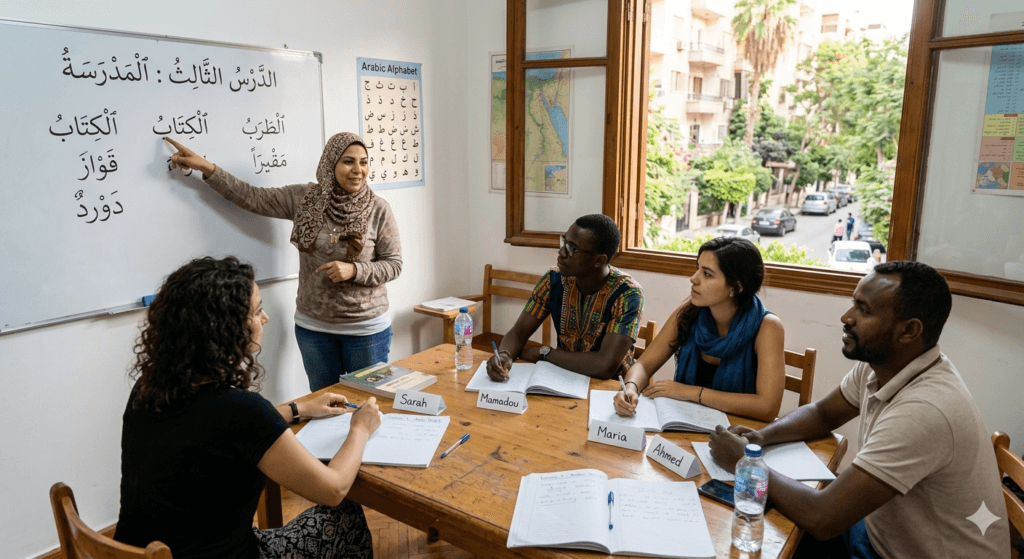
Format affects both your pace and your budget, and schools rarely explain the trade-offs honestly. Private tuition moves at exactly your speed and can be scheduled around your life, but it’s the most expensive per hour and you lose the social pressure that comes from classmates. Small groups (four to six students) are usually the sweet spot for adult learners — enough peer energy to stay motivated, small enough that the teacher still adjusts to individual gaps. Large groups are the cheapest option but the most likely to leave you either bored or lost, since the pace has to serve the middle of the class, not you specifically.
A red flag worth watching for: a school that only offers one format and presents it as the only “real” way to learn. The honest answer is that the right format depends on your schedule, budget, and personality — not a single correct method.
Where the School Is Based Matters More Than People Expect
Cairo is enormous, and a 45-minute commute across the city, twice a day, several times a week, will quietly erode your consistency faster than any curriculum problem will. This is one of the most overlooked factors in choosing a school. It’s worth reading a dedicated breakdown of why Maadi works so well as a base for foreign learners before you commit to a location — safety, walkability, and an established international community all reduce the daily friction that causes people to quietly stop attending week six.
If cost and visa logistics are part of your decision — and for most study-abroad students and relocating professionals, they are — our practical guide to studying Arabic in Cairo breaks down realistic budget ranges and visa pathways in detail, so you’re not comparing schools on tuition price alone without accounting for where that price actually leaves you.
Teacher Qualifications: What to Actually Check
“Native speaker” is not a qualification on its own — every Egyptian is a native Arabic speaker, and most have never taught the language to a foreigner. What you want to verify is experience teaching Arabic as a foreign language, specifically to adults. That’s a distinct skill from teaching Arabic to Egyptian schoolchildren, and it shows up in how a teacher handles things like explaining grammar in terms that make sense to someone coming from English or French, or knowing which mistakes are worth correcting immediately versus which ones resolve naturally with more exposure.
In my own classrooms, the students who progress fastest are almost never the ones with the “best” textbook — they’re the ones whose teacher figured out, within the first week, exactly where their specific confusion was coming from. That’s an experience-based skill, not something a course outline can guarantee. Ask a prospective school directly how long their teachers have been teaching non-native adults, and whether you can meet or trial with the specific teacher you’d be assigned — not just “a teacher from our team.”
Questions to Ask Before You Enroll
- What does a placement assessment actually involve? A real placement test covers listening, speaking, reading, and writing — not just a five-minute chat.
- What happens if the format or teacher isn’t a good fit after week one? Flexibility here signals confidence in the match, not just the sale.
- Can I see a sample weekly schedule, not just total hours? “15 hours a week” means very different things depending on how it’s structured.
- How is progress measured? Look for concrete checkpoints, not vague reassurance that you’ll “feel more confident.”
- What happens outside class? Programs built around a specific neighborhood, like Maadi, can turn errands and cafés into practice — a purely classroom-based program can’t.
- Where can I read independent reviews? A Trustpilot rating or similar third-party review platform tells you more than testimonials curated on the school’s own site.
Want to put these questions to a real teacher instead of a sales page?
Explore our in-person Arabic program in Cairo and ask them directly — placement process, teacher background, and weekly structure included.
Red Flags: Mistakes Expats Commonly Make When Choosing a School
Quick answer: The most common mistakes are choosing a school before clarifying your own dialect goal, assuming a bigger institution automatically means better teaching, ignoring commute distance, and picking a program based only on price without checking teacher experience with adult foreign learners.
- Choosing dialect after enrolling, not before. Get clear on ECA vs. MSA vs. both before you compare schools, not after your first frustrating month.
- Assuming size equals quality. A large, well-known institute isn’t automatically better matched to your goals than a smaller, specialized program — sometimes the opposite is true.
- Underestimating commute fatigue. A cheaper school on the far side of the city can end up costing you more in missed sessions than a slightly pricier one within walking distance.
- Comparing only tuition price. Factor in accommodation proximity, format flexibility, and teacher experience — not just the number on the pricing page.
- Skipping the trial lesson. A single trial session tells you more about fit than an hour of reading marketing copy ever will.
In-Person in Cairo vs. Online vs. Hybrid
| Format | Best for | Trade-off |
|---|---|---|
| In-person in Cairo (e.g., Maadi) | Daily immersion, faster spoken fluency, cultural adjustment support | Requires being physically in Cairo; higher logistics overhead |
| Fully online | Flexibility, starting before you travel, ongoing study after you leave | No ambient daily exposure outside the lesson itself |
| Hybrid (online then in-person, or vice versa) | Building foundations before arrival, then accelerating with immersion | Requires a school that genuinely coordinates both formats with the same teaching team |
Takeaway: Many of our own students start with a few online lessons before ever landing in Cairo, then move into the in-person Maadi program once they arrive — the same teacher, the same curriculum, just a different setting. If a school offers only one format, ask what happens if your circumstances change mid-course.
How eArabicLearning Fits This Checklist
To be transparent about where we fit into this comparison: eArabicLearning has been teaching Arabic to expats, diplomats, and study-abroad students since 2007, with a 4.9 Trustpilot rating from students across more than 40 countries. Our in-person program is based in Maadi, which we chose deliberately for the reasons covered above — safety, walkability, and an established international community that reduces the daily friction of staying consistent. Every student starts with a genuine placement assessment covering listening, speaking, reading, and writing, and you can choose private tuition or small-group classes depending on your budget and learning style. We also offer the online-to-in-person handoff described in the hybrid row above, so your course doesn’t reset if your circumstances change.
One remote-worker relocation client I taught last year is a good example of how this plays out. She’d completed an entire self-paced MSA course before arriving and still froze the first time a shop owner asked her a simple question in Cairene Arabic. Within the first placement session, it was clear she needed a program weighted almost entirely toward Egyptian Colloquial for the first two months, with MSA layered in later for reading paperwork. That kind of adjustment only happens if the placement process is real, not a formality.
A Simple Decision Framework
- Define your goal first — daily life, formal reading, religious study, or a blend.
- Shortlist two or three schools based on location relative to where you’ll actually live.
- Ask each one the six questions above, and compare the specificity of their answers, not just the answers themselves.
- Book a trial lesson before committing to a multi-month program.
- Check independent reviews, not just testimonials on the school’s own website.
Ready to test the fit yourself?
Start learning Arabic with a native teacher — book your free trial lesson
Frequently Asked Questions
Do I need to know the Arabic alphabet before choosing a school?
No. Most schools, including ours, start complete beginners with the alphabet as part of the first few sessions. What matters more at the choosing stage is your goal (dialect vs. MSA) and preferred format.
Is it better to choose a school based only in Cairo, or one that also teaches Alexandria-based students?
What matters is whether the specific teacher and program are set up for your location and goals — not how many cities a school’s marketing page lists. Ask specifically where your lessons would be based and who would teach them.
How do I know if a school’s “native teacher” claim is meaningful?
Ask how long that teacher has specifically taught non-native adult learners, not just how long they’ve spoken Arabic. Every Egyptian is a native speaker; not every native speaker knows how to teach the language to a foreigner.
Should I prioritize price or teacher experience when comparing schools?
Teacher experience with adult non-native learners has the biggest impact on how fast you actually progress. Price matters, but the cheapest option that leaves you stuck at a plateau isn’t actually the cheaper choice once you count wasted months.
Can I switch between private and group lessons after I start?
At schools with real flexibility, yes. Ask this directly before enrolling — it’s a good indicator of whether a program is built around your progress or around a fixed package they’d rather not adjust.
How long does it typically take to hold a basic conversation?
With consistent lessons and daily practice in an immersive environment like Maadi, many students reach basic conversational ability within 8–12 weeks. This varies with hours per week, prior exposure, and how much daily practice happens outside class.
What’s the difference between a “complete guide” article and a checklist like this one?
A complete guide typically walks through everything about studying in a specific place — cost, visas, daily life. This checklist is narrower on purpose: it’s built specifically to help you compare schools against each other before you commit to any one of them.