
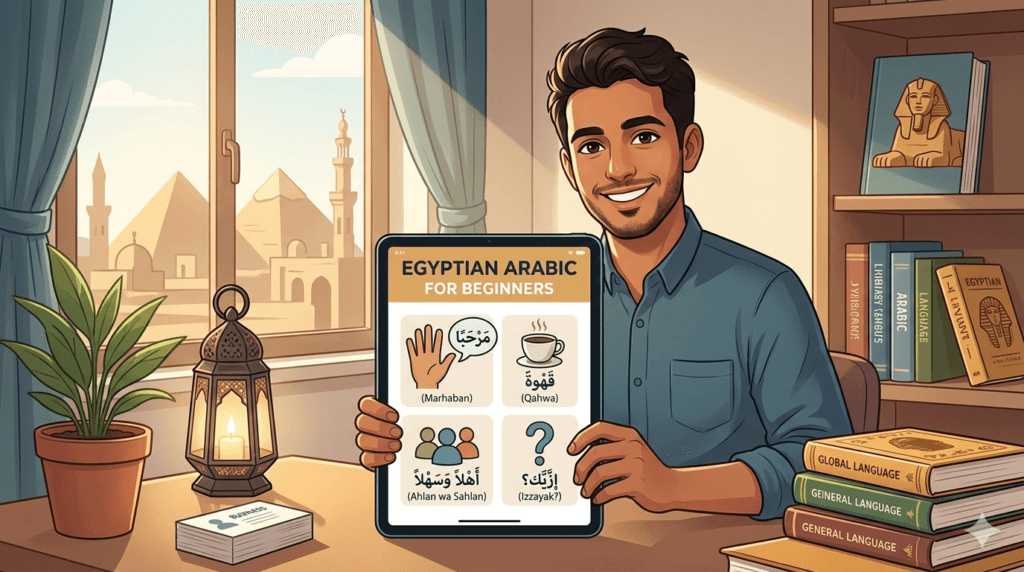
There’s a Cairo taxi driver who will tell you about your face in great detail the moment you get in. An old woman in a Zamalek market who will try to adopt you on the spot. A group of men outside a café in Alexandria who will insist, genuinely insist, that you sit down and have tea with them before you go anywhere.
The Egypt that people fall in love with — the warmth, the humour, the theatrical generosity — is almost entirely conducted in Egyptian Arabic. And the moment you respond in it, even badly, even with the wrong pronunciation and the wrong word order, something changes. You’re no longer a tourist. You’re a guest who made an effort.
This guide shows you how to make that effort count.
Egyptian Arabic — called Masri (مَصْرِي) or Ammiya (عَامِّيَّة) — is the spoken dialect of Egypt’s 104 million people. It’s also, by a significant margin, the most widely understood Arabic dialect in the world. A learner of Egyptian Arabic can be understood from Casablanca to Muscat — a geographic reach no other dialect approaches.
I’m Egyptian. I grew up speaking this language before I ever studied it. And after twenty years of teaching it to beginners from the United States, the United Kingdom, France, Germany, Canada, Japan, and dozens of other countries, I know exactly what makes it click for people and what makes it frustrating. This guide is the distillation of all of that.
Why Egyptian Arabic — and Why It’s Your Best First Dialect
If you’ve looked into Arabic at all, you’ve probably encountered the question of which dialect to learn. There are dozens of Arabic dialects — Gulf (Khaleeji), Levantine (Syrian, Lebanese, Jordanian), Moroccan (Darija), Libyan, Iraqi, Sudanese, and many more. Why choose Egyptian?
The answer has two parts. First, reach. Egyptian Arabic is the only dialect that is genuinely, reliably understood across the entire Arabic-speaking world. When researchers have tested Arabic dialect comprehension across countries, Egyptian Arabic consistently achieves the highest cross-regional recognition. Ask a Moroccan, a Saudi, a Lebanese, and a Yemeni which dialect they understand most easily — the answer, across the board, is Egyptian. A learner who speaks Egyptian Arabic doesn’t need to worry about being understood. Their dialect does the work.
The reason for this reach is cultural history. Egypt’s entertainment industry — particularly its film and television production — dominated Arab popular culture from the 1930s through the present. The classic Arab films that entire generations grew up watching were Egyptian. The most celebrated Arab singers — Om Kalthoum, Abdel Halim Hafez — were Egyptian, singing in Egyptian dialect. Generations of Arabic speakers from every country grew up absorbing Egyptian Arabic through media before they ever met an Egyptian person.
The second reason is content. Egypt produces more Arabic media — films, television, comedy, music, YouTube content — than any other Arab country. This means the learning resources for Egyptian Arabic through authentic media are richer than for any other dialect. A learner of Egyptian Arabic has access to a vast library of real, natural Arabic content to listen to, watch, and learn from.
For a full comparison of Egyptian Arabic against other dialects and MSA, including when each variety is the right choice, see our complete guide: MSA vs Egyptian Arabic vs Gulf Arabic — Which Should You Learn?
How Egyptian Arabic Differs from MSA — The Key Changes
Egyptian Arabic evolved from Classical Arabic over centuries of daily use, absorbing influences from Coptic (Egypt’s pre-Islamic language), Greek, Turkish, French, Italian, and English along the way. The result is a variety that shares the same roots and basic grammar logic as Modern Standard Arabic but differs in pronunciation, vocabulary, and several key grammatical patterns.
Understanding the differences before you start learning saves considerable confusion — and it helps you see how MSA and Egyptian Arabic relate to each other rather than treating them as completely separate systems.
The biggest pronunciation differences
ق
ق
ج
ج
These two sound shifts — glottal stop for ق and hard “g” for ج — are the most iconic features of Egyptian Arabic. When you hear them, you know immediately you’re listening to an Egyptian speaker. When you produce them correctly, Egyptians know immediately that you’ve actually studied their dialect and aren’t just reciting textbook Arabic.
Vocabulary differences: words only Egyptians use
| Concept | MSA word | Egyptian Arabic word | Origin of Egyptian word |
|---|---|---|---|
| How are you? | كَيْفَ حَالُك | إِزَّيَّك | From Coptic Egyptian |
| Now | الآن | دِلْوَقْتِي | Contracted Arabic phrase |
| Good / Fine | جَيِّد | كْوَيِّس | Italian buono (good) |
| A lot / very | كَثِيرًا | أُوِي | Unique Egyptian Arabic |
| So / therefore | إِذَن | يَعْنِي | Arabic (means “it means”) |
| Go away / leave | اذْهَب | امْشِي | Arabic root m-sh-y |
| Cool / great | no equivalent | تَمَام | Arabic (means “complete”) |
| Of course | بِالطَّبْع | أَكِيد / طَبْعًا | Arabic roots |
| Guy / man | رَجُل | رَاجِل | Egyptian Arabic form |
| Girl / woman | امْرَأَة | سِتّ / بِنْت | Arabic roots |
| Bus | حَافِلَة | أُوتُوبِيس | French autobus |
| Car | سَيَّارَة | عَرَبِيَّة | Literally “Arab/vehicle” |
The Sounds of Egyptian Arabic: What’s Unique, What’s Familiar
Egyptian Arabic has a distinctive musicality that learners often comment on. It’s not the formal precision of MSA or the melodic lilt of Levantine Arabic — it’s something more conversational, more rhythmically relaxed, with a particular warmth that comes partly from the sounds and partly from how Egyptians use them.
For English speakers, here’s the good news: Egyptian Arabic is phonologically somewhat more accessible than MSA, for one specific reason. The two hardest features of Classical Arabic — the full case-ending system and the more emphatic forms of some back consonants — are softened or absent in Egyptian speech. What remains challenging are the pharyngeal sounds (ع and ح) and the emphatic consonants (ص، ض، ط، ظ), which genuinely have no English equivalent and require a teacher’s ear to learn correctly.
For the complete breakdown of all Arabic sounds, including which require the most attention from English speakers, see our Complete Arabic Alphabet Guide.
Egyptian-specific pronunciation features
| Letter | MSA Sound | Egyptian Sound | English Comparison |
|---|---|---|---|
| ق | Deep “q” (uvular) | Glottal stop ʾ | The pause in “uh-oh” |
| ج | “j” as in jump | Hard “g” as in go | Exactly like English “g” |
| ث | “th” as in think | “t” or “s” | تِلاتَة = talaata (three) |
| ذ | “dh” as in this | “d” or “z” | كِدَا = kida (like this) |
| ظ | Emphatic “dh” | “z” (in many words) | Simplified from MSA |
Notice that ث (tha) and ذ (dha) — which in MSA are “th” sounds like “think” and “this” — simplify in Egyptian Arabic to “t/s” and “d/z” respectively. This is actually easier for English speakers than the MSA version. The “th” sound exists in English but feels unnatural between Arabic consonants; the Egyptian simplification makes these words more phonetically approachable.
Egyptian Arabic Grammar: How It Simplifies MSA
One of the most encouraging things about learning Egyptian Arabic after exposure to MSA is discovering how much the grammar simplifies. Egyptian Arabic is not “broken” MSA — it’s a complete, rule-governed language variety that has evolved toward efficiency over centuries of daily use. And several of the features that make MSA most challenging for English speakers are significantly reduced in Egyptian Arabic.
MSA has a full grammatical case system where word endings change depending on the word’s role in the sentence (subject → -u, object → -a, possessive/after prepositions → -i). This is one of the most demanding features of MSA grammar for English speakers.
In Egyptian Arabic, case endings are almost entirely absent from everyday speech. Nouns don’t change their ending when they move from subject to object position. Word order carries more of the grammatical work. This is significantly easier for English speakers, who are accustomed to word order (not endings) signalling grammatical relationships.
Egyptian Arabic uses a distinctive circumfix negation pattern — wrapping a word with ma- before it and -sh after it to negate it. This is one of the most useful and immediately recognisable grammar patterns to learn, and it’s absent from MSA.
The mish form (short for ma…sh) can also stand alone before adjectives and nouns as a simple negator: mish tamam = not good; mish mumkin = not possible / impossible.
MSA marks the future with a sa- prefix or the separate word sawfa. Egyptian Arabic uses ha- as a prefix directly attached to the present tense verb. It’s simple, consistent, and immediately useful.
Egyptian Arabic marks the present tense with a b- prefix added to the verb. This distinguishes habitual/ongoing actions from the subjunctive (used after certain words like “want to,” “can”). This b- marker is absent from MSA — it’s a distinctly Egyptian feature that learners need to learn as a new pattern.
For the foundational grammar concepts that underlie both MSA and Egyptian Arabic, see our Arabic Grammar for Beginners guide — the 7 core concepts that explain how the language works at its root.
Essential Egyptian Arabic Phrases — Organised by Situation
These are the phrases that do the most work in the most situations. Not a comprehensive dictionary — the specific expressions that open doors, build warmth, and carry you through the situations you’ll actually encounter.
| Egyptian Arabic | Transliteration | Meaning & Notes |
|---|---|---|
| أَهْلَن | Ahlan | Hello / Hi — casual, warm, used constantly |
| إِزَّيَّك / إِزَّيِّك | Izzayyak / Izzayyik | How are you? (masc./fem.) — the most Egyptian greeting possible |
| تَمَام، شُكْرًا | Tamaam, shukran | Fine, thank you — standard response to Izzayyak |
| الحَمْدُ لِلَّه | Al-hamdu lillah | Praise be to God — also a common positive response to “how are you?” |
| إِسْمَك إِيه؟ | Ismak eh? (m) / Ismik eh? (f) | What’s your name? — eh = “what” in Egyptian Arabic |
| إِسْمِي… | Ismi… | My name is… |
| فُرْصَة سَعِيدَة | Fursa sa’iida | Nice to meet you (literally: a happy occasion) |
| إِنْتَ مِنَيْن؟ | Inta mineen? | Where are you from? — very common opener with foreigners |
| أَنَا مِن… | Ana min… | I’m from… |
| صَبَاح الخَيْر / صَبَاح النُّور | Sabaah el-kheir / Sabaah en-nuur | Good morning / Good morning (response) — lit. “morning of goodness / morning of light” |
| Egyptian Arabic | Transliteration | Meaning |
|---|---|---|
| مِشْ فَاهِم / فَاهْمَة | Mish faahim (m) / faahma (f) | I don’t understand |
| مُمْكِن تِتْكَلِّم بِالرَّاحَة؟ | Mumkin titkallim bil-raaha? | Can you speak more slowly? |
| مُمْكِن تِعِيد؟ | Mumkin ti’iid? | Can you repeat that? |
| يَعْنِي إِيه…؟ | Ya’ni eh…? | What does … mean? (yacni = “it means / like”) |
| إِيه ده بِالإِنْجِلِيزِي؟ | Eh da bil-inglizi? | What is this in English? |
| بَتْكَلِّم عَرَبِيّ شُوَيَّة | Batkallim ‘arabi shwayya | I speak a little Arabic |
| بَتْتَعَلِّم عَرَبِيّ | Batta’allim ‘arabi | I’m learning Arabic |
| Egyptian Arabic | Transliteration | Meaning |
|---|---|---|
| بِكَام ده؟ | Bikam da? | How much is this? — the most essential shopping phrase |
| غَالِي أُوِي | Ghali awi | It’s very expensive — awi = very (uniquely Egyptian word) |
| رُخِّص شُوَيَّة | Rukhkhas shwayya | Lower the price a little — opens negotiation politely |
| خُد… جِنِيه | Khud… gineeh | Take … pounds — making a counter-offer |
| مِشْ عَاوِز / عَاوْزَة | Mish ‘aawiz (m) / ‘awza (f) | I don’t want it |
| عَاوِز / عَاوْزَة… | ‘Aawiz (m) / ‘awza (f)… | I want… — عاوز is the Egyptian Arabic word for “want” |
| فِيه…؟ | Fih…? | Is there…? Do you have…? |
| الحِسَاب، لَوْ سَمَحْت | El-hisaab, law samaht | The bill, please — in restaurants |
| Egyptian Arabic | Transliteration | Meaning |
|---|---|---|
| فِين…؟ | Feen…? | Where is…? — feen = where in Egyptian Arabic |
| وِدِّينِي… | Waddini… | Take me to… — to taxi drivers |
| عَلَى طُول | ‘Ala tool | Straight ahead |
| شِمَال / يِمِين | Shimaal / Yimiin | Left / Right |
| وَقِّفْ هِنَا | Waqqif hina | Stop here |
| بَعِيد / قَرِيب | Ba’iid / ‘Ariib | Far / Near |
| الأُوتُوبِيس بِتَاع… فِين؟ | El-otobis bita’ … feen? | Where is the bus to…? — otobis from French “autobus” |
| Egyptian Arabic | Transliteration | Meaning |
|---|---|---|
| تَفَضَّل / تَفَضَّلِي | Tafaddal (m) / Tafaddali (f) | Please / Go ahead / Here you go / Come in — one of the most versatile Egyptian words |
| اللَّه يِكْرِمَك | Allah yikrimak | God bless you — warm response to hospitality or a favour |
| بِالعَافِيَة | Bil-‘afiya | Said to someone who has just eaten or bathed; response to “ma’a s-salaama” |
| إِنْ شَاءَ اللَّه | Inshallah | God willing — essential phrase for future plans |
| مَاشَاءَ اللَّه | Mashallah | What God has willed — admiration, used for good news |
| يِسْلَمُوا إِيدِيك | Yislamu eedek | God bless your hands — said after receiving food or a gift; deeply warm |
| نَوَّرْتِنَا | Nawwartina | You’ve brightened our home — said to welcome a guest; literally “you’ve lit us up” |
Core Egyptian Vocabulary You Won’t Find in MSA Dictionaries
Every dialect has words that don’t exist in MSA — words that evolved locally, borrowed from other languages, or developed new meanings in everyday use. These Egyptian-specific words are the ones that make you sound Egyptian rather than formally Arabic. They’re also the ones most learners encounter immediately and can’t find in their MSA dictionary.
| Egyptian Word | Transliteration | Meaning | Notes |
|---|---|---|---|
| أُوِي | awi | Very / a lot / so much | Uniquely Egyptian — “tamam awi” = very good |
| يَعْنِي | ya’ni | Like / I mean / sort of / it means | The most overused word in Egyptian Arabic — also used as a filler |
| إِيه | eh | What? | Egyptian Arabic “what” — very different from MSA |
| كِدَا | kida | Like this / so / in this way | “Amel kida” = Do it like this |
| مَالِش | malish | Never mind / it’s okay / don’t worry | One of the most characteristically Egyptian expressions |
| بَصّ | bass | Only / just / but / enough | “Bass keda” = Just like that / That’s enough |
| شُوَيَّة | shwayya | A little / a bit / slowly | “Shwayya shwayya” = little by little / slowly slowly |
| حَاجَة | haaga | Thing / something / anything | “Fih haaga?” = Is there something? Is anything wrong? |
| زَعْلَان / ة | za’laan/-a | Upset / sad / annoyed | More commonly used than MSA “haziin” for sad |
| طَبْعًا | tab’an | Of course / naturally | Used constantly in conversation |
| آه | aah | Yes | Casual affirmation — like “yeah” vs “yes” |
| لَأ | la’ | No | The Egyptian glottal stop on ق turns “laa” into “la'” |
| مَفِيشْ | mafiish | There isn’t / there aren’t / none | From “ma + fiih + sh” — a very Egyptian construction |
| أَيْوَا | aywa | Yes | More emphatic than “aah” — originally from Coptic |
| يَلَّا | yalla | Let’s go / come on / hurry up | Used to initiate movement or action — very common |
For the full strategy of building Egyptian Arabic vocabulary systematically — including frequency-based learning and the Anki approach that works best for dialect vocabulary — see our Arabic Vocabulary Strategy Guide.
Your Learning Roadmap: From Zero to Conversational Egyptian Arabic
Weeks 1–2: The Alphabet and the Two Key SoundsLearn the Arabic alphabet — 28 letters, their basic forms, and the vowel marks. Twenty minutes daily. Even if you’re primarily interested in speaking, the alphabet makes everything faster. Simultaneously, focus on the two most distinctive Egyptian sounds: the glottal stop for ق and the hard “g” for ج. Get these right from the start, under a teacher’s ear. They’re not hard to produce once someone demonstrates them — but they’re very hard to self-correct later if you’ve established wrong habits. See our complete alphabet guide.
Month 1: Core Phrases and Basic InteractionLearn all the greeting phrases, the essential social expressions (inshallah, alhamdulillah, mashallah, tafaddal, malish, yalla), and the 50 most common words in the phrase tables above. At the end of month one, you should be able to greet someone, introduce yourself, ask basic questions, and navigate a simple purchase or taxi ride. This isn’t fluency — it’s enough to have real, warm interactions with Egyptians that go beyond pointing and smiling.
Month 2–3: Core Grammar Patterns and 200 WordsLearn the four core Egyptian grammar patterns: the ma…sh negation, the ha- future, the bi- present, and basic verb conjugation in Egyptian Arabic. These four patterns, once internalised, allow you to construct original sentences rather than just reciting memorised phrases. Build your vocabulary to 200 words using Anki with an Egyptian Arabic deck — 15 minutes daily. Use each new word in a sentence with your teacher within the same lesson you learn it.
Month 3–6: Real Conversations and Media ImmersionBegin using your Egyptian Arabic in real conversations — with your teacher in extended conversation practice, in language exchanges with Egyptian native speakers, or in Egypt if you’re there. Start watching Egyptian media: start with subtitled films or series rather than raw audio, so you can follow the content while building comprehension. The goal is to start hearing Egyptian Arabic as natural speech rather than as a stream of unfamiliar sounds. The transition from “this sounds like noise” to “I catch words and phrases” is one of the most encouraging moments in dialect learning.
Month 6–12: Fluency Expansion and Natural SpeechWith 200–400 words, core grammar, and several months of media immersion, you’ll be able to follow conversations and hold your own in most everyday Egyptian Arabic exchanges. This phase is about expanding range — more vocabulary, more idioms, faster comprehension, more natural production. The word awi, the filler ya’ni, the versatile tafaddal — these quintessentially Egyptian expressions should be coming naturally by now, not being consciously remembered. That naturalness is the sign that the dialect is moving from studied knowledge to actual language ability.
Learning Through Egyptian Media: The Most Enjoyable Immersion
Egyptian media is the richest Arabic-language media library in the world — and it’s your most powerful tool for building the listening comprehension and natural vocabulary that lessons alone can’t fully provide.
Egyptian Films — The Classics
Egypt’s golden-age films (1950s–1970s) are available on YouTube and Arabic streaming platforms. Start with comedies — the language is clearer and the situations more transparent. Youssef Wahby, Adel Imam, and Nour El-Sherif films are entry points. Watch with Arabic subtitles, not English.
Egyptian TV Series
Ramadan series are watched across the Arab world and contain natural, everyday Egyptian speech. Recent series on Netflix and Shahid (Arabic streaming) are increasingly accessible internationally. The dialect is contemporary and the situations are relatable.
Egyptian Comedy
Egyptian comedy — particularly stand-up and YouTube channels — is extraordinarily useful because humour requires understanding language at a nuanced level, which drives deep comprehension. Bassem Youssef’s satirical show (available on YouTube) is widely recommended for intermediate learners.
Egyptian Music
Om Kalthoum for classical Arabic (lyrical, slow, beautifully enunciated), Amr Diab for contemporary Egyptian pop, and Shaabi music (street-level Egyptian Arabic) for the most authentic street-level dialect exposure. Song lyrics are available online with Arabic script.
Egyptian YouTube and Social Media
Egyptian YouTube channels — vlogs, reaction videos, commentary — expose you to fast, natural contemporary Egyptian speech. This is harder than film for beginners but invaluable at intermediate level. Start with channels that have captions.
Arabic Podcasts (Egyptian)
Several podcasts are conducted in Egyptian Arabic or mixed Egyptian/MSA register. These are excellent for listening practice during commuting or exercise. Intermediate-level learners find podcasts more accessible than fast conversational speech because speakers often speak slightly more clearly.
Mistakes Beginners Make with Egyptian Arabic
Mixing MSA and Egyptian Arabic carelessly
Some mixing is fine and happens naturally — educated Egyptians mix MSA vocabulary into Egyptian speech all the time. But beginners who haven’t consciously learned Egyptian Arabic often produce a stilted hybrid that sounds like someone reading an Arabic newspaper out loud. The pronunciation is wrong (no glottal stop, no hard “g”), the vocabulary is formal, and the grammar has case endings that no Egyptian uses in speech. If you’re learning Egyptian Arabic, commit to it. Learn the Egyptian pronunciations, the Egyptian vocabulary, the Egyptian grammar patterns. A teacher who is specifically an Egyptian Arabic teacher makes this much cleaner.
Using MSA words when Egyptian words exist
A beginner who asks “kayfa haalak?” (MSA — how are you?) instead of “izzayyak?” is communicating in a way Egyptians understand but find formal and slightly odd. The same goes for using MSA “dhahaba” (he went) instead of Egyptian “raah,” or MSA “kabiir” (big) where an Egyptian might say “kitiir awi” in a specific context. Learning the distinctly Egyptian vocabulary — not just the grammar — is what makes Egyptian Arabic feel natural. A good teacher will call you out on MSA-isms and redirect you to the Egyptian equivalents.
Not learning the glottal stop and hard “g” from day one
These two sounds are the most iconic features of Egyptian Arabic. Learners who skip them and use MSA pronunciations for ق and ج end up sounding like they’re speaking a different dialect. More importantly, they miss the connection to how Egyptians actually sound — the glottal stop and hard “g” are not quirks, they’re load-bearing features of the dialect’s sound identity. Get them right in your first two weeks and carry them through everything.
Expecting Egyptian Arabic to be “easier” in a way that makes you careless
Egyptian Arabic is genuinely more accessible than MSA in certain ways — simplified case system, more loanwords, more media for immersion. But it is still Arabic. The pharyngeal sounds (ع، ح), the emphatic consonants (ص، ض، ط، ظ), the verb conjugation system, and building a real conversational vocabulary all require consistent, serious effort. The “easier” framing can create a false expectation that Egyptian Arabic is a shortcut when it’s actually a different path to the same destination — which requires the same consistent work.
“I had studied MSA for eight months before switching to Egyptian Arabic with a teacher at eArabicLearning. The first week was disorienting — the ‘g’ instead of ‘j’, the glottal stop, the different everyday words. But within a month I was holding conversations in Egypt that I could never have had with eight months of MSA. Real conversations. With real people who weren’t simplifying anything for me.”
— Sophie R., student at eArabicLearning, France
📚 The Complete eArabicLearning Library — Every Guide in the Cluster
MSA vs Egyptian vs Gulf ArabicWhy Egyptian Arabic is the best first dialect
Arabic Alphabet: Complete GuideThe first step even for Egyptian Arabic learners
Arabic Vocabulary Strategy + 100 Essential WordsFrequency-based vocabulary for dialect learners
Arabic Grammar: The 7 Core ConceptsThe grammar logic shared by MSA and Egyptian
Learn Arabic as an Adult: The Honest RoadmapRealistic timelines for adult dialect learners
Best Apps to Learn Arabic 2026Which apps work for Egyptian Arabic specifically
Arabic for Business: Complete Professional GuideEgyptian Arabic in professional and expat contexts
Why Understanding the Quran Changes EverythingFor learners who want both dialect and Quranic Arabic
Arabic for New MuslimsFor Muslim learners starting with Egyptian Arabic
How to Learn Arabic Online: Complete GuideHow online instruction works for dialect learning
Online Arabic Classes for KidsEgyptian Arabic for children of Egyptian heritage
Learn Arabic from Scratch — Full GuideThe complete beginner roadmap
Ready to Actually Speak Egyptian Arabic?
Reading about a language and speaking it are two completely different things. A qualified Egyptian Arabic teacher brings the sounds to life, corrects the glottal stop and the hard “g” in real time, builds conversations around your actual life and goals, and gives you the cultural context that makes the language feel alive rather than studied.
The first lesson is free. No commitment, no payment — one session to hear Egyptian Arabic from a native speaker, get your pronunciation assessed, and see the roadmap laid out specifically for you.
Book My Free Egyptian Arabic Lesson →
Native Egyptian Arabic teacher · All levels · Beginner to advanced · 30+ countries served
Frequently Asked Questions About Egyptian Arabic for Beginners
One Final Thought
Egyptian Arabic is not just the most widely understood Arabic dialect. It’s arguably the warmest. Egyptians are famously hospitable, characteristically funny, and genuinely delighted when foreigners make the effort to speak their language. The warmth in the culture and the warmth in the dialect reflect each other — the same people who produced 100 years of the Arab world’s most beloved films, music, and comedy speak this language every day.
When you speak it — even badly, even with the wrong word order, even with the accent of someone who has been studying for three months — something happens. The interaction changes. You stop being a person being translated for and start being a person communicating directly. That change is small in word count and enormous in human terms.
Start with the greetings. Get the “g” right. Say izzayyak to the first Egyptian you meet. See what happens.