
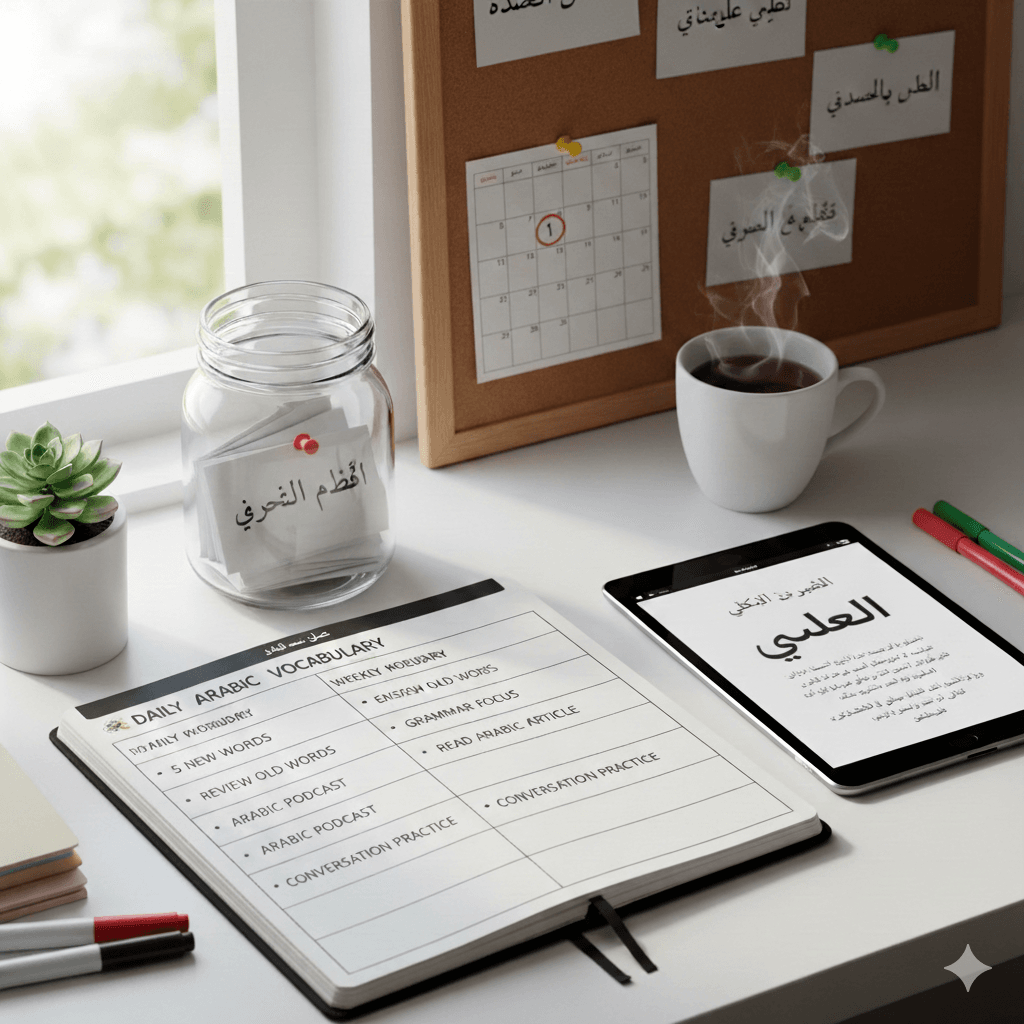
Daily & Weekly Arabic Vocabulary Study Routine
(With AI + Teacher Support That Actually Works)
Most Arabic learners don’t fail because Arabic is “too hard.”
They fail because they don’t have a routine that respects how the human brain really learns language.
Random apps. Random word lists. Random motivation.
That’s not learning—that’s linguistic gambling.
This guide gives you a clear, repeatable daily and weekly Arabic vocabulary routine, designed for real people with real lives, using AI tools wisely and real teachers strategically. No burnout. No busywork. Just steady, visible progress.
Why Vocabulary Routines Matter More Than Motivation
Motivation is unreliable.
Routines are boring—and that’s exactly why they work.
Arabic vocabulary sticks when:
Words appear repeatedly across different contexts
Your brain retrieves them, not just recognizes them
A human corrects your mistakes before they fossilize
AI handles repetition and exposure, not decision-making
Think of it this way:
AI = scale and consistency
Teachers = accuracy and meaning
You = daily small effort
Miss one piece, and the system collapses.
The Core Principle: Input → Use → Feedback → Reinforcement
Every effective routine follows this loop:
Input: Learn new words in context
Use: Actively produce them (speaking or writing)
Feedback: Get corrected by a human
Reinforcement: Review intelligently with AI
Most learners stop at step 1.
That’s why their vocabulary stays passive.
The Ideal Daily Arabic Vocabulary Routine (30–60 Minutes)
This routine works whether you’re A1 or C1.
Only the complexity changes, not the structure.
Step 1: Contextual Vocabulary Input (10–15 minutes)
Forget word lists.
Each day, choose one small context, such as:
A short dialogue
A paragraph from a story
A situational text (ordering food, booking travel, discussing work)
Focus on 5–10 words max.
Use AI to:
Highlight high-utility words
Show example sentences
Generate variations of the same sentence
But do not memorize yet.
Your brain needs meaning first, not pressure.
Step 2: Active Recall (5–10 minutes)
Close the text.
Now force your brain to work:
Can you recall the word when you see the meaning?
Can you complete a sentence with it?
Can you say it out loud without reading?
Struggle here is good.
Effort equals memory formation.
AI is excellent for:
Quick recall quizzes
Sentence gap exercises
Instant feedback on spelling
But AI does not know if you sound natural. That comes later.
Step 3: Short Output Practice (5–10 minutes)
Use the words actively:
Write 3–5 sentences
Speak them out loud
Record yourself if possible
This step turns vocabulary from knowledge into skill.
Most learners skip this because it feels uncomfortable.
That discomfort is literally your brain rewiring itself.
Step 4: Micro Review (5 minutes)
End the session by reviewing:
Yesterday’s words
One sentence where you made a mistake
One word you still hesitate on
Stop early.
Leave your brain wanting more.
The Weekly Structure (Where Real Progress Happens)
Daily routines build habits.
Weekly routines build language.
Weekly Vocabulary Focus Theme
Each week should have a single theme, such as:
Daily life
Travel
Work & meetings
Social conversations
Media & opinions
This prevents scattered learning and helps AI and teachers reinforce the same semantic field repeatedly.
Weekly Teacher Session (Non-Negotiable)
At least one live session per week with a real teacher.
Why this matters:
Teachers catch unnatural phrasing instantly
They explain why a word works or doesn’t
They adjust vocabulary to your level and goals
They force active use under pressure
Your teacher should:
Review your weekly vocabulary
Correct your sentences
Push you to paraphrase
Replace “correct but weird” Arabic with natural Arabic
AI cannot do this reliably.
Anyone telling you otherwise is selling software, not fluency.
Weekly Deep Review (20–30 minutes)
Once a week, zoom out:
Which words stuck?
Which words are passive?
Which words appear again and again in real use?
Use AI to:
Generate review tests
Create mini-dialogues using your vocabulary
Simulate conversations for rehearsal
This is where long-term memory is built.
How AI Fits In (Without Ruining Your Arabic)
AI is powerful—but only when it stays in its lane.
Use AI for:
Spaced repetition
Sentence generation
Personal vocabulary tracking
Instant practice anytime
Do not rely on AI for:
Naturalness judgment
Dialect nuance
Cultural appropriateness
Pronunciation accuracy at advanced levels
AI is your gym equipment.
Teachers are your coach.
How This Routine Changes by Level
A1–A2: Focus on survival vocabulary and sentence patterns
B1–B2: Focus on paraphrasing, synonyms, and connectors
C1: Focus on nuance, register, collocations, and style
The routine stays the same.
Only the depth changes.
That’s how professionals learn languages.
The Biggest Mistake Learners Make
Trying to learn more instead of learning better.
Ten well-used words beat fifty forgotten ones.
Every time.
Consistency beats intensity.
Structure beats enthusiasm.
Final Thought
Arabic vocabulary mastery is not about talent, memory, or apps.
It’s about:
Small daily systems
Smart AI support
Human correction at the right moments
And respecting how learning actually works
Do this for 90 days, and your Arabic will feel alive, not academic.
That’s the difference between studying Arabic and using Arabic.
If you want, the next logical step is:
Linking this routine to CEFR levels
Or converting it into a downloadable study plan
Or mapping it directly to teacher-led programs
The system is built. You just run it.
Q: What is the best daily routine for learning Arabic vocabulary?
The best daily Arabic vocabulary routine follows four steps: learning words in context, actively recalling them, using them in speaking or writing, and reviewing them briefly. This process turns vocabulary from passive knowledge into usable language.
Q: How long should I study Arabic vocabulary each day?
Thirty to sixty minutes per day is enough when the routine is structured. Short, focused sessions are more effective than long, irregular study periods.
Q: How many new Arabic words should I learn daily?
Five to ten new words per day is ideal. Learning fewer words deeply and using them actively leads to better retention and real communication ability.
Q: Why should Arabic vocabulary be learned in context?
Context shows how words are actually used. Vocabulary learned through dialogues, short texts, or real situations is easier to remember and much easier to use correctly.
Q: What is active recall and why is it important?
Active recall means forcing your brain to remember a word without looking at it. This effort strengthens memory and helps vocabulary move from recognition to real use.
Q: Why is speaking or writing vocabulary every day necessary?
Using vocabulary through speaking or writing turns knowledge into skill. Without output practice, words remain passive and disappear quickly.
Q: What should a weekly Arabic vocabulary routine include?
A strong weekly routine includes a single vocabulary theme, one live teacher session, and a deep review of the week’s words. Weekly structure is where long-term progress happens.
Q: Why is a weekly vocabulary theme important?
Weekly themes prevent scattered learning. Focusing on one topic allows words to repeat naturally across different contexts, making them easier to remember and use.
Q: How often should I review Arabic vocabulary?
Daily micro-reviews and one weekly deep review work best. Daily review maintains momentum, while weekly review builds long-term memory.
Q: How can AI support a daily Arabic vocabulary routine?
AI can provide spaced repetition, sentence generation, recall quizzes, and instant practice. It helps with consistency and volume but should not replace human correction.
Q: Why is a real Arabic teacher still important?
Teachers correct unnatural phrasing, explain meaning and nuance, and help learners sound natural. Human feedback prevents long-term mistakes that AI may miss.
Q: Does this routine work for beginners and advanced learners?
Yes. The structure stays the same for all levels. Beginners focus on basic survival vocabulary, while advanced learners focus on nuance, style, and precision.
Q: What is the biggest mistake learners make with vocabulary routines?
Trying to learn too many words too fast. Consistency and quality always beat intensity and quantity.
Q: How long does it take to see results with a daily and weekly routine?
Most learners notice clear improvement within 60–90 days when they follow the routine consistently.