
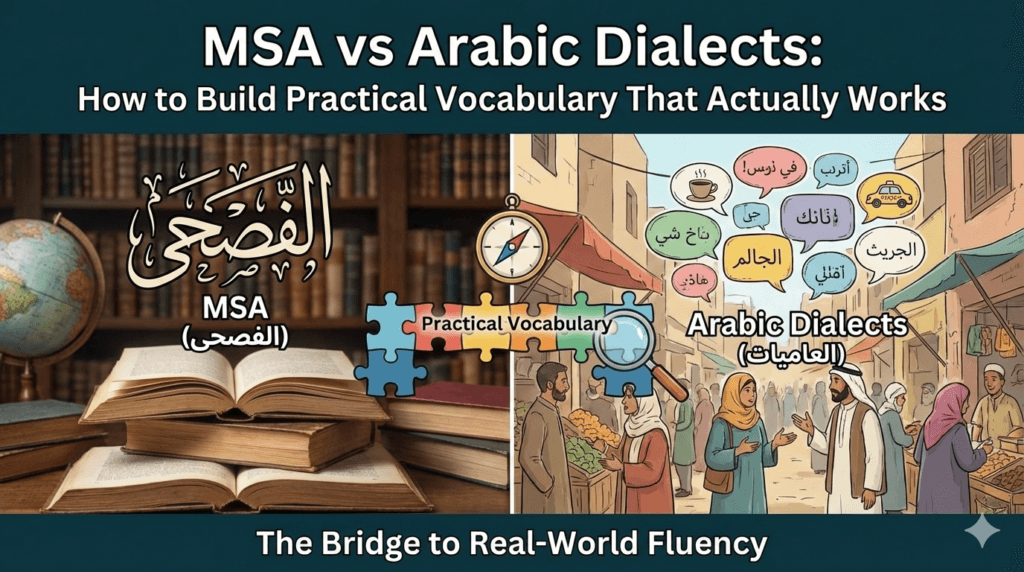
Every Arabic learner eventually asks the same question:
“Should I learn Modern Standard Arabic or a dialect?”
And almost every learner gets a bad answer.
Some are told:
“Only MSA matters.”
Others hear:
“Forget MSA—dialects are all you need.”
Both positions are incomplete. Both slow learners down.
Arabic is not one language in practice. It’s a system of registers. If you want vocabulary that actually works—in conversations, travel, work, media, and study—you must understand how MSA and dialects coexist, not choose one blindly.
This guide explains the difference, the purpose of each, and—most importantly—how to build vocabulary that transfers between them.
What Is Modern Standard Arabic (MSA), Really?
Modern Standard Arabic (MSA) is:
The language of news, books, formal writing, and education
Understood across the Arab world
Structurally consistent
Grammatically rich
MSA is not a dialect.
It is a shared formal standard.
You will encounter MSA in:
News broadcasts
Newspapers
Websites
Formal speeches
Exams and certifications
Religious and academic contexts
If Arabic were a city, MSA would be the infrastructure.
What Are Arabic Dialects?
Arabic dialects are:
The spoken forms of Arabic used daily
Regionally influenced
Faster, more flexible, and less formal
Examples:
Egyptian Arabic
Levantine Arabic
Gulf Arabic
Maghrebi Arabic
Dialects dominate:
TV shows
Movies
Social media
Daily life
If MSA is infrastructure, dialects are traffic.
The Real Problem: Vocabulary That Doesn’t Transfer
Most learners fail not because they pick the “wrong” Arabic—but because they learn vocabulary that doesn’t transfer.
They learn:
Rare formal words with no spoken equivalent
Dialect-only slang with no structure
Vocabulary disconnected from context
Result?
They can read but not speak—or speak but not understand others.
The solution is functional vocabulary layering.
Vocabulary That Works in Both MSA and Dialects
Here’s the secret most courses never explain:
A large percentage of core Arabic vocabulary overlaps between MSA and dialects.
Words like:
كتاب (book)
بيت (house)
يوم (day)
شغل / عمل (work)
وقت (time)
كبير / صغير (big / small)
These words:
Sound similar
Carry the same meaning
Appear everywhere
Start here.
This shared vocabulary gives you:
Reading ability in MSA
Listening ability across dialects
A foundation you can expand safely
When Vocabulary Changes (And How to Handle It)
Some words change slightly.
Example:
MSA: أريد (I want)
Egyptian: عايز
Levantine: بدي
The concept is the same. The form changes.
Instead of panic, learn mapping:
Learn the MSA word first
Learn 1–2 common dialect equivalents
Practice switching in context
This builds flexibility instead of confusion.
Why Starting with Only Dialect Can Backfire
Learning only dialect early can feel fast—but it has limits.
Problems learners face:
Inability to read or write
Confusion when switching countries
Weak grammar awareness
Plateau after basic conversation
Dialect without MSA is narrow.
You may survive socially—but you won’t grow linguistically.
The Practical Solution: Layered Vocabulary Learning
This is what actually works.
Step 1: Learn Core Vocabulary in MSA
Verbs
Nouns
Adjectives
Connectors
This gives you:
Structure
Transferability
Reading and listening ability
Step 2: Add Dialect Variants Gradually
High-frequency verbs
Daily expressions
Common responses
Not everything—only what you’ll actually use.
Step 3: Practice Switching by Context
Formal = MSA
Casual = dialect
Mixed = real life
This mirrors how native speakers operate.
How AI Helps (When Used Correctly)
AI can:
Generate parallel examples (MSA vs dialect)
Create dialogues in specific registers
Highlight overlap and differences
Track vocabulary usage
But AI alone cannot tell you:
What sounds natural
What feels awkward
What is culturally appropriate
That’s where teachers step in.
Why Teachers Are Critical Here
Teachers:
Prevent over-mixing
Correct unnatural combinations
Teach register awareness
Explain why one form fits a situation
Without guidance, learners often create “hybrid Arabic” that no one actually speaks.
Teachers keep your vocabulary usable.
A Sample Vocabulary Mapping
Concept: “I want coffee”
MSA: أريد قهوة
Egyptian: عايز قهوة
Levantine: بدي قهوة
Same idea. Different social setting.
Learn the concept once, then map the forms.
A Realistic Learning Path
If your goal is real-world Arabic:
Start with MSA core vocabulary
Add one dialect (based on your goals)
Practice context-based switching
Reinforce with speaking and listening
Use AI for repetition, not replacement
This approach scales. Others don’t.
Common Mistakes to Avoid
Choosing sides (MSA vs dialect)
Mixing forms randomly
Ignoring context
Learning slang before structure
Assuming natives speak “one Arabic”
Arabic is layered. Your learning should be too.
Final Takeaway: Practical Arabic Is Not a Choice—It’s a System
You don’t need to pick MSA or dialect.
You need vocabulary that:
Transfers
Adapts
Evolves with context
When you understand how MSA and dialects interact, Arabic stops feeling fragmented and starts feeling coherent.
This is how learners move from classroom Arabic to real Arabic—without starting over.
And this is how vocabulary actually works.
Q: Should I learn Modern Standard Arabic (MSA) or a dialect?
A: Neither instead of the other. Arabic is not a single spoken language; it’s a system of registers. MSA and dialects serve different functions, and real fluency comes from understanding how they interact—not from choosing sides.
Q: What is Modern Standard Arabic (MSA) actually used for?
A: MSA is the shared formal standard across the Arab world. It’s used in news, books, education, formal writing, exams, and official communication. It provides structure, consistency, and cross-country comprehension.
Q: Are dialects more “real” than MSA?
A: Dialects are what people speak daily, but that doesn’t make MSA irrelevant. Dialects handle daily interaction; MSA handles information, ideas, and formal communication. One without the other creates gaps.
Q: Why do learners argue so much about MSA vs dialect?
A: Because they’re given bad advice. “Only MSA” produces learners who can read but can’t speak. “Only dialect” produces learners who can chat briefly but hit a ceiling fast. Both approaches are incomplete.
Q: What’s the real reason learners struggle?
A: Vocabulary that doesn’t transfer. Learners often memorize words that exist only in formal texts or only in local slang, with no bridge between them. That kills comprehension and confidence.
Q: Is there vocabulary that works in both MSA and dialects?
A: Yes. A large core of Arabic vocabulary overlaps across MSA and most dialects—basic nouns, verbs, adjectives, and concepts. This shared vocabulary is where learners should start.
Q: What happens when the same idea uses different words in dialects?
A: The concept stays the same; the form changes. You don’t relearn meaning—you map forms. Learn the MSA version first, then add one or two common dialect equivalents based on your goals.
Q: Why not start with only a dialect since it’s spoken?
A: Because dialect-only learners usually can’t read, write, or transfer their skills across regions. Grammar awareness stays weak, and progress stalls after basic conversation.
Q: Why not start with only MSA then?
A: Because spoken Arabic simplifies structure and changes rhythm. MSA-only learners often freeze in real conversations because they’ve trained in theory, not interaction.
Q: What’s the most effective learning strategy, realistically?
A: Layered learning:
- Build core vocabulary in MSA
- Add one dialect gradually
- Practice switching based on context
This mirrors how native speakers actually use Arabic.
Q: How can AI help with this process?
A: AI is good for generating parallel examples, showing MSA–dialect differences, and drilling vocabulary. It’s bad at judging what sounds natural in real social settings.
Q: Why are teachers still necessary if I use AI?
A: Because AI optimizes for correctness, not social acceptability. Teachers prevent unnatural mixing, explain register choice, and keep your Arabic usable instead of technically correct but socially odd.
Q: What’s the main mistake learners should avoid?
A: Treating Arabic as a single form or choosing a side. Arabic is layered. Learning it any other way guarantees relearning later.